

Construction Automation: Closing the Three Leaks Between Estimate and Payment
78% of clients sign with the first contractor who answers, and the average response takes 42 hours. The three margin leaks and the workflow that closes them.
A project does not go over budget on site. It goes over budget in the three intervals where nothing is recorded. 78% of clients sign with the first contractor who answers and the average response is 42 hours; 70% of contractors and subcontractors collect late, on cycles approaching 90 days; and the margin lost to change orders is not killed by the number of changes, but by changes arriving late and without a trace. What closes all three leaks is five automations wired through an orchestrator and the WhatsApp API: quote acknowledgement, 30-day follow-up, a change-approval gate, milestone billing and collections escalation.
Three leaks, not a software problem
The diagnosis is almost never "we lack a system." The money escapes through three concrete intervals, and each one has a number you can measure today:
| Leak | Evidence | Metric to check today | Automatable lever |
|---|---|---|---|
| Site visit → quote sent | 78% hire the first responder; 62% conversion at 2 minutes vs. 28% at 42 minutes (ServiceTitan 2025) | Hours between visit and quote | WhatsApp acknowledgement + template + 5 touches |
| Conversation → signed change | 1.70 change orders per project under 500K; cost variation band −8% to +15.9% (AIA benchmark, 18,229 projects) | % of changes agreed in messages with no written approval | Form + digital signature + budget-vs-actual recalculation |
| Project finished → money arriving | 70% collect late on 90-day cycles; 50% of subcontractors wait over 30 days (Rabbet); average delay 36.4 days (ENR) | Days of overdue receivables | Milestone invoicing + stepped reminders + aging alert |
Most teams buy software for the left column. The two right-hand columns are where margin actually leaks, and both live in WhatsApp, not in a dashboard.
Leak 1: between the site visit and the quote
Speed data is consistent across sources. Jobber surveyed 1,050 contractors in December 2025: only 20% respond to a lead within the hour and 60% respond the same day. ServiceTitan measured 62% conversion when answering at 2 minutes against the industry average of 28% (at 42 minutes). And 70% of homeowners consider a same-day quote a positive factor (NAHB). This is not impatience: speed is a signal of capacity. The contractor who sends the quote 72 hours later hands the competitor a three-day head start.
The second number is follow-up. Hatch reports that 63% contact a quoted lead only once or twice and only 18% have follow-up automated — the other 82% leave between 8,000 and 25,000 USD per month unrecovered. The same April 2026 analysis adds that 80% of deals do not close on site and that 43%–53% of the deals that close happen between day 2 and day 30 after the quote: exactly where most contractors stop writing.
What to automate, in order:
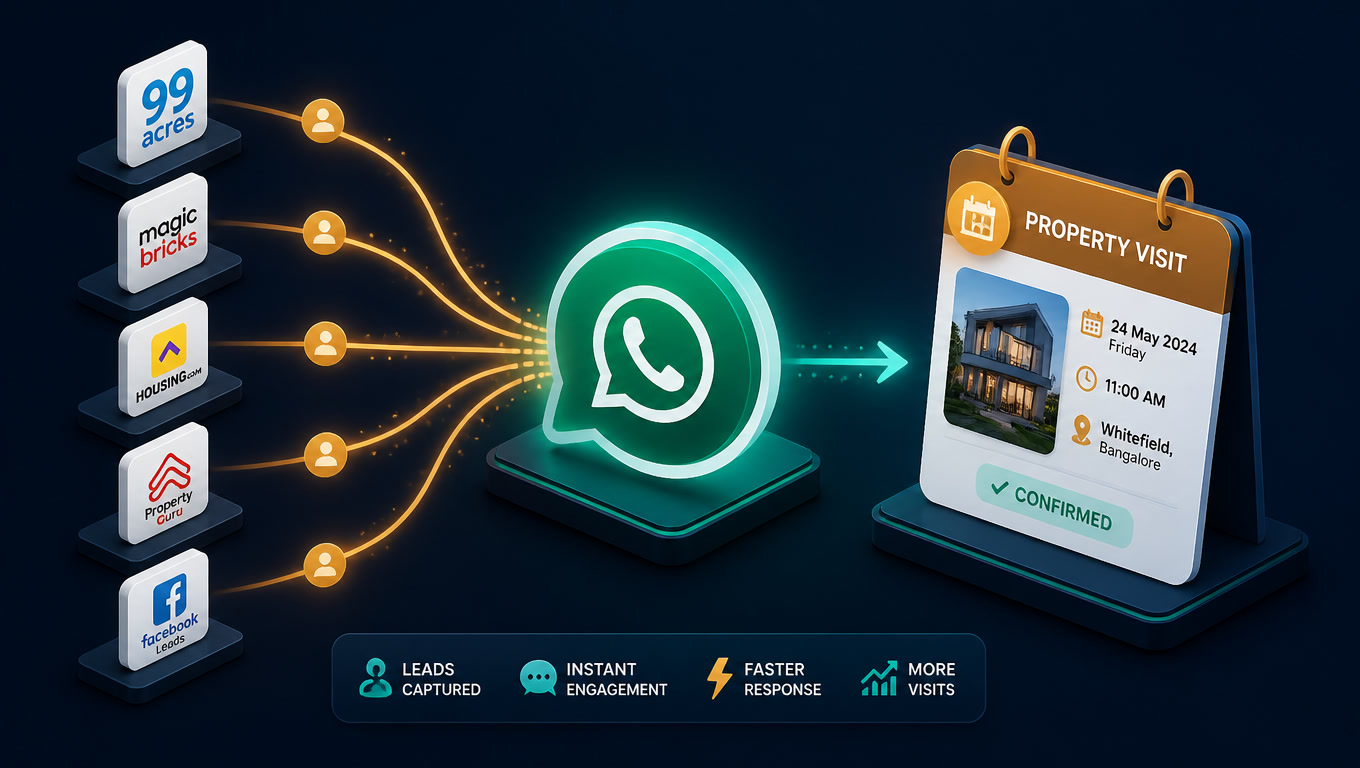
- Instant acknowledgement. Incoming message or form → confirmation with the visit date in under a minute. That is a webhook, not a project.
- Quote from template. Line items, scope and 30-day validity come from a template with current pricing; the person only reviews and sends. The logic in speed-to-lead response applies identically: minutes, not days.
- Five touches in 30 days. Day 1 send, day 3 call, day 7 comparable case, day 15 validity, day 29 close or disqualify. 80% of sales need five or more contacts and 48% of salespeople never follow up at all (RAIN Group).
- Cold-lead alert. No open in 48 hours, the task lands on the rep with context instead of a shared spreadsheet (see silent prospect follow-up).
Leak 2: the change order nobody signed
The opinion that makes us unpopular in site meetings: change orders are not the enemy. Untraced and late changes are.
The AIA database, covering 18,229 projects, shows that total cost varies barely 4% over the life of a project and that projects under 500K accumulate an average of 1.70 change orders. The "more changes = more overrun" correlation does not hold: what matters is timing — the later a change is issued, the fewer alternatives the owner has and the more expensive it ends up. Love (2002) documents a mean overrun of 12.6% in which rework explains 52%.
In practice the problem is not that the client changes their mind. It is that the change gets agreed in a message, the crew executes it to keep work moving, and three weeks later nobody can prove what was included, who approved it and for how much: a process with no gate.
The gate is short:
- Structured capture: the site manager raises the change from a form (description, line items, amount, schedule impact), not free text.
- Approval with signature and date, configurable by threshold: lower amounts approved by the site lead, higher amounts sent to the client with the breakdown.
- Automatic recalculation of budget vs. actual with a same-day notice to finance.
- Invoice or credit note triggered once approved and executed.
The principle matches AI change approval, with a construction-specific twist: on site change is the rule, so the goal is not to reduce changes but to shorten the interval between "it was decided" and "it is recorded." That is where the top of the 15.9% variation band lives.
The other side is spend: across most SMBs in the region, purchase orders go out on WhatsApp or on paper and nobody can answer on the spot how much has been spent or whether the project is still inside budget (the pain Mawi describes). If the automatic change does not update cost progress, you automated the paperwork, not the control.
Leak 3: the project is finished and the money does not arrive
HousingWire reported in August 2026 that 70% of contractors and subcontractors collect late consistently, on 90-day cycles, at a cost close to 300 billion dollars a year. Rabbet is just as blunt: 50% wait more than 30 days, 83% say late payment affects crew productivity and 67% would not bid on projects with a reputation for slow payment. ENR, surveying 640 subcontractors, measures an average delay of 36.4 days.
It is the most invisible leak: it never shows up as a site problem, it shows up as tight cash flow, materials on credit and a crew waiting.
- Invoice on milestone validation. Approved progress triggers the invoice with line-item breakdown, with no round trip through finance.
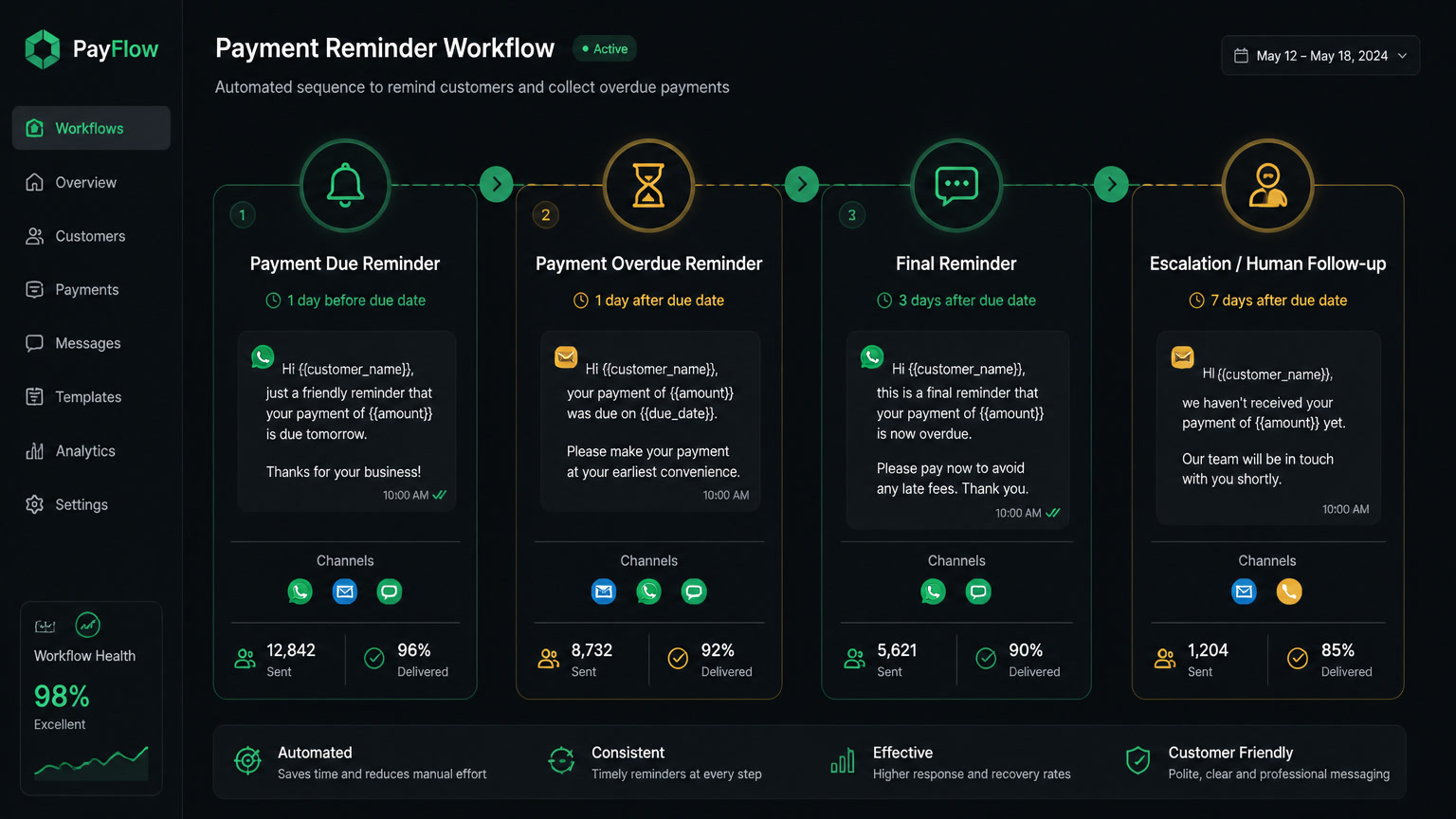
- Stepped reminders. Issue date, due −3 and due +1 on WhatsApp to the person who actually pays; email only as document trail.
- Aging alert, not due-date alert. The task arrives with amount, days and the recorded excuse: collections is a sequence, not a heroic call.
- Automatic early-payment discount. 72% of subcontractors would take a discount to be paid within 30 days (Rabbet); if you offer it, let the system calculate it.
The WhatsApp collections discipline we use in other verticals fits almost unchanged: the project invoice simply travels with signed progress as backup.
The full workflow: from project to cash in five stages
| Stage | Trigger | Channel | What it automates | Metric |
|---|---|---|---|---|
| 1. Capture | Incoming form or message | WhatsApp + web | <1 min acknowledgement, qualification, visit scheduling | Hours visit → quote |
| 2. Quote | Visit logged | Email + WhatsApp | PDF from template, 30-day validity, 5 touches | Quote win rate |
| 3. Change | Field request | Form + signature | Threshold approval, recalculation vs. actual | Time change → record |
| 4. Progress | Milestone validated by site manager | WhatsApp + CRM | Automatic invoice with line items | Days invoice → payment |
| 5. Cash | Due date | WhatsApp → call | Reminders, early payment, aging alert | Receivables over 30 days |
All of this lives inside a lead-to-cash pipeline; in construction, stage 3 does not exist in any generic CRM and has to be built.
Buy construction software or layer automation over WhatsApp
Over 70% of LatAm SMBs operate at low digital maturity (IADB) and the market already sells construction software with bill-of-quantities budgeting and cost control: there is no need to reinvent it. The question is which path pays first:
| Criterion | Construction software / ERP | Layer over WhatsApp + CRM |
|---|---|---|
| Bill-of-quantities and real costs | Strong | Not solved alone |
| Simultaneous projects | 5+ with admin staff | 1 to 5 with the owner hands-on |
| Client response | Needs a separate integration | Native |
| Time to deploy | 1 to 3 months, mandatory training | 1 to 3 weeks |
| Monthly cost | 100-500 USD + per-seat licenses | 30-200 USD, no licenses |
| Who maintains it | Someone from the trade | Any team member with a guide |
Our stance: if the operation lives on WhatsApp and you run fewer than five active projects, start with the layer — do not buy the ERP. Construction software solves building accounting; it does not answer at 9:40 p.m. when the client asks about progress, and it does not sign the change order while the site manager is on the scaffold. Buy it when the pain is "I do not know what this line item cost" — any earlier and you pay twice for the same process.
Where to start this week
- Measure the three leaks: hours between visit and quote, % of changes without written approval, days of overdue receivables. No baseline, no business case.
- Ship the instant acknowledgement first: one webhook and one template, with the largest measured effect on conversion.
- Build the change gate before billing: it protects margin and no generic CRM ships it.
- Connect milestone → invoice once you are collecting on time.
- Leave the support chatbot last: it is the cheapest of the three leaks.
Three mistakes we see constantly: quoting without a template (nothing is comparable), leaving changes in the WhatsApp thread "so work does not stop" (that is how the top of the 15.9% band disappears), and invoicing at the end of the project instead of by milestone (where the 90-day cycle becomes structural).
What does not get automated: high-value claims, scope disputes and any change that moves margin beyond your threshold go to a person with full context; the rule lives in the human handoff architecture. We automate the trail, not the judgment.
If you want to review it against your own operation, let's talk automation and chatbots or start from CRM data quality — the layer everything else stands on.
Frequently Asked Questions
Which construction processes can be automated?
Three, in this order: estimate response and delivery (instant WhatsApp acknowledgement, quote from template, 30-day follow-up sequence), change-order approval (structured form with digital signature that updates budget vs. actual and triggers billing) and milestone collections (automatic invoice on verified progress, stepped reminders, overdue-cash alert). Scope decisions, claim adjudication and negotiation stay with a person.
How much does this automation cost?
A modular stack runs about 30 to 200 USD per month: self-hosted orchestrator (6-20), CRM (0-99), AI API for drafting and classification (20-50) and the WhatsApp API billed per delivered message. A 14-module construction ERP costs 100 to 500 USD monthly plus per-seat licenses, and it only pays off when you need bill-of-quantities budgeting and real cost accounting, not just client conversation tracking.
Does automation replace the site manager?
No. It automates the trail, not the judgment: the change order is captured in a structured form, approved with a signature and logged with date, amount and owner, but approval stays human. On high-value work, any change above a defined threshold requires mandatory review before execution.