
Speed to Lead: The Most Overlooked Conversion Lever (and How Automation Fixes It)
Responding to a lead within 5 minutes yields 21% conversion vs 2.3% after 24 hours. Real benchmarks, a maturity framework, and automation architecture for LatAm businesses.
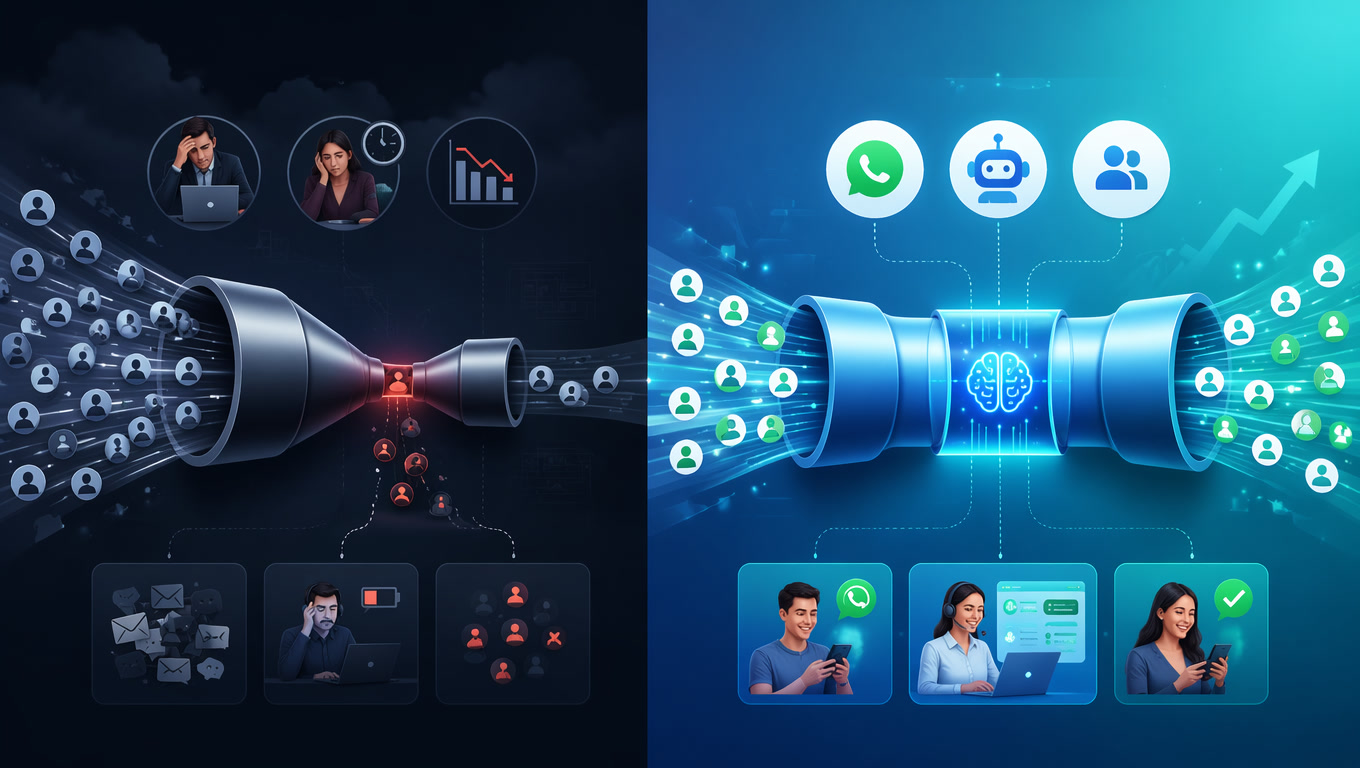
Responding to a lead within 5 minutes delivers a 21% conversion rate. Waiting 30 minutes drops that to 13%. After 24 hours, it's 2.3%. The median B2B response time in 2026? 42 hours. The gap isn't budget — it's automation.
The 2026 Speed to Lead Benchmark from Artemis GTM analyzed over 250,000 lead responses across 1,247 B2B companies. The findings confirm what InsideSales and HubSpot have been saying for years: the relationship between response time and conversion is not linear — it's exponential. Within 5 minutes, you've already lost 29% of the lead's potential value, according to data compiled by ChatCenter and GreetNow. At 60 minutes, conversion plummets from 21% to 8%.
The problem? Only 7% of companies respond in under 5 minutes. The median is still 42 hours.
This article covers why speed to lead is your most undervalued conversion lever, how to measure it honestly, and — most importantly — how to automate it with tools accessible to any business in Latin America.
Why Response Time Wins Over Lead Volume
Most sales teams optimize for lead volume: more campaigns, more ads, more landing pages. But the real bottleneck isn't the top of the funnel — it's how fast those leads get attention.
The 2026 data makes this brutally clear:
| Response Window | Conversion Rate | Drop vs. <5min |
|---|---|---|
| Under 5 minutes | 21% | — |
| 5 to 30 minutes | 13% | -38% |
| 30 to 60 minutes | 8% | -62% |
| 1 to 24 hours | 5% | -76% |
| Over 24 hours | 2.3% | -89% |
Source: Artemis GTM 2026 Speed to Lead Benchmark (250,000+ responses).
The math is simple: cutting response time from hours to minutes has a bigger impact on conversions than doubling your ad budget. But most teams ignore this because "we've always done it this way" or "fast responses without quality don't work." That's a false dilemma — and proper automation resolves it.
The Speed-to-Lead Maturity Framework
Based on implementations we've done across LatAm, we see four maturity levels. Each has a direct impact on conversion and requires a different automation approach.
Level 1: Manual Response (~50% of companies)
Leads land in the CRM or email inbox, and someone responds when they can. Median: 42 hours. No metrics, no tracking, no prioritization.
Conversion: Under 5%. The lead has already gone cold, researched competitors, and found another option.
Hidden cost: Every hour of delay reduces contact probability by 25%, per the same Artemis GTM dataset. If you're running ads, you're paying full price for half the results.
Level 2: Auto-Assignment (~30% of companies)
The CRM automatically assigns the lead to the right rep or territory. Response is still manual, but at least leads don't disappear into a black hole.
Typical response: 1-4 hours. Conversion: 5-10%.
Improvement: Eliminates orphan leads no one claims. But the bottleneck remains the team's capacity to respond quickly.
Level 3: Hybrid Response (~15% of companies)
The lead gets an immediate automated reply (confirmation, context, next step) while the human team prepares a personalized response. Achieved with a chatbot or AI assistant that handles first contact in seconds.
Time to first contact: Under 60 seconds. Conversion: 10-18%.
The key: The automated reply isn't generic enrichment. The system already captured the lead's name, company, need, and priority score. When the sales rep opens the CRM, they see a qualified lead — not a name on a list.
Level 4: Autonomous Responder (~5% of companies)
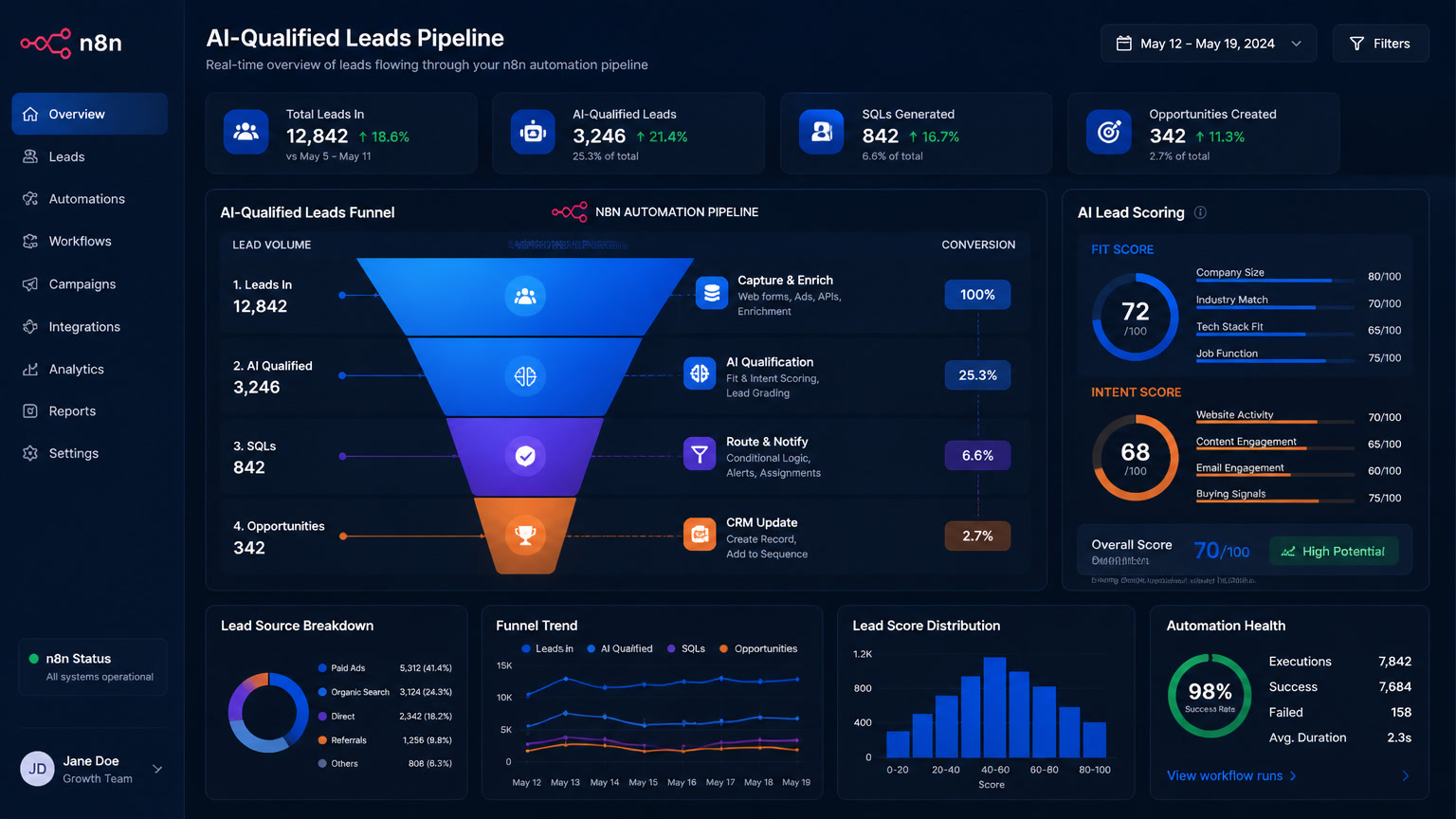
The lead is captured, enriched with public data (LinkedIn, Clearbit, website), scored with AI, assigned to the best available rep based on workload and expertise, and receives a contextual response within 5 minutes. The human team only intervenes when the lead crosses a qualification threshold.
Time to first contact: Under 5 minutes (fully automated). Conversion: 19-30%.
Typical stack: Self-hosted n8n + Clientify + OpenAI API + WhatsApp Business API.
We implemented this for a Mexico City IT consulting firm. Their lead response time went from 6 hours (6% conversion) to 90 seconds (19% conversion). The change wasn't hiring more staff — it was automating capture, enrichment, scoring, and first contact.
Measuring Your Response Time (the Honest Way)
Before automating, you need a baseline. Most CRMs log the lead's arrival time and first contact time. If yours doesn't, that's problem number one.
Three metrics that matter:
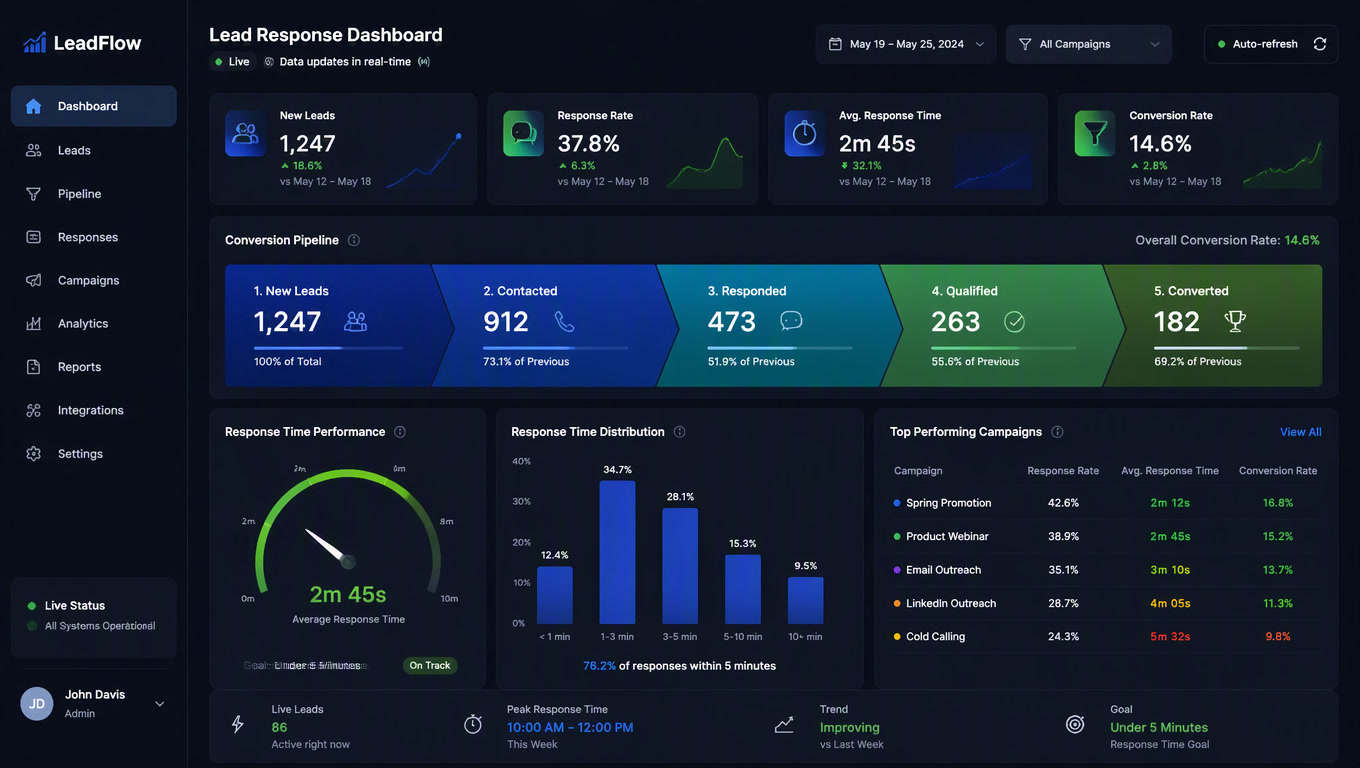
- Time to first contact (TFC): From lead arrival to first response (human or machine). Target: under 5 minutes for qualified leads.
- Leads with zero follow-up: How many leads never get a response. If this is over 20%, you have an operational leak, not a volume problem.
- Conversion rate by response window: Group leads by response time and calculate each bucket's conversion rate. If your data doesn't show the exponential drop-off, your processes are likely masking the problem (e.g., calling all leads 3 days later and recording "didn't answer" as the lead, not the delay).
In our work with a dental clinic in Guadalajara, we found their average TFC was 26 hours because leads came through a web form no one monitored in real time. We automated a WhatsApp alert with lead data in seconds. Appointment booking went from 8% to 23% in two weeks — without changing a single word of the response message.
That's the data point most teams don't want to see: the message content matters less than when it arrives.
Automation Architecture for Fast Response
Here's the pattern we've validated across real implementations using n8n + CRM:
Layer 1 — Capture & Enrichment (<1 second)
The lead arrives via web form, WhatsApp, or email. n8n captures the webhook, extracts data, and passes it through enrichment APIs (Clearbit free tier for basics, LinkedIn for professional profile). Within one second, you have: name, company, title, industry, location, company size.
Layer 2 — Qualification & Prioritization (<5 seconds)
With enriched data, an AI prompt classifies the lead as cold/warm/hot based on defined criteria (target industry, estimated budget, urgency level). Hot leads get immediate response; cold leads enter an automated nurture sequence.
Layer 3 — Assignment & First Contact (<5 minutes)
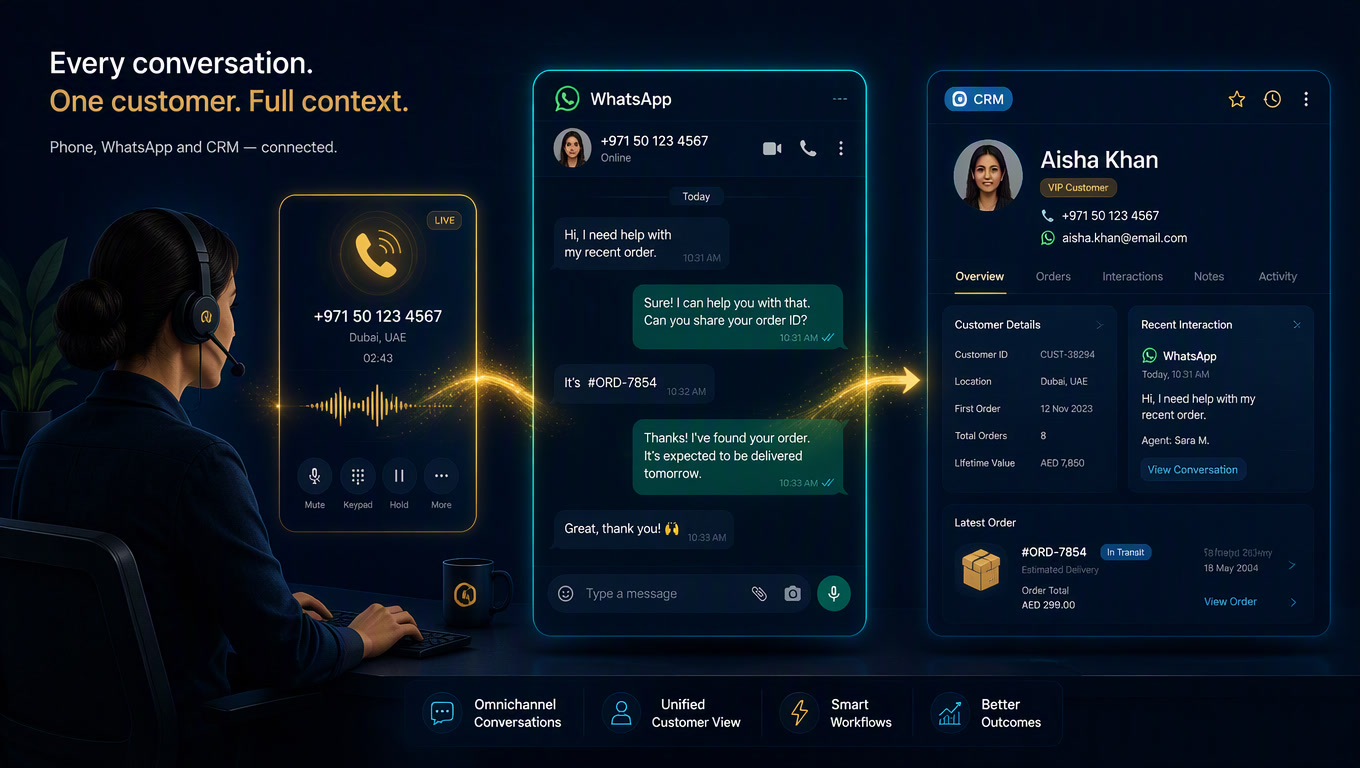
Hot leads are assigned to the available rep with the lightest workload. An automated WhatsApp message goes out with context and next steps. The rep receives a notification with an executive summary: who the lead is, what they need, what score they got.
Layer 4 — Automated Follow-up (next days)
If the rep doesn't respond within 30 minutes, the system reassigns the lead and notifies the supervisor. If the lead doesn't open the message within 24 hours, they enter a re-engagement sequence.
This flow — which sounds complex written out — takes about a week to implement with n8n + Clientify + AI APIs. And it costs between $50 and $169 per month, depending on volume.
Automation vs. Hiring More Salespeople
| Action | Monthly Cost | Conversion Impact | Time to Implement |
|---|---|---|---|
| Hire one more sales rep | $2,000-4,000 | +15-25% (if funnel supports it) | 4-8 weeks |
| Automate response time | $50-169 | +100-300% (if speed was the bottleneck) | 1-2 weeks |
| Simple chatbot + CRM | $30-100 | +40-80% (immediate response + scoring) | 2-5 days |
The data is clear: for most SMBs in Latin America, automating response speed delivers a far better ROI than any hiring decision. It's not that you don't need more reps — it's that your current reps shouldn't be losing 80% of leads because they reply 42 hours late.
Common Speed Automation Mistakes
We've seen these patterns repeat across implementations:
Automating without enrichment. Responding in 5 seconds with "thanks for contacting us, someone will call you" doesn't help. Speed without context is noise. Every automated response must demonstrate you know who the lead is and what they need.
Ignoring qualification. Fast-responding to every lead without distinguishing hot from cold overwhelms the team. Cold leads should get automated responses but not consume sales time until they self-qualify (by opening an email, visiting a pricing page, etc.).
No baseline measurement. Implementing automation without measuring current TFC is flying blind. One of our clients was "sure" they responded within 30 minutes. Their CRM showed a 9-hour average.
Letting AI make final decisions. AI should prioritize, not discard. We configure systems so AI never rejects a lead without human review — it tags and prioritizes. Humans make the final call.
The Cost of Not Automating
Let's run the numbers. A company receiving 200 leads per month with a 5% conversion rate closes 10 clients. If automated response pushes conversion to 15%, they close 30 clients. At a $500 average ticket, that's $10,000 additional monthly revenue — against a $50-169 automation investment.
That's not 10x ROI. It's 60x.
And here's the kicker: according to CallSetter's 2026 benchmarks across 12 industries, the average response time is 47 hours. Only 7% of companies respond within 5 minutes. That means the competitive advantage from automating speed isn't temporary — while 93% of your competition takes 47 hours, you can respond in 90 seconds.
We've covered how to build AI lead generation agents with n8n and when NOT to use AI for automation. This article sits between them: speed to lead isn't about AI hype — it's about data-driven response architecture. For a deeper look at diagnosing whether your bottleneck is speed or volume, see our operational diagnosis framework. And if you're evaluating the full pipeline, our sales & support pipelines service covers end-to-end implementation.
Speed to lead isn't a CRM feature. It's the metric that separates teams that convert leads from teams that collect them. And automating it today is cheaper and faster than ever.
Frequently Asked Questions
What is the ideal lead response time?
Under 5 minutes. The 2026 Artemis GTM benchmark shows 21% conversion rate for responses under 5 minutes, dropping to 13% between 5-30 minutes, and 2.3% after 24 hours. Top performers responding in under 60 seconds see up to 30% conversion.
How can small businesses automate fast lead responses without sounding robotic?
Use a layered automation stack: capture and enrich leads via n8n + CRM (Clientify, HubSpot), qualify with AI, then send a contextual first response. The automation handles the speed; personalization comes from enrichment data. Tools like n8n ($6-20/mo self-hosted) plus OpenAI APIs make this affordable for any budget.
Is speed to lead or lead quality more important?
Both matter, but speed is the multiplier. A high-quality lead that waits 24 hours converts at 5% — the same as a cold lead answered within 5 minutes. Automate response time first, then optimize lead quality. The data shows most teams optimize volume when the real bottleneck is speed.