Why Your n8n Lead Generation Agent Isn't Booking Meetings (And How to Fix It)
Building an AI lead qualification agent with n8n is easy. Making it actually book meetings is where most fail. We break down the three mistakes we see in client implementations and a 3-stage framework that turns a technically sound pipeline into a revenue engine.
Why Your n8n Lead Generation Agent Isn't Booking Meetings (And How to Fix It)
Building an AI agent that captures, enriches, and scores leads with n8n is relatively straightforward. Getting that pipeline to actually book real meetings is where most implementations fail. Over the past few months we've reviewed dozens of setups —some we built, many from clients who reached out after their agent was technically running but producing zero pipeline —and the pattern is consistent: the technical pipeline works, the commercial pipeline doesn't.
This is not another n8n tutorial. There are plenty of those, and the Vyoma AI Studios guide covers the mechanical build better than I could. This is about the gap between an agent that technically functions and one that generates revenue —and how to close it.
The short version: Your lead agent isn't booking meetings because you're optimizing for capture and scoring, not for conversation and conversion. The rest of this article is the 3-stage framework we use at Mintec to fix that.
The Technical Pipeline Mirage
When you build a lead qualification agent in n8n, it's tempting to measure success by technical metrics: "processed 847 leads in 30 days," "response time dropped from 4 hours to 2 minutes," "scoring is 94% accurate." These sound impressive. The problem is that none of them directly correlates with meetings booked.
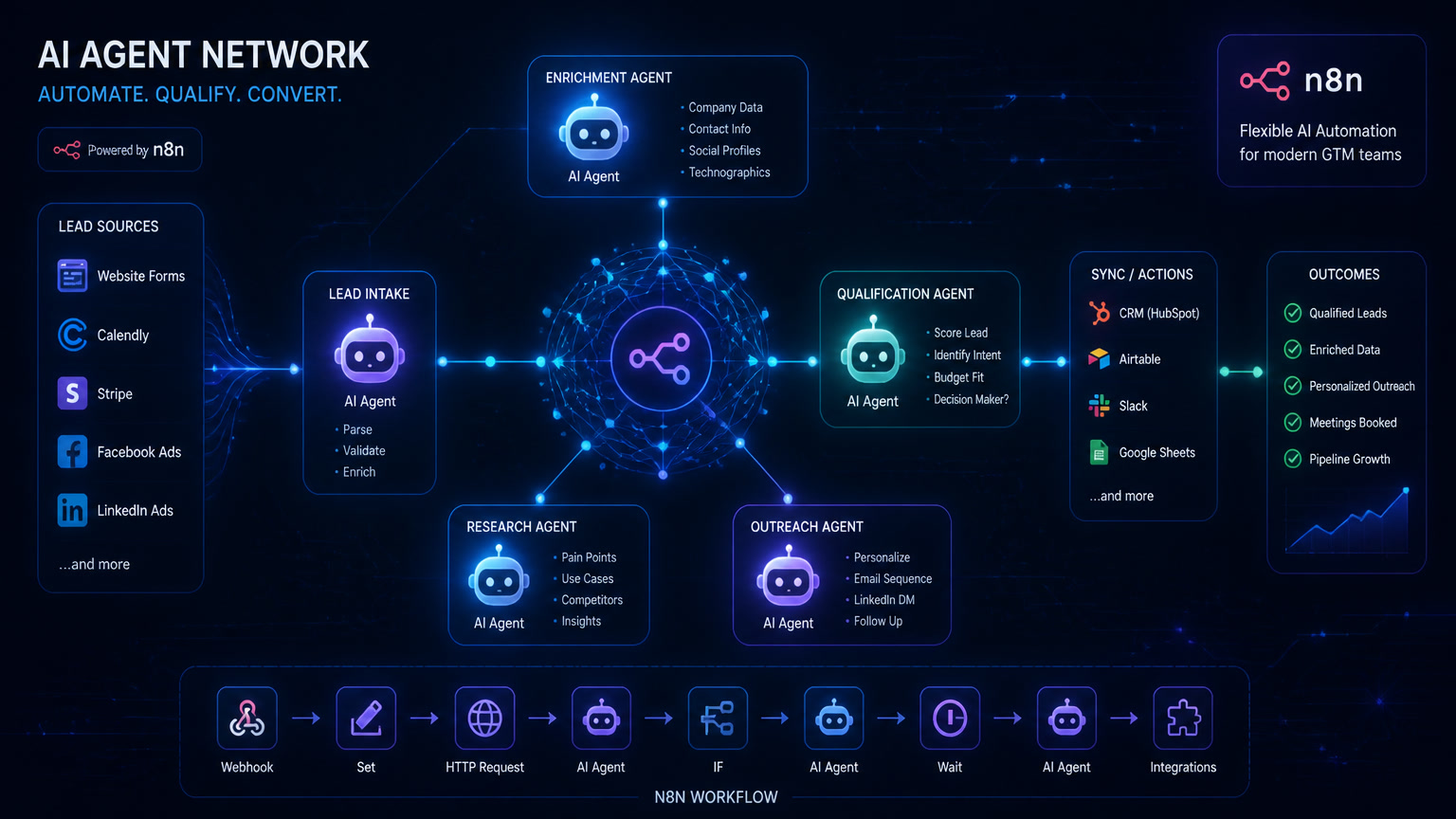
The case that taught me this most painfully was a B2B SaaS client in Mexico City. They had an immaculate pipeline: webhook → HubSpot deduplication → Clearbit enrichment → GPT-4o-mini scoring → routing by score → personalized Gmail outreach → Slack notification. 18 n8n nodes. The CTO was proud. Three months later: zero meetings closed from agent-generated leads.
What happened? The agent was technically flawless, but the lead scoring was calibrated for firmographics (company size, industry, job title) —not purchase intent. A lead could score 85/100 as the CEO of a perfect-fit company, but if they weren't actively looking for a solution, no automated email in the world was going to get them on a call. The agent was qualifying leads that fit the ICP, not leads ready to buy.
That experience —and several more like it— gave us the framework I'm sharing here.
The 3-Stage Framework for a Lead Agent That Actually Books
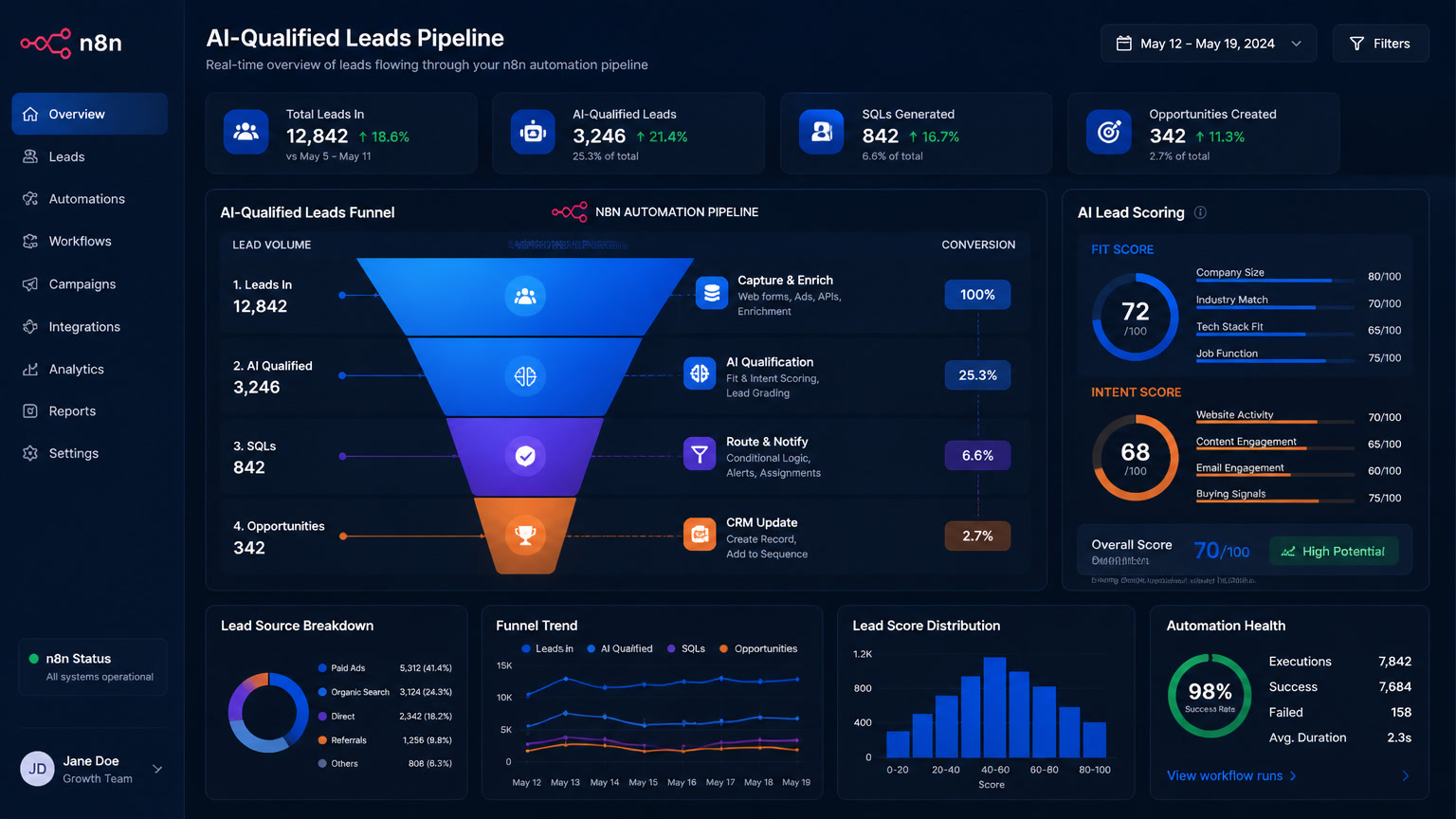
Stage 1: Two-Layer Scoring — Fit + Intent
The most common mistake is using a single scoring prompt that mixes firmographics with intent signals. The result is an ambiguous number that doesn't tell you whether the lead is good for your business or ready to buy right now. Those are different things.
What works: two separate scoring passes.
Pass 1 — Fit Score (firmographics only): Evaluate exclusively whether the lead fits your ICP. Use firmographic data: industry, company size, job title, tech stack, estimated budget. This scoring can be deterministic (rules in an n8n IF node) without an LLM —cheaper and more predictable.
# Example deterministic scoring in an n8n Code node
fit_score = 0
if lead.industry in ["SaaS", "Fintech", "E-commerce"]: fit_score += 25
if 10 <= lead.employees <= 200: fit_score += 20
if lead.job_title in ["CEO", "VP", "Director", "Head of"]: fit_score += 20
if lead.uses_crm in ["Salesforce", "HubSpot"]: fit_score += 15
if lead.funding_stage in ["Seed", "Series A", "Series B"]: fit_score += 10
if lead.market in ["US", "UK", "Canada", "LATAM"]: fit_score += 10
# Penalties
if lead.employees > 500 or lead.employees < 5: fit_score -= 20
if lead.email_domain in ["gmail.com", "outlook.com", "yahoo.com"]: fit_score -= 15
Pass 2 — Intent Score (intent only): This one needs an LLM. Run it only for leads with Fit Score ≥ 60 (saves tokens). Analyze intent signals: did the lead come through a "request demo" form or a whitepaper download? Does their form message mention a specific problem or is it generic? Did they visit the pricing page after filling the form?
The prompt we use:
You are a B2B purchase intent analyst. Evaluate this lead 0-100 based ONLY on intent signals, not firmographics. A demo request mentioning a specific use case = 70+. Educational content download with no further interaction = 30-. Return JSON: {"intent_score": N, "signal": "high|medium|low", "trigger": "what drove this score"}
Real qualified lead: Fit Score ≥ 60 AND Intent Score ≥ 50. Nothing less.
Stage 2: Two-Tempo Outreach (No More Generic Sequences)
The second mistake: the automated first-touch email that sounds automated. n8n lets you personalize down to a company-specific line —but if the prospect detects a template, you've lost the game.
Our approach: split outreach into two moments with different logic.
Moment 1 — Human touch with agent data (hot leads, Intent ≥ 70): The agent doesn't send the email. It prepares a briefing for the rep in Slack and CRM: lead summary, what intent signal triggered, what the lead mentioned in their message, and a recommended opening line. The rep writes and sends manually. This sounds like "less automation," but a human-written email backed by agent intelligence converts at 3x the rate of any automated sequence.
Moment 2 — AI-assisted warm sequence (warm leads, Fit ≥ 60, Intent 40-69): Here you do automate, but with a critical difference: each email in the sequence is generated fresh on the spot by the LLM, not pulled from a saved template. The prompt includes the lead's history, their company, and what content they consumed. The result: an email that sounds human because it is —AI-generated, but parameterized with lead-specific data that couldn't exist before that lead showed up.
Fixed templates get detected in seconds. What you can't easily detect is an email that mentions your specific industry, your specific problem, and the whitepaper you downloaded two days ago —because that combination literally didn't exist before you arrived.
Stage 3: Context-Rich Handover (Not Just "This Lead Is Hot")
The third mistake: when the agent identifies a hot lead, the handover to sales is an empty notification. "New hot lead: Sarah Chen, 85/100." That's useless to a rep.
What works: a one-page brief the agent generates automatically with:
| Component | What it includes |
|---|---|
| Lead data | Name, company, title, LinkedIn, email |
| Intent signal | What the lead did, what they said, what page they visited |
| Fit score breakdown | Why the lead fits the ICP, point by point |
| Intent score | Why we believe they're ready to talk |
| Opening recommendation | A suggested first line based on the trigger event |
| Next step | What the lead expects (demo, call, proposal) |
| Context URLs | Links to the product page, use case, pricing the lead viewed |
In n8n, this is a Code node that formats a JSON object with all the data and sends it to Slack plus writes it as a note in HubSpot. The rep opens Slack, reads the brief in 30 seconds, and knows exactly what to say.
We implemented this for a logistics client in Colombia: in the first month they went from 0 to 12 meetings sourced by the agent. The change wasn't technical —it was that the rep stopped receiving "another lead" and started receiving "a conversation already in progress."
The Hidden Cost of False Positives
There's a metric almost no one tracks that can kill agent credibility: the cost of meetings that shouldn't have happened. When the agent misqualifies a lead and a rep wastes 30 minutes on a call with someone who'll never buy, the rep stops trusting the agent. And once your sales team loses trust, getting it back is nearly impossible.
The fix is conservative: calibrate Intent Score so false positives are rare, even if it means missing some warm leads that might have converted. We'd rather an agent that sends 3 briefs per week with high precision than one that sends 15 with 30% noise. Sales teams prefer 3 excellent leads over 15 mediocre ones —and when they trust the scoring, the agent becomes part of the process instead of a nuisance.
To calibrate: for the first 4 weeks, every lead flagged as "hot" should be reviewed by a human before reaching the rep. Document false positives. Tweak the Intent Score prompt. Repeat. After one month, the agent can run autonomously with random spot checks.
Is It Worth It?
If you're processing under 50 leads per month, you probably don't need an AI agent. A Google Sheet with conditional formatting and a well-defined manual process will outperform. The n8n lead agent starts making sense above 200 leads/month, or when the opportunity cost of a misqualified lead is high (B2B deals at $5,000+).
Real numbers we've seen: a well-calibrated pipeline converts 6-8% of leads into meetings (vs 2-3% without qualification). At a $10,000 average deal size, that's $400-600 in additional pipeline per 100 leads processed. Infrastructure runs ~$175/month. The math works —but only when the agent is calibrated for meetings, not just leads.
At Mintec we've implemented this framework for clients across LATAM and the US using self-hosted n8n. If you're in the "I've got the technical pipeline, now what?" phase, the problem isn't n8n. It's how you connected the agent to your actual sales process. This 3-stage framework is the shortcut we learned through several failures —but it works.
Frequently Asked Questions
Why isn't my n8n lead agent generating meetings?
The most common mistake is confusing automation with demand generation. A pipeline that captures, enriches, and scores leads is not the same as one that convinces prospects to book a meeting. The three core problems are: (1) your scoring reflects firmographics, not purchase intent; (2) your outreach sequence sounds automated, and prospects can tell; (3) there's no clear handover process when the agent identifies a hot lead.
How much does an n8n lead pipeline cost?
Monthly infrastructure for processing up to 1,000 leads runs around $175/month: n8n self-hosted ($20-40/month), enrichment API like Clearbit ($99/month) or Hunter.io ($49/month), and OpenAI GPT-4o-mini tokens ($5-10/month). Initial build time is 3-5 hours if you're familiar with n8n. The real cost is in designing the qualification logic, not the technology stack.
Is n8n better than Make for lead generation?
It depends on volume and data sensitivity. n8n wins when you self-host (regulated data, compliance), volumes exceed 2,000 leads/month (Make's credit-based pricing gets expensive), or you need granular control over every pipeline node. Make is better for non-technical teams who need something running in hours and don't handle regulated data.