AI Prospecting Agents in 2026: Build with n8n vs. Buy Specialized Tools
A practical comparison of two paths to AI-powered lead prospecting: building custom agents with n8n vs. subscribing to tools like Clay, Apollo, or Sales Navigator. Real costs, tradeoffs, and what we learned implementing both approaches for clients.
AI Prospecting Agents in 2026: Build with n8n vs. Buy Specialized Tools
The promise sounds irresistible: an AI agent that researches companies, scores leads, writes personalized emails, and fills your pipeline while you sleep. And yes, it's real. But there are two distinct paths to get there, and choosing wrong can mean either saving thousands per year — or burning months on a solution that never quite works.
We've implemented both approaches for clients over the past year. Here's what we actually learned.
The problem with "build your SDR agent in 60 minutes" tutorials
There's no shortage of guides promising you'll have a production-ready prospecting agent running on n8n in an hour. The reality is more nuanced.
Yes, in 60 minutes you can build a workflow that:
- Searches LinkedIn or Apollo for target companies
- Feeds results through GPT to generate personalized emails
- Sends them via Gmail or SendGrid
What those guides don't tell you: that workflow will fail in production for reasons that have nothing to do with the code. API changes with no notice. Rate limits that spike mid-campaign. Dirty data that breaks your prompts. Bouncing domains you didn't warm up. Duplicate leads because there's no real deduplication.
We've watched teams spend three months trying to make a "simple" n8n agent run reliably at scale. The problem isn't n8n — it's that automated prospecting is inherently complex, and most tutorials skip the painful details.
The two real options in 2026
Option A: Build with n8n + AI APIs
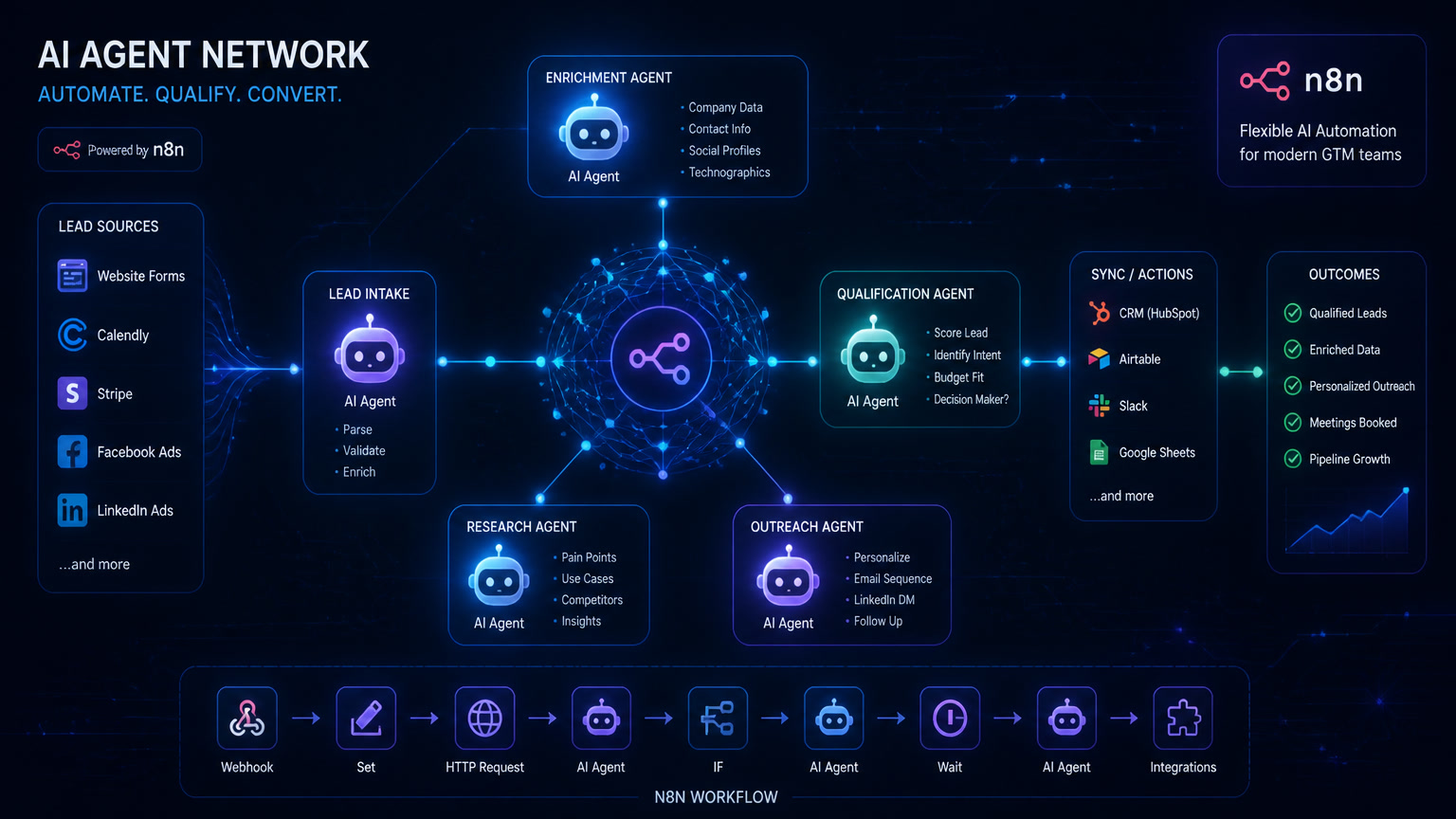
n8n has become the go-to platform for building custom prospecting agents. Its native AI Agent node, released in 2025, lets you connect LLMs directly into your workflow without glue code.
What it includes:
- n8n self-hosted ($0, just your server)
- AI APIs: OpenAI or Claude ($20-100/month depending on volume)
- Data source: Apollo API ($99-299/month), Clearbit, or custom scraping
- Storage: your existing CRM (Clientify, HubSpot, Salesforce)
- Maintenance: 5-10 hours/week of engineering time
Real advantages:
- Full control over every step of the pipeline
- Integration with legacy or custom systems
- Data stays on your infrastructure (critical for compliance-heavy industries)
- No artificial platform limits
Real tradeoffs:
- Maintenance isn't optional — it's the norm
- Every external API is a potential failure point
- Output quality depends entirely on how you structure prompts and data
Option B: Buy specialized prospecting tools
Clay, Apollo, Sales Navigator, Lemlist, Instantly — the AI prospecting tool ecosystem exploded in 2025-2026.
What it includes:
- SaaS subscription: $150-500/month per seat
- Built-in data enrichment
- Pre-built outreach templates
- Support and regular updates
Real advantages:
- Time-to-value: days, not weeks
- Small teams can operate without technical expertise
- Integrations exist and are maintained
Real tradeoffs:
- Fixed monthly cost that scales with your team
- Vendor lock-in — API changes or price hikes mean painful migration
- Limited to what the platform allows
- Your prospecting data lives on their infrastructure
Decision framework: build vs. buy
Use this matrix with your team. Score each criterion from 1 to 5:
| Criterion | Score 1-2 (buy) | Score 4-5 (build) |
|---|---|---|
| Monthly lead volume | < 500 leads | > 2,000 leads |
| Custom integrations | CRM + email only | Proprietary DB + ERP + external data |
| Technical team | No developer available | Dedicated engineer or agency partner |
| Time pressure | Live in 2 weeks | Can wait 6-8 weeks |
| Monthly tool budget | < $500/month | > $1,000/month or infra already exists |
| Data sensitivity | Public data is fine | Regulated or proprietary data |
Total score:
- 6-12: buy a tool — don't waste time building
- 13-18: hybrid approach — tool for initial prospecting, n8n for enrichment and post-processing
- 19-30: building with n8n will give more flexibility and better long-term ROI
Real case: what worked for a B2B SaaS client
We worked with a B2B software company that needed to prospect 1,500 accounts per month in the US market. They evaluated Clay and Apollo, but the projected cost ($2,400/month for 3 seats) plus the need to integrate with their existing customer database pushed them toward the build approach.
Final architecture:
- Apollo API for initial account and contact discovery (free tier + basic plan)
- n8n + OpenAI to enrich each contact with public company data (tech stack, funding, headcount growth)
- Automated scoring based on vector similarity to their existing customer base
- Context-aware email generation using industry-specific signals from each prospect
- Staggered sending with automatic domain warm-up and bounce handling
Results at 3 months:
- 1,200-1,500 enriched contacts per week
- 34% cold email open rate (vs. 22% with previous manual campaigns)
- 8% reply rate (vs. 3-4% before automation)
- Total monthly cost: $380 (Apollo $99 + OpenAI $120 + server $60 + maintenance ~$100 in engineering hours)
The equivalent SaaS tool (Clay for Teams) would have run approximately $1,800/month. The savings were real — but required 5 weeks of implementation and a half-time engineer for ongoing maintenance.
The hybrid approach we actually recommend
After several projects, here's what we suggest for most companies:
- Start by buying. Use Apollo or Clay for the first 3-6 months. Learn what data you actually need, what messaging works, what volume you handle.
- Find the bottlenecks. Is cost-per-lead too high? Do you need data the tool can't provide? Is your team spending time on manual tasks the tool doesn't cover?
- Build only where it hurts. Don't replace the whole tool — build an n8n agent that complements exactly what's missing: custom enrichment, proprietary scoring, integration with your internal database.
- Reassess at 6 months. If volume justifies the investment, migrate gradually to n8n. If not, stick with the tool and focus on improving prompts and segmentation.
We've applied this pattern using Clientify as the CRM backbone across multiple engagements, and it consistently delivers.
What's next
AI prospecting isn't magic — it's engineering. The good news is that in 2026, both the tools and the open-source ecosystem are mature enough that any business can implement prospecting agents, as long as they understand the tradeoffs.
If you're evaluating this decision, start with a two-week diagnostic: map your current pipeline, identify where leads are lost, and measure where your team spends the most time. From there, the build vs. buy decision becomes obvious.
At Mintec, we help companies execute on both paths. Our team has worked on CRM automation and conversational AI agents across multiple industries. We also have hands-on experience integrating n8n with sales systems to achieve exactly this kind of automation.
The decision isn't binary and it isn't permanent. It's strategic — and knowing when to apply each approach is the difference between an agent that generates revenue and one that generates headaches.
Frequently Asked Questions
What is an AI prospecting agent?
An AI prospecting agent is an automated system that combines artificial intelligence with workflow automation to research companies, qualify leads, personalize outreach messages, and manage the sales pipeline with minimal human intervention. It integrates with CRM, email, LinkedIn, and external data sources.
When should you build AI prospecting agents with n8n instead of buying a dedicated tool?
Building with n8n makes sense when you need deep customization, non-standard integrations, full data control, or operate at very high prospecting volumes (> 2,000 leads/month). Buying a tool like Clay or Apollo is better when your team is small, time-to-value is critical, or you'd rather pay for convenience than invest in development.
What does it cost to maintain an n8n-powered prospecting agent?
The software is free if self-hosted. Variable costs include AI APIs ($20-100/month for OpenAI/Claude), data enrichment ($50-200/month for Apollo/Clearbit), and ongoing technical maintenance (5-10 hours/week of engineering time). A SaaS tool like Clay runs $150-500/month per seat but includes support and regular updates.