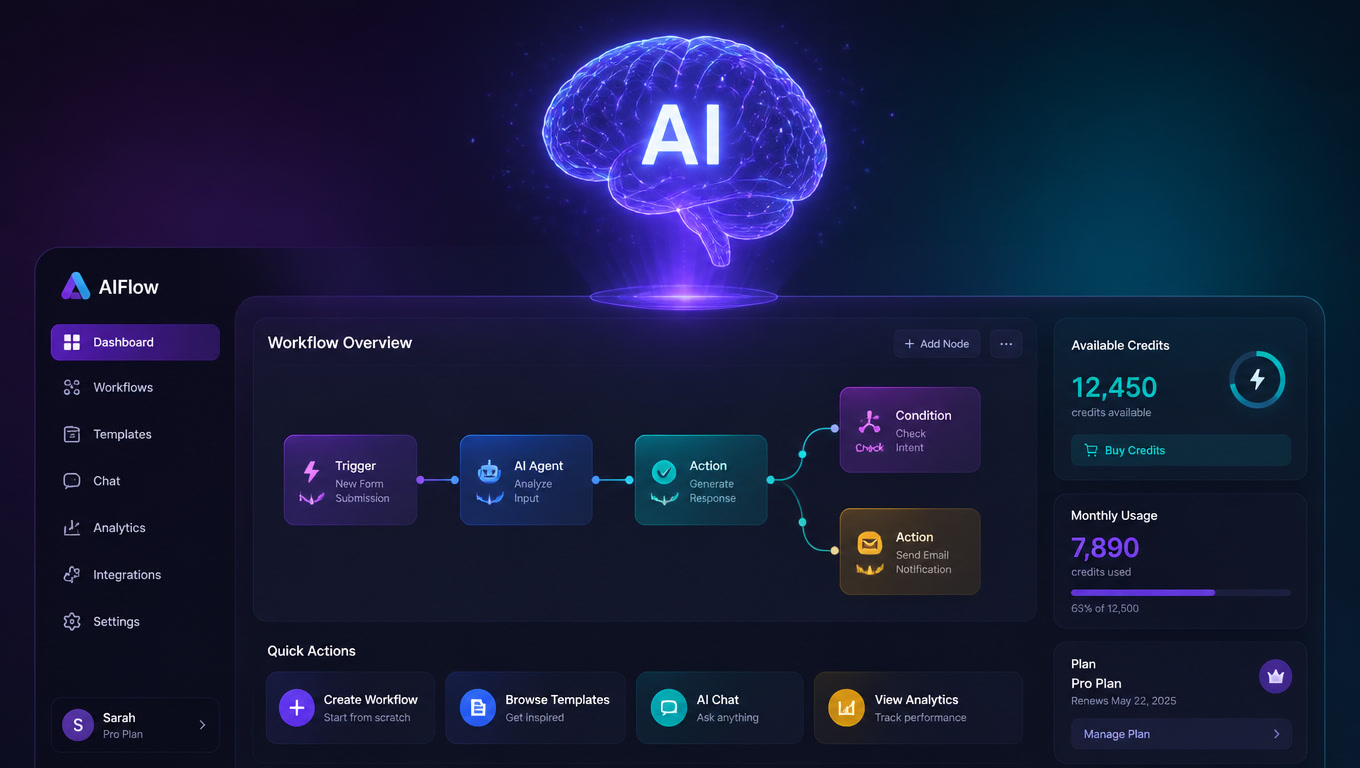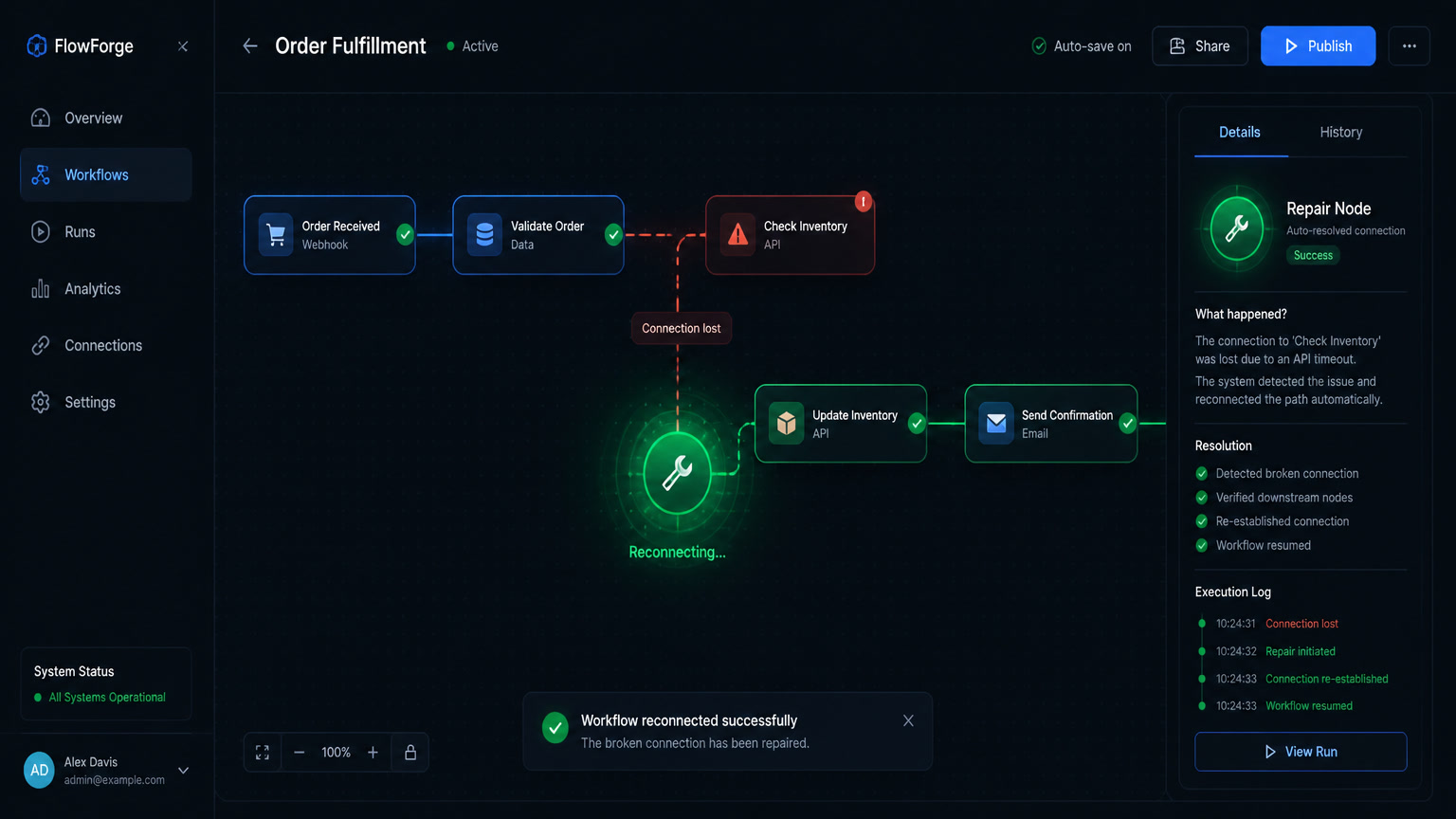

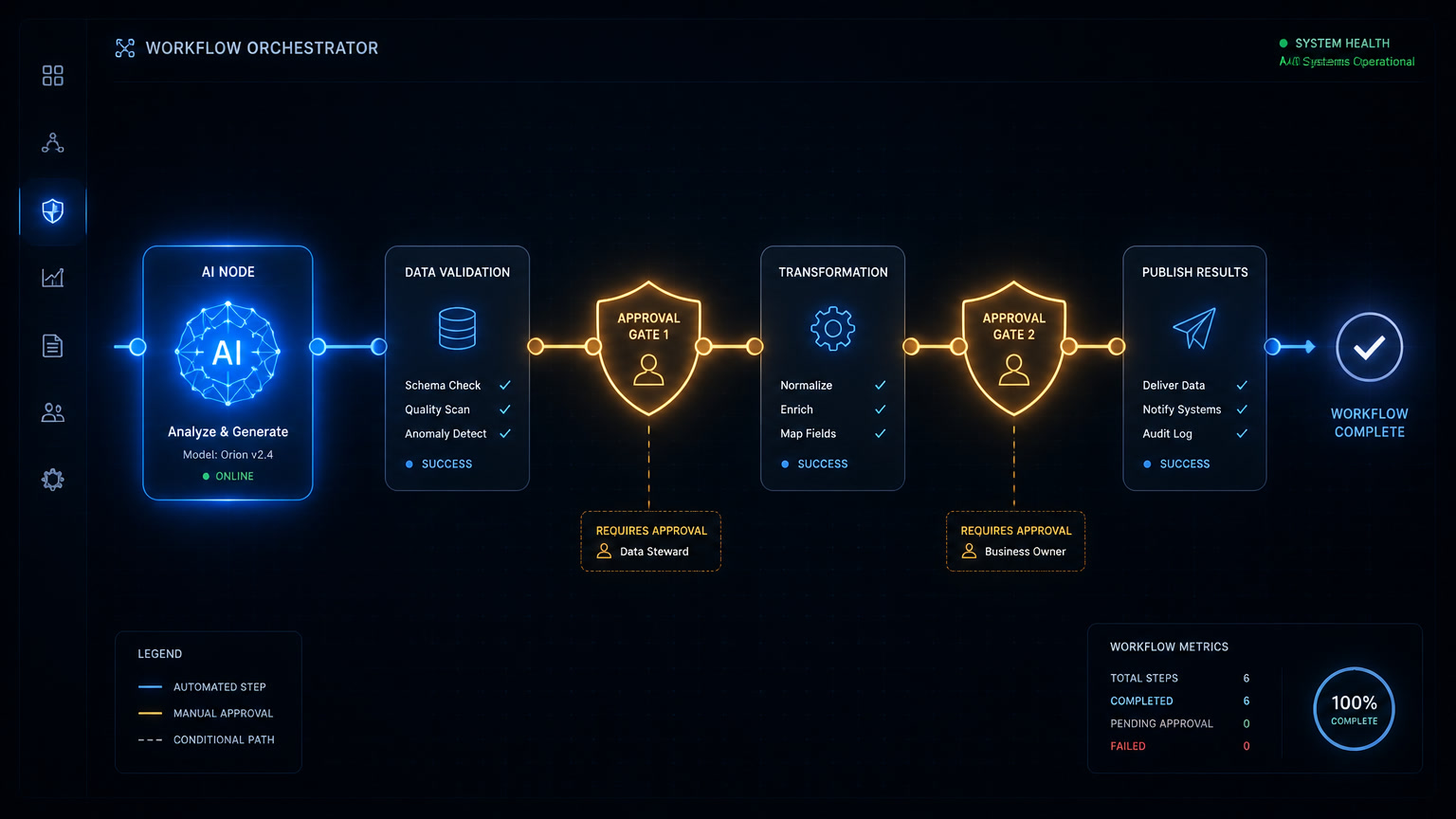
The agent is no longer a product: it is now a step inside your workflow
Zapier put the agent inside the Zap: per-tool approval, a 75-task cap and task billing. What changed and which controls your stack still lacks.
On October 6, 2026, Zapier stopped selling the agent as a product: Zapier Agents — which lived on its own at agents.zapier.com — is now a single AI step inside any Zap, with per-tool approval, a per-step model choice (1, 3 or 5 tasks depending on tier) and a 75-task cap per run that pauses the flow instead of letting it loop. This is not an interface detail: Make had already moved its AI Agents onto the scenario canvas in February 2026, and n8n never had a separate agent at all — it was always a node inside the workflow. With the last standalone agent moving inside, what we have been seeing in client implementations is now confirmed: the agent stopped being a product and became a component with guardrails around it. Before you migrate anything: turn on per-tool approval for anything that writes, lower the task ceiling to what your operation tolerates, and save a named version of the flow before touching production.
What exactly changed at Zapier
Zapier's October 6 post (written by Ruchira Kulkarni, who leads agent product) frames it this way: Agents was made of four ingredients — a prompt, tools, a trigger and permission to act — and all four now live in one step you drop into any Zap. The help center migration guide, updated October 1, carries the details that matter for operating.
| Agents (before) | AI by Zapier (since Oct 6, 2026) | |
|---|---|---|
| Where it lives | Standalone product at agents.zapier.com | One AI step inside any Zap |
| Triggers | A handful of agent triggers | Any Zapier trigger, webhooks, or a sub-Zap calling another agent |
| Approval | All-or-nothing per agent | Per tool: Require approval before running, plus admin approval for publishing Zaps that contain AI steps |
| Model | Not selectable | Standard / Advanced / Premium tiers (1, 3 or 5 tasks) or a named model |
| Billing | Separate Agents subscription (Free 400 activities; Pro $400/year = $33.33/mo for 1,500) | Tasks — the same meter as the rest of Zapier |
| Runaway run | No stated cap | Pauses at 75 tasks per run for review (adjustable up to 500) |
| History | Its own panel | Zap History next to every Zap: tools called, inputs and outputs, tier and tasks consumed |
| Knowledge sources | Available | Not supported yet: HubSpot, Asana, Zendesk, Zoom and Jira |
Two pieces of context that change the urgency. First, on October 10 the Agents plans were still published on Zapier's pricing page and the announcement sets no shutdown date, so there is no race. Second, the agent now runs on the same infrastructure that executes millions of tasks a day — filters, branches, retries and run history, everything a standalone agent was always denied. It is also Zapier's second big move in a month: three weeks ago we broke down Next Gen Zaps and Agentic Management and its flow-repairing agent.
Why a standalone agent was never going to give you control
Zapier says it plainly in its own post: "We know runaway agents were a concern with Zapier Agents, and this is our solution" — the 75-task cap. That sentence is the architectural confession of the year: an agent that lives outside the workflow can only be turned off completely or not at all, because there is nothing around it to hang a decision on. The all-or-nothing approval was not a Zapier design gap; it was the symptom of an autonomous product sitting loose with permissions over your data.
We made that argument for permissions in why your agent should not hold the keys to your CRM: least privilege is not something you ask the model for, it is enforced from the outside. And the jump from "chatbot that reads" to "agent that executes" that we described in AI agents that execute real actions in CRMs is only safe when a deterministic layer decides what it may touch. The embedded step is that layer: the agent reasons inside, and high-risk actions stay in steps you design, approve and audit.
Our read, after implementing agents for clients in LatAm: the value is no longer in the agent, it is in the fence you put around it. Any vendor will give you reasoning and tool calling; very few give you per-tool approval, a ceiling per run, and an audit log a human can read.
The four controls that exist today (and the ones you still build)
October was the month the three big platforms converged without consulting each other: all three now point to the embedded agent with controls around it. This is the matrix we use to review a stack in production:
| Control | What it prevents | What the platform already gives you | What you still build yourself |
|---|---|---|---|
| 1. Per-action approval | A model error sending, charging or deleting | Zapier: per-tool approval plus publish approval for AI steps (Oct 6) | Make and n8n: the gate goes before the action — approval steps in Make, a Wait node with a Slack or email button in n8n |
| 2. Run ceiling | A looping run spiking your invoice | Zapier: pauses at 75 tasks, adjustable up to 500 (Oct 6); Make: monitoring via signed event subscriptions (Oct 8) | The number is yours, set by what hurts in your invoice, not by the default |
| 3. Model fallback | A down provider leaving the flow half-done | Make: fallback connection with its own AI Provider as the default backup, plus prompt caching (Oct 9) | Zapier and n8n: you pick the model per step or node (n8n added Gemini 4 Argon on Oct 13); no automatic fallback announced |
| 4. Change record and audit | Knowing who broke what, and when | Make: version control with descriptions (Oct 7), signed event subscriptions with delivery logs (Oct 8), audit logs over MCP (Oct 9). Zapier: Zap History with inputs, outputs, tier and tasks. n8n: migration report by impact (2.43, Oct 6) | The patch calendar: n8n published 15 security advisories on October 14 (4 high severity), fixed in 2.43.5 — if you self-host, that version is the floor |
Two October decisions that fall under control 4 and that almost nobody reviews: n8n 2.43 (Oct 6) ships Browser Use enabled by default for the instance assistant — it is the admin who decides whether a production automation may drive a browser — and its bi-weekly bulletin makes clear that n8n Cloud patches itself while any self-hosted instance below 2.43.5 stays exposed to those four high advisories (stored XSS in webhook responses, cross-project data-table access, denial of service via prototype pollution, and an event-loop block in the Files node).
What an agent inside the workflow costs
Task billing changes the arithmetic of a loop. An AI step costs 1, 3 or 5 tasks depending on the tier, and each app action in the same Zap adds 1. A lead-qualification Zap with one Premium AI step and three app actions is 8 tasks per run: 200 runs a month is already 1,600 tasks. The Free plan stops at 100 tasks a month and Professional starts at $19.99/mo billed yearly ($29.99 monthly) — prices checked on October 10, 2026 — so the exercise before migrating is simple: multiply your monthly runs by the tasks in your flow and compare it with what you pay today.
| Zapier (AI by Zapier) | Make | Self-hosted n8n | |
|---|---|---|---|
| How it bills | Tasks: 1/3/5 by model tier + 1 per app action | Credits per operation | Fixed server |
| Entry price | Free 100 tasks/mo; Professional from $19.99/mo yearly | From $9/mo per 10,000 operations (June 2026) | $6-20/mo server, no per-operation charge |
| What protects you | The 75-task pause per run | Model fallback and signed event subscriptions | You set the ceiling; nobody bills you for a loop |
| Where it hurts | Flows with many loops and Premium-tier AI steps | Volume spikes moving the invoice every month | Needs a technical owner for patches and upgrades |
The full platform comparison still stands in Make vs n8n for AI agents, and the real cost of scaling on Zapier is broken down in the hidden cost of scaling with Zapier. What is new here is not the price: it is that for the first time you see the per-run breakdown in your history before the invoice arrives, which is exactly the argument we have been making about per-seat versus usage pricing — the meter has to reflect the work, and now the meter is the task.
How to migrate without breaking the operation
- Inventory before migration. List your agents and note which tools they touch. Flag the ones that send messages, create or update records, issue invoices or delete: only those need per-tool approval; reads can run free.
- Recreate it as a smaller step, not a bigger agent. The agent decides; deterministic steps act, as in build with AI, execute with rules. Moving a standalone agent into a giant agent inside the Zap repeats the same mistake in a new shell.
- Per-tool approval on everything that writes, sends, charges or deletes. If more than one person works in the account, also turn on publish approval for Zaps containing AI steps.
- Lower the ceiling and the tier. Start with a cap that hurts little, and use Premium only where the reasoning earns it: almost every classification fits in Standard.
- Check knowledge sources before promising anything. HubSpot, Asana, Zendesk, Zoom and Jira are still unsupported. If your operation depends on them, that is your blocker — not the interface.
Our take
For a LatAm stack — Clientify + n8n + Make — October's convergence means one thing: don't buy the agent product, buy the controls. Reasoning and tool calling are already a free step in every platform; what still costs is the fence: per-action approval, a run ceiling, model fallback and an auditable history. And if you are dollar-sensitive, Zapier's task billing punishes loop-heavy flows while self-hosted n8n keeps a fixed floor: your platform decision is dictated by volume and risk tolerance, not by the new agent.
What we would not do: rebuild your standalone agents as they were, only bigger, inside the Zap. What we would: split each agent into a decision step plus action steps with approval, and only then turn up the volume. The agent is no longer the product; the operation around it is the product.
Frequently Asked Questions
What is AI by Zapier?
It is the AI step inside the Zap editor where everything Zapier Agents used to do now lives: instructions, tools, trigger and permission to act. It bills in tasks (1, 3 or 5 depending on the model tier), supports per-tool approval before a run, and logs every run in Zap History alongside the rest of your automations.
Is Zapier Agents being discontinued?
Zapier has not announced a shutdown date. On October 10, 2026 the Agents plans were still listed on its pricing page, and the migration guide tells you to recreate each agent as an AI step inside a Zap with the same goal and the same tools. Migrate deliberately, not in a panic — but don't wait for the old product to lose support either.
How much does an agent inside a Zap cost?
An AI step consumes 1, 3 or 5 tasks depending on the model tier you pick, plus one task per app action in the same Zap. If a single run exceeds 75 tasks (adjustable up to 500) it pauses for human review instead of quietly looping.