
Beyond the Chatbot: How We Built AI Agents That Execute Real Actions in CRMs
Most 'AI chatbots' are read-only. Here's how we built AI agents that create contacts, update deals, trigger workflows, and write to CRMs and ERPs — with zero human intervention.
Beyond the Chatbot: How We Built AI Agents That Execute Real Actions in CRMs
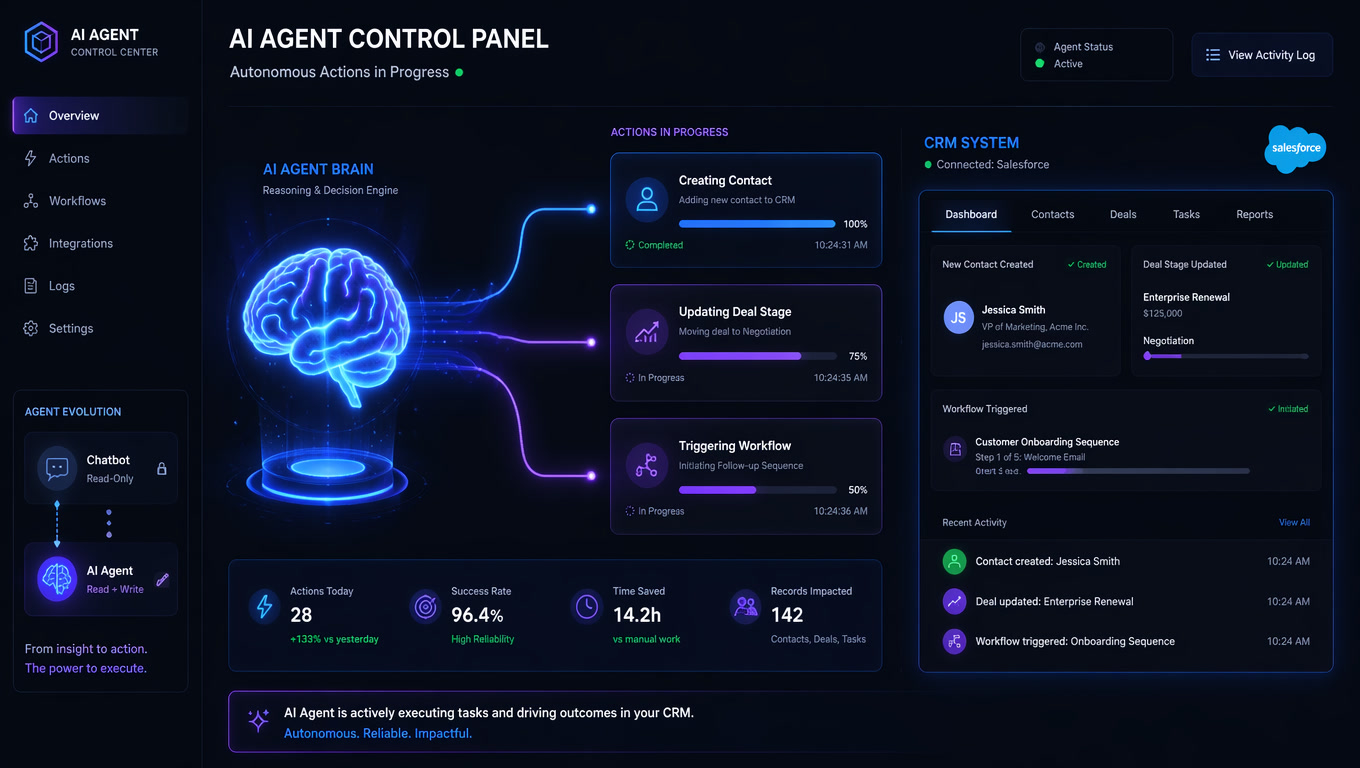
A chatbot answers. An agent acts. That single distinction separates 90% of conversational AI projects — expensive question-answering boondoggles — from the 10% that genuinely transform business operations.
Throughout 2026 we've been deploying AI agents that don't just answer questions. They create CRM contacts, update deal stages, trigger email campaigns, generate purchase orders, and modify records in accounting systems. This isn't theory. It's what we're running today with n8n, OpenAI, Clientify, and REST APIs.
This article shares the framework we use, the mistakes we made so you don't repeat them, and an honest comparison of the tools available for building agents that do, not just say.
The Read-Only Chatbot Trap
If your "AI agent" can only query a knowledge base and return text, it's not an agent. It's a chatbot on steroids.
The market is flooded with implementations that promise "AI for your business" and deliver a pretty chat interface that searches FAQs. According to Gartner's 2026 enterprise automation report, companies that deployed conversational assistants without execution capabilities saw a marginal 12% improvement in operational efficiency. Those that allowed their agents to write to transactional systems reported a 43% reduction in process cycle times.
The difference isn't the language model. It's the architecture.
When you connect an AI agent to a CRM, the right question isn't "what questions can it answer?" It's "what actions can it execute?" An agent that only reads data solves 20% of the problem. An agent that also writes, updates, and triggers workflows solves the remaining 80%.
Our Framework: Three Levels of Agent Autonomy
After deploying agents for clients in real estate, logistics, and professional services, we've defined three levels of autonomy. Each corresponds to a different integration depth and trust threshold.
Level 1: The Informed Assistant (Read-Only)
The agent queries CRM or ERP data and presents it in natural language. It uses tools like semantic search over knowledge bases or SELECT queries against databases.
Real-world example: An agent connected to the Clientify API that answers "what's the total pipeline value this month?" by querying the database and returning the formatted number.
Value: low. Implementation: trivial. This is where most projects get stuck.
Level 2: The Supervised Executor (Tool-Enabled)
The agent can execute actions in external systems, but each action requires human confirmation. It uses function calling to expose CRUD operations (create, read, update, delete) as tools the model can invoke.
Real-world example: A lead submits a web form → the agent receives the data → the agent determines whether to create a contact, assign it to a sales rep, and send a welcome email → it shows the summary to a human → the human clicks confirm → the agent executes all three actions sequentially.
We built this for a logistics client receiving 200+ quote requests daily. The agent classified each request, created the lead in Clientify with the correct fields, and assigned priority — but a human reviewed the batch each morning before emails went out.
Level 3: The Governed Autonomous Agent (Goal-Oriented)
The agent receives an objective and executes a sequence of actions without human intervention, subject to configurable policies (spend limits, permitted action types, operating hours, exception-based escalation).
Real-world example: An agent monitors incoming leads in the CRM. When it detects a lead with score > 80 from a high-conversion channel, it automatically: (1) enriches the contact with LinkedIn data via API, (2) updates the deal stage to "qualified", (3) assigns it to the sales rep with the lightest load, (4) schedules a follow-up task for 2 hours later, (5) sends a summary to the team Slack channel.
This level requires a full audit trail. Every action the agent takes is logged with timestamp, model that made the decision, reasoning, and result. If something breaks, we know exactly which decision led to the error.
How We Build It: The Real Tech Stack
No magic platforms, no over-engineered frameworks. Our production stack as of June 2026:
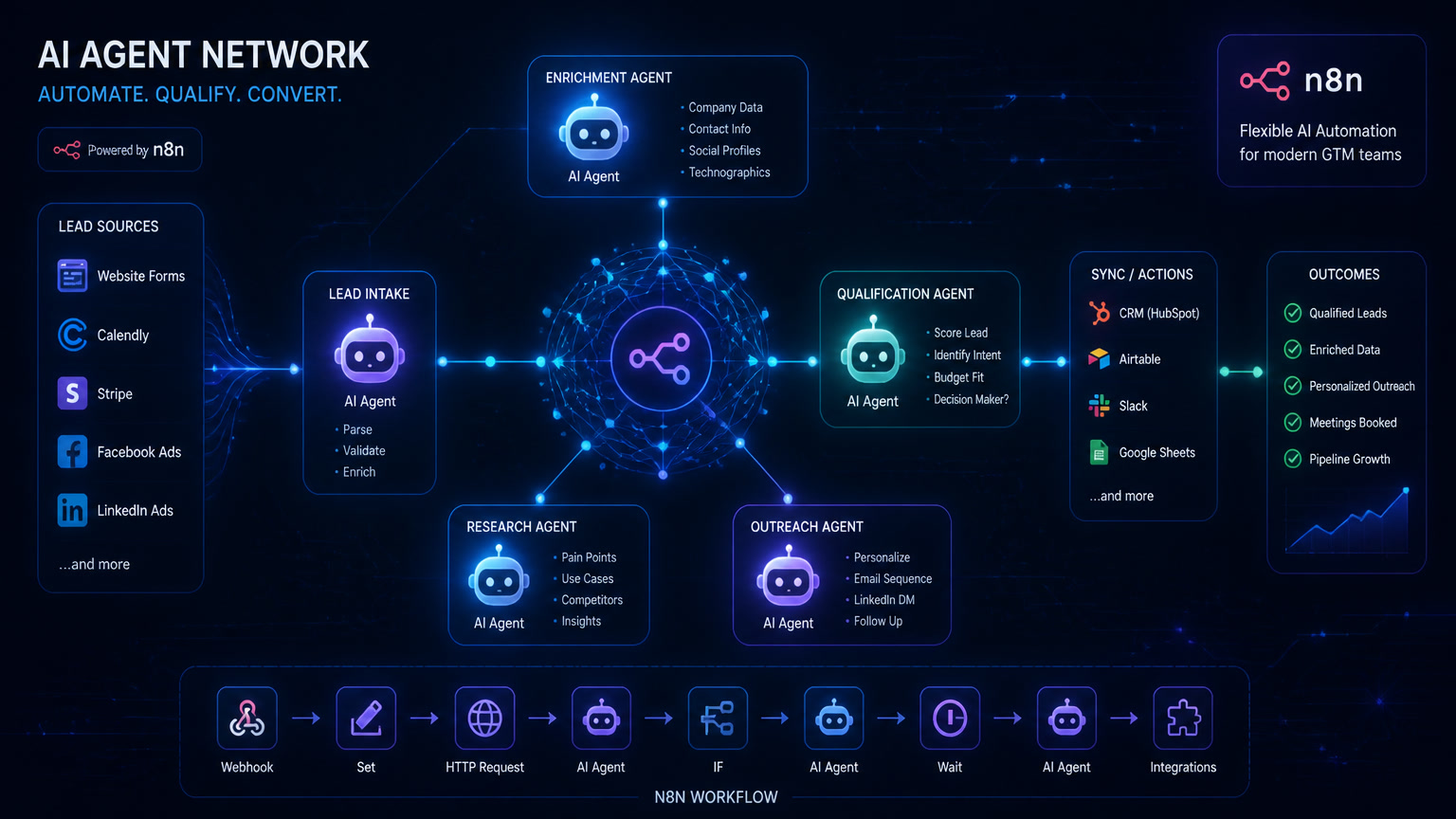
- Orchestration: n8n (self-hosted) with its AI Agent node, exposing tools via function calling to OpenAI models (GPT-4o and GPT-4.1). For simpler flows, Make.com with HTTP + AI modules.
- CRM: Clientify, with REST endpoints for creating contacts, deals, tasks, and notes. We've also integrated HubSpot for clients already on it.
- Models: We default to OpenAI for function-calling consistency, but have tested Claude 4 Sonnet with comparable results for structured actions.
- Governance: A thin Python layer that evaluates every action against policy before execution: is the agent authorized to write to this object? Does the deal value exceed the threshold? Are we within business hours?
The model isn't the bottleneck — how you expose tools and govern their use is what makes or breaks the system.
Lessons Learned the Hard Way
Not everything went smoothly. Here are the three most expensive mistakes:
Mistake 1: Underestimating Tool Description Quality
When you define a function tool for a model, naming and description matter more than the implementation. A parameter called deal_stage with insufficient context will cause the model to invoke the tool with wrong values. We learned to write tool descriptions as if they were documentation for a junior developer: explicit, with examples, and clear constraints ("this field only accepts 'open', 'qualified', 'proposal', 'closed_won', or 'closed_lost'").
Mistake 2: Ignoring Idempotency
An agent can fail mid-sequence. If it retries, it may duplicate contacts or send emails twice. We now design every tool to be idempotent: create a contact only if one doesn't exist with that email, or allow updates instead of recreations. This is non-negotiable for real autonomy.
Mistake 3: Skipping Graduated Supervision
We jumped from Level 1 to Level 3 in one week for a client. Bad idea. The agent started creating duplicate deals and reassigning leads incorrectly. The lesson: every level needs an observation period. Minimum two weeks at Level 2 with full decision logging before releasing control.
Tool Comparison: Building Action-Oriented AI Agents
| Tool | CRM Execution | Native Function Calling | Configurable Autonomy | Cost |
|---|---|---|---|---|
| n8n (AI Agent node) | Excellent (via HTTP/REST) | Yes (native) | High (sub-workflows) | Free (self-hosted) |
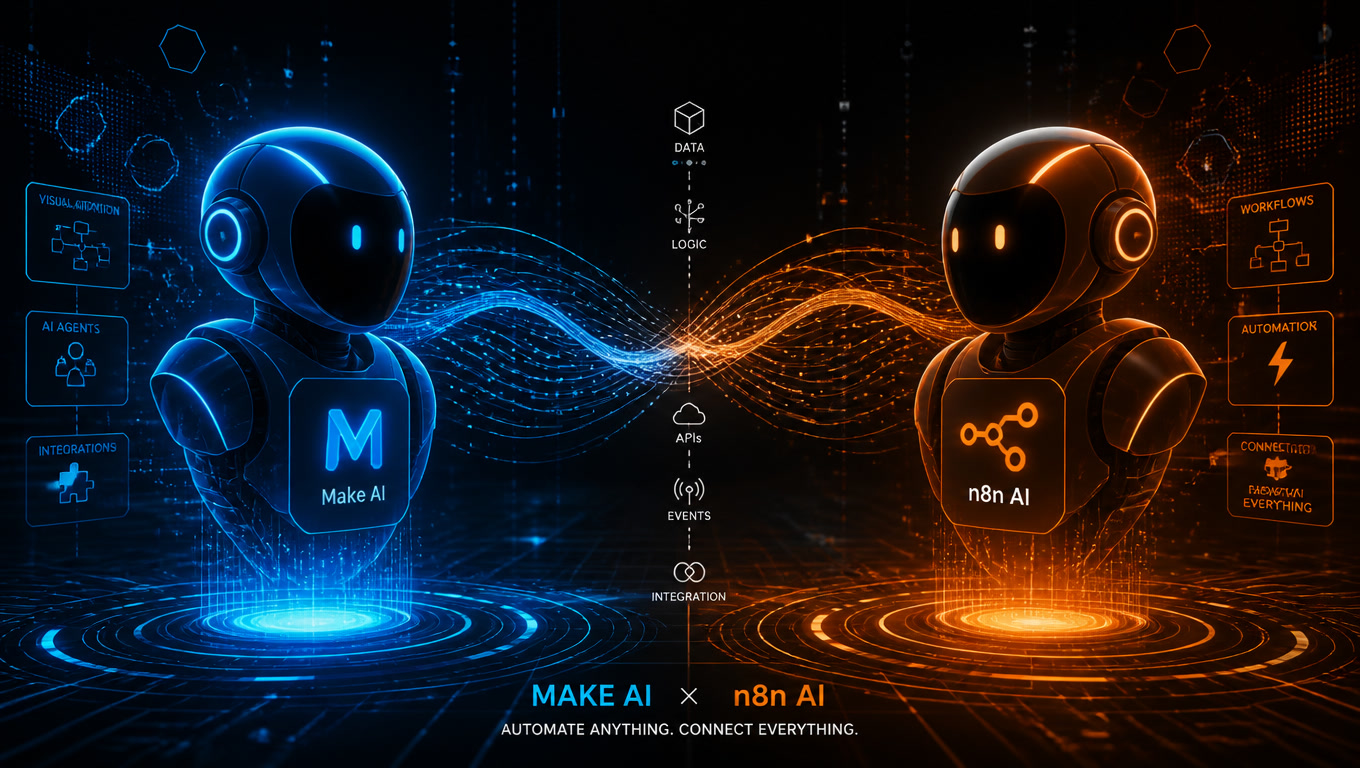
| Make.com | Good (via modules) | Limited (HTTP only) | Medium (scenarios) | ~$20-100/mo |
| Lindy.ai | Good (prebuilt connectors) | Partial | High | ~$30-200/mo |
| Salesforce Agentforce | Excellent (native) | Yes | High | $$$ (per conversation) |
| Clientify + direct API | Excellent | Via external orchestrator | Whatever you implement | API calls only |
For most SMBs and mid-market companies, the n8n + Clientify/HubSpot + OpenAI combination offers the best balance of cost, control, and real execution capability.
What's Next: Agents That Decide, Not Just Execute
Over the next 12 months, we'll see agents that don't just execute predefined actions — they discover which actions to take based on high-level objectives. Not "create a lead when a form is submitted", but "increase pipeline conversion rate by 15% this quarter" — and the agent figures out the strategy.
This is already happening with multi-agent frameworks where an orchestrator agent delegates tasks to specialized agents. We deployed this for a client and the early results are strong: 34% more qualified leads without expanding the sales team.
But that power comes with greater responsibility. A poorly governed autonomous agent can cause more harm than good. Traceability, idempotency, and graduated supervision aren't optional extras — they're the foundation of any serious deployment.
At Mintec we build AI agents that execute real actions in CRMs and business systems. If you're ready to go beyond the chatbot, get in touch.
Related reading: