
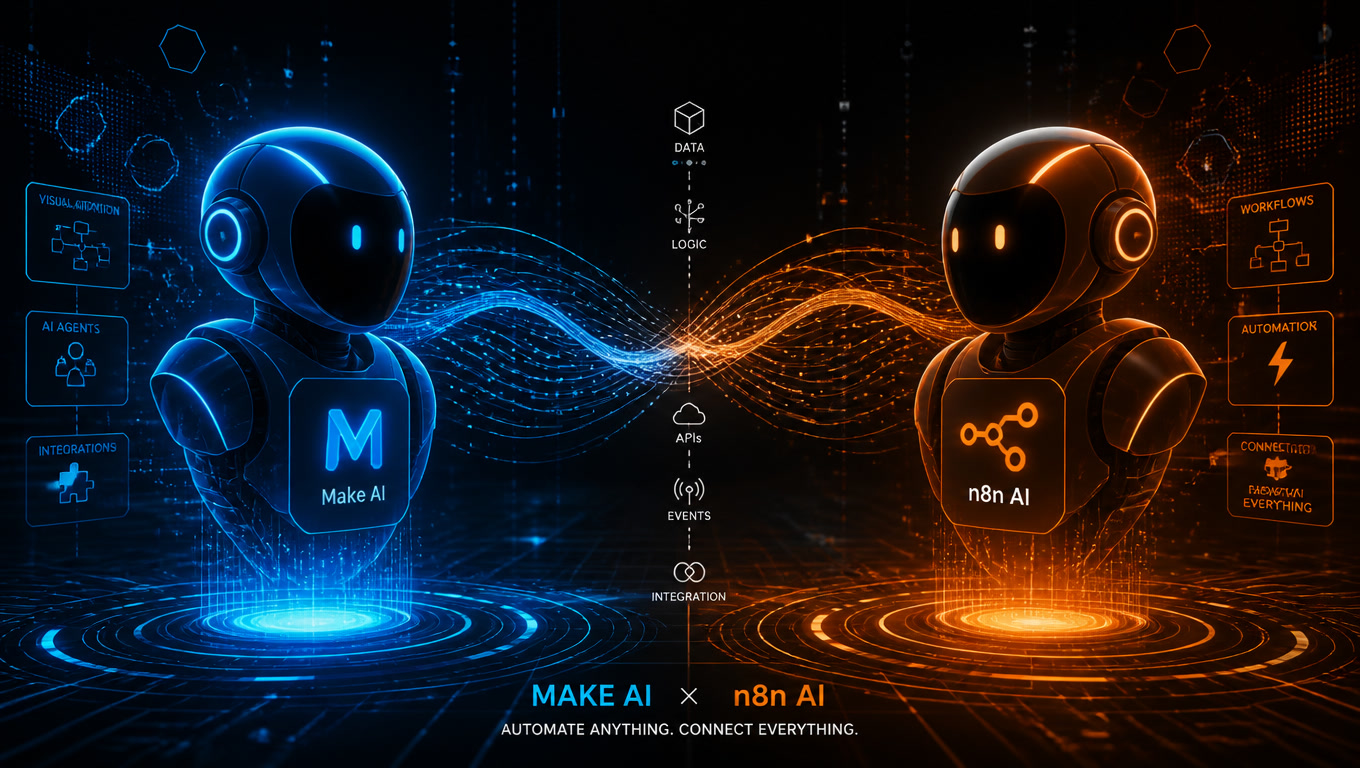
Make AI Agents vs n8n AI Agents: Which One Should Your Business Use in 2026?
Make launched native AI Agents in May 2026. n8n has had LangChain-based AI nodes for over a year. We compare both from real client implementations in Latin America: capabilities, actual costs, privacy implications, and a decision framework for choosing the right one.
Make launched native AI Agents in May 2026. n8n has had LangChain-based AI nodes for over a year. Both build "AI agents," but they do it in radically different ways — and that difference determines which projects succeed and which stall out in pilot purgatory.
This is not a generic platform comparison. It's what we've learned at Mintec implementing AI agents with both tools for real clients across Latin America: when to use each one, what the actual costs look like, and how to avoid getting locked into the wrong platform when your agents start scaling.
If you want the short version: Make AI Agents is the right choice when your team isn't technical, you already use Make, and you need an agent running in days. n8n AI Agents is better when you handle sensitive data, need self-hosting, or expect high execution volumes. But the decision has more nuance. Let's dig in.
The Big News: Make AI Agents (May 2026)
Make —formerly Integromat— launched its native AI Agents app in May 2026. This isn't a marketing badge: it's a real architectural change inside the platform.
Before, if you wanted an AI agent in Make, you built it manually: call the OpenAI API from an HTTP module, manage context yourself, implement your own reasoning loop. Now Make ships a native component that works on a goal + tools model. You give the agent an objective ("qualify this lead, write a follow-up email, and update the CRM"), connect tools (Make modules or complete scenarios), and the LLM decides at each step which tool to use and how to interpret the results.
The five components of a Make AI Agent, per their documentation:
| Component | What it does |
|---|---|
| Brain (LLM) | The reasoning model (OpenAI, Claude, Gemini, or any compatible endpoint) |
| Instructions | System prompt defining the agent's role and constraints |
| Memory | Files or context the agent consults for informed decisions |
| Tools | Make modules or entire scenarios the agent can invoke |
| Reasoning | Visible thought process when deeper analysis is needed |
The twist: each tool call executes a full Make scenario. This is great if you already have scenarios built —you reuse what works— but each call burns multiple credits.
Entry price is low: Core plan costs ~$10.59/month (billed annually) and includes 10,000 credits. The problem: an agent making 3-4 tool calls per execution consumes 3-4× more credits than an equivalent traditional scenario. When you scale, costs multiply faster than you expect.
Our take: Make AI Agents is the shortest path to a working agent if your stack already lives in Make. But the credit-based pricing model is a silent trap for complex or high-volume agents. We've seen clients start with a simple lead qualification agent and end up paying $200+/month because the agent makes 8-10 calls per lead.
The Established Option: n8n AI Agents
n8n has had AI nodes since 2025, and in 2026 it has evolved to include roughly 70 dedicated AI nodes with native LangChain integration. The fundamental difference from Make: here you have granular control over every aspect of the AI pipeline.
Where Make gives you a "packaged" agent that you connect tools to, n8n lets you build the agent piece by piece: the language node, the memory node, the tools node, the output parser. You decide exactly how context is managed, which model is used at each step, how responses are structured.
n8n isn't easier. It's more powerful.
Capabilities n8n has and Make (currently) doesn't:
- Full LangChain nodes: build processing chains with multiple models, persistent conversational memory, and RAG retrievers.
- Native vector stores: ideal for agents that need to query internal documentation, knowledge bases, or product catalogs.
- Persistent memory: the agent remembers past conversations across sessions, not just immediate context.
- Custom code: inject JavaScript or Python into any node, enabling logic no visual interface can express.
- Self-hosting: critical for regulated industries (fintech, healthcare, legal) where data can't leave the client's infrastructure.
And the pricing model is radically different: n8n charges per workflow execution, not per individual step. An agent making 10 tool calls consumes 1 execution. In Make, that would be 10+ credits. For complex agents, this difference is enormous.
Our take: n8n is the right choice when the AI agent is critical to operations — not an experiment. When you need it to work at scale, with sensitive data, and with the flexibility to modify any aspect of the pipeline without waiting for the platform to expose it.
Head-to-Head: Make AI Agents vs n8n AI Agents
| Dimension | Make AI Agents | n8n AI Agents |
|---|---|---|
| Launch date | May 2026 (open beta) | 2025 (mature, 70+ nodes by 2026) |
| Architecture | Packaged agent (goal + tools) | Modular nodes (LangChain) |
| Supported models | OpenAI, Claude, Gemini, compatible endpoint | Any model via LangChain (OpenAI, Claude, Gemini, local Ollama, etc.) |
| Memory | Per-session context | Persistent (vector store, conversational memory) |
| Self-hosting | ❌ Cloud only | ✅ Cloud + self-hosted (Community Edition) |
| Custom code | ❌ No | ✅ JavaScript and Python in any node |
| Native RAG | ❌ No | ✅ Yes (vector stores, retrievers) |
| Minimum real price | ~$10.59/month (10,000 credits) | Free (self-hosted, server ~$6-20/month) |
| Cost per complex agent | High (each tool call = credits) | Low (1 execution = entire workflow) |
| Learning curve | Low (if you know Make) | Medium-high (requires understanding LangChain) |
| Best for | Non-technical teams, Startups, Quick validation | Technical teams, Sensitive data, High volume |
Decision Framework: Which One to Use
At Mintec, we use this matrix with each client:
Use Make AI Agents when…
- Your team already works in Make. If you have existing scenarios, adding an agent means connecting existing tools. ROI is immediate.
- You need a prototype in days. Make AI Agents configures in hours, not weeks. For validating whether an agent makes sense before investing in infrastructure, it's unbeatable.
- Your agents are simple (1-3 tools per execution). An agent that classifies leads, assigns a score, and sends an email —3 tool calls = 3 credits. On Make Core, that's pennies per execution.
- You don't have a technical team. Make is visual, requires no programming, and the AI Agents app has a guided interface.
Use n8n AI Agents when…
- You handle sensitive or regulated data. Healthcare, fintech, legal. If client data can't pass through third-party servers, self-hosted n8n is the only path.
- Your agents are complex (5+ tools, loops, RAG). An agent that researches prospects, cross-references multiple data sources, generates personalized reports, and sends them. On Make, this would burn dozens of credits per execution. On n8n, it's 1 execution.
- You need long-term memory. Agents that converse with clients over weeks, remember past interactions, and build on historical context. n8n with vector stores handles this well; Make doesn't have this capability today.
- You expect to scale to thousands of daily executions. Self-hosted n8n has no artificial limits. You pay for your server and run whatever you need.
The Gray Zone: When Either Works
Some projects work well on both platforms. For example: a customer support agent that answers FAQs, queries a knowledge base, and escalates complex cases to humans. Make does it fast and well. n8n does it with more control and lower marginal cost.
Our recommendation: start with Make if speed is the priority. Migrate to n8n when the agent proves value and you need to scale. The business logic transfers, though the technical implementation needs rebuilding.
What We've Learned Deploying Both
Three patterns have repeated across our Latin American clients that are worth sharing:
1. Make agent costs scale faster than they appear.
A client started with a Make agent that qualified leads from WhatsApp. The agent received the message, analyzed intent, consulted the CRM, updated the score, and replied —5 tool calls per lead. At 500 leads/month, that's 2,500 credits just for that agent. On Core (10,000 credits, ~$10/month) it worked fine. When they grew to 2,000 leads/month, they needed Pro (~$29/month) and then Teams (~$99/month). On self-hosted n8n, the same volume costs ~$10/month in server fees, regardless of how many leads you process.
2. n8n requires upfront technical investment, but pays dividends.
A logistics client needed an agent that processed shipping documents (invoices, waybills, bills of lading) using RAG to extract data and update their CRM. They tried it on Make: the agent worked, but each document required multiple calls and credits spiked. They migrated to n8n with a single classification + extraction + update workflow. Cost per document dropped from ~$0.15 to ~$0.01.
3. Running both platforms is more common than anyone admits.
Several of our clients end up running Make for traditional automation (connecting forms, CRMs, emails) and n8n for the AI agents that require complex processing. Make orchestrates; n8n executes the intelligence. It's more work maintaining two platforms, but financially it's the optimal combination.
How This Fits Your Automation Stack
If you already work with a CRM like Clientify, the Make vs n8n decision for AI agents comes down to two factors: where your data lives and who will operate it.
Clientify has native integration with Make via REST API, making it trivial to connect Make agents to your CRM. If your priority is having an AI agent feeding your CRM in days, Make + Clientify is the fastest combination.
If instead you handle sensitive data or need agents running 24/7 without depending on third-party availability, self-hosted n8n + Clientify via API gives you the control you need. Initial setup takes longer, but once it's running, operational costs are predictable and low.
To understand how AI agents differ from traditional automation, our guide on AI agents vs traditional automation covers when each approach makes sense. And if you're considering implementing AI agents for the first time, our agent implementation framework takes you from scoping to deployment.
Conclusion
Make AI Agents and n8n AI Agents don't compete in the same arena. Make competes on speed of implementation and accessibility. n8n competes on control, scalability, and long-term cost.
The right choice depends on your context: if you value time over money and your operation doesn't handle sensitive data, Make is the answer. If you value control and scalability, or work in a regulated industry, n8n is the right investment.
And if you're not sure, the pragmatic path is to start with Make for validation, then migrate the agents that prove valuable to n8n when volume justifies it. It's what we do with most of our clients at Mintec, and it works.
Frequently Asked Questions
What are Make AI Agents and how do they work?
Make AI Agents are native autonomous agents within Make that work on a goal + tools model. You give the agent an objective, connect tools (Make modules or complete scenarios), and the LLM decides which tool to use at each step and how to interpret results. Available on all plans since May 2026, including Free.
When should I use n8n instead of Make for AI agents?
Choose n8n when you need self-hosting for data regulations (fintech, healthcare, legal), when execution volumes are high (Make's credit-based pricing becomes expensive for complex agents), when you need advanced LangChain capabilities (RAG, persistent memory, vector stores), or when your technical team needs full control over the AI pipeline.
Make AI Agents or n8n AI Agents for an SMB?
For most SMBs, Make AI Agents offers the fastest path: if you already use Make, adding agents takes minutes, entry cost is low ($9/month Core), and the learning curve is minimal. We recommend n8n when the business handles sensitive data, needs to scale to thousands of daily executions, or requires agents with long-term memory and RAG capabilities.