
When AI Agents Replace Your Workflow Tools (Not Just Your Workers)
Zapier, Make, and n8n dominated business automation. But in 2026, AI agents are rewriting the rules. We break down when to replace traditional workflows with autonomous agents and how to make the transition without breaking your operations.
When AI Agents Replace Your Workflow Tools (Not Just Your Workers)
The most dangerous question you can ask about business automation in 2026 is not "which tool should I use?" It's "what am I actually automating?"
For the past decade, the answer was straightforward: you were automating connections. An email arrives → create a task in Asana. A Shopify order comes in → update the CRM. A form submission happens → send a Slack notification. The logic was deterministic, the triggers were predefined, and the outcome was predictable. Platforms like Zapier, Make, and n8n built billion-dollar categories on this "if-this-then-that" paradigm, and for good reason — it worked, it was visual, and anyone could build it without writing code.
But a subtle shift has been underway. We started seeing a different kind of question from our clients at Mintec. Not "how do I connect tool A to tool B?" but "how do I make this process figure itself out?"
That question changes everything.
The Paradigm Lies Hidden in Plain Sight
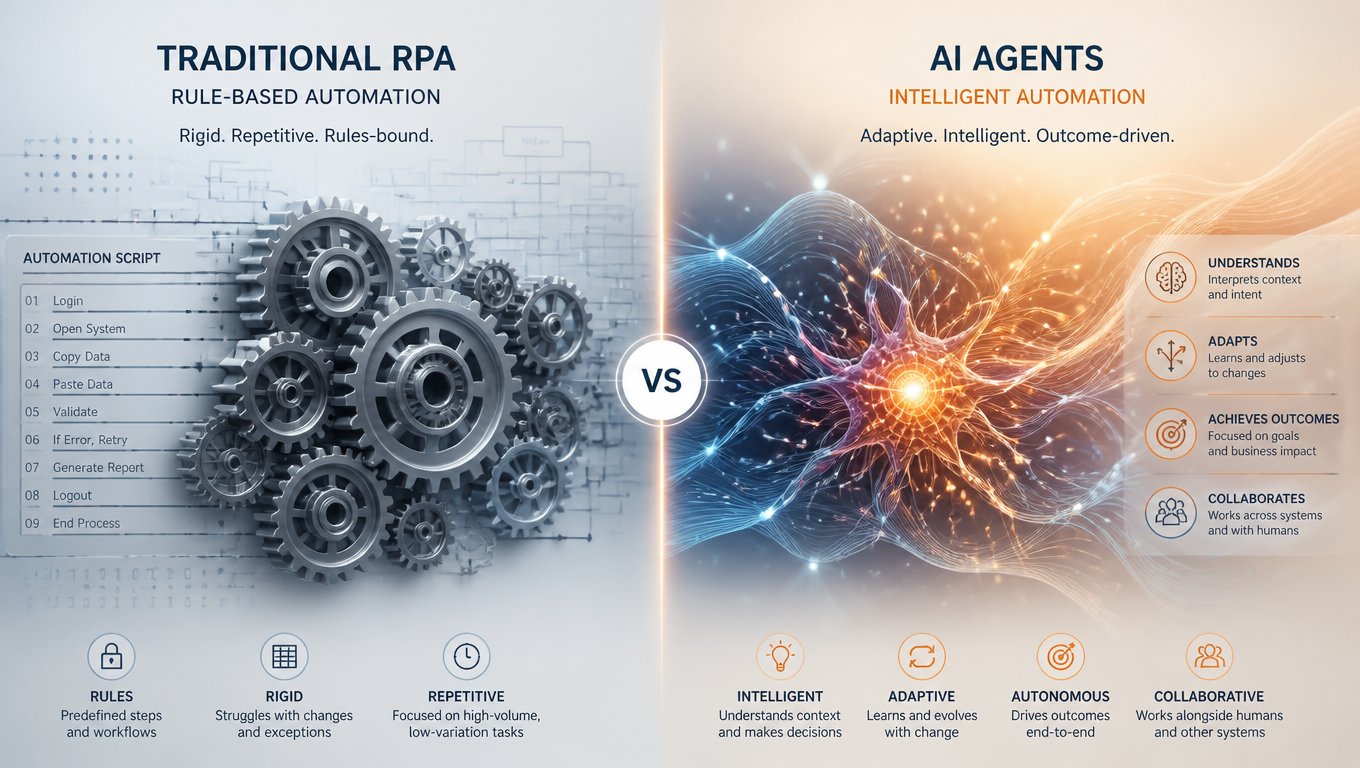
Traditional iPaaS tools like Zapier and Make excel at deterministic, linear workflows. You define a trigger, apply a filter, transform data, and send it to an action. Every path is mapped, every edge case needs a branch. This works beautifully for repetitive, high-volume tasks.
AI agents operate on intent instead. Give them a goal — "handle our customer onboarding for new Shopify subscribers" — and they look at the tools they have (CRM, email, Slack, knowledge base, calendar), evaluate incoming data, and decide what to do in the moment. They skip steps, reorder actions, and recover from errors they weren't explicitly programmed to handle.
This is not a faster horse. It's a different vehicle.
We saw this with a Mintec client — a mid-market e-commerce brand doing roughly £2M monthly. They had thirty-five active Zapier workflows connecting Shopify, HubSpot, Mailchimp, Slack, and a custom inventory system. The workflows were breaking constantly — an API change here, a field mapping mismatch there, a new product category that didn't fit existing filters. Their operations team spent more time debugging than the workflows saved them.
We didn't replace all thirty-five workflows. We mapped each onto a spectrum: deterministic vs. ambiguous.
Deterministic workflows — "when a tracking number is generated, send a shipping confirmation" — stayed on Zapier. Ambiguous workflows — "when a customer returns a product, figure out whether to refund, replace, or offer store credit based on their history, product condition, and stock levels" — migrated to an AI agent built on Lindy.
The result was a 60% reduction in maintenance overhead and measurable improvement in customer satisfaction, because the agent could dynamically offer better resolutions than rigid if-then logic. This is exactly the shift from rule-following to context-aware decision-making we explored in our analysis of autonomous AI agents.
When the Agent Makes More Sense Than the Workflow
The mistake most SMBs make in 2026 is treating AI agents as "Zapier with ChatGPT inside." An AI agent is not a workflow tool that happens to have a language model attached. It is a fundamentally different paradigm that demands different evaluation criteria.
Here is the decision framework we use at Mintec:
Use Traditional Workflows (Zapier, Make, n8n) when:
- The process has fixed, known steps executed in the same order every time
- Data transformation is predictable and well-defined
- The cost of a wrong action is high and requires full human verification
- Volume is high and latency tolerance is low (sub-second response needed)
- Compliance requires fully auditable, deterministic logic paths
Use AI Agents (Lindy, Relevance, custom) when:
- The process requires judgment and context-dependent decisions
- Input data is unstructured or varies significantly between runs
- The workflow changes frequently or needs to adapt to new situations
- Error recovery is complex and would require extensive branching in traditional tools
- You need to integrate with tools that lack a Zapier connector
Use Hybrid (both) when:
- The process has a stable core with variable edges
- You need deterministic compliance logging but adaptive decision-making
- Existing workflows handle volume well but struggle with edge cases
This framework saved one of our logistics clients from a costly mistake. They were about to migrate their entire Shopify → warehouse management pipeline to an AI agent, assuming "AI is better." But order processing is highly deterministic: order comes in, stock check, pick list generation, shipping label creation. Latency matters — they process 400+ orders an hour. A traditional n8n workflow handled this at under 200 milliseconds per order. An agent would have added 2–4 seconds of LLM overhead per transaction, compounding into hours of additional processing daily. They kept the deterministic core on n8n and added an agent above it to handle exception orders — flagged addresses, payment mismatches, out-of-stock substitutions.
Thinking in "Figure It Out" Instead of "If This Then That"
The hardest shift for teams adopting AI agents is cognitive, not technical. We've trained ourselves to decompose every business process into trigger-action pairs. Visual workflow tools encode a specific assumption: that you can predict every path through a process before it happens.
You can't. Not for the processes that actually consume your team's time.
Consider customer support triage. A traditional Zapier workflow detects a new ticket, assigns it via round-robin, and sends a canned acknowledgment. That's it. An AI agent can read the full ticket context, search the knowledge base, draft a personalized response for approval, create a GitHub issue for known bugs, and prioritize premium SLA cases — all without being told exactly which steps to take or in what order.
This is what we mean when we say the paradigm shift is from "when this happens, do that" to "here's what I need, figure it out."
Opinión Mintec: Las empresas que ganan con agentes de IA no son las que automatizan más tareas. Son las que dejan de describir sus procesos en términos de disparadores y acciones y empiezan a describirlos en términos de resultados y restricciones.
Where the Industry Is Headed
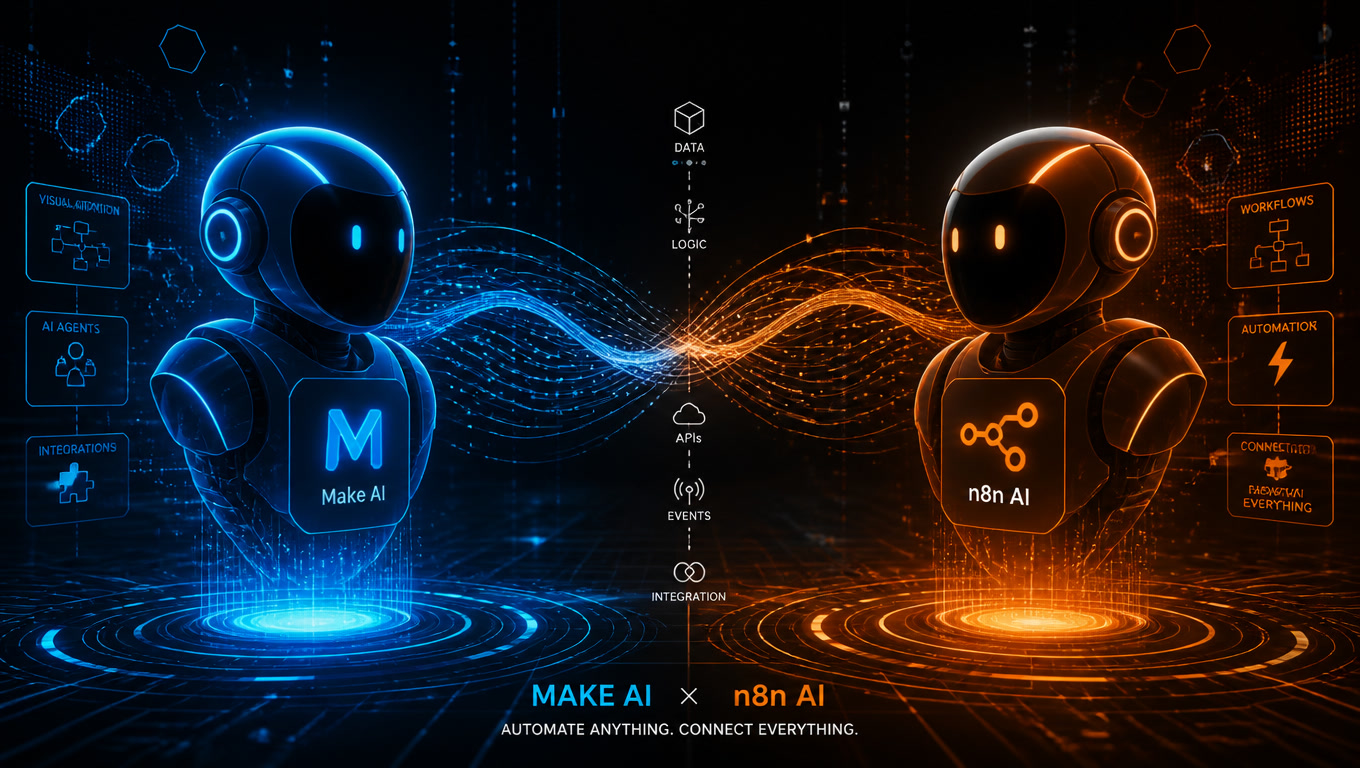
The iPaaS players are responding. Make has introduced AI modules for natural language transformations. Zapier launched Zapier Central — an attempt to add agentic behavior on top of their connector ecosystem. n8n, which we've long recommended at Mintec for its open-source flexibility, now supports AI nodes that route data based on LLM decisions.
But these are adaptations, not transformations. Trigger → filter → action constrains how agentic these platforms can become. A real AI agent doesn't sit inside a workflow; the workflow emerges from the agent's decisions.
That's why purpose-built tools are emerging. Lindy is built for autonomous business agents. Relevance AI focuses on agent teams for sales and support. These are agent runtimes where you define tools, permissions, and goals, and the system figures out the sequence.
For SMBs, the implication is clear: audit which of your automations are truly deterministic, and which are pretending to be. That customer onboarding sequence with seventeen branches and fifteen decision points? It's not a workflow. It's an agent wearing a workflow costume.
Building the Transition Without Breaking Operations
The path forward is not a rip-and-replace, but methodical triage.
Start by exporting your active workflows. Map each to three dimensions: (1) how deterministic is the decision logic, (2) how much does the input vary, (3) how frequently does the process change. Workflows scoring high on determinism and low on variance and change frequency stay on your existing platform. Everything else is a candidate for an agent.
Next, identify one workflow causing operational pain — not the easiest one, the painful one. The workflow your team complains about, the one with the most manual overrides, the longest error log. That's your pilot.
For a Mintec client in professional services, this was their lead qualification process. They had a Make scenario with 23 modules routing inbound leads based on company size, industry, and budget. It worked — barely. Leads fell through cracks when prospects skipped fields. Industry categories changed. Rules needed constant updating. We migrated it to an agent that could read the full form response, visit the prospect's website, cross-reference LinkedIn data, and make a qualification decision with nuance the original workflow couldn't capture. The agent halved the time from lead capture to first contact and increased qualified meeting rate by 34%.
The key insight? They didn't remove the Make workflow entirely. The agent sat in front of it, triaging leads and passing structured data to the existing flow for deterministic next steps. Hybrid architectures like this — agents handling ambiguous front-ends, traditional workflows handling deterministic back-ends — are the pattern we expect to dominate through 2027. Our pieces on Facebook bot automation and WhatsApp business automation in 2026 dive deeper into channel-specific hybrid patterns.
What This Means for Your Automation Strategy
Here is the honest take: if you're a small business with fewer than ten automations, keep using Zapier or Make. The complexity of managing an agent runtime — tool definitions, permission scoping, prompt engineering, observability — is not worth the overhead for a handful of simple flows.
But if you have twenty, fifty, or a hundred workflows running your operations, you have a problem that looks like a workflow problem but is actually a decision-making problem. You've encoded business judgment into rigid if-then branches, and every time the business changes, you pay a tax in debugging and maintenance.
The shift to AI agents is not about making your automations faster. It's about making them smarter — and in doing so, making your team's time more valuable. The tools that win your automation budget in 2027 will not be the ones with the most connectors. They will be the ones that most effectively handle the ambiguity your business encounters every day. We wrote about building the systems to support this kind of thinking in our piece on content production pipelines — the same principle applies whether you're moving content or decisions.
We help SMBs navigate exactly this transition — auditing existing automation estates, identifying high-value agent candidates, and building hybrid architectures that keep operations running while introducing autonomous capabilities where they matter most.
Talk to Mintec about your automation strategy →
Sources
- Zapier. "Zapier Central: AI-Powered Automation." 2025.
- Make. "AI Modules and Intelligent Automation Features." 2026.
- n8n. "AI Agent Nodes and LLM Integration." 2026.
- Lindy. "Autonomous AI Agents for Business Operations." 2025–2026.
- Relevance AI. "Agent Teams for SMB Sales and Support." 2025–2026.
- Mintec. "How Autonomous AI Agents Are Changing Business Operations." https://mintec.co/blog/autonomous-ai-agents
- Mintec. "Why Your Business Needs a Facebook Bot (and When It Doesn't)." https://mintec.co/blog/facebook-bot
- Mintec. "WhatsApp Business Automation in 2026: What's Changed." https://mintec.co/blog/whatsapp-business-automation-2026
- Mintec. "Building a Content Production Pipeline That Actually Works." https://mintec.co/blog/content-production-pipeline