
No-Code AI Automation: Building Enterprise Workflows Without Engineers
The no-code/low-code market hit $65 billion. Gartner says 70% of new enterprise apps will use these platforms. Practical guide to AI-powered automation for businesses in 2026.
No-Code AI Automation: Building Enterprise Workflows Without Engineers
Gartner said it and it happened. By 2026, 70% of new enterprise applications will be built on low-code or no-code platforms. The global market has already surpassed $65 billion, according to Searchlab.
But here is what actually changed this year: AI stopped being a nice add-on and became the core engine. No-code automation tools now embed AI agents that can make decisions, process natural language, and execute complex workflows without human intervention.
And no, you do not need a team of engineers to implement it.
The state of no-code automation in 2026
If you have not looked at the no-code/low-code space since 2024, you are in for a surprise. The evolution has been brutal.
Make (formerly Integromat) and n8n have become the favorites for complex automations. Make was acquired by Workday in 2026, giving it enterprise backing, while n8n remains the preferred choice for technical teams that need granular control with Git sync for workflow versioning.
Zapier remains king of simple integrations, but its new AI layer (Zapier Central and AI-powered steps) lets it handle flows that previously required custom code. According to Vellum, Microsoft's Power Automate continues strong in the Office 365 and Azure ecosystem, combining RPA (robotic process automation) with AI.
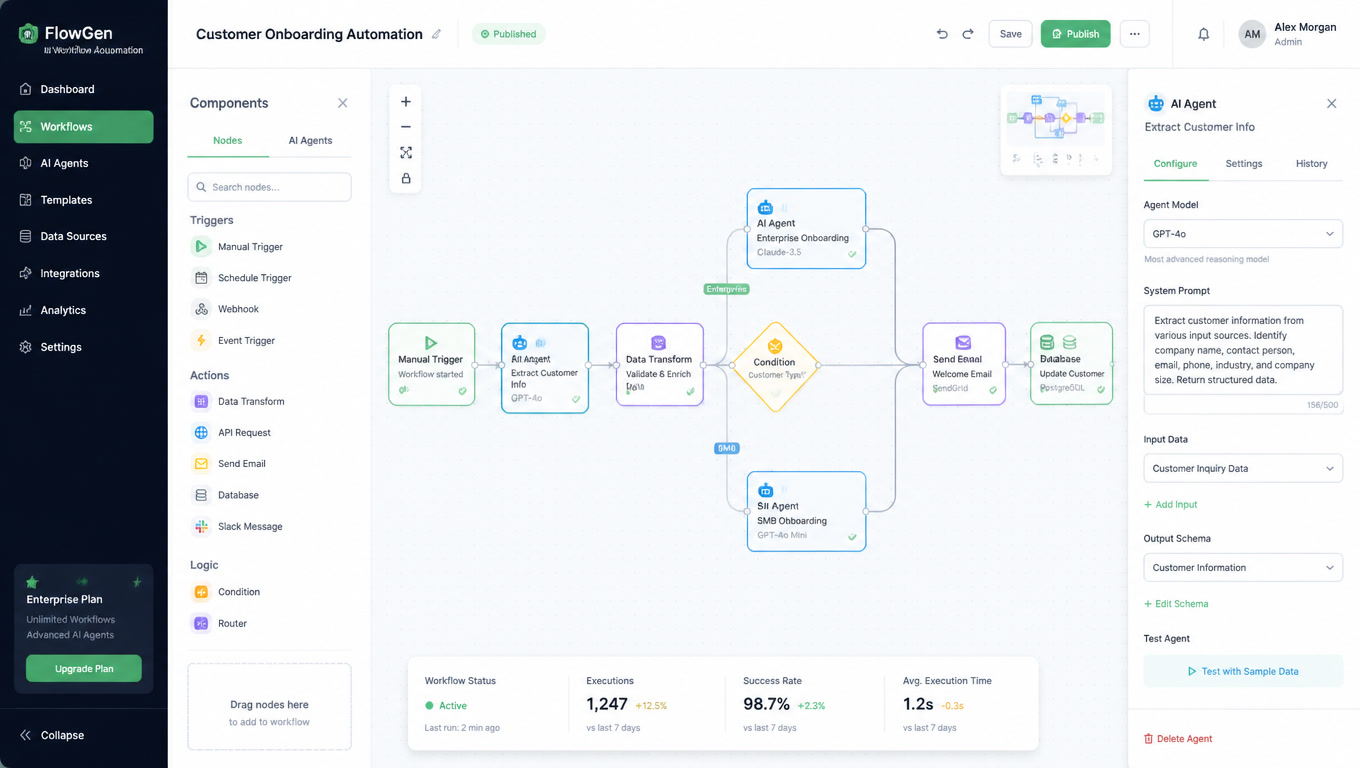
The real disruption: AI agents in workflows. The most important trend of 2026 is the integration of autonomous AI agents into automation pipelines. It is no longer just "if X happens, do Y" — workflows can now analyze data, make contextual decisions, and adapt their behavior based on previous results.
WeWeb describes how the fusion of AI and no-code is democratizing enterprise power, letting business users design and improve the processes they know best without depending on IT.
What you can actually automate (without code)
Let me be specific about what works and what does not.
Use cases that work great:
- Document processing. Extract data from invoices, contracts, or PDF forms using AI vision and send it straight to your CRM or ERP. Tools like Rossum or Nanonets integrated with Make/n8n do this in minutes.
- Multi-channel customer support. An AI bot that classifies tickets, extracts the issue, searches the knowledge base, and responds automatically — or escalates to a human if it cannot find a solution. According to Cflow, hyperautomation and agentic AI are redefining how enterprises handle approvals and operations.
- Content generation and distribution. Pipelines that research, write, design images, and publish across multiple platforms without manual intervention. Particularly useful for small marketing teams.
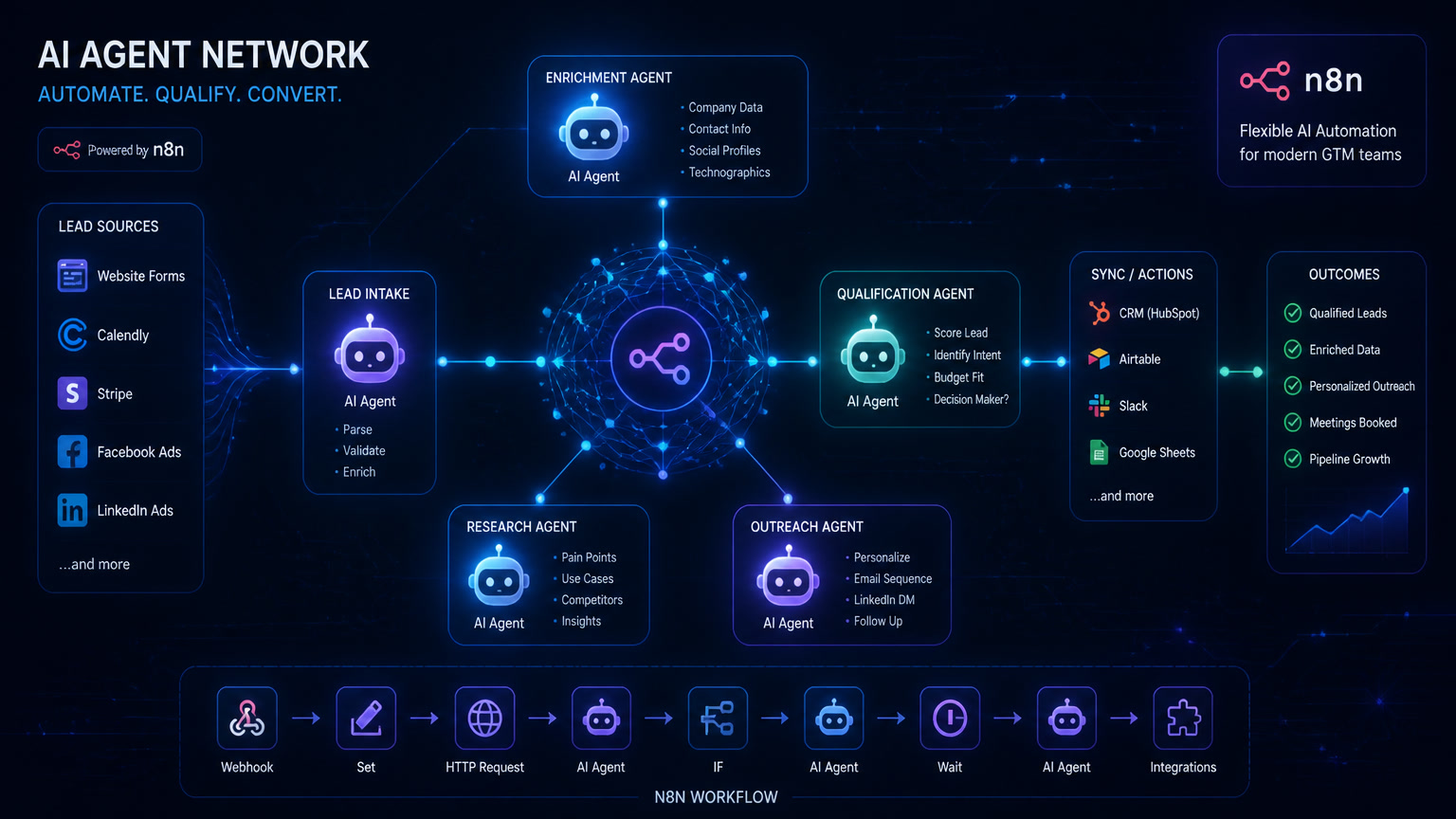
- Lead qualification and nurturing. Workflows that capture leads from multiple sources, enrich them with public data, score them against business criteria, and route them to the right salesperson — all without code.
What still does not work well:
- Processes with high legal or regulatory uncertainty. If an automated decision can get your company in trouble with regulators, you need human oversight. Full stop.
- Workflows requiring extremely sensitive data access. No-code platforms have improved security, but granular access control for classified information is still limited.
- Processes that change drastically every week. Automating an unstable flow is like building a road on quicksand.
The agentic automation layer
The biggest shift in 2026 that most people are still sleeping on is the rise of agentic automation. Traditional no-code automation follows deterministic rules: "if this happens, do that." Agentic automation works differently. AI agents within the workflow can observe, reason, and act based on changing conditions.
For example, a lead scoring workflow in 2024 might have said: "if email opened AND page visited > 3 times → assign score 85." In 2026, the same workflow looks more like: "analyze this lead's behavior across 12 touchpoints, compare against 500 historical conversion patterns, predict likelihood to convert within 30 days, and either send a personalized nurture sequence or route to sales — without a human deciding the rules upfront."
The Mean CEO blog makes a crucial point about agent readiness: a tool can be safely inserted into real workflows only when it has proper permissions, observability, approval rules, and reliable integrations. Agentic automation without guardrails is just automated chaos.
Tool selection guide for 2026
The tool landscape has matured significantly. Here is my honest assessment of the major platforms as of mid-2026:
n8n — Best for technical teams. Open source, self-hosted, granular control. Git sync for version control. The learning curve is steeper but the flexibility is unmatched. Ideal if you have at least one person comfortable with JSON and API concepts.
Make — Best mid-range option. Visual builder is intuitive. The Workday acquisition brought enterprise features. Better for teams that need complex logic without writing code. Pricing is credit-based which can get expensive at scale.
Zapier — Best for simple integrations. The AI steps (Zapier Central) are genuinely useful for classification and data extraction tasks. But pricing per task makes it expensive for high-volume workflows. Good for small teams, less ideal for enterprise scale.
Power Automate — Best if you are already deep in Microsoft 365. The RPA capabilities (desktop automation) are unique. The AI Builder integration is solid but limited compared to dedicated AI platforms.
UiPath — The enterprise RPA leader adding AI capabilities. Overkill for most small-to-medium businesses but essential for large organizations with legacy systems that need screen-scraping automation.
How companies are implementing this
Kissflow documents that enterprise adoption of no-code automation is accelerating in banking, manufacturing, retail, and healthcare. Not just startups — established companies are migrating entire processes to no-code platforms.
The pattern I see most often works like this: companies start with one small, painful process — something that requires crossing 3-4 different systems and takes hours of manual work every week. They automate it with a no-code tool, measure the time saved, and scale from there.
Concrete example: a logistics company that Mintec worked with automated their invoicing process. A team of 5 used to spend 3 days a month reconciling invoices against purchase orders. Now a single n8n workflow reads incoming invoices with AI-powered OCR, cross-references them against the purchasing system, and only sends discrepancies for human review. The team went from 5 people to 1, and errors dropped by 80%.
Is it worth it? The numbers
According to Index.dev, companies adopting no-code platforms report:
- 50-90% reduction in development time for internal processes
- 30-60% reduction in operational costs for automated processes
- Implementation time measured in days, not months
But there is a catch. Glean's analysis warns that no-code tools work well until process complexity, latency, or security requirements exceed platform limits. The smart approach: start with no-code tools and migrate only the unstable parts when necessary.
How to get started
If you are considering no-code automation for your business, here is my advice:
- Find your most tedious process. The one you dread doing every week. That is your candidate.
- Evaluate if it is predictable. If the process changes every month, automating it will create more work than it saves.
- Pick the right tool. For simple integrations, Zapier works. For complex processes with conditional logic, n8n or Make are better. If you are already on Microsoft 365, Power Automate is the natural choice.
- Measure before and after. Time spent, errors, cost — everything. If you cannot measure impact, you do not know if it worked.
- Iterate. The first version is never perfect. Automate 80% of the process, review, and adjust.
Related articles
- No-Code Meets AI: The Future of Business Automation
- AI Agents vs. Traditional Automation: What Actually Works for Business Processes
- AI-Powered Customer Support Automation: Chatbots, Agents, and Real Results
The bottom line
No-code AI automation is not the future — it is the present. The $65 billion market does not lie. Companies adopting these tools today are cutting costs, eliminating errors, and freeing talent for more valuable work.
The ones waiting for the technology to "mature" will wake up in 2027 wondering why their competitors moved so fast.
Want to explore how automation can transform your business? Check out our automation and chatbots service. You can also read about AI agents vs traditional automation and AI customer support automation for more context. And if you need a CRM that integrates with these workflows, our CRM implementation service can help.
The technology is ready. The only obstacle is you deciding to start.