
Why Operational Bottlenecks Are Your Real Problem (You Don't Need More Leads)
Most businesses think they need more leads. The data says otherwise: it's an operations problem. Responding in under 5 minutes multiplies conversions. A diagnostic framework for finding what to automate with AI before losing more leads.
Why Operational Bottlenecks Are Your Real Problem (You Don't Need More Leads)
Your business probably doesn't need more leads. It needs to stop losing the ones it already has.
We have this conversation every week with clients: "we need more leads, the competition is eating our lunch." And after we dig into their data, the diagnosis is almost always the same. It's not a volume problem. It's an operations problem.
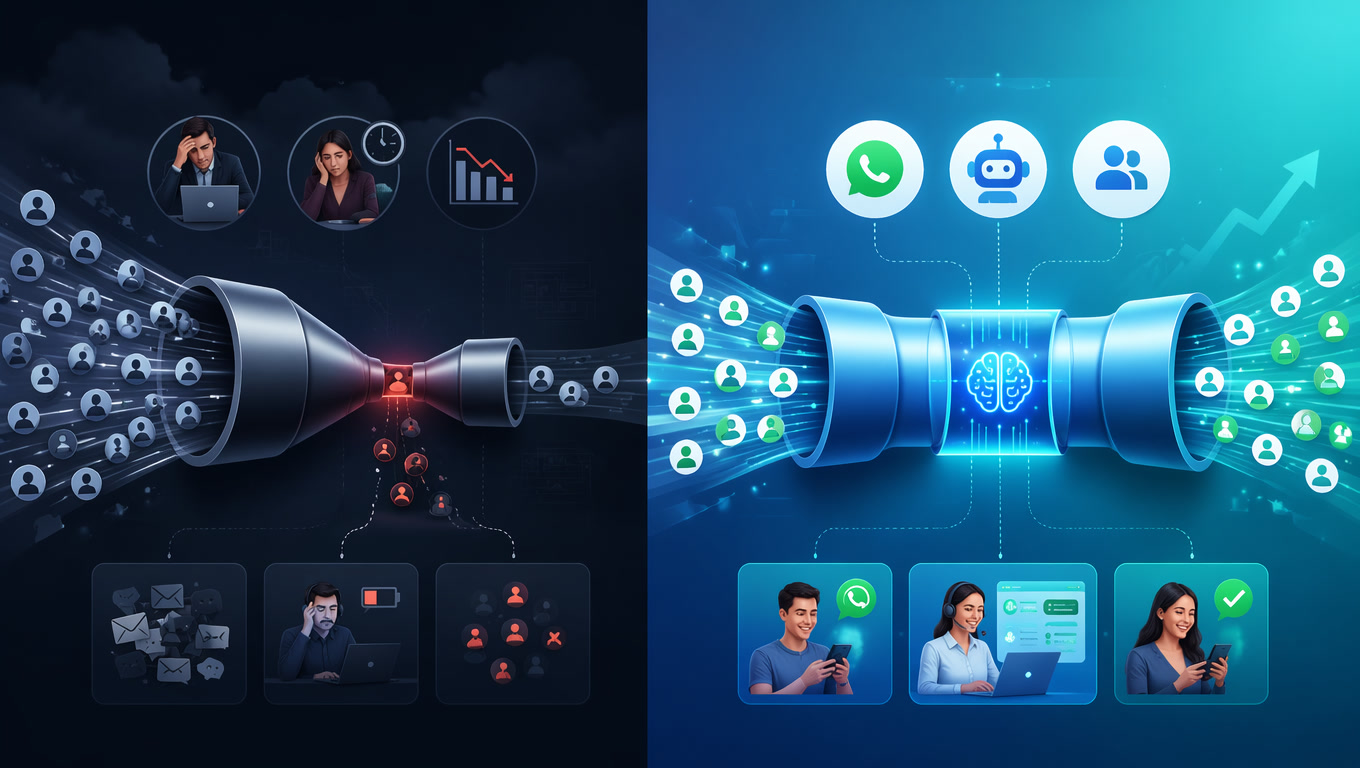
Leads come in, but nobody reaches out within 24 hours. Or they land in a CRM black hole because there's no clear assignment process. Or the sales team is manually copying data between three tools while leads go cold. It's not that leads are scarce. It's that the system to handle them simply doesn't exist.
This pattern is so common it has a name in the industry: operational leakage. And it's the main reason why well-executed automation produces results that look like magic — when really it's just plugging a hole that should never have been open in the first place.
The data that should change your strategy
The latest Artemis GTM 2026 Speed to Lead Benchmark tells a stark story:
| Response Time | Conversion Rate |
|---|---|
| Under 5 minutes | 21% |
| 5–30 minutes | 13% |
| 30–60 minutes | 8% |
| 1–24 hours | 5% |
| Over 24 hours | 2.3% |
The gap between responding in 5 minutes versus one hour isn't a 10% difference. It's 62% fewer conversions. That's not marginal — it's structural.
And this isn't an isolated study. HubSpot has documented that leads contacted within the first 5 minutes are up to 100 times more likely to convert than those contacted after 30 minutes. The impact isn't linear — it's exponential.
We've seen this pattern replicate across every industry we work with. One real case: a real estate client went from responding to leads in 4 hours (4% conversion) to 2 minutes (18% conversion) with an automated flow. They multiplied conversions by 4.5x without generating a single additional lead. That's not marketing. That's operations.
McKinsey confirms it: the problem isn't the technology
In June 2026, McKinsey published "Winning the race to rewire in 2026", analyzing why some companies scale automation successfully while others stay stuck in pilot programs that never deliver ROI. The conclusion: "Companies that have built advanced technology into their operational excellence achieve significantly higher productivity increases than those relying on manual or analog systems."
The key finding: when automation is deployed on end-to-end processes, ROI is consistent. When it's deployed in isolated patches, it almost never works.
Translation: don't buy an automation tool because "it sounds good." Buy one because you've identified exactly where the bottleneck is and how the tool resolves it.
The 5-question diagnostic framework for finding automation opportunities
Before you write a single line of code or configure a single n8n node, ask these five questions. We use them with every client before designing any workflow. They never fail.
1. Where's the gap between the lead that arrives and the action they receive?
Audit your pipeline: how many leads come in per month versus how many actually receive a call, email, or WhatsApp follow-up? If that ratio is below 60%, you have an operational problem in assignment or speed — not a lead quantity problem.
2. How much time passes between each step of your sales process?
Map it out: form submission → assignment → first contact → qualification → demo → proposal → close. If any step takes more than 24 hours without a deliberate reason (e.g., "the lead needs 3 days to evaluate"), it's an immediate automation candidate.
3. How many tools does a lead touch before reaching your sales team?
Trace the journey: Google Ads → landing page → form → auto-responder email → CRM → spreadsheet → salesperson's Slack. Every hop between tools is a leak point where data gets lost, duplicated, or corrupted. Three or more manual hops = red alert.
4. What manual tasks does your team repeat more than 5 times a day?
This is the simplest question and the one that stings most. Copying data between systems. Sending generic follow-up emails. Updating CRM statuses. Generating weekly reports by hand. If someone on your team does this daily, you're paying money for work a machine does better, faster, and without errors.
5. What would happen if your team's operational capacity doubled today?
If twice as many leads showed up tomorrow, would your current process scale or collapse? If it would collapse, you need structural automation. If it would scale fine, focus on volume. Most businesses we've diagnosed answer: "it would collapse within a week."
Three bottleneck patterns we see every time
Applying this framework, three patterns recur across industries and company sizes:
| Pattern | Symptom | Solution | Suggested Stack | Estimated Cost |
|---|---|---|---|---|
| Speed | You respond to leads in hours or days | Real-time auto-assignment with AI qualification | n8n + OpenAI + WhatsApp Business API | $50-100/month |
| Data quality | CRM has duplicate leads, incomplete records, no enrichment | Automated cleaning, dedup, and enrichment on entry | Clientify + Make + enrichment sources | $30-80/month |
| Follow-through | Leads get one touchpoint and disappear | Automated multi-channel nurture sequence with behavioral triggers | Make + email automation + CRM with scoring | $50-150/month |
The most common — and the most economically damaging — is speed. A business can generate high-quality leads, but if nobody contacts them within the critical 5-minute window, all that generation effort is wasted.
Real case: what we built for a consulting firm in Mexico
A 15-person IT consulting firm was generating ~80 qualified leads per month from their website and LinkedIn. They had a team of 3 sales reps. The problem: leads landed in a shared CRM, and each rep checked the inbox "when they had time between calls." Average response time: 6 hours. Conversion rate: 6%.
We implemented three n8n workflows connected to their CRM (Clientify) and the WhatsApp Business API:
Flow 1 — Detection and qualification: When a new lead arrived, an OpenAI call analyzed the full profile (industry, role, company size, source) and assigned a priority: high, medium, or low. High-priority leads got immediate attention.
Flow 2 — Smart assignment: The lead was automatically assigned to the rep with the lowest current workload and best historical conversion rate for similar profiles. No more "first come, first served" roulette.
Flow 3 — Immediate WhatsApp outreach: A personalized message fired from the CRM to the lead's WhatsApp with relevant information based on their profile. If the lead replied within 2 hours, the system notified the rep to pick up the conversation hot.
Results after 90 days:
- Response time: from 6 hours to 90 seconds on average
- Conversion rate: from 6% to 19%
- Estimated incremental revenue: +$45,000 USD annually
- Team hours recovered: ~20 hours/week previously spent manually sorting leads
The most important number: they didn't generate a single additional lead. All the growth came from not losing the leads they already had.
Diagnose before you automate
The most expensive mistake companies make isn't picking the wrong tool. It's buying a tool without knowing exactly what problem they're solving. If you automate the wrong process, you end up with qualified leads arriving faster into a pipeline that loses them anyway.
In our article on why 90% of automation projects fail, we break down these failure patterns in detail. The common denominator isn't technical — it's strategic. Companies that fail buy the tool first and look for the problem after.
The right order is always: diagnose → design → automate. In that order. Never backwards.
For deeper dives on the tools, we have practical guides on workflow automation with n8n and Make, CRM integration with AI, and how to calculate the real ROI of your automation. We also wrote about the hidden cost of keeping automation tools disconnected, which is another pattern we see constantly in businesses that tried to automate but did it in patches.
Before exploring any of those options, run the five-question diagnostic. It takes 30 minutes, costs nothing, and will save you months of implementations that don't solve the real problem.
Most businesses don't need more leads. They need a system that doesn't lose them.
Frequently Asked Questions
How do I know if my business has an operations problem or a lead generation problem?
If you're generating leads but they aren't converting, the problem is almost always operational: you aren't contacting them fast enough, follow-up is inconsistent, or data is fragmented across tools. Measure your speed to lead: if you respond after 5 minutes, you're losing 50-80% of potential conversion based on 2026 benchmarks.
What does it cost to implement automation for operational bottlenecks?
A simple lead assignment flow in n8n or Make costs $20-50/month in tools and takes days to implement. A multi-channel automation with AI, CRM, and WhatsApp can cost $150-300/month and take 2-4 weeks. Typical ROI recovers the investment in 3-6 months through retained team hours and leads not lost.
Which operational processes should I automate first?
The ones with the highest revenue impact and lowest risk: lead assignment, post-demo follow-up, inbound lead qualification, and drop-off alerts. Automate what you're already doing manually but poorly, not what you aren't doing yet.