
Clinic Automation: How to Cut No-Shows Without Spamming Patients
The evidence says one reminder placed close to the appointment beats a three-message cadence. A 5-stage pipeline, the real cost of every no-show, and the consent health data actually requires.
Automating clinic appointments is not about sending more reminders: it is about confirming the booking when it is made, sending a single reminder close to the time, and recovering the slot the moment the patient doesn't show. The counterintuitive evidence — a trial covering 475,214 appointments, detailed below — says the closeness of the message matters more than the three-message cadence most tools sell. The problem is not software: across Latin America, clinics lose between 15% and 30% of their appointments to no-shows, and most of that money disappears in layers nobody counts.
A no-show costs more than what shows up in the cash register
2026 benchmarks put outpatient no-shows between 20% and 30%, at roughly USD 200 per missed visit, with an aggregate USD 150 billion a year in the US alone. In the region the published range runs 15% to 30%, and the Buenos Aires trial recorded a 34.6% baseline risk in public primary care.
The calculation almost every practice manager runs is missed appointments × average fee: at 50 appointments a day and a 20% no-show rate, that is 10 lost consultations a day and about USD 5,500 a month. It is striking, and incomplete. We read it in four layers:
| Layer | What you lose | How to measure it |
|---|---|---|
| 1. Direct revenue | The consultation you never billed | Missed appointments × average fee |
| 2. Clinician time | Slots never refilled the same day | 12–18 min of manual handling per no-show |
| 3. Rescue administration | Reception chasing patients instead of serving them | Front-desk minutes × hourly cost |
| 4. Patient attrition | The one who misses once disengages from treatment | The remaining visits in the cycle |
Layer 4 is the one everyone ignores: a patient who no-shows once is roughly three times more likely to drop out of their care plan. In 12-visit treatment plans, an absence that ends in dropout is not worth one consultation — it is worth the whole cycle.
Opinion: if your no-show dashboard shows a single number, you are managing layer 1 and silently funding the other three. The first thing we automate at every clinic is not the reminder: it is measuring the four layers for two weeks.
What the evidence says about when to send the reminder
Standard advice and the academic literature disagree. Vendors recommend an active cadence — message at 48 hours, a second message if there is no reply, a call if there is still no reply — and report 15% to 25% reductions. The research says something else:
- Systematic review (PAMJ One Health, Opon et al.): a positive effect in 95% of studies, with 41% fewer missed appointments and 34% higher attendance.
- Buenos Aires trial (Esteban et al., medRxiv, August 2026): 475,214 appointments against a control. All three active strategies reduced no-shows, but the dual ones increased patient-initiated cancellations. The authors' conclusion: timing is the lever, and a single proximal reminder is the default strategy for resource-constrained outpatient settings.
Our reading of that contradiction: a double reminder does not reduce no-shows, it converts them into cancellations. That is only bad if your clinic cannot release and refill the slot. With an automatic waitlist, more cancellations are exactly what you want — the patient warns you in time and the chair never sits empty. Without that second half, sending three messages is spamming patients to arrive at the same lost revenue.
| Clinic profile | Cadence we recommend | Why |
|---|---|---|
| High volume, constrained resources (public, dense schedule) | One proximal reminder (2–4 h before) with one-tap confirm / reschedule | The scenario that won in Buenos Aires: fewer messages, fewer late cancellations |
| Private specialty, long schedule (2–4 weeks out) | Confirmation at booking + proximal reminder | Long gaps drive forgetfulness (35–40% of no-shows); confirming early releases slots early |
| High-value procedures (surgery, aesthetics) | Explicit confirmation + active waitlist + a call only if unconfirmed | The cost of an empty slot exceeds the cost of one reception call |
Three messages in a row is not a strategy: it is the same one repeated. The strategy is where you place the message and what you do with the answer.
The five-stage pipeline that should run on its own
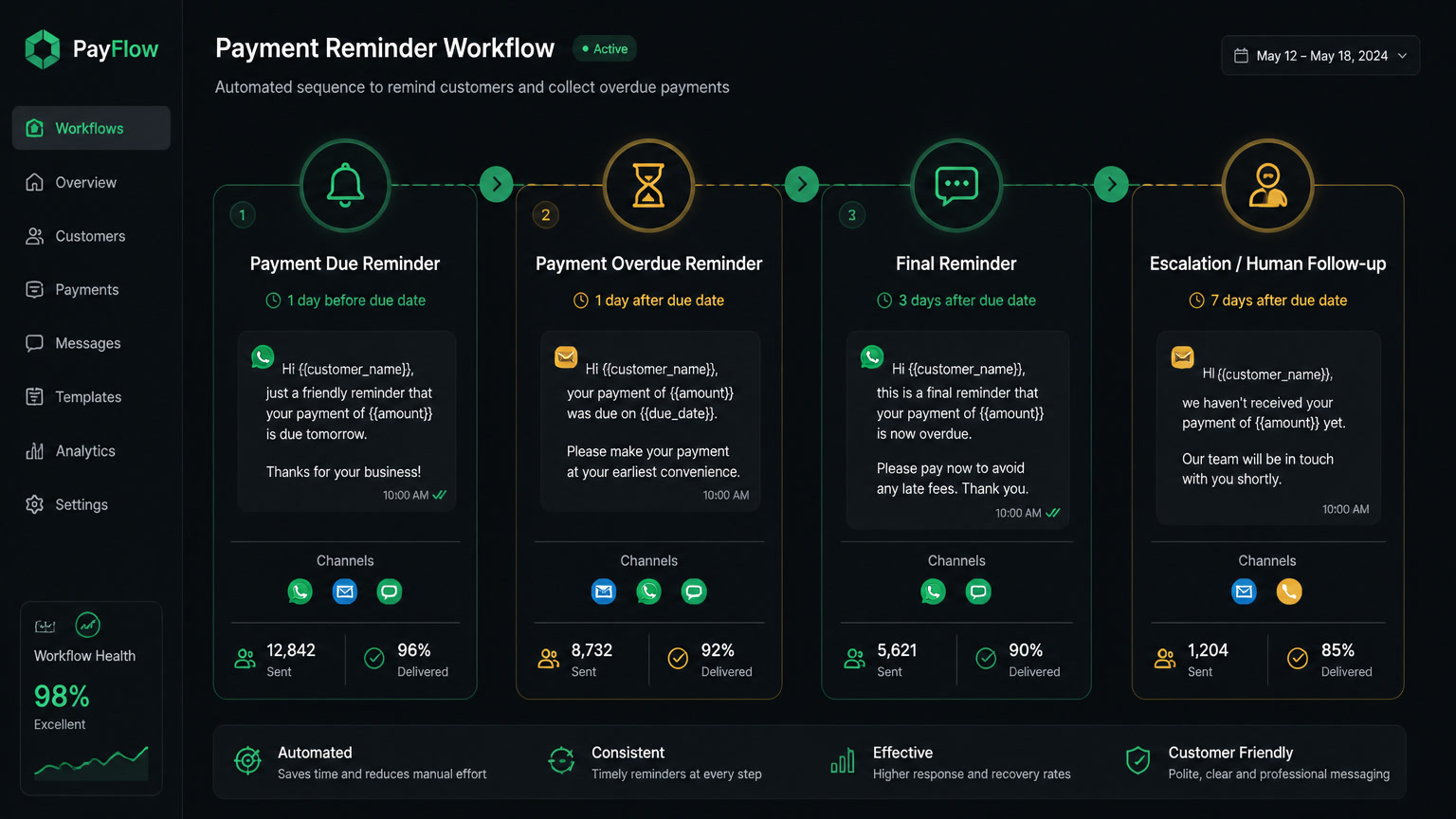
Clinics that solve this do not have "a reminder": they have a loop where every stage has a trigger, an action and a metric. This is what we build with n8n, the WhatsApp Business API and the client's CRM:
| # | Stage | Trigger | Automated action | Metric |
|---|---|---|---|---|
| 1 | Capture and scheduling | Patient messages or calls | The agent proposes open slots and writes the booking; after hours, it captures the intent | Appointments booked without human effort |
| 2 | Explicit confirmation | Appointment created | Welcome message with the privacy notice and a one-tap confirmation | % confirmed at booking |
| 3 | Proximal reminder | 2–4 h before | One message: confirm / reschedule / cancel | No-shows ÷ confirmed appointments |
| 4 | Slot rescue | Cancellation or detected absence | The slot is offered to the waitlist; if nobody answers, it opens to the schedule | Slots recovered ÷ slots released |
| 5 | Return | 30–90 days of inactive | Reactivation on the channel where the patient replies | Reactivated ÷ inactive base |
If stage 4 does not exist, stages 2 and 3 are overworking your patients for a benefit that never reaches your bank account. The half of the system that matters is not the message, it is the rescue.
Stage 1 has a voice layer too: in our AI voice agents data, more than a quarter of inbound calls arrive after hours and a meaningful share of them carry buying intent. A clinic that misses an 8 p.m. call did not lose a call — it lost an appointment.
Which tool fits which size of clinic
| Situation | Tool | Typical cost | The ceiling |
|---|---|---|---|
| 1–2 people, simple schedule | WhatsApp Business App + manual reminders | $0 | No integrations, no metrics; knowledge lives on reception's phone |
| Own records, mid volume | Vertical scheduling software | Per provider / per site | Strong on calendar and chart; weak on marketing and patient recovery |
| High volume, multi-specialty, real slot rescue | WhatsApp Business API + CRM + orchestration (Clientify + n8n + AI) | ~USD 60–200/month | Needs a process owner and data discipline |
The question is not which tool is best, it is at what point the tool stops following your process. If your vertical software cannot offer a released slot to another patient automatically, you are buying scheduling and selling no-shows. And if you are starting, buy in the opposite order to everyone else: first the confirmation-and-rescue loop with what you have, then the platform.
Health data is not handled like everything else
A patient's phone number is personal data; their diagnosis and clinical history are sensitive data, and that changes the rules in the three countries where we work most:
- Mexico (LFPDPPP): explicit, recorded consent — "Do you accept that we use your health information to book your appointment?", saving the answer — plus an accessible privacy notice and an ARCO response within 20 business days.
- Brazil (LGPD, Art. 11): health data is processed only on a specific legal basis; for non-contractual purposes, specific and highlighted consent. Email consent does not cover WhatsApp: each channel keeps its own record with timestamp, IP and exact wording.
- Colombia (Ley 1581): express authorization for sensitive data; the number given to book an appointment is not authorization for promotions.
Three practical rules: minimization (do not ask for a national ID to book), purpose separation (the reminder is a service message, the cleaning campaign is marketing, and the consent is not the same) and traceability (every proactive send is logged against its legal basis). We develop the country-by-country detail in our guide to WhatsApp compliance in the region, and the ARCO rights flow is built as a workflow.
Calendar note: since October 1, WhatsApp service messages are billed from message 1,001 per phone number per month. On a mid-volume clinic that is barely noticeable — but better before the invoice than after. Numbers in what a WhatsApp reply costs after October 1.
Three mistakes in clinics that already bought automation
- Buying the platform before fixing the confirmation loop. Moving the schedule into new software without confirmation and rescue just relocates the problem to another interface.
- Measuring reminders sent instead of slots recovered. "We sent 1,200 reminders" is a delivery metric; the business one is how many became attendance and how many empty slots were refilled.
- Treating the reminder as marketing. Same channel, same list, no purpose separation — that is how a clinic ends up reported as spam and its consent invalid the moment an authority asks.
Our clinic work is consistent: the jump from 18% to 6% no-shows came from automatic WhatsApp reminders with one-tap rescheduling, not from a more expensive platform. And at a dental clinic in Mexico City, putting the knowledge base in order — not the model — was what lifted automated resolution from 28% to 44% in a week.
Where to start: two weeks measuring the four cost layers, then confirmation plus proximal reminder, then the automatic waitlist, and only then any platform purchase. The full scheduling and reminder design is in AI agents for appointment scheduling; if you would rather we review it against your real operation, that is how we run our automation and chatbot flows for healthcare.
Frequently Asked Questions
How much do automated reminders reduce no-shows in a clinic?
A systematic review of 20 studies (PAMJ One Health) found a positive effect in 95% of cases, with an average 41% reduction in missed appointments and 34% higher attendance. In our own clinic implementations the jump goes from 18% no-shows to 6% once the reminder fires on its own over WhatsApp with a one-tap confirm-or-reschedule option.
How many appointment reminders should I send: one or several?
It depends on whether you can release the slot. A target-trial emulation covering 475,214 appointments in the Buenos Aires public system (August 2026) found that proximity matters more than frequency: a single reminder close to the appointment is the default winner, and dual reminders increased patient-initiated cancellations. With no automatic waitlist, more messages don't save you — they turn no-shows into cancellations you still don't recover.
What patient data can I store in a CRM?
Only what the purpose requires. In Mexico, health data is sensitive and needs explicit, recorded consent; in Brazil, LGPD Article 11 requires a specific legal basis and highlighted consent; in Colombia, Ley 1581 requires express authorization. Do not ask for a national ID to book an appointment, log the exact wording of consent, and keep appointment consent separate from promotional consent.