
From Overdue Invoice to Recovered Payment: The Automated Collections Engine
Most late payments are forgetfulness, not cash-flow problems (Deloitte 2025). How to build the collections engine with WhatsApp, CRM and n8n: 4 aging buckets, smart escalation and real costs.
Most late payments are not a customer liquidity problem — they are your follow-up problem. Deloitte estimates that 68% of invoices paid late are delayed by forgetfulness, not by lack of money. And Chaser's 2026 Accounts Receivable Report shows most companies still chase payments by hand: only 15% use WhatsApp for payment reminders (vs 23% using SMS), and a huge share have no defined process at all. That gap is the opportunity. Here is how we build what we call the collections engine at Mintec — an automated aging-bucket sequence that, for a distributor issuing over a thousand invoices a month, recovered a third of overdue accounts without anyone picking up the phone.
Your problem is not the deadbeat, it's the process
Fifteen years of running agency operations and automation projects for clinics, distributors, agencies and professional firms has shown us the same pattern: collections happen "when there's time," reminders go out late or not at all, and every overdue invoice depends on somebody's memory. The cost is not just the cash that doesn't land. It's the receptionist burning two hours a day on calls, the salesperson who stops selling to chase payments, and the owner who discovers the overdue book at month-end close.
The data says this is a process problem, not a portfolio problem. Deloitte found that automated collections sequences cut DSO by 22 days on average and recover 35% of overdue invoices before a human intervenes. Chaser's 2026 report adds the stat I like most: businesses combining channels (SMS + email) get paid within two weeks 73% of the time, versus 49% for email-only. So it's not about sending more messages — it's about sending the right message, on the right channel, at the right frequency.
In LatAm, the right channel is almost always WhatsApp. More than 80% of SMBs already talk to customers there, and our experience building finance automation for SMBs is that the reminder arrives and gets read — it doesn't drown in promotions or spam. What almost nobody documents is the design of that engine: which aging bucket deserves which message, how often you can push without torching the relationship, and how you know when a case must leave the automated flow.
The four aging buckets: the heart of the engine
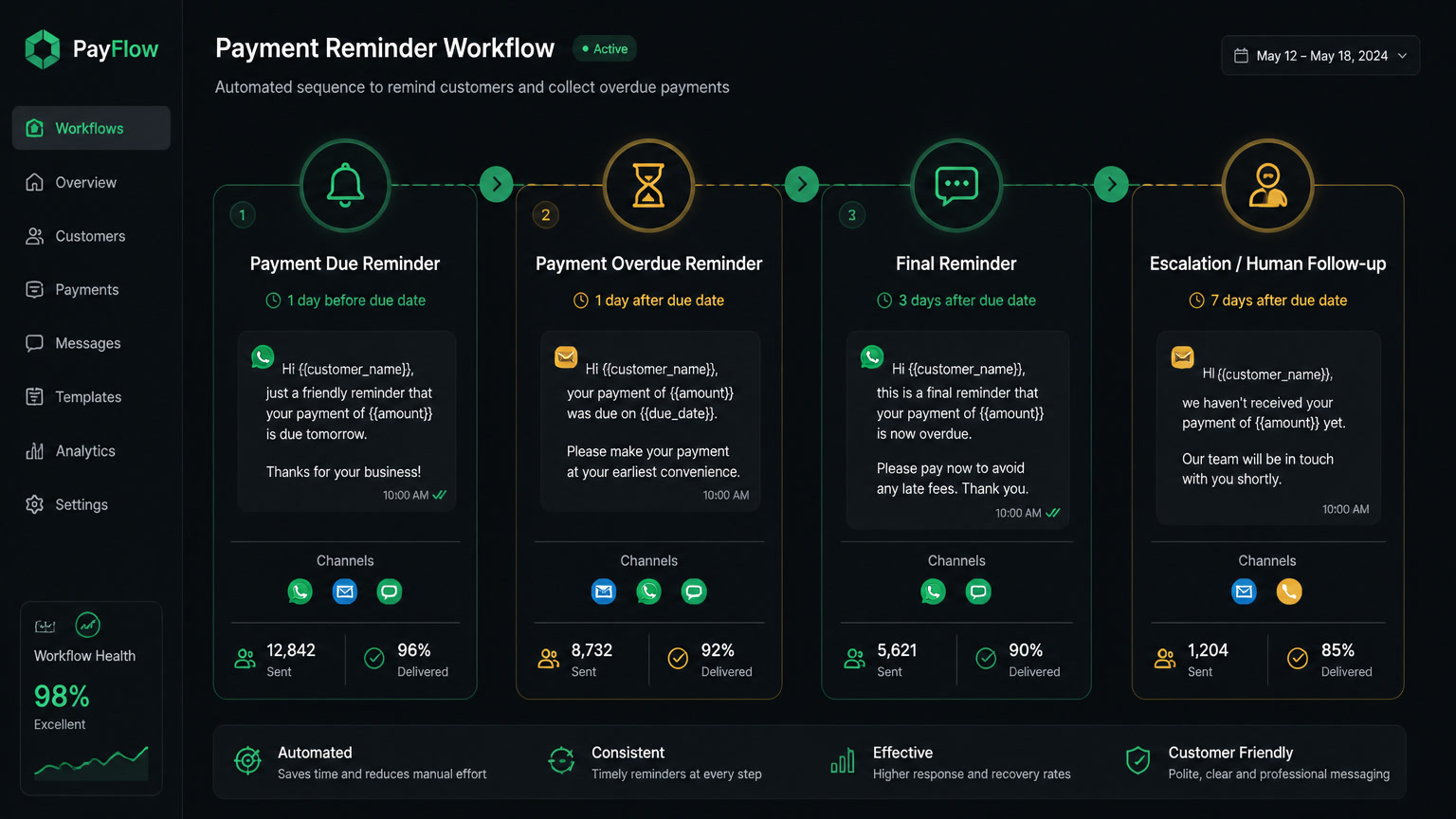
A generic "remind at day 7, escalate at day 14" sequence is not an engine, it's a reminder with ambitions. An engine classifies every invoice into an aging bucket, and each bucket has its own channel, tone, frequency cap and escalation rule. It's the same principle used in LatAm credit-and-collections practice (Optimatiza, 2026): every invoice enters a bucket by age and amount with a defined channel and objective, and only pre-approved contacts are reached, under a strict frequency cap.
| Bucket | Channel | Tone & message | Max frequency | Escalation |
|---|---|---|---|---|
| 0-7 days (courtesy) | WhatsApp (utility) | Friendly reminder with invoice + payment link | 1 message | None: system lapse, not customer failure |
| 8-15 days (nudge) | WhatsApp + email | Neutral tone, total amount + original due date | 1 WhatsApp + 1 email per week | "Already paid" replies go to automatic verification |
| 16-30 days (managed) | WhatsApp + email + scheduled call | Firm but professional; offer a 2-installment plan | 2 touches per week | Every reply or promise is logged with date and amount |
| 30+ days (recovery) | Human call + WhatsApp | Direct conversation: situation, plan or renegotiation | Human judgment | Escalates with full file: history, broken promises, balance |
The job of the first two buckets is frictionless payment: a one-click payment link, the invoice in front of them, zero shame. The most common mistake we make when implementing is jumping straight to the hard tone because the owner is angry. It doesn't work. Deloitte's 68% forgetfulness number is solved with courtesy and a link, not with threats.
The architecture: three workflows that talk to each other
The engine runs on the modular stack we use everywhere: Clientify as the CRM, n8n as the orchestrator, the WhatsApp Business API as the channel, and the accounting system as the source of truth. Three workflows:
Workflow 1 — Invoice sync. Every night, n8n reads issued invoices and applied payments from the accounting system (Alegra, QuickBooks, or even a well-kept Google Sheet), updates balances in Clientify and assigns the aging bucket. Without this flow, the engine works on lying data: you chase paid invoices, and that is the fastest way to kill trust in automation.
Workflow 2 — Bucket sequence. For every overdue invoice, n8n fires the template for its bucket — a Meta-approved utility template with the payment link (Mercado Pago, Stripe, OXXO or SPEI depending on the market) — and schedules the next touch within the frequency cap. When the gateway's webhook reports payment, the flow marks the invoice paid, removes it from the engine and sends the customer a confirmation. The loop closes by itself.
Workflow 3 — Smart escalation. This is what separates a reminder from a collections system. When the customer replies, an AI classifier decides: "already paid" goes to automatic reconciliation, "I'm in a tough spot" opens a collector file with full history, "I don't recognize this charge" is treated as a dispute and escalates with the file. Here we apply the same discipline as our CRM exception lanes: if a reply doesn't fit the happy path, it doesn't die in silence — it goes to a lane with an owner.
What breaks automated collections (in production, not in the demo)
The demo always works. Production taught us more:
| Failure | Symptom | Fix |
|---|---|---|
| Template rejected by Meta | Reminder never sends, or sends as marketing (pricier, less opened) | Use the utility category for payments and reminders; approve variants before month-end |
| No global frequency cap | Customer gets 4 messages for 2 different invoices the same day | Cap per customer, not per invoice: 1 touch every 72h |
| Misunderstood 24-hour window | Reminder misses customers who already chatted that day | Session design matters: within an open session, the reminder rides as free-form messaging |
| Unverified promises | "I'll pay Friday" gets logged, nobody checks | A promise is a task with date and amount; if unmet, the invoice bumps up automatically |
| Zero monitoring | A gateway changes its webhook and the engine chases paid invoices | Daily execution digest: the Day-2 discipline applies to collections too |
The case that taught us most was a clinic: their sequence ran perfectly for two weeks, then started reminding patients who had already paid at the front desk, because the sync against their billing system broke silently. Nobody noticed until an annoyed patient replied. Since then, the rule is: the sync workflow has its own alert and a human who receives the daily digest. A collections flow you can't audit is a reputational risk machine.
When to automate and when to call
Automation doesn't replace the collector — it leaves them the work only they can do. Our rule:
- Low amount + early bucket (0-15 days): 100% automated. The cost of a call exceeds the value of the recovery.
- Mid amount + 16-30 days: automated + one scheduled call. The call triggers the promise; the flow captures the commitment.
- High value or strategic account + any delay: AI classifies, a human decides the message from day one. Judgment beats frequency here.
- Dispute, complaint or distress: zero automation. Escalate with the full file — same principle as our framework on which finance tasks to delegate to AI, where exceptions always leave the flow.
What it costs and what you recover
| Component | Monthly cost |
|---|---|
| n8n self-hosted (VPS) | $6-20 |
| Clientify (up to 5,000 contacts) | $0-99 |
| WhatsApp Business API (utility conversations) | $5-40 depending on volume |
| Payment gateway (per-transaction fee) | 2-4% |
| AI classification (OpenAI API, moderate use) | $5-20 |
| Total | $50-200 depending on volume |
The math is simple. A business billing $50,000 per month that cuts its collection cycle from 34 to 18 days frees roughly $26,000 of working capital. In our experience with distributors, ROI shows up in the first billing cycle: the automatic sequence pays for itself with the first aging book. In a recent engagement, the admin went from spending two hours a day calling debtors to reviewing a 10-minute report, and DSO dropped from 41 to 26 days in three months.
If you want to start, the path is the same as always — CRM-driven automation for your operations — but this time with the accountant as a partner, not a spectator. Define the buckets, connect billing to the CRM, and let the engine do the boring work. Keep the conversations that actually need judgment for yourself.
Frequently Asked Questions
What is automated collections (dunning) software?
It is a workflow that manages every overdue invoice by aging bucket: it sends payment reminders via WhatsApp and email with a payment link, logs payment promises, detects disputes, and only escalates to a human the cases that need judgment. It runs on your CRM, the WhatsApp Business API and a no-code tool like n8n or Make, for $50-200 USD per month.
How much can automated dunning reduce DSO?
According to Deloitte (2025), companies running automated collections sequences reduce average days sales outstanding by 22 days and recover 35% of overdue invoices before a human ever intervenes. The effect comes from attacking the root cause: 68% of late payments are caused by forgetfulness, not lack of liquidity.
Does automated WhatsApp collection damage the customer relationship?
Only if you use it like a cannon. A well-designed engine respects frequency caps per aging bucket, changes tone as days pass, always includes a one-click payment link, and routes disputes to a person with full context. Collecting without friction usually improves the relationship: the customer resolves in 30 seconds instead of dodging phone calls.