
What Does a WhatsApp Reply Cost After October 1? Your First Invoice, With the 1,000 Free Messages per Number
Since October 1, WhatsApp charges for every service reply past 1,000 free messages per number each month. What your first bill actually looks like — and what to fix.
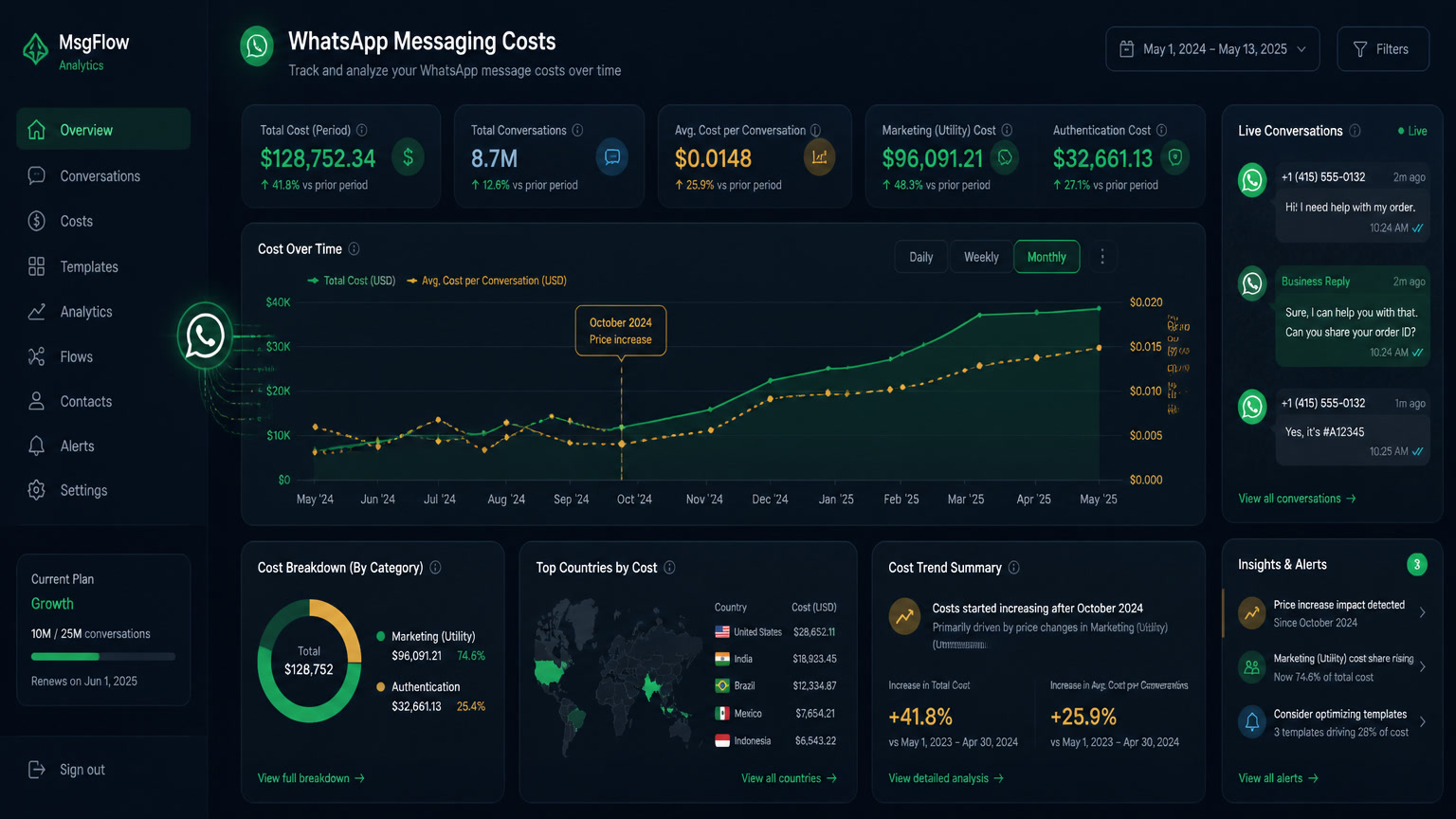
Since October 1, 2026, every free-form reply your business sends on WhatsApp beyond the first 1,000 service messages per business phone number each month is charged at that market's utility rate: between $0.0008 and $0.026 per delivered message, with no volume discounts. Utility templates sent inside the 24-hour window are billed from the very first message, with no free tier. If your operation answers fewer than 1,000 messages per number per month, your Meta invoice will be $0 — this change hits mid-size operations and chatty multi-turn bots, not the corner clinic.
The billing we flagged in early September went live yesterday. Two things we said in that analysis need correcting now, because between the announcement and the effective date Meta published the full rulebook: there is a 1,000-message free allowance per number, and the asymmetry between service messages and in-window utility templates flipped. Here is the real math for your first invoice, based on Meta's pricing documentation updated September 28.
What Meta charges as of October 1 (and what stays free)
Most guides still say "service replies: free." Not anymore. This is the table that matters:
| Message type | From October 1, 2026 | Impact |
|---|---|---|
| Free-form reply inside the 24-hour window (human or third-party AI) | First 1,000 per number/month free; from the 1,001st, the market's utility rate | New charge |
| Utility template inside the window | Billed per message from the first send, no free tier | New charge |
| Marketing / authentication templates | Unchanged (already billed) | — |
| Meta Business Agent | Per token ($2 per 1M) since August 1; never also billed as a service message | Aug 2026 |
| User messages and undelivered messages | Free | — |
| 72-hour window from a Click-to-WhatsApp ad or Facebook/Instagram CTA | Free, except Meta Business Agent replies | Leverage |
Two details almost no summary mentions. First, charges apply to delivered messages, not sent ones, and the rate follows the country of the customer's phone, not yours. Second, each message is billed under exactly one model — third-party AI replies are service messages; Meta Business Agent replies are token-based; never both.
The correction we owe our own analysis
Our September 2 post projected that "businesses with 300-1,000 monthly conversations add $20-90/month of new cost" and stated that service messages have no volume tiers. Meta's final clarification cuts both claims short in the same direction: for a large share of small SMBs, the new cost is $0, not $20-90.
| Lever recommended on September 2 | What October 1 reality looks like | Adjustment |
|---|---|---|
| Compress conversations (fewer turns) | Still lever #1: every extra turn is a billed message | No change |
| Reclassify toward utility templates | Applies only out of window: inside the window, utility has no free allowance while service replies do | Keep templates for proactive sends |
| Use the 72-hour Click-to-WhatsApp window | Fully intact (except Meta Business Agent) | Double down on it |
| Meta Business Agent as first-turn layer | One MBA turn costs $0.04-0.05 (~20,000-25,000 tokens): 5 service replies in Mexico, 6 in Brazil, 50 in Colombia | Use it for complexity, not savings |
The flipped second lever is the expensive error. If you redesigned your flows in September by migrating confirmations to utility templates "because they have volume tiers," check which of those templates go out inside a window the customer opened: those now cost from the first send, while a service reply with the same content would count against the 1,000-message allowance. Template volume tiers still exist for proactive sends — order statuses, reminders, notifications outside any window — and that is where they belong.
The three rules that decide your bill
The allowance is per number, not per account. Each business phone number on your WABA gets its own 1,000 free messages a month: they don't pool across numbers, don't roll over, and don't exist without a payment method registered in Billing Hub. Two numbers with 800 replies each pay $0; one number with 2,500 replies pays for 1,500 of them. That creates a portfolio decision most teams aren't taking seriously: consolidating numbers earns better template volume tiers, while spreading volume across numbers keeps you under the free cap. Near the threshold, your number geometry is worth money.
The price is the customer's country rate. On the USD card effective October 1: Brazil $0.0068, United States $0.0034, and across Latin America the rates circulating since Meta's September 1 publication — Mexico ~$0.0085, Argentina ~$0.026, Chile ~$0.02, Colombia ~$0.0008 — confirming Colombia as the region's cheapest market by a factor of ten. Verify them against Meta's official rate card before budgeting; they typically change with 30 days' notice.
No payment method means no 1,001st message. It isn't a fine: Meta stops delivering your service messages as soon as the allowance is exceeded. Since September 8 they accept Visa and Mastercard in addition to credit lines, so there's no excuse for hitting mid-October with a silent channel.
Who pays $0 and who pays real money
| Operation profile | Service replies/month | Estimated Meta cost | Priority |
|---|---|---|---|
| Local shop or clinic with a basic bot, 1 number | < 1,000 | $0 | Just confirm the payment method |
| Operation with 2 numbers near the threshold | 800-1,000 each | $0 - ~$17 (MX) | Watch the 1,001st of each number |
| Mid-size SMB in Mexico | 10,000 | ~$77 (after the allowance) | Compress turns + move templates out of window |
| Same volume in Argentina | 10,000 | ~$234 | Urgent compression + ad-driven capture |
| Multi-turn bot with no redesign | 30,000 | ~$247 (MX) - ~$754 (AR) | Flow redesign this week |
The strategic read: this billing punishes bots that talk too much, not small businesses. A bot that answers in four messages when two would do doubles its bill and nobody notices until the charge lands. It's the same pattern we saw with disconnected automation: the hidden cost isn't in the rate, it's in the design.
How to read your first invoice
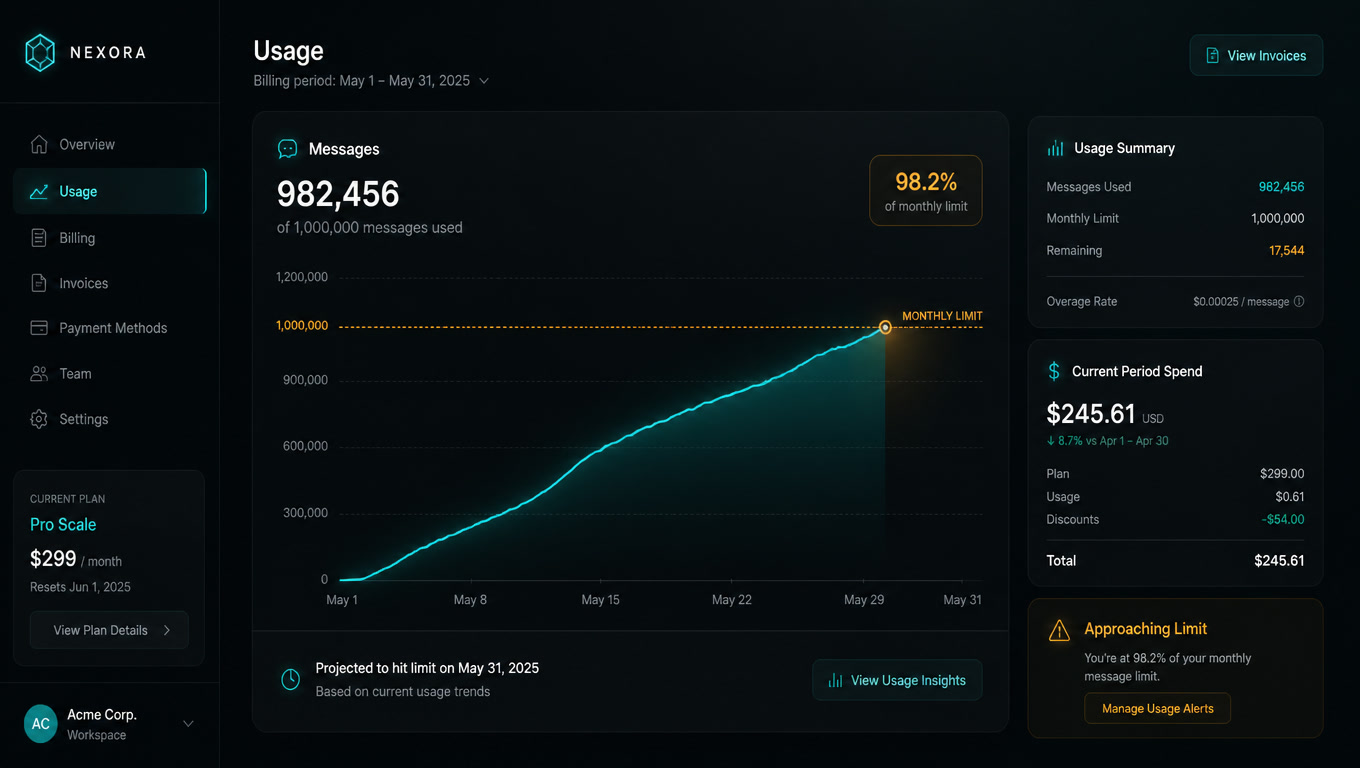
- Open Billing Hub and confirm an active payment method for every messaging account in production. Without one, the cutoff is automatic.
- Pull the per-category breakdown via the Pricing Analytics API: query
PRICING_CATEGORY = SERVICEfor a date range and compare it against your transcripts. That's the only way to see how many messages landed above the allowance and how many below. - Count messages per conversation, not conversations. The billing impact is measured in turns: 10,000 three-turn conversations are 30,000 billable messages, not 10,000.
- Mark the windows. Anything arriving through Click-to-WhatsApp within 72 hours is still free; if you're paying for messages inside that window, a classification is misconfigured.
What we're doing in the accounts we operate
We're continuing the 7-day audit we described in September — export a month of transcripts, count turns per conversation, reclassify by billing category — with two changed criteria. First: we no longer migrate to utility templates anything answered inside a window; those migrations now generate invoices from the first send. Second: we treat the 1,000 allowance as a budget, not a gift: each number gets a monthly ceiling and the alert fires at 80% of the cap, the same way we monitor WhatsApp collections — no number being monitored means no decision being made.
If you're choosing what to build all this on, our WhatsApp CRM comparison for LatAm is still the starting point, and our Meta Business Agent breakdown covers where Meta's native agent fits versus a custom build. The 6-stage WhatsApp lead-to-cash framework doesn't change — it's just that every stage now has a per-message price.
My take, no hedging: this charge is reasonable for Meta and WhatsApp is still the cheapest resolved-conversation channel in LatAm — but it now rewards teams that design short conversations and punishes bots that drag replies out. A business answering fewer than 1,000 times per number a month will see no charge at all. The mid-size operation that skips the review will discover the cost in the November invoice, when there's no margin left to redesign.
What to review this week
- Active payment method in Billing Hub for every production number.
- Service replies per number last month: near 1,000, decide whether to compress, add a number, or budget the overage.
- Utility templates sent inside windows: move them to proactive flows.
- Average turns per conversation in your order and support flows: compressing from four turns to two is the cheapest bill reduction there is.
- Your October invoice against the Pricing Analytics API breakdown: any gap between "what you thought you sent" and "what Meta charged" is a misclassified flow.
Frequently Asked Questions
How much does a WhatsApp service message cost since October 1?
The first 1,000 service messages per business phone number each month are free. From the 1,001st, Meta charges that market's utility rate — about $0.0085 in Mexico, $0.0068 in Brazil, $0.0008 in Colombia and $0.026 in Argentina per delivered message — with no volume discounts.
Do the 1,000 free messages roll over or pool across numbers?
No. The allowance is per business phone number, resets every month, does not pool across numbers, and does not roll over. Without a payment method registered in Billing Hub, Meta stops delivering service messages once the allowance runs out.
Which WhatsApp messages are still free?
Inbound messages from users, undelivered messages, replies inside the 72-hour free entry point window opened by a Click-to-WhatsApp ad or a Facebook and Instagram CTA button (except Meta Business Agent replies), and the first 1,000 service messages per number each month.