Meta Business Agent Is Here: Why Your WhatsApp Still Needs a Real CRM
Meta launched its AI Business Agent for WhatsApp globally on June 3, 2026. Over a million businesses tested it. But a chatbot without a CRM is still an island. Here is why — and how to bridge the gap.
Meta Business Agent Is Here: Why Your WhatsApp Still Needs a Real CRM
Short answer: Meta's new AI agent for WhatsApp Business is a massive step forward for conversational automation. But if it runs without a CRM connection, you're fixing one problem and creating two—fragmented customer data and zero sales pipeline tracking.
On June 3, 2026, Meta launched its Business Agent globally at the Conversations conference in London. After nearly two years of limited testing in India, Mexico, and Brazil—where over a million businesses participated—the AI agent is now available to any business across WhatsApp, Messenger, and Instagram.
The pitch is compelling: an assistant that answers queries 24/7, recommends products, books appointments, processes transactions, and escalates to a human only when needed. No code required. All from the WhatsApp Business dashboard.
But there is a catch that few are talking about.
What the Meta Business Agent Actually Does
Before analyzing its limits, it is worth understanding what it brings. Based on Meta's official announcement and TechCrunch's coverage, the agent can:
- Answer FAQs using the product catalog and business configuration.
- Recommend products based on conversation context.
- Book appointments and reservations without human intervention.
- Process basic transactions directly in the chat.
- Escalate to a human when the conversation needs intervention (the handover problem).
- Provide daily briefings of overnight conversations (in beta, per TechCrunch).
The pricing model matters too: Meta charges per processing token, layered on top of WhatsApp Business Premium subscriptions. Large enterprises can integrate with Shopify, Zendesk, and Shopee through an enterprise tier. Small businesses configure it directly from the app.
All sounds great. And it is—for a specific set of use cases.
The Orphan Agent Problem
Here is what we have seen implementing similar solutions for clients across LATAM over the past two years: a WhatsApp chatbot without a CRM is like having an excellent salesperson who writes nothing down.
The Meta Business Agent handles the conversation, but not what happens after the conversation. And that "after" is where real commercial relationships are built.
The concrete problems that appear when you use Meta's agent without a connected CRM:
- The customer who asked about a product yesterday and comes back to buy today — the agent has no historical memory. Every conversation starts from zero.
- The lead you qualified as "interested" who needs follow-up in three days — there is no system to remember or assign it to a salesperson.
- The conversation that started on WhatsApp, continued by email, and closed on a call — Meta's agent only sees its piece of the puzzle.
- The interaction data that could feed your sales pipeline — it stays trapped in Meta's chat, never reaching your CRM.
We documented this in detail in our article on how to solve the handover problem in WhatsApp Business, where we showed that 68% of customers abandon a conversation when the handover loses context. The Meta Business Agent escalates to a human, but without a CRM, that human has no idea what was already discussed.
The Framework: Three Levels of WhatsApp Automation Maturity
After implementing WhatsApp Business solutions for clients ranging from SMBs to multi-country operations, we have identified three maturity levels:
Level 1: Standalone Chatbot
The business uses Meta Business Agent or a third-party chatbot to answer questions. No connection to internal systems. Fast to deploy (days) and cheap. It works for businesses with low conversation volume and simple sales processes. The limit: no tracking, no historical data, no personalization.
Level 2: Connected Chatbot + CRM
The chatbot connects to an external system—typically a CRM like Clientify—through the WhatsApp Business API. Conversations generate contacts, interactions get logged, and qualified leads are automatically assigned. Implementation takes weeks, but ROI becomes measurable. This is the sweet spot for most SMBs.
Level 3: Multi-Agent Orchestration
Multiple AI agents collaborate inside the CRM: one handles WhatsApp, another follows up by email, another updates opportunities, and an orchestrator decides who does what—all with human supervision at critical points. We covered this in depth in our article on implementing AI agents inside a real CRM. This is the most advanced level, suited for companies with complex sales cycles.
The Meta Business Agent takes you to Level 1 with near-zero effort. But you only reach Level 2 if you connect it to a CRM.
What Meta Is Not Telling You About Its Agent
This is not a critique of Meta. The Business Agent is an excellent product for what it does. But there are limitations any serious business should consider before going all-in:
Your data lives on Meta's servers, not yours. Every conversation passing through the Business Agent stays in Meta's infrastructure. You cannot easily export that data to your CRM. You do not build an enriched customer profile over time. This is especially relevant if you handle sensitive data or operate under GDPR or Brazil's LGPD.
Token-based pricing can scale unpredictably. Meta has not published exact rates, but the per-conversation pricing model of the WhatsApp Business API already represents a significant cost for high-volume businesses. Adding AI token costs on top can make automation unprofitable for low-value conversations. Our analysis of WhatsApp Business automation pricing breaks down the real costs.
No cross-channel orchestration. The Meta Business Agent operates within Meta's ecosystem (WhatsApp, Messenger, Instagram). But what about leads that come through email, web forms, or phone calls? That is where you need a CRM to centralize everything. Our guide on AI-powered CRM integration explains exactly how to solve this without losing data.
When Is the Standalone Agent Enough?
To be fair, there are scenarios where the standalone agent is sufficient:
- Businesses with a small catalog and purchase processes resolved in a single conversation.
- Tier-1 technical support where questions are predictable and repetitive.
- Businesses starting from zero with automation who need a fast, free way to validate the channel.
- Companies that already have a CRM and just want to add Meta's agent as an additional channel within their existing ecosystem.
But if your business depends on long-term relationships, sales cycles longer than a week, or multiple communication channels, the standalone agent is not enough. Not even close.
How to Connect the Meta Business Agent with a Real CRM
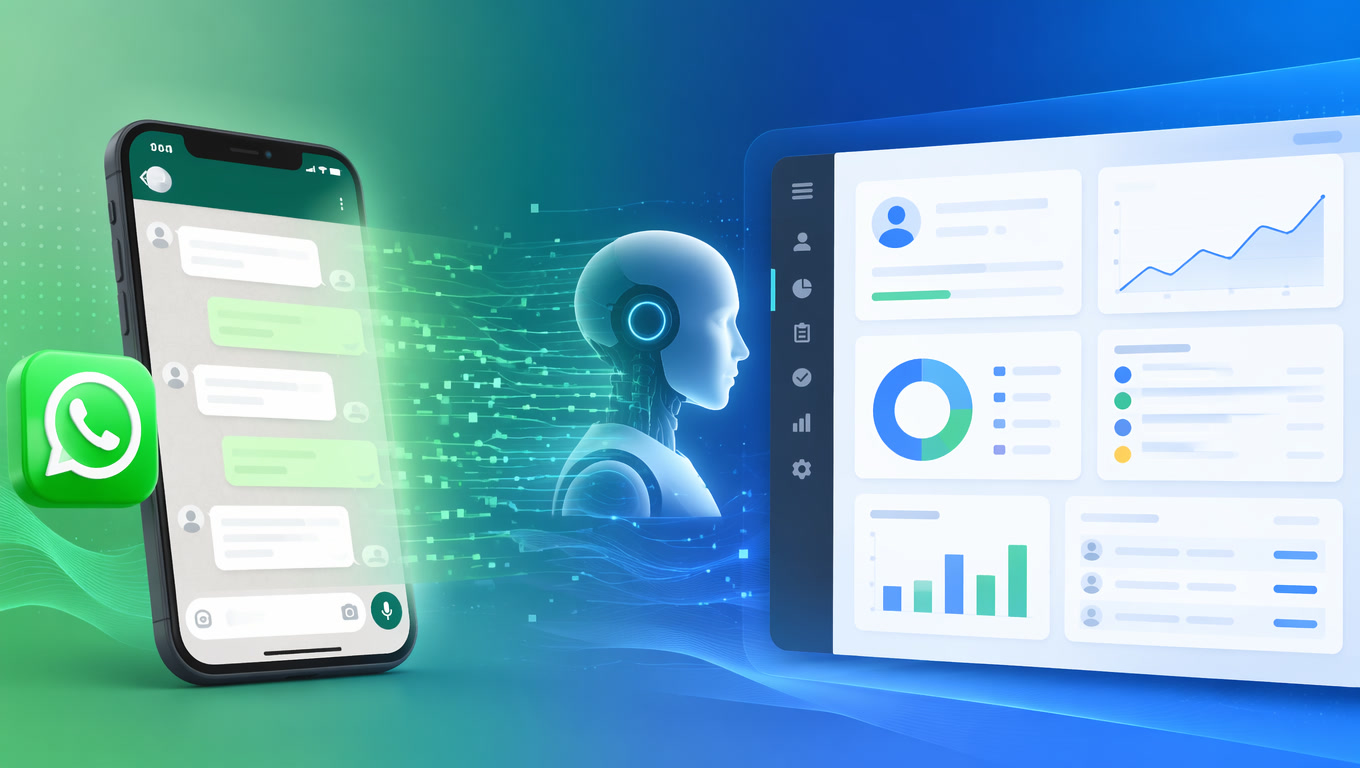
The architecture we recommend for clients who want the best of both worlds is a middleware layer that connects the agent with the CRM. In the LATAM ecosystem, WhatsApp integration with Clientify is particularly powerful because it turns every conversation into a contact, logs interactions as activities, and updates the sales pipeline in real time.
The ideal flow works like this:
- The Meta Business Agent handles the initial conversation, answers questions, and qualifies the lead.
- When the lead is ready to buy or needs human intervention, the agent escalates.
- The CRM receives the contact with full conversation context—products viewed, objections raised, interest level.
- The assigned salesperson sees the complete history and picks up where things left off.
- Every future interaction—regardless of channel—gets logged against the same contact.
Without step 3, step 4 is impossible and step 5 never happens.
Conclusion: Meta's Agent Is the Striker, Not the Full Team
The Meta Business Agent is without question the most accessible tool Meta has released for any business to have an automated presence on WhatsApp. Its global launch is great news for conversational commerce maturity in LATAM, where WhatsApp is the dominant channel with over 3 billion monthly active users.
But a striker does not win matches alone. You need a midfield, defense, and a coach who sees the full game. That coach is your CRM.
The difference between a business using the Meta Business Agent and one that truly automates customer relationships lies in what happens after the conversation. And there, a CRM is not optional. It is the difference between having a chatbot and having a sales system that works 24/7.
At Mintec, we help businesses connect WhatsApp Business, AI chatbots, and CRMs like Clientify into a single automation architecture. Meta's technology is the starting point. The CRM is the destination.