
WhatsApp + CRM + AI Agents: The Stack Transforming Sales in Latin America
WhatsApp has a 98% open rate, CRMs like Clientify centralize contacts, and AI agents execute the workflows. In Latin America, this combination is creating a new sales automation standard. Here's how to build it.
WhatsApp + CRM + AI Agents: The Stack Transforming Sales in Latin America
Every sales team in Latin America faces the same structural problem: they communicate where their customers actually live — WhatsApp — but their workflows, data, and follow-up logic live somewhere else entirely.
The result is a leaky bucket. Leads fall through the cracks. Follow-ups happen late or not at all. Salespeople copy-paste messages from spreadsheets. And the CRM — if there is one — becomes an after-the-fact record of deals that already closed or died, not an active engine driving them forward.
There is a fix. It involves three layers that together create something far more powerful than any single tool: WhatsApp + CRM + AI Agents. When stacked correctly, this combination turns a chaotic, high-volume sales operation into a predictable, automated flywheel. And it works especially well in Latin America — not despite the region's quirks, but because of them.
The Three-Layer Model
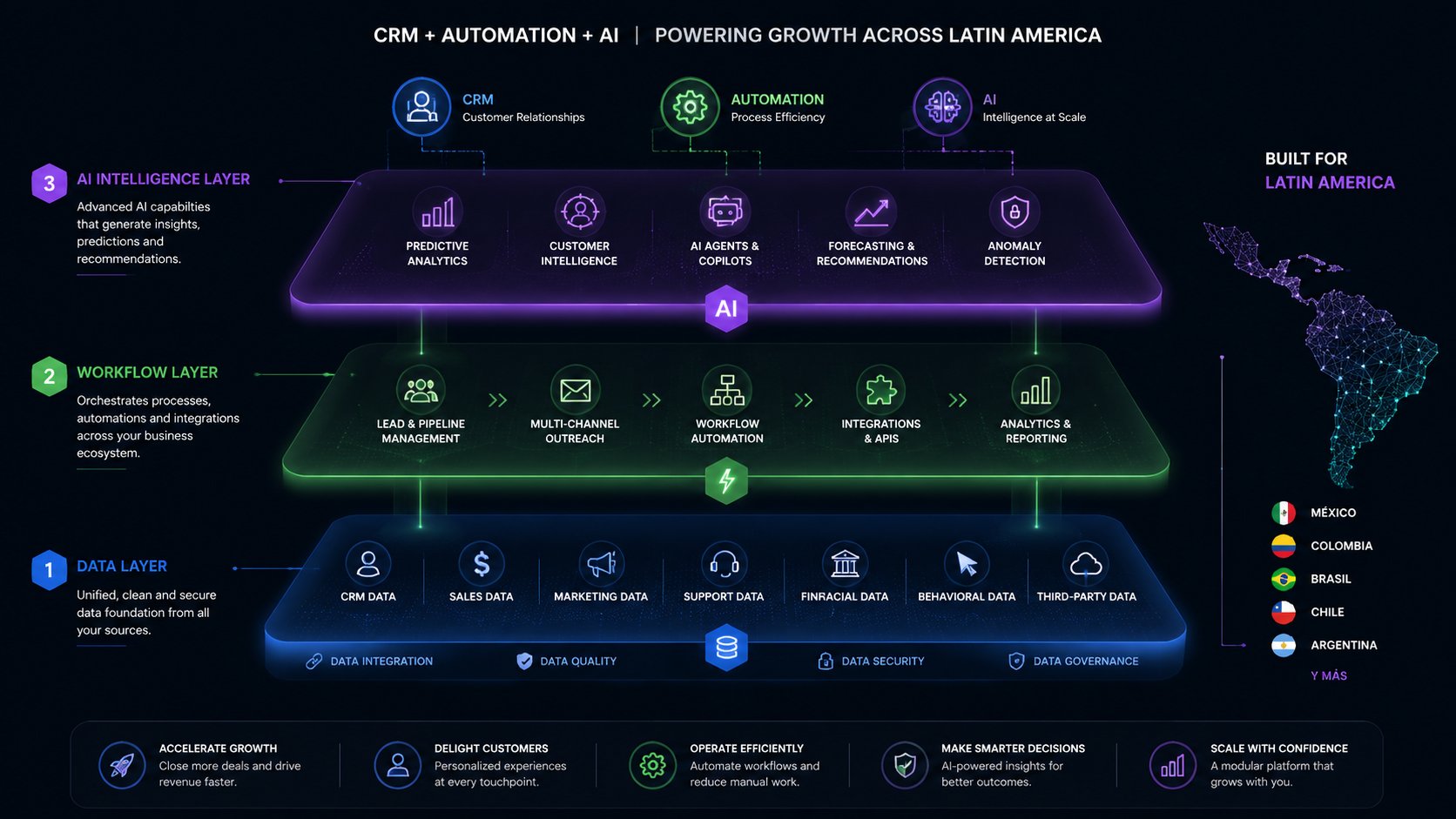
Think of this stack as three distinct layers, each building on the one before it.
Layer 1: Notification — WhatsApp as the universal inbox. Every lead, every inquiry lands in one place with near-guaranteed read rates.
Layer 2: Chatbot — Rule-based automation on top of the inbox. Common questions answered instantly. Qualification flows that gather data before a human ever touches the conversation.
Layer 3: Autonomous Agent — AI that doesn't just respond, but acts. It qualifies leads, updates CRM records, triggers follow-ups, and escalates intelligently. The agent runs the workflow; the human supervises.
Most companies stop at Layer 2. They put a chatbot on WhatsApp and call it automation. That's like installing a self-checkout machine and calling it a grocery store. The real leverage comes at Layer 3, where the CRM and the AI agent form a closed loop: every conversation feeds the database, and every database change can trigger a conversation.
Why This Stack Dominates in Latin America
The three-layer model works anywhere, but it hits differently in LatAm. Three structural factors make it almost unfair for businesses that adopt it early.
WhatsApp is the operating system. With over 3 billion users globally and penetration rates above 90% in countries like Brazil, Mexico, Colombia, and Argentina, WhatsApp isn't just an app in Latin America — it's the substrate on which business relationships are built. Email open rates hover around 20%. WhatsApp Business API messages average a 98% open rate within minutes. In a region where trust is built through personal conversation, not form submissions, WhatsApp is where deals actually happen.
Mobile-first, always. Latin America leapfrogged desktop internet. The majority of users interact with businesses exclusively through their phones. A sales process that requires a web portal, a form fill, or even an email thread loses people at every step. WhatsApp-native flows match how people already live.
High-touch trust dynamics. Business in LatAm is relational. Cold email doesn't work the way it does in North America. People want to talk to someone — or at least feel like they are. An AI agent that communicates in natural Spanish or Portuguese, with regional phrasing and appropriate tone, preserves that trust while removing the friction of availability. The best agents don't feel like bots. They feel like a very responsive, very organised salesperson who never sleeps.
The data backs this up. Click-to-WhatsApp ad conversion rates in LatAm range from 25% to 45%, compared to single-digit rates for traditional landing pages. When a prospect clicks an ad and lands directly in a WhatsApp conversation — handled by an agent that already knows what they clicked and can qualify them in real time — the drop-off plummets.
Layer 1: WhatsApp as the Notification Backbone
Before you automate anything, you need a reliable channel. Layer 1 is about getting every customer-facing notification into WhatsApp, not SMS or email: order confirmations, appointment reminders, payment confirmations, abandoned cart nudges, and lead intake from ads and landing pages.
The WhatsApp Business API makes this possible with template messages and session-based free-form messaging. These aren't marketing blasts — they are transaction-specific, triggered by customer actions. Done right, they feel like a natural extension of the conversation.
In practice, businesses that implement Layer 1 properly see dramatic drops in support calls. A fashion retailer in Mexico City we worked with cut inbound call volume by 60% simply by routing shipping confirmations and return status updates through WhatsApp instead of email.
Layer 2: The Intelligent Chatbot
Layer 1 sends messages. Layer 2 receives them and responds — intelligently, but not autonomously. A well-designed Layer 2 chatbot handles frequently asked questions, lead qualification, out-of-hours coverage, and basic product recommendations based on simple rules.
The crucial distinction between Layer 2 and Layer 3 is that Layer 2 is deterministic. Every branch of the conversation is pre-written. The bot follows a tree. It cannot deviate, cannot infer intent it wasn't explicitly programmed to handle, and cannot update the CRM on its own.
Most businesses that tell themselves they have "AI-powered sales automation" are actually at Layer 2. And Layer 2 is useful — it saves time, reduces friction, and covers the basics. But it has a ceiling. When a customer asks something unexpected, the bot either fails or hands off to a human with no context. Layer 2 bridges the gap between chaos and structure. Layer 3 is where the structure starts working for you.
Layer 3: Autonomous AI Agents
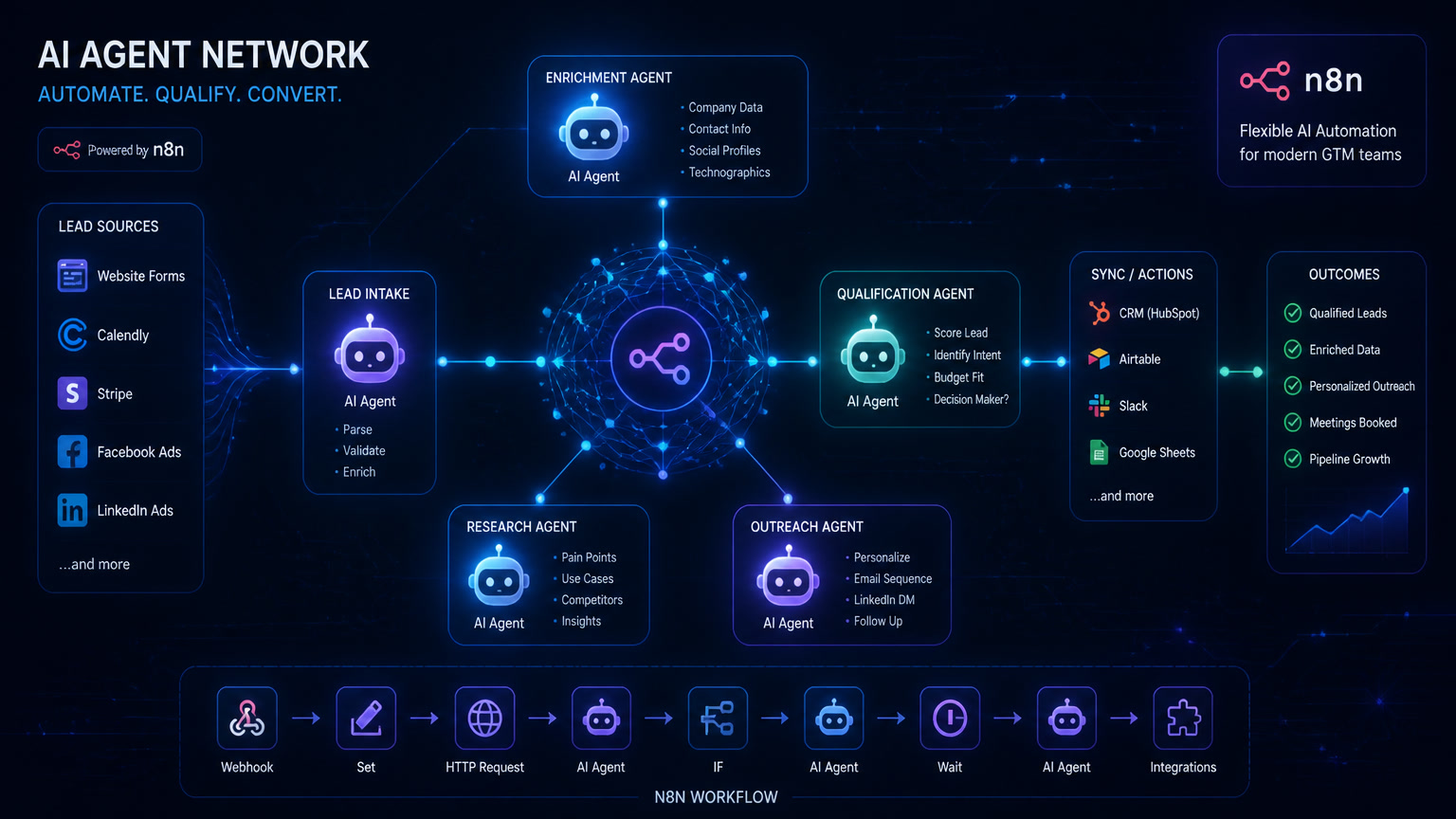
Layer 3 is the step most teams haven't taken yet. At this level, the AI agent is not just responding to messages — it is running sales workflows autonomously, with the CRM as its memory and execution engine.
Here's what that looks like in practice. A prospect clicks a Facebook ad for a specific product. The click triggers a WhatsApp message — not a generic greeting, but a contextual opener: "Hi, I see you were looking at the X200 sound system. Would you like to know about financing options or available colours?"
The prospect responds with a question about delivery timelines. The agent checks inventory via the CRM, finds that the X200 is in stock in the prospect's city, and replies with estimated delivery in hours. The prospect asks about pricing. The agent checks for active promotions, applies a regional discount code, and sends a payment link — all within the same conversation, all without a human touch.
The prospect doesn't buy immediately. The agent logs the interaction to the CRM: lead scored, interest recorded, follow-up scheduled for three days. When that follow-up fires, the agent reopens the conversation with the exact context from the previous exchange.
This is the flywheel. Every conversation improves the CRM. Every CRM update improves the next conversation. The human sales team focuses on closing, not on data entry or message drafting. We've seen this model produce 3x to 5x increases in qualified lead volume for SMBs in the region, with response times dropping from hours to seconds. The agents handle 80% of the pre-sales conversation end to end. Humans handle the last 20% — the negotiation, the close — but they enter those conversations armed with complete context.
Tying It Together: CRM as the Operating System
None of this works without a CRM that can play the role of central nervous system. The CRM is where contacts are stored, interactions are logged, pipelines are tracked, and automation rules are defined. It's the source of truth that both the WhatsApp layer and the AI agent layer read from and write to.
Platforms like Clientify are particularly well suited to this stack because they support native WhatsApp integration, custom field mapping, and multi-step automation triggers. But the principle applies broadly: the CRM must be the system of record, not an afterthought.
When the CRM is properly integrated:
- Every WhatsApp conversation creates or updates a contact record automatically
- Custom fields capture qualification data extracted by the AI agent
- Pipeline stages advance based on conversation outcomes, not manual input
- Tags and segments update in real time as the agent learns more about each lead
- Automation rules fire across channels — WhatsApp, email, SMS — triggered by the same CRM data
This is where the stack becomes more than the sum of its parts. A chatbot on WhatsApp is a better chatbot. A CRM with WhatsApp integration is a better CRM. But a CRM-driven AI agent operating on WhatsApp creates an entirely new capability: continuous, autonomous sales execution at scale.
Practical Steps to Build the Stack
If you're running an SMB in Latin America and want to implement this stack, start with Layer 1, then add Layer 2, and only move to Layer 3 once the foundation is solid.
Get on the WhatsApp Business API. The consumer app won't cut it for automation. You need the API for templated messages, multi-agent management, and integration hooks.
Integrate your CRM with WhatsApp. Every inbound and outbound message must sync to a contact record. Without this, Layers 2 and 3 have no memory.
Build notification flows first. Start with the highest-volume, lowest-effort notifications: order confirmations, shipping updates, appointment reminders.
Add a Layer 2 chatbot for the top 10 FAQs. Map the most common questions to a decision tree. Monitor dead-end conversations to refine.
Layer in AI agents gradually. Start with a single workflow — lead qualification from Facebook ads. Train the agent on your product catalogue, CRM fields, and conversation scripts. Measure the handoff rate. Iterate.
Close the loop. Once the agent handles qualification reliably, connect it to pipeline automation. Let it move deals between stages, schedule follow-ups, and flag hot leads for human attention.
The LatAm Advantage
Companies in Latin America that adopt this stack now have a first-mover advantage that will compound over the next two to three years. The region's WhatsApp dominance, relational business culture, and mobile-first infrastructure create conditions where this stack delivers outsized returns compared to markets where email and web portals still dominate.
The businesses that figure this out first will not just sell more. They will build data assets — structured, CRM-native databases of prospect interactions — that make every subsequent campaign smarter, every agent faster, and every sales hire more productive.
The stack is available today. The question is not whether it works — it's whether you're ready to build it.
Ready to implement this stack in your business? Mintec builds WhatsApp-CRM-AI automation systems for LatAm SMBs. We handle the integration, the agent training, and the ongoing optimisation so you can focus on closing deals.
Sources
- WhatsApp Business API: 98% open rate, 3B+ users — Meta for Business, 2025–2026 reporting
- Click-to-WhatsApp ad conversion data (25–45% in LatAm) — internal benchmarks and regional ad platform reporting, 2025
- WhatsApp penetration in LatAm markets — Statista, Digital 2025 Global Overview Report (We Are Social / Meltwater)
- Email vs. WhatsApp open rate comparison — Campaign Monitor, Mailchimp industry benchmarks, 2025
- Clientify CRM integration documentation — Clientify.io, 2025–2026
Related reading: WhatsApp Business Automation in 2026 · Autonomous AI Agents for Sales · Building Conversational Flows with Facebook Bot · Content Production Pipeline for Automation Teams