RevOps Automation for LatAm Agencies: The Modular Stack We Use to Unify Sales, Marketing and Operations
How to implement automated Revenue Operations (RevOps) for agencies and consultancies in Latin America without depending on HubSpot Enterprise. A modular stack with Clientify, n8n and AI APIs, based on real B2B client implementations.
RevOps Automation for LatAm Agencies: The Modular Stack We Use to Unify Sales, Marketing and Operations
Revenue Operations (RevOps) isn't an enterprise luxury reserved for companies with six-figure software budgets. For an agency or consultancy in Latin America, the right modular stack — Clientify + n8n + Make + AI APIs — costs between $70 and $200 a month and replaces functionality that costs $1,200+ on HubSpot Enterprise. We've implemented it for clients and it works: teams that used to operate with fragmented data now have complete pipeline visibility, automations that cross the boundaries between sales, marketing and operations, and reports that used to take two days of manual work.
The problem isn't that RevOps is expensive. It's that virtually every piece of content about RevOps assumes you work at a US company with a Salesforce Enterprise budget, a dedicated data team, and a software stack that costs more than an employee's salary. For Latin American agencies and consultancies, that playbook doesn't apply.
In this article, we share the modular stack we use at Mintec to implement RevOps automation for B2B agencies and consultancies in LatAm. This isn't theory. These are real implementations with real budget constraints.
What RevOps Means for a LatAm Agency
Let's start with a concrete definition. Revenue Operations (RevOps) is the function that aligns sales, marketing, and customer success around a single revenue flow. It sounds theoretical, but in practice it answers very specific questions:
- How many marketing leads actually convert into paying customers?
- How much time passes between a qualified lead being assigned to sales and the first contact?
- Which acquisition channels generate customers with the highest LTV?
- How many onboarding clients are at risk of churn before day 90?
When each team runs its own system — marketing in Mailchimp, sales in a basic CRM, operations in spreadsheets — answering these questions takes days of manual cross-referencing. RevOps automation solves exactly that: it connects the systems so answers are available without manual work.
According to Gartner (2026), by year-end 40% of enterprise applications will include task-specific AI agents, up from less than 5% in 2025. Salesforce reports that enterprise AI agents are already shifting from "almost always doing the right thing" to "always hitting the expected outcome" thanks to deterministic guardrails and context engineering. But these capabilities come packaged in enterprise platforms that cost $1,200+/month.
For a LatAm agency with 5-20 employees, that's not a realistic option. The good news is you don't need it.
The Problem with All-in-One Platforms in LatAm
Before showing the modular stack, let's understand why enterprise platforms aren't the answer for most Latin American agencies.
| Factor | HubSpot Enterprise / Salesforce | Modular Stack |
|---|---|---|
| Monthly cost | $1,200-$5,000+ | $70-$200 |
| Local integrations | Limited (Mercado Pago requires middleware) | Native or API-configurable |
| Data sovereignty | Data on US/EU servers | n8n self-hosted on local server |
| Learning curve | 2-4 months to leverage | 1-3 weeks per tool |
| Customization | Limited to vendor roadmap | Unlimited (open source + APIs) |
| Scaling | Price scales linearly with users | Fixed infrastructure cost |
The conclusion is straightforward: all-in-one platforms are designed for companies where $1,200/month is a minor operating expense. For a LatAm agency, that same budget covers the entire operations technology stack.
The 3-Layer Stack for RevOps Automation
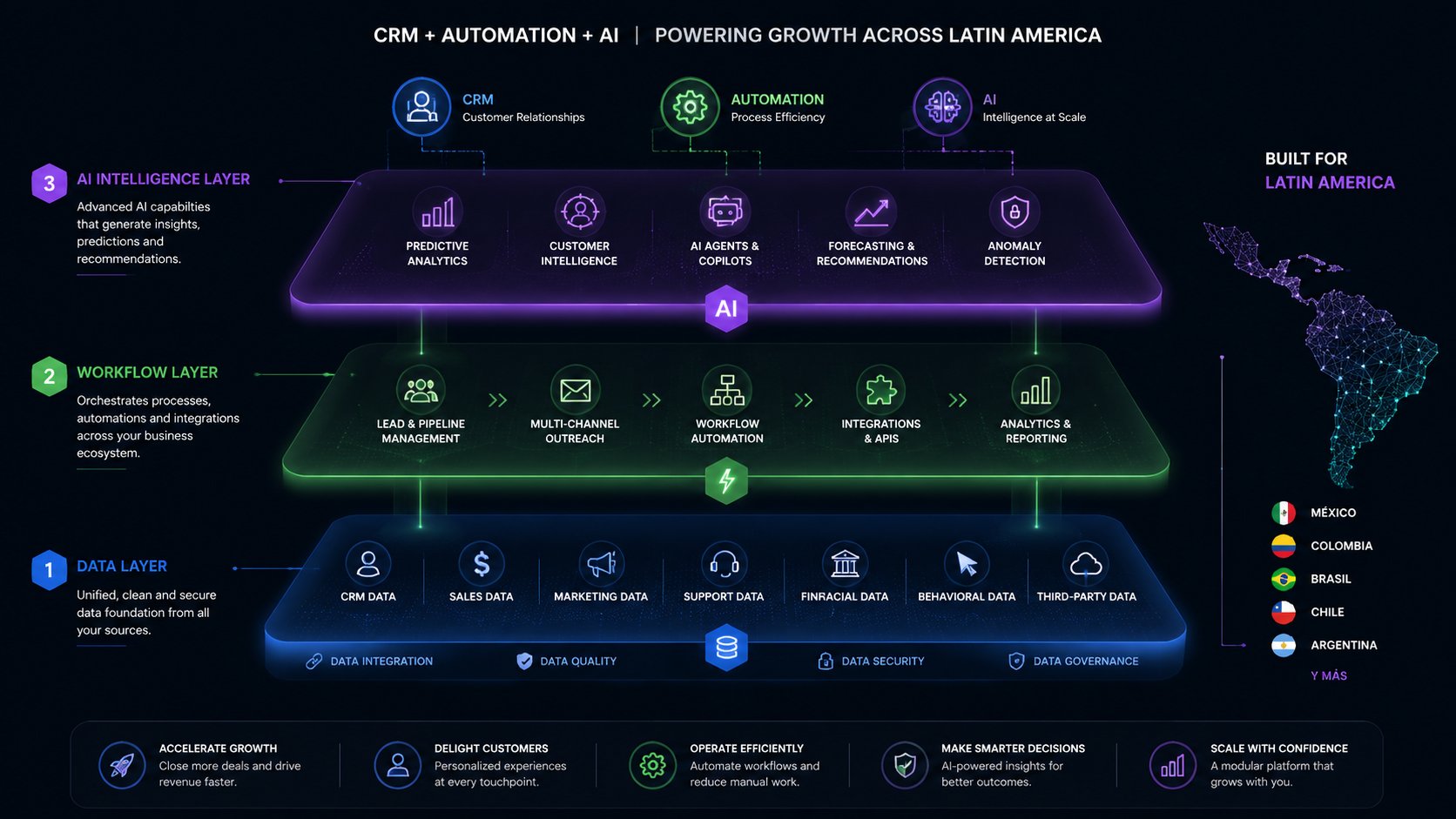
This is the framework we use at Mintec. We call it the 3-Layer Stack because each layer solves a specific problem and connects to the next via APIs and webhooks.
Layer 1: Data — Unified CRM with Automatic Enrichment
Base tool: Clientify
Clientify is our reference CRM for LatAm. Not just because it costs from $0/month (free plan) to $99/month (Pro plan), but because it has native connectors for local platforms that other CRMs don't offer.
What we automate in this layer:
- Unified lead capture: All web forms, WhatsApp Business API leads, and referrals land directly in Clientify with automatic enrichment (job title, company, industry) via enrichment APIs.
- Automatic deduplication: Before creating a new contact, the workflow checks if it already exists by email, phone, or company name. This sounds basic, but most CRMs don't do it without manual configuration.
- Real-time segmentation: As soon as a lead arrives, it's classified by industry, company size, and acquisition source. This segmentation feeds the layers below.
Cost: $0-99/month
Layer 2: Workflow — Multi-Tool Process Orchestration
Tools: n8n + Make
This is where the RevOps magic happens. n8n (self-hosted) and Make (cloud) orchestrate the flows that connect CRM, email, WhatsApp, invoicing, and reporting.
The 5 highest-impact workflows:
Sales → Delivery Handoff: When a lead converts to a qualified opportunity, n8n automatically creates the project record, assigns the delivery team, sends the welcome email, and triggers the onboarding template. This eliminates the most common gap in agencies: leads stuck in limbo between sales and operations.
Multi-channel nurture: Based on Layer 1 segmentation, Make or n8n run email + WhatsApp + LinkedIn sequences. If a lead opens an email but doesn't click, they receive a WhatsApp message 48 hours later. If they respond, the AI agent (Layer 3) qualifies the conversation.
Real-time pipeline alerts: When an opportunity goes more than 7 days without activity, n8n sends a notification to the sales team with full context: last interaction, deal value, and lead score.
Automatic invoicing: When a deal closes as "won," the workflow creates the invoice in the electronic invoicing system (native connectors for Mexican, Colombian, and Chilean e-invoicing) and sends the receipt to the client.
Consolidated weekly reports: Every Monday, n8n collects metrics from Clientify (open opportunities, pipeline value), the invoicing system (monthly revenue), and productivity tools, then generates a Looker Studio dashboard.
Cost: n8n self-hosted ~$20/month (VPS server) + Make $9-29/month
Layer 3: Intelligence — AI Agents on Unified Data
Tools: OpenAI/Claude APIs + Clientify + n8n
This layer is what separates an automated stack from an intelligent one. AI agents operate on the unified data from Layers 1 and 2 to make decisions that previously required human intervention.
Concrete applications:
- Dynamic lead scoring: The AI agent evaluates each new lead against the ideal customer profile, considering variables that fixed-rule scoring can't process: language intent in the web form, behavior in previous emails, and contextual signals.
- WhatsApp conversation qualification: When a lead interacts via WhatsApp, the agent analyzes the conversation in real time and determines whether it's a qualified lead (MQL) or needs more nurturing.
- Early churn detection: The agent monitors behavior patterns in active clients: decreased portal usage, unopened emails, support tickets with negative tone. When it detects a signal combination, it alerts the customer success team with an action recommendation.
Cost: ~$20-50/month in AI APIs (depending on lead volume)
Total Stack Cost
| Layer | Tools | Monthly Cost |
|---|---|---|
| Data | Clientify Pro | $99 |
| Workflow | n8n self-hosted + Make Pro | $20-49 |
| Intelligence | OpenAI/Claude APIs | $20-50 |
| Total | ~$140-200/month |
Compare that to HubSpot Enterprise at $1,200+/month or Salesforce Sales Cloud at $300+/user/month.
Why the Modular Stack Wins in LatAm (Opinion)
Having implemented both types of stacks for clients, our position is clear: for Latin American agencies and consultancies, the modular stack isn't just cheaper — it's objectively better. Here's why:
1. Local integrations matter more than global features. Clientify has native connectors for Mercado Pago, Mexican electronic invoicing (CFDI), and local payment methods. HubSpot and Salesforce require expensive middleware to achieve the same.
2. Data sovereignty is regulatory, not just political. With Brazil's LGPD and emerging data protection laws in Chile, Colombia, and Mexico, keeping client data on locally controlled servers (n8n self-hosted) isn't a technical advantage — it's a compliance requirement.
3. Dollar pricing hits 6x harder in LatAm. HubSpot Enterprise at $1,200/month equals 1.5-2 minimum monthly wages in several countries in the region. That money produces better returns invested in the operations team than in software licenses.
4. Open-source flexibility lets you scale without renegotiating contracts. When an agency grows from 5 to 20 employees, self-hosted n8n costs the same server fee. HubSpot goes from $1,200 to $3,000+.
Roadmap: 3 Steps to Implement RevOps Automation
Step 1: Audit Your Current Stack (Week 1)
Before buying any tool, map which systems you use today for marketing, sales, operations, and customer success. Identify where the silos are: do marketing leads automatically reach the CRM? Does sales update the pipeline after every call? Does operations use the same data as sales to plan capacity?
The goal isn't to replace everything — it's to connect what already works.
Step 2: Implement Layer 1 + One Critical Workflow (Weeks 2-3)
Set up Clientify as the central CRM. Connect the main lead sources (web forms, WhatsApp, email). Then choose one single workflow — the sales-to-delivery handoff is the highest-impact one for agencies — and implement it in n8n or Make.
Don't try to automate everything in parallel. One working workflow builds momentum and trust for the next.
Step 3: Add Intelligence and Repeat (Weeks 4-6)
With data flowing cleanly and at least one critical workflow automated, add the AI layer. Start with dynamic lead scoring — it's the fastest to implement and generates the most visible ROI for the sales team.
Then repeat: choose the next highest-impact workflow, automate it, measure the result.
Conclusion
RevOps automation isn't an enterprise luxury reserved for six-figure budgets. For Latin American agencies and consultancies, the modular 3-layer stack — Clientify for data, n8n/Make for workflows, AI APIs for intelligence — delivers the same capabilities at a fraction of the cost.
We've seen teams go from "we never really know how many qualified leads we have" to "every Monday we have a dashboard with the full pipeline, churn risks, and action recommendations" in under six weeks.
The first step isn't buying expensive software. It's connecting what you already have.
Want to learn more about CRM automation for agencies? Read our article on sales-to-delivery handoff automation and the AI lead scoring framework. We also have a guide on client onboarding automation that complements this stack.
Frequently Asked Questions
What is RevOps (Revenue Operations)?
RevOps is the function that aligns sales, marketing and customer success around a single revenue flow. Instead of each team operating its own CRM with separate metrics, RevOps centralizes the data, processes and tools so the entire revenue cycle becomes predictable and measurable.
How much does RevOps automation cost for a LatAm agency with a modular stack?
A complete modular stack — Clientify ($0-99/mo), n8n self-hosted (~$20/mo server), Make ($9-29/mo), and AI APIs (~$20-50/mo) — costs between $70 and $200/month total. Compared to HubSpot Enterprise at $1,200+/mo or Salesforce at $300+/user/mo, the savings range from 6x to 17x.
Why does the modular stack work better than all-in-one platforms for LatAm agencies?
Three reasons: cost in dollars is 6-17x lower, modular tools have native connectors for local platforms (Mercado Pago, Mexican electronic invoicing), and self-hosted n8n keeps sensitive data on local servers to comply with privacy regulations like Brazil's LGPD.