Client Onboarding Automation: The 4-Phase Framework That Cuts Churn by 16 Points
90% of users churn without strong onboarding. Agencies lose 8% of clients in the first 6 months. Here's the 4-phase automated onboarding framework we use with Make, n8n, and Clientify — with real data and implementation patterns.
Client Onboarding Automation: The 4-Phase Framework That Cuts Churn by 16 Points
The most critical moment in a client relationship isn't when you close the deal. It's what happens immediately after.
The data is brutal. According to UserGuiding's 2026 analysis of 100+ onboarding studies, 90% of users churn without strong onboarding. 72% abandon a service if the onboarding process requires too many steps. And the average onboarding checklist completion rate across SaaS companies? Just 19.2%.
For agencies and professional services firms, the impact hits the bottom line directly: retainer agencies lose up to 8% of clients in months 1-6 (Focus Digital, 2026), and 23% of cancellations are directly linked to poor onboarding (Wyzowl).
At Mintec, we've implemented onboarding automation for marketing agencies, IT consultancies, and creative studios across Latin America. What we've learned is that automation isn't about sending a welcome email. It's about designing a system that orchestrates your CRM, your project tools, and your operations team into a repeatable, measurable process.
This article breaks down the 4-phase framework we use — with concrete data, tool choices, and the mistakes we've seen most often.
Why Manual Onboarding Is Killing Your Retention
Let's start with the numbers that make the case for automation.
Forrester Research calculates that every $1 invested in customer onboarding returns $5 in additional revenue or cost savings. The catch: 55% of companies don't have a formal onboarding process at all (Groove HQ).
The gap between doing onboarding well and not doing it is staggering:
| Metric | With Onboarding | Without Onboarding | Source |
|---|---|---|---|
| 90-day retention | 92% | 76% | Totango 2026 |
| Year-1 upsell rate | 32% | 18% | Totango 2026 |
| Support ticket volume | -45% | Baseline | Gainsight 2026 |
| Client satisfaction (NPS) | +33 points | Baseline | Gainsight 2026 |
| Customer LTV | +21% | — | Sixteen Ventures |
But the most alarming number is this: 44% of all cancellations happen within the first 90 days (Marketing LTB). That 90-day window is where onboarding decides whether the client stays or churns.
In our experience with agencies across Latin America, the issue isn't that teams don't want to do good onboarding. It's that they don't have a system to do it consistently. Onboarding is handled "manually," case by case, and as the team grows, the process breaks.
The 4-Phase Onboarding Automation Framework
After implementing onboarding systems for more than a dozen agencies, we've distilled a framework that works regardless of business size.
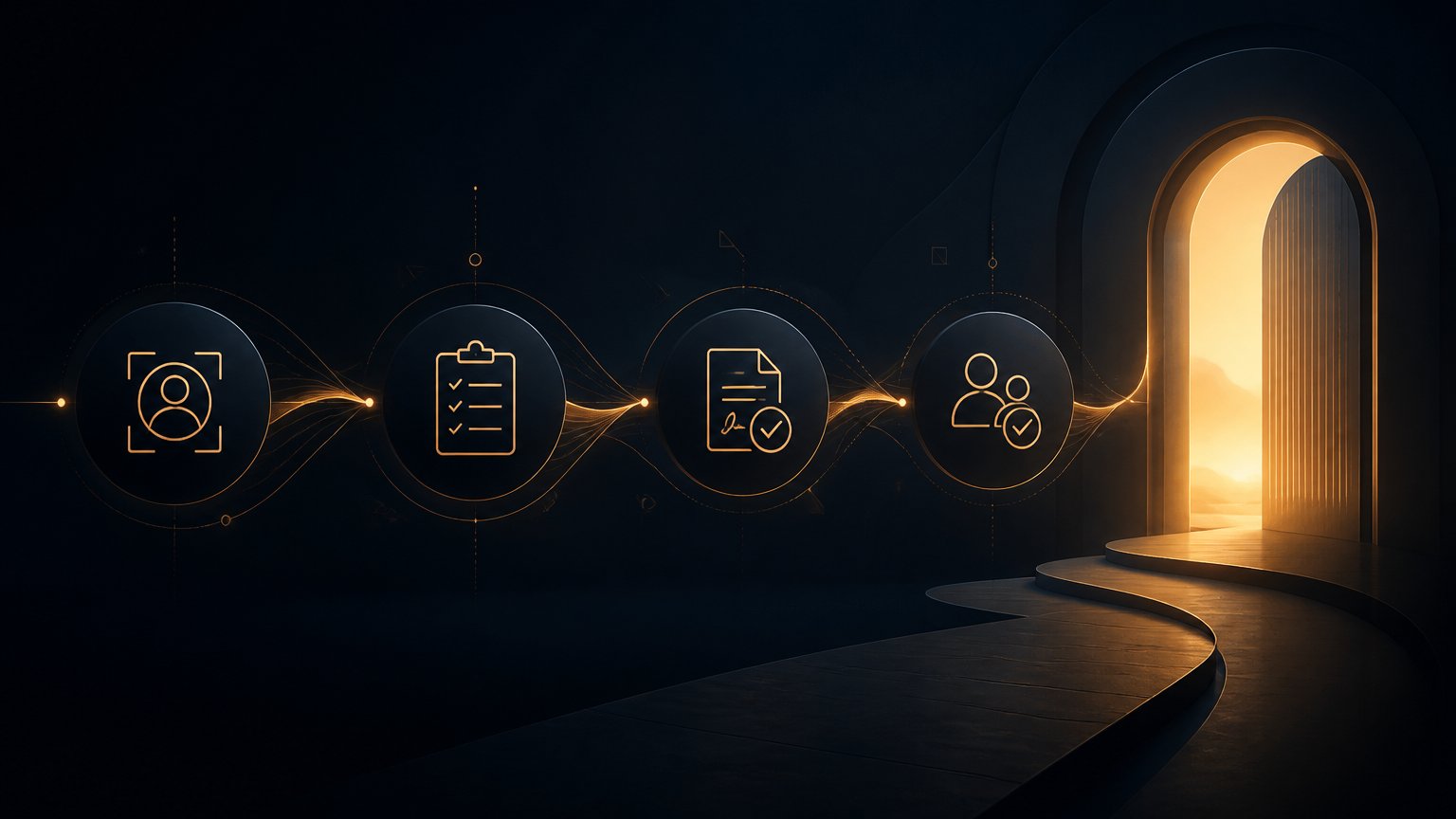
We call it Capture → Welcome → Activate → Handoff.
Each phase has a distinct objective, toolset, and automation level.
Phase 1: Capture — Smart Information Intake
The moment a contract is signed is the highest-intent point in the client lifecycle. You need to capture that momentum.
What to automate:
- CRM detection of deal status change to "closed won"
- Automatic intake form with pre-populated client data
- Document collection (signatures, tax info, briefs)
- Enriched client record creation in the CRM
How we implement it:
With Clientify (or any CRM with webhook support), we configure a trigger that fires when a deal moves to "Closed won." That webhook activates a Make scenario that:
- Sends the client a branded onboarding portal with pre-filled forms
- Creates a shared folder in Google Drive or Dropbox
- Assigns automated tasks to the delivery team
The most common mistake: asking for everything at once. According to UserGuiding, each extra step drops conversion by 3%. A 10-field intake form gets 47% fewer completions than a 4-field one.
Our rule: 4 mandatory fields max on the first interaction. Everything else gets collected in subsequent phases via progressive profiling.
Phase 2: Welcome — The Sequence That Builds Trust
The first week after signing is where you earn or lose the client's trust.
What to automate:
- Welcome email with assigned team and next steps
- Calendar invitation for kickoff call
- Client portal or project dashboard access
- "First 30 days" document with clear milestones
Key data point: companies that include a personalized welcome video see 47% higher activation rates (Marketing Scoop / Wyzowl). It doesn't need to be produced — a 90-second Loom from the account manager works.
With n8n, we build workflows that cross-reference the delivery team's calendar with the client's timezone, suggest 3 kickoff call slots, and auto-block the calendar when the client picks one — all without human intervention.
What DOESN'T work: generic mass emails. 65% of customers expect a personalized onboarding experience (WalkMe). A "Welcome to [company]" template with no personalization signals the beginning of neglect.
Phase 3: Activate — Delivering First Value Fast
This is where most onboarding automation fails. Not because the work doesn't get done, but because too much time passes before the client sees results.
What to automate:
- Automated reminders for pending client steps
- Internal team notifications when the client completes milestones
- Weekly progress reports generated automatically
- Shared activation checklist
The game-changing stat: products that deliver a "quick win" during onboarding retain 80% more users (UserGuiding). That quick win doesn't need to be complex — an initial diagnostic, a benchmark report, or a dashboard with the client's own data.
With Make, we automate a "first fast deliverable" sent 7 days after signing. It's not the full project — it's a value preview: an audit of their current situation, an analysis using their data, or a metrics dashboard.
This single step reduces support tickets by 45% (Gainsight), because the client is already seeing value. Their questions shift from "how does this work?" to "how do we get to the final result faster?"
Phase 4: Handoff — The Transition to Operations
The last onboarding phase is also the most overlooked: transitioning from the onboarding team to regular operations.
What to automate:
- Full client documentation transferred to delivery team
- Onboarding workflows deactivated, recurring service workflows activated
- Post-onboarding NPS survey
- Handoff report with sales promises and lessons learned
The trap: according to Default.com (2026), critical client context — goals, risks, sales commitments — gets lost in this handoff 67% of the time. Three months of sales conversations compressed into a 30-minute handoff meeting.
With Clientify + n8n, we auto-generate a "Client Handoff Document" containing:
- Full CRM interaction history
- Specific commitments made during sales
- Agreed technical configurations
- Client communication preferences
This document is generated automatically when the onboarding workflow reaches 100% completion.
Tool Comparison: What to Use for Onboarding Automation
| Tool | Best For | Cost | Learning Curve | LatAm Fit |
|---|---|---|---|---|
| Make | Phases 1-2: capture forms, welcome emails, CRM integration | $9/mo (10K ops) | Low-medium | Strong — good local tool integrations |
| n8n | Phases 3-4: activation workflows, provisioning, handoff | Free self-hosted ($6-20/mo server) | Medium-high | Strong — ideal for data-sensitive clients |
| Clientify | Central CRM + complete process automation | From $29/mo | Low | Strong — native LatAm and Spain presence |
| Zapier | Phase 1: simple capture, quick integrations | $19.99/mo (2K tasks) | Very low | Not recommended at scale (per-step cost) |
| Rocketlane / GuideCX | Purpose-built onboarding platform | From $39/user/mo | Medium | English-only, no local presence |
The 3 Mistakes We See Most Often
After implementing onboarding automation for multiple clients, these patterns repeat:
1. Automating everything at once. The 4 phases are designed to be implemented sequentially. Trying to automate all four simultaneously guarantees none of them work well. We wrote about why 90% of automation projects fail — and this is exactly the pattern. Start with Phase 1 (Capture). When it runs smoothly, add Phase 2 (Welcome). Then Phase 3, then Phase 4.
2. Skipping personalization. A fully generic automated sequence feels cold. UserGuiding's data confirms it: personalized onboarding paths increase completion rates by 35%. Personalization doesn't need to be complex — segmenting by client type (new vs. upgrade, SMB vs. enterprise) already produces dramatic improvements.
3. Not measuring progress. If you don't know what percentage of clients completes each onboarding phase, you can't improve. The average completion rate is 19.2%. Companies that measure and experiment improve 2.5x faster than those that don't (Optimizely).
Why This Matters More in 2026 Than Ever
Three converging trends make automated onboarding a competitive necessity:
First: time-to-first-value has become the single most important retention metric. Clients won't wait weeks for results.
Second: 63% of customers consider the onboarding experience when making purchasing decisions (Wyzowl). The post-sale experience is part of the product you're selling.
Third: well-onboarded clients are 4x more likely to become brand advocates (Wyzowl). Good onboarding doesn't just retain — it attracts new clients through word of mouth.
How to Start Tomorrow
You don't need a 6-month implementation to see results. 80% of the impact comes from 20% of the effort:
- This week: set up a CRM webhook that sends an automated welcome email when a deal closes (Phase 2)
- Next week: add the automated intake form (Phase 1)
- Month 2: implement activation with a 7-day quick win deliverable (Phase 3)
- Month 3: complete the cycle with handoff automation (Phase 4)
Only 29% of professional services firms have a standardized onboarding process (Totango). Building yours puts you in the top third of your market. And the data says that top third retains 16 points more.
We already covered the sales-to-delivery transition in our article on automating the client handoff, and the impact of data enrichment in automated CRM enrichment. This onboarding framework is the next link in the chain.
Want to see how we implement this framework with Clientify, Make, and n8n for real clients? Let's talk.
Frequently Asked Questions
What is client onboarding automation?
It's the use of workflow automation tools (Make, n8n, CRM) to manage the complete new-client intake and activation process — from contract signature to first value delivery — without manual intervention at each step.
How much does onboarding automation improve retention?
Properly onboarded clients show 92% 90-day retention vs 76% without structured onboarding — a 16-point improvement (Totango). Automated onboarding workflows specifically reduce churn by 25% (UserGuiding).
Which tools work best for automated onboarding?
Make excels at capture and welcome phases (forms, emails, CRM integration). n8n is better for activation and provisioning (self-hosted, complex logic). Clientify works as the central CRM orchestrating the entire process. The right stack depends on your scale and data sensitivity needs.