From Drip Sequences to Conversational Email Automation — A Framework That Actually Works
Drip sequences treat every lead the same. Conversational email automation adapts to behavior in real time. Here's the 3-phase framework we use and how to build it with Make, n8n, and your CRM.
The drip sequence is running on fumes
For years, email automation meant one formula: "day 1 → welcome email, day 3 → educational content, day 7 → offer." Predictable, linear, and increasingly ignored.
Email itself isn't the problem. It's still the highest-ROI channel in digital marketing: $36 to $42 for every $1 spent, far ahead of paid search ($2) or social advertising ($2.80) (Litmus/Digital Applied, 2026). The problem is the linear sequential format that treats every lead the same way.
We worked with a fashion e-commerce brand in Honduras that had a 5-email abandoned cart sequence: the same 5 emails, same intervals, for every visitor. Recovery rate: 2.1%. When we redesigned the flow to branch based on behavior — whether the user opened but didn't buy, which products they viewed, whether they'd purchased before — the rate jumped to 7.8%. Without adding a single new email. We just changed when and what gets sent based on what the lead actually does.
That's the difference between a drip sequence and a conversational one.
What conversational email automation actually is
It's not a chatbot. It's not an email with "AI" in the subject line. It's an automation architecture where every send depends on a condition based on the contact's behavior, not a date on the calendar.
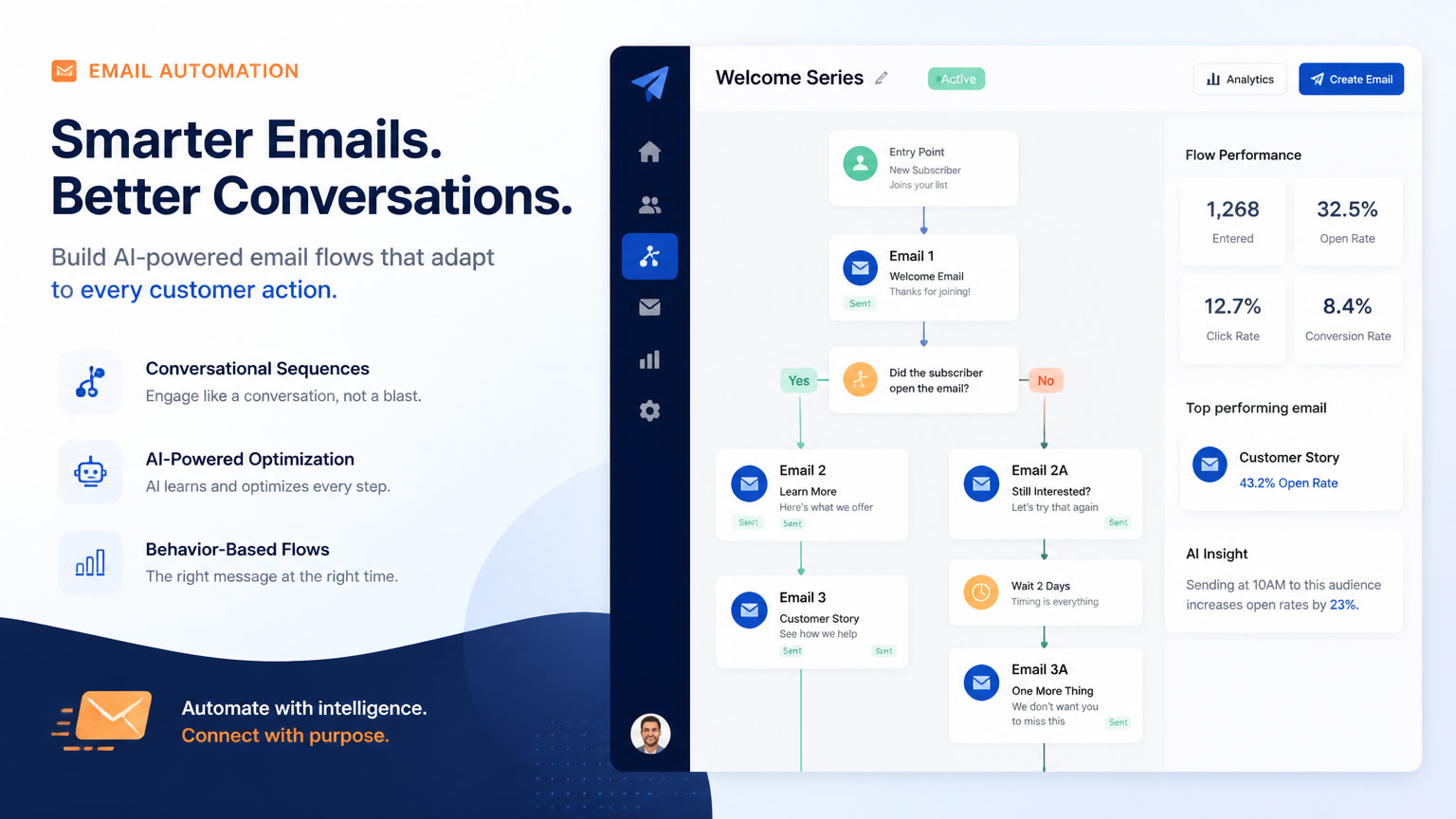
A conversational sequence works like this:
- A lead enters via a form, download, or purchase
- The CRM updates their profile with behavioral data
- The automation engine evaluates conditions: did they open the last email? click? visit a specific page? what's their lead score?
- The correct branch fires: if opened → follow-up content; if not opened → subject line + timing change; if clicked → related offer; if no clicks in 3 sends → re-engagement sequence
The output isn't a "drip." It's an automated dialogue where every interaction decides the next step.
Why traditional drip sequences lose ground
The drip model was designed for an era when email was the only digital channel and CRMs barely tracked opens. In 2026, that model has three structural flaws:
Flaw #1: It assumes the lead moves in a straight line. A lead ready to buy on day 1 gets educational content on days 3, 5, and 7. Another lead needs 30 days of nurturing but gets an offer on day 7 because "that's how the sequence is set up."
Flaw #2: It ignores context. The lead who opened every email and visited the pricing page three times gets the same message as the one who hasn't opened a single email since subscribing.
Flaw #3: It doesn't read CRM data outside email. The lead who just spoke with sales on WhatsApp gets the same automated email as the one who never had human contact. This creates contradictory experiences that erode trust. An AI-powered CRM can bridge this gap — but only if your email automation is designed to read real-time CRM data.
According to Klaviyo (2026), automated flows generate up to 30x more revenue per recipient than individual campaigns. But that differential doesn't come from "sending more emails." It comes from sending the right email at the exact right moment. Linear drip sequences can't do that because they lack real branching conditions.
The 3-phase conversational framework
When we build email automation for clients, we organize sequences into three phases. Each phase has its own branching logic and key metrics.
Phase 1: Capture and calibrate
The lead just entered the CRM. We know almost nothing about them. The goal here isn't to sell — it's to learn what motivates them.
Branching conditions:
- Did they open the welcome email? → If yes, send educational content in 24h. If no, change subject line and resend at 48h with different timing.
- Did they click any link? → Log the interest and update lead scoring.
- Did they download a resource? → Activate resource-specific sequence.
Recommended duration: 5-7 days. If no interaction after 3 attempts, move to re-engagement or pause.
Key metric: Early-phase interaction rate (target: >40%).
Phase 2: Adaptive nurturing
The lead has shown interest. We know what type of content works for them. Now the flow adapts to their demonstrated preferences.
Branching conditions:
- Clicked product content → Feature and use case sequence.
- Clicked educational content → Authority building and thought leadership.
- Visited pricing page → Email with ROI calculator or case studies.
- Combined behaviors → Tag as "hot" and notify sales.
Recommended duration: Variable. The lead controls the pace. If they stop engaging, pause.
Key metric: Advancement-to-conversion rate (target: >15%). For deeper scoring logic, our AI lead scoring framework covers the 3-stage model we use with clients.
Phase 3: Conversion and consolidation
The lead is ready to buy... or to go cold. This phase requires the tightest integration with your CRM and automation tools like Make or n8n.
Branching conditions:
- Requests demo or contact → Trigger sales notification + confirmation email.
- Opens offer email but doesn't buy → Objection handling sequence (3 spaced emails).
- Total silence after offer email → Testimonial or guarantee email.
- Purchases → Post-sale and upselling sequence.
Recommended duration: Until conversion or cold-lead flag (no interaction in 14 days).
Key metric: Conversion rate by branch (compare branches to optimize).
| Dimension | Traditional drip sequence | Conversational sequence |
|---|---|---|
| Trigger | Time (days since entry) | Lead behavior |
| Content | Fixed for all leads | Dynamic by interest |
| Pace | Predictable (day 1, 3, 7) | Adaptive (lead controls) |
| CRM integration | Email-only | Email + web + WhatsApp + sales |
| Personalization | Name + company | Behavior + stage + score |
| Typical conversion rate | 1-3% | 4-8% (abandoned cart: up to 7.69%) |
| Relative ROI | $36 per $1 spent | Up to 30x per active recipient |
Sources: Klaviyo 2026, Omnisend 2026, CodeCrew/Litmus 2026.
How to build it with Make, n8n, and your CRM
The conversational model sounds complex, but the technical implementation is simpler than it looks if you have the right layers.
Layer 1 — CRM with behavioral data. You don't need an expensive CRM. Clientify or HubSpot track opens, clicks, and page visits natively. The key requirement: the CRM must export this data via API or webhook.
Layer 2 — Automation engine. This is where Make or n8n come in. These engines receive webhooks from the CRM, evaluate branching conditions, and execute the corresponding actions. If you haven't connected your CRM to automation tools yet, our no-code AI automation guide covers the setup.
Layer 3 — Email platform. ActiveCampaign, Klaviyo, or Mailchimp with behavioral trigger support. The platform sends the emails and reports metrics back to the CRM.
Concrete example: A lead downloads an ebook from your site. The CRM records them as "new lead" tagged "ebook: automation." Make receives the webhook, checks if the lead exists in the "qualified prospects" list, and triggers the welcome sequence specific to that ebook. If the lead clicks a pricing link inside the email, Make updates the CRM score to "hot" and sends a Slack notification to the sales team.
All of this happens in seconds, without human intervention, and every decision is based on what the lead actually did.
Why most email automation fails
We've been configuring email automation for LatAm clients for years, and the failure pattern is consistent: people confuse "automation" with "fixed sequence."
They set up a 5-email flow in Mailchimp or ActiveCampaign, turn it on, and expect results. When results don't come, they blame email. The problem isn't the channel. It's that there are no real branching conditions. It's a newsletter in automation's clothing.
Conversational automation requires three things most implementations skip:
- Real-time behavioral data. If your CRM doesn't update the lead's profile when they click or visit a page, the sequence can't adapt.
- Real conditional logic. "If opened → email A, if not → email B" isn't enough. You need decision trees with multiple variables: engagement level, buyer journey stage, lead score, past interaction history.
- Feedback loop. Conversational sequences improve over time. You need to measure which branches convert best and adjust conditions. If you don't measure, you don't optimize.
A Mexican insurance client had a 0.8% conversion rate on their quote follow-up sequence. The problem: they sent the same follow-up email to everyone who requested a quote, regardless of whether the user had previously bought insurance or whether they abandoned at step 1 or step 5. When we redesigned the sequence with branching based on quote-form progress, the rate hit 4.2%. We multiplied conversion by 5x without changing a single word of the email content — we just changed who got what and when. (For comparison, AI agents vs traditional automation follow similar patterns — we cover the differences here.)
The future is contextual, not chronological
Drip sequences won't disappear entirely. For purely informational or transactional campaigns (confirmations, invoices, account updates), the time-based model still works.
But for conversion campaigns, lead nurturing, and cart recovery, the linear drip model is giving way to a conversational approach where every interaction defines the next step. The data is clear: automated emails generate 320% more revenue, behavior-based flows convert 3-4x better, and brands that segment and personalize drive 58% of all email revenue.
The question isn't whether you should migrate to conversational sequences. The question is how many more leads you can afford to lose while your automation still treats everyone the same.
Want to audit your current email automation? At Mintec, we help businesses across LatAm migrate from drip sequences to conversational models using Make, n8n, and CRMs like Clientify and HubSpot. Contact us for a free diagnostic of your current flows.
Sources: Litmus/Digital Applied (2026) — email ROI benchmarks; Klaviyo (2026) — automated flow performance data; Omnisend (2026) — email effectiveness survey; CodeCrew (Dec 2025) — aggregated email marketing statistics; Mintec proprietary implementation data from LatAm client projects.
Frequently Asked Questions
What's the difference between a drip sequence and a conversational sequence?
A drip sequence sends emails on a fixed schedule (day 1, day 3, day 7) regardless of what the recipient does. A conversational sequence adapts content, timing, and branching based on the lead's behavior: opens, clicks, page visits, downloads, and CRM data.
What tools do I need for conversational email automation?
Three layers: a CRM that tracks behavior (Clientify, HubSpot), an automation engine for conditional branching (Make, n8n), and an email platform that supports behavioral triggers (ActiveCampaign, Klaviyo, Mailchimp).
How much can conversational sequences improve conversion rates?
Automated emails generate 320% more revenue than non-automated ones. Behavior-based flows (abandoned cart, cold lead recovery) convert at 3-8%, compared to 1-2% for traditional campaigns. Brands that segment and personalize generate 58% of all email revenue.