
Meta Business Agent on WhatsApp: How It Changes Your Automation Strategy (and What Doesn't Change)
Meta launched its native AI agent in WhatsApp Business with per-token pricing from August 2026. We analyze how it changes the automation stack for LatAm SMBs — and when you should still build a custom solution.
Meta Business Agent — the native AI agent Meta launched globally inside WhatsApp Business on June 3, 2026 — changes the game for micro and small businesses that handle customer inquiries manually on WhatsApp, but it does not replace the need for custom automation when you need CRM, ERP, or proprietary system integrations. With per-token pricing starting August 1, 2026 ($2 per million tokens, roughly 4-5 cents per message), Meta is entering the chatbot market directly — but with clear limitations that any business in Latin America needs to understand before deciding on their automation strategy.
At Mintec, we build WhatsApp Business API automation for clients across Mexico, Colombia, Central America, and Peru. This article covers what Meta Business Agent actually changes, who benefits most, and when — despite the launch — building your own agent still makes more sense.
What Meta Business Agent Is and Why It Matters
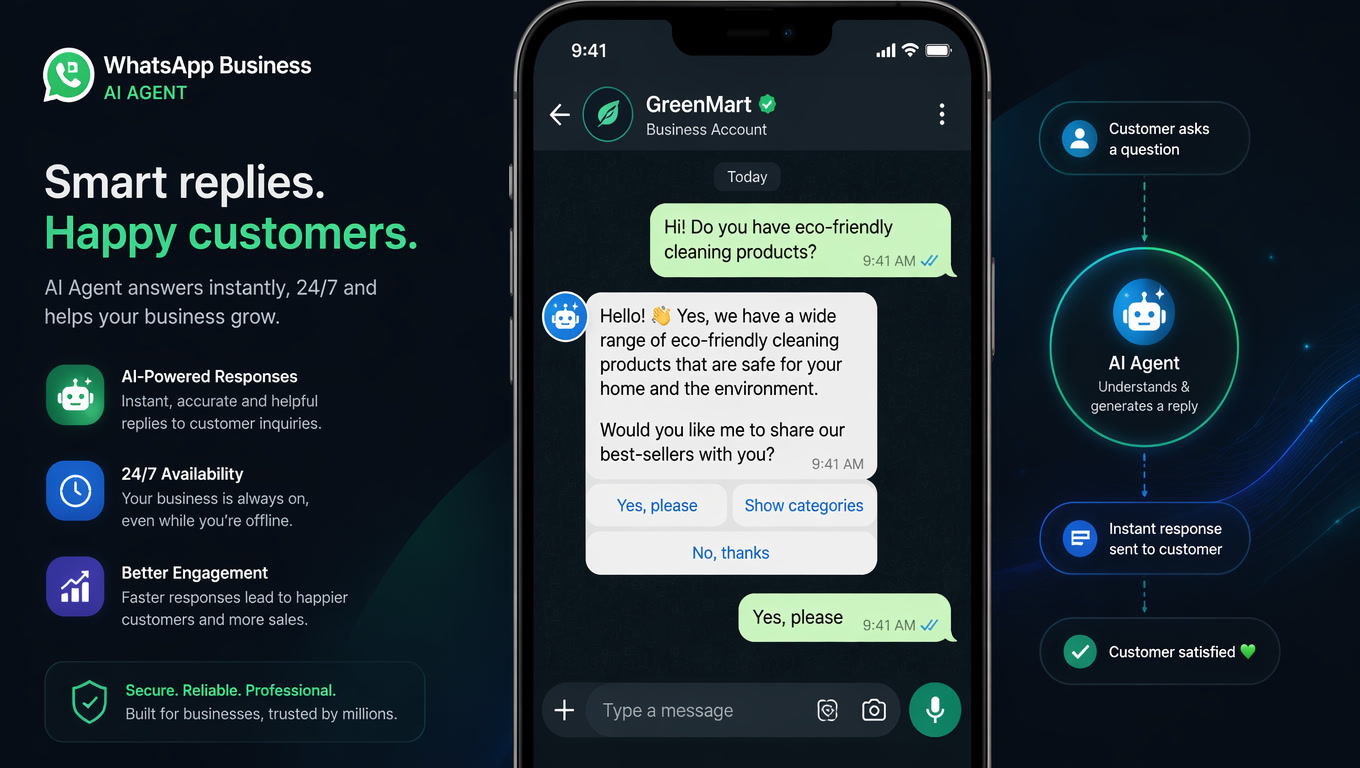
Meta announced Meta Business Agent on June 3, 2026 at its Conversations conference in London. This is not another chatbot that connects to your WhatsApp number. It is an AI agent built directly into the WhatsApp Business app, requiring no developers, no additional subscriptions, and no technical integration to get started.
Mark Zuckerberg framed it as: "As our models advance, your agent will take on more and eventually help you run your whole business."
The launch follows nearly two years of testing in India, Mexico, and Brazil, where over a million businesses were already using earlier versions. Meta reports over a billion active conversation threads between businesses and customers every day across WhatsApp, Messenger, and Instagram.
The native agent's confirmed capabilities include:
- Answering customer questions using your product catalog, website, and FAQs
- Recommending products directly from the WhatsApp Business catalog
- Booking appointments by connecting to your calendar
- Qualifying incoming leads and separating serious buyers from casual inquiries
- Escalating to a human when complexity exceeds a threshold
- Responding in the customer's local language automatically
- Matching your brand's tone and personality
All of this is configured from the app, with no coding required. Meta says setup takes under 10 minutes for a business with an existing catalog and FAQs.
What Changes: The New WhatsApp Automation Map
Before June 2026, businesses had essentially two options for WhatsApp automation:
- WhatsApp Business App — manual management, no real automation
- WhatsApp Business API — requires development or integration with platforms like WATI, Twilio, or CRM-native APIs like Clientify
Meta Business Agent creates a third lane: native automation with no code, no API, and no third-party provider. This changes the map for the micro-business segment that previously couldn't access automation due to cost and technical complexity.
Comparison Table: Three Paths for WhatsApp Automation
| Aspect | Meta Business Agent (native) | WhatsApp API + n8n/Clientify | BSP like Twilio/WATI |
|---|---|---|---|
| Monthly cost | $0-15/mo estimated (token) | $30-100/mo (VPS + AI API) | $50-500/mo depending on volume |
| Setup time | 10 minutes (no code) | 2-5 days (n8n + API) | 1-3 days (platform) |
| CRM integration | ❌ Not available | ✅ Contacts, leads, tasks | ✅ Depends on plan |
| ERP/system integration | ❌ Enterprise tier only | ✅ n8n connects any API | ⚠️ Limited |
| Broadcast/Campaigns | ❌ Inbound only | ✅ Proactive messaging | ✅ Proactive messaging |
| Multi-channel | ❌ WhatsApp only | ✅ WhatsApp + Email + Web | ⚠️ Depends on BSP |
| Data control | ❌ Data on Meta servers | ✅ Self-hosted (n8n) | ❌ Data on BSP servers |
| AI customization | ⚠️ Configurable, not programmable | ✅ Custom prompts, models, RAG | ⚠️ Limited to BSP |
What Doesn't Change: The Limitations That Matter
Here is what Meta does not put on the landing page. The native agent has three structural limitations that any business with real operations needs to consider.
1. No External System Integration (Self-Serve Tier)
The native Meta agent cannot read or write to Shopify, Salesforce, HubSpot, your ERP, or your internal database. If a customer asks "what's the status of my order #4821?" or "update my shipping address," the native agent can only respond with information already in the WhatsApp catalog or files you uploaded.
For deep integrations, Meta offers an enterprise tier (Meta Business Agent Platform) that connects to Shopify, Zendesk, and Shopee through APIs — but it is designed for high-volume businesses with consumption-based pricing.
2. Responds Only, No Proactive Messaging
The native agent handles inbound queries only. You cannot use it for marketing campaigns, abandoned cart reminders, or automated post-sale follow-ups. For that, you need the WhatsApp Business API with approved message templates.
3. Token Pricing That Scales with Complexity
The per-token pricing model ($2/1M tokens) means the more complex the conversation — and the more context it requires — the more each message costs. Meta estimates 4-5 cents per typical message, but conversations requiring extensive context (long histories, multiple product references) can consume significantly more tokens.
For high volumes of simple queries (FAQ, prices, hours), this is cheap. For complex, multi-turn conversations requiring heavy context, the cost can exceed that of a custom solution making direct LLM API calls.
The Decision Framework: Native Agent or Custom Build?
Based on our experience implementing WhatsApp automation for clients in Latin America, here is the framework we use:
| Your Situation | Native Meta Agent | Custom Agent (n8n + API) |
|---|---|---|
| FAQ-type queries, no integrations needed | ✅ Use native | ❌ Overengineered |
| Need CRM integration (Clientify, HubSpot) | ❌ Doesn't connect | ✅ Build custom |
| Volume < 500 inquiries/month | ✅ Native is enough | ❌ Too expensive for volume |
| Queries requiring actions in business systems | ❌ Can't execute | ✅ Build custom |
| Proactive campaigns / broadcast | ❌ Inbound only | ✅ API required |
| Tight budget, no technical team | ✅ Native fits | ❌ Needs support |
| Sensitive data / local regulation (LGPD) | ❌ Data on Meta | ✅ Self-hosted n8n |
| Multi-channel (WhatsApp + web + email) | ❌ WhatsApp only | ✅ Build custom |
The Hybrid Strategy (Our Recommendation)
For most businesses that already have a CRM and defined processes, the best approach is not to pick one or the other, but to use both in sequence:
Phase 1 (weeks 1-4): Use Meta's native agent to deflect simple FAQ queries while you start measuring what your customers actually ask. This gives you real data on the most frequent intents without investing in custom development.
Phase 2 (weeks 4-8): With Phase 1 data, build a custom agent with n8n + WhatsApp Business API + Clientify/HubSpot that handles queries requiring system access. The native agent continues handling simple questions.
Phase 3 (months 2-3): Unify everything into a single stack where the custom agent decides what it can resolve autonomously and what escalates to a human — with complete conversation context.
This hybrid approach is what we have found works best in practice. Meta's native agent is excellent as a first-response layer; the custom agent is necessary as the integration layer with the systems that actually run the business.
Implications for Latin America
WhatsApp is the dominant communication channel in Latin America. Meta reports that over 80% of SMBs in the region use WhatsApp to communicate with customers. Meta Business Agent's launch has specific implications for this market:
For micro-businesses and entrepreneurs — This is a massive change. A business that previously handled WhatsApp manually can now have an AI agent running in 10 minutes, with no monthly chatbot subscription. This democratizes automation access for the largest segment of Latin America's economy.
For SMBs with CRM and processes — The native agent is a complement, not a replacement. If you already use Clientify or any CRM with automation, the native agent can handle the first response layer, but queries that require creating leads, updating contacts, or checking inventory still need a custom solution.
For agencies selling automation — Meta's native agent compresses the market for simple FAQ-based chatbots. Agencies offering only FAQ chatbots will lose clients to Meta's free solution. Differentiation now depends on deep CRM, ERP, and process integrations — exactly where Meta's native agent cannot reach.
What This Means for Your Automation Stack
The launch of Meta Business Agent does not kill the custom automation market. What it does is split the market into two layers:
- Layer 1 — Basic customer service: FAQ, catalog, hours, simple questions. Meta's native agent is sufficient and cheap/free.
- Layer 2 — Process automation: CRM integration, lead creation, contact updates, database queries, multi-channel. Here you still need a custom stack with WhatsApp Business API + n8n + AI + CRM.
The mistake we see in the market is assuming Meta Business Agent solves everything. It does not. It is an excellent tool for a specific layer of customer service, but businesses that need process automation — where the real ROI lives — still need a custom architecture.
At Mintec, our approach does not fundamentally change: we continue building custom agents with n8n + WhatsApp Business API + Clientify for clients who need genuine system integration. What changes is that we can now recommend Meta's native agent as a first line for smaller businesses that previously did not qualify for automation, and as a complement for companies that already have automated processes.
The decision is not binary. As we explain in our article on when NOT to use AI for automation, the right tool depends on the specific problem. Meta Business Agent is the right tool for a specific set of problems. For everything else, a custom stack remains the answer.
If you want to understand how to build a custom WhatsApp agent, our article on WhatsApp CRM integration with AI agents covers the architecture and costs in depth. And the WhatsApp bot-to-human handover guide addresses one of the most critical aspects of any WhatsApp automation implementation.
Frequently Asked Questions
What is Meta Business Agent and how does it work on WhatsApp?
Meta Business Agent is a native AI agent built directly into the WhatsApp Business app. It automatically answers customer questions using the knowledge sources you provide: your product catalog, website, FAQs, and past conversations. You can set it up from the app in under 10 minutes without any coding.
How much does Meta Business Agent cost starting August 2026?
Meta will charge $2 USD per million tokens consumed. A typical message consumes between 20,000 and 25,000 tokens, which works out to roughly 4-5 US cents per message. Service messages (from third-party agents or humans) remain free until October 1, 2026, when per-message pricing begins.
Does Meta Business Agent replace custom WhatsApp automation built with n8n?
No. The native agent handles FAQ-type queries and catalog questions well, but its self-serve tier cannot read or write to external systems like CRM, ERP, or Shopify. For deep integrations with your business stack — creating leads, updating orders, checking inventory — you still need a custom agent built on WhatsApp Business API + n8n + AI.