

Pharmacy Automation: Recovering Chronic Prescriptions Without Touching Controlled Ones
Half of chronic patients don't follow treatment. Here is how to automate prescription refill reminders without crossing the rules around controlled medicines.
Pharmacy Automation: Recovering Chronic Prescriptions Without Touching Controlled Ones
Automating prescription follow-up in a pharmacy means knowing the day each chronic patient's treatment runs out and pinging them on WhatsApp before that patient buys the box somewhere else — with a hard line: everything that touches controlled medicines stays with the pharmacist and on paper. The WHO puts adherence to chronic treatment at around 50% in developed countries and below that figure elsewhere. In the United States that leak is worth roughly USD 142,000 a year in lost refills per pharmacy (CDC/NCPA, 2025). Nobody publishes the regional number, but the mechanism is identical: a chronic patient does not quit treatment on a Monday. One day they don't stop by for the box, and two months later they are buying at another pharmacy.
The prescription that drops itself
Adherence is the quiet asset of a neighbourhood pharmacy. A chronic patient who refills on time is not a sale — it is a repeating revenue line for years with zero acquisition cost. Abandonment is almost never a decision; it is a logistics interruption.
Independent sources converge:
- 50% adherence in chronic conditions in developed countries, lower elsewhere (WHO, as cited in adherence reviews such as Ortega Cerdá, Salud Pública de México, 2018).
- Between 14% and 90.1% depending on the study and the population: a Peruvian systematic review of 14 studies (Camacllanqui Santos, 2025) shows the real range is so wide that averaging it is useless.
- 35.4% of adults aged 30 to 79 with hypertension across the Americas (PAHO, 2024): the chronic-patient base is growing faster than any neighbourhood pharmacy's capacity to follow up by hand.
- USD 142,000 a year in lost refills per pharmacy (CDC/NCPA, 2025). That is not a health figure. It is a business figure.
- Up to 75% of a pharmacist's hours go to administrative tasks and manual data entry (datascanpharmacy, 2026), and handling supply incidents eats about 12 hours a week on average (El Global Pharma, 2026).
The market is responding: pharmacy automation moves from USD 8.36 billion in 2026 to a projected USD 17.34 billion in 2035, a 9.32% annual rate (Market Research Future), almost all of it into dispensing robots and hospital software. What an independent pharmacy needs is far more boring: a treatment clock and a message.
What moves adherence and what doesn't
Here the evidence contradicts itself, and the contradiction is what shapes the architecture.
What the reminder vendors say: an automated 7-, 3- and 1-day alert schedule improves adherence by 34% compared with no alerts (Journal of the American Pharmacists Association, 2025, cited in pharmaceutical automation guides). And short messages do get read: 98% of SMS opened within 3 minutes against 22% of email within 3 hours (Pharmacy Times, 2025).
What academia says: a controlled trial with 403 hypertensive and diabetic patients in Maringá, Brazil, 16 weeks of follow-up, compared usual care against usual care plus 55 WhatsApp messages: 67.5% adherence in the intervention group against 58.5% in the control (risk ratio 1.15; confidence interval 0.99–1.34; p = 0.077). The authors call it a clinically relevant 15% increase. It is not significant in the strict sense. A WhatsApp trial moved the needle 9 points and still failed significance.
Our reading: the reminder is not the product, the logistics are. A message that says "time to refill" and has no idea whether the box is on the shelf or whether the patient can collect today produces a broken promise — and a pharmacy that breaks promises loses patients faster than a pharmacy that never writes at all. The meta-analysis of pharmacist-led interventions in older adults (Journal of the American Geriatrics Society, 2021) improves adherence significantly, and its common ingredient is not the channel: it is that someone with judgement answers.
The pharmacy's three lanes
We keep seeing the same architectural mistake: treating "the prescription" as a single object. It is not. Three lanes, three levels of automation, and one you never touch.
| Lane | What it covers | Who decides | What gets automated |
|---|---|---|---|
| A — Straight-through fill | Repeat simple prescription, same active ingredient and dose, treatment longer than 30 days | The rule | Expiry calculation, alerts at −7/−3/−1 day, reply, routing to pickup or delivery, dispense logging |
| B — Supervised fill | First dispense, dose change, polypharmacy, recorded allergies, prescription missing required fields | The pharmacist | Draft message, history summary and alert; the decision and the signature stay human |
| C — Never automated | Controlled medicines, retained original prescription, stamp per fill, control ledger, illegal or incomplete prescription | Human and paper | Only two things: a stock alert and a notice that it is time to come in. Dispensing and recording never enter the flow |
The boundary is not commercial, it is legal. In Mexico, a prescription missing required fields obliges the pharmacy not to dispense (NOM-024-SSA3-2012 and NOM-072, which requires the generic name): if your automation "helps" by filling in fields, it is manufacturing the evidence of its own violation. Practical rule: if the system can calculate the date, it can message. If the system can sign, stamp or file, it is not a system — it is an administrative offence waiting to happen.
What changed on 14 July
If you operate in Mexico, an update rewrites Lane C. COFEPRIS press release 15/2026, published 3 July: tramadol moved into Fraction III of Article 245 of the General Health Law, in force since 14 July 2026. It still goes out on a plain prescription from any licensed physician — no special prescription — but the operational burden falls entirely on the pharmacy:
- Stamp the prescription on every delivery, noting the date and quantity dispensed.
- Record each operation immediately in the corresponding control ledgers.
- Up to three fills from a single prescription, depending on the prescribed treatment duration, with the prescription retained and archived once finished.
- Storage in a restricted, locked area, plus digital traceability of batch, invoice and the buyer's sanitary licence (an obligation on distributors and warehouses).
Translated into architecture: Lane C can no longer carry a generic "auto-refill reminder", because in these treatments the patient does not hold the prescription — you do. What you can automate is the system knowing how many fills remain from the prescription sitting in the drawer, and alerting the pharmacist when the third one approaches. The stamp and the ledger stay ink and skin. That is exactly why automated compliance across Latin America is designed in layers, not in tools.
How it is built
The full flow has five steps, and none of them needs AI at first:
| Step | What it does | Typical tool |
|---|---|---|
| 1. Consent | Explicit opt-in for WhatsApp contact for health purposes, with the exact wording and date stored | Form + CRM |
| 2. Treatment clock | Last dispense + days of supply → expiry date per patient | Connected POS or sheet + n8n |
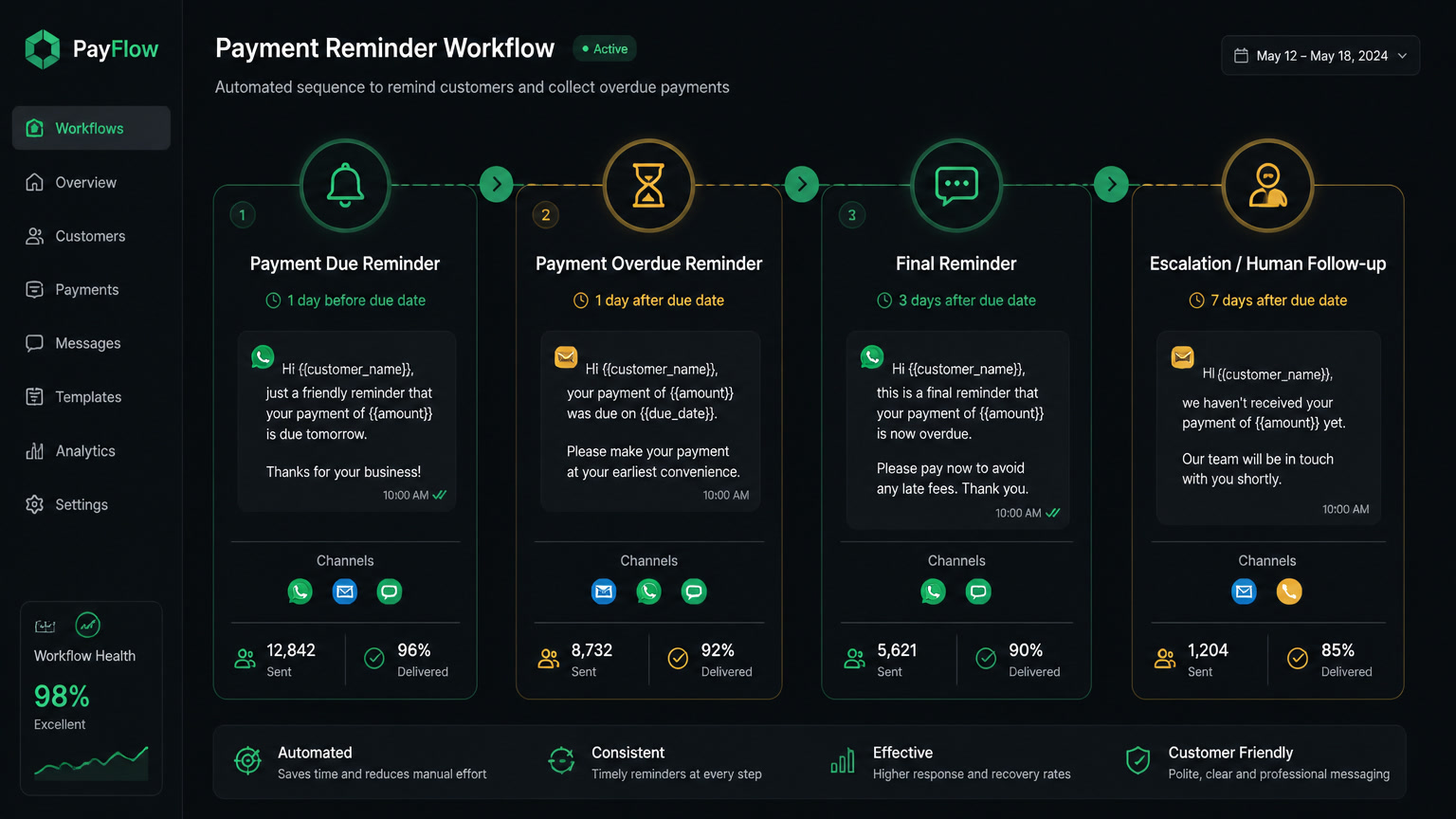
| 3. Cadence | Alerts at −7, −3 and −1 days, with a gate: already ordered, no repeat | n8n or Make |
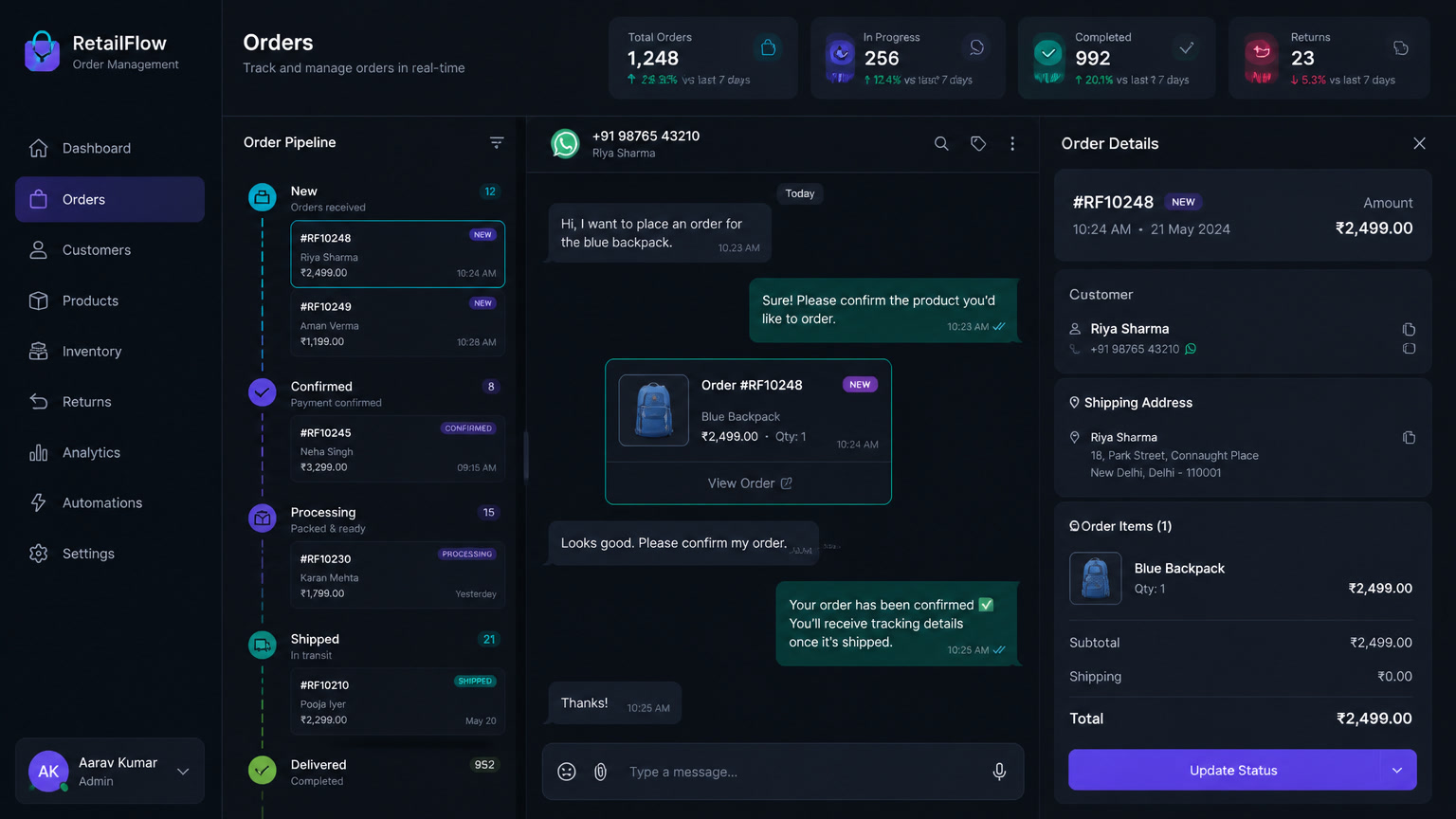
| 4. Reply routing | "Is it in stock?", "send my prescription", "I don't need it anymore" → pickup, pharmacist question or unsubscribe | WhatsApp API + classification |
| 5. Close the loop | Log the dispense and return to step 2 with a fresh clock | CRM + n8n |
Three decisions that define the cost:
- A proactive message is not a service message. Alerts go out as templates outside the 24-hour window, and their classification — utility if transactional, marketing if it pushes a purchase — changes the price of each conversation. Replies inside the window are the free part: 1,000 service messages per business number per month since 1 October. For a pharmacy sending 500 reminders a month, that matters more than any AI feature.
- AI enters late, at one point only. Classifying a patient's free-text reply ("my stomach burns", "can I take this with another one") is natural language and does justify a model. Calculating expiry dates does not.
- Stock comes before the message. If the box isn't there, the reminder turns a sale into a complaint. That is why the inventory replenishment clock gets connected before the cadence is switched on.
Typical cost of a modular stack: self-hosted n8n at USD 6–20/month, a Clientify-style CRM at USD 0–99/month, WhatsApp Business API per conversation (varies by country and category), and USD 10–30/month in API if you add AI classification. Total: USD 40 to 160 a month against the tens of thousands an automated dispensing system costs.
Four metrics from week one
- Refill within 7 days: the share of expired treatments renewed in the following week. The only metric that tracks revenue.
- Same-day reply rate: if a WhatsApp question waits until tomorrow, the sale waits until tomorrow — or leaves.
- Broken promises: alerts sent with the product out of stock. Zero tolerance.
- Opt-out rate: tells you whether you are reminding or spamming. In health, a fast opt-out is information, not failure.
Opinion: open rate is the best-looking metric worth the least. A pharmacy can hit 98% open and still lose the treatment, because opening is not collecting.
Three mistakes we see when implementing
- Starting with Lane C. The owner asks for "everything on its own" first because that is where it hurts. That is where the mistake costs a sanitary licence. You start with A.
- Alerting without stock visibility. The fastest flow to build and the most expensive one in trust.
- Confusing adherence with a missing reminder. When a refill drops, it is almost always stock, price, hours or distance. The message only exposes the problem; it does not cure it. We saw the same in clinics: appointment no-shows are not fixed with more cadence, and the same principle applies here.
What stays human
The pharmacy is not automated end to end, and it shouldn't be. The clock is automated, the dispense is supervised, and everything the law turned into the pharmacist's personal responsibility stays untouched. That edge is not a limitation of the project — it is the design.
Start with the deterministic 80% (clock, alert, reply, log) and leave AI for when the volume of free-text replies justifies the cost, the same way we treat process automation without overengineering. And if WhatsApp is the channel, put consent and opt-out first: storing health data is a purpose decision, not a form field.
A chronic patient doesn't leave you over price. They leave because one Tuesday they didn't stop by for the box and nobody told them.
Frequently Asked Questions
What is prescription refill automation in a pharmacy?
It is the workflow that calculates when each chronic patient's treatment runs out based on the last dispense, messages them on WhatsApp before it lapses, and logs the reply. It does not replace the pharmacist: it separates what is a rule from what needs clinical judgement or a legal procedure.
Can follow-up on controlled medicines be automated in Mexico?
Only the patient reminder and the stock alert. Dispensing still requires the original prescription, a stamp with date and quantity on every fill, and an immediate entry in the control ledger. Since 14 July 2026 that includes tramadol, reclassified into Fraction III of the General Health Law.
How much does WhatsApp-based refill automation cost?
A modular stack with self-hosted n8n, a CRM such as Clientify and the WhatsApp Business API runs roughly USD 40 to 160 per month depending on volume. Reminder templates are billed per conversation, and the 24-hour window includes 1,000 free service messages per business number each month.