From Spreadsheet to Purchase Order: How to Automate Inventory Replenishment
84.8% of businesses still track stock in spreadsheets and only 36% use reorder points. Here is how to automate replenishment with n8n, rules and WhatsApp approval.
From Spreadsheet to Purchase Order: How to Automate Inventory Replenishment
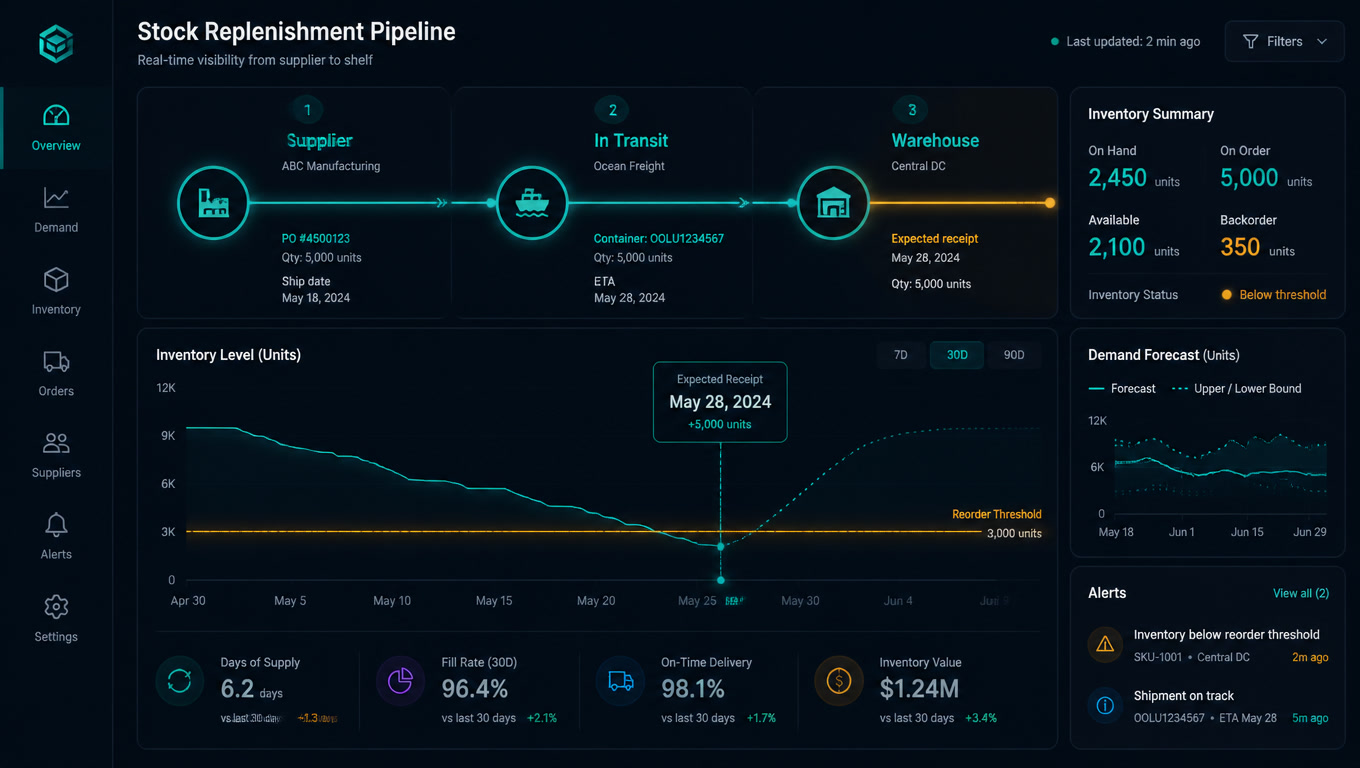
Automating inventory replenishment means turning a stock level into a signal that reaches the buyer at the right moment, with the quantity already calculated and a draft purchase order waiting for approval. For an SMB, the profitable path is not a demand-forecasting model: it is a reorder point per SKU, a daily stock sync, and a WhatsApp approval gate. 84.8% of operators still track inventory in spreadsheets and only 36% use reorder points or alerts (inflow, 400 operators, 2026; HandiFox, 50 SMBs, 2026). That is the gap, and closing it does not take a data science team.
Stockouts and dead stock look like opposite problems. In practice they come from the same failure: the business decides late. Someone notices there are a few units left after they are gone, and discovers the excess when the month-end close shows cash sitting in the warehouse.
We have built replenishment flows for retail and logistics clients in Mexico and Colombia. The pattern repeats: the math was never the problem. The problem was that the buying decision lived in one person's memory and in a spreadsheet nobody opened between Monday and Thursday.
Both extremes come out of the same pocket
Independent 2026 studies agree:
- Global inventory distortion: $1.7 trillion, or 6.2% of worldwide retail sales, combining stockouts and overstocks (IHL Group, 2026).
- 84.8% of operators use spreadsheets to track stock; among 500+ employee companies, 86.4% use them and 53% use no software at all (inflow, survey of 400 operators, 2026).
- Only 36% of SMBs use reorder points or alerts. 46% do manual stock checks and 44% reorder "when it runs low" (HandiFox, Small Business Outlook 2026).
- Excess stock reached 38% of SMB inventory, and 55% of SMBs report 20% or more of their stock as excess (Netstock, 2024–2025).
- 43% of consumers switch to a competitor when a product is out of stock (Orlio, retail research review).
- Carrying inventory costs 20–30% of its value per year (Institute for Supply Management, via NetSuite).
Translated: overpaying for excess and losing the sale to a stockout are not two inventory problems. They are two invoices for the same slowness.
The calculation almost nobody has: a reorder point per SKU
Automation needs a rule, not an intuition. The base rule:
Reorder point = (average daily sales × supplier lead time) + safety stock
Safety stock = (maximum lead time − average lead time) × average daily sales
A concrete example. A store sells 10 units per day of one SKU. Its supplier delivers in 12 days, with up to 3 days of variability over recent months.
- Safety stock: 3 × 10 = 30 units
- Reorder point: (10 × 12) + 30 = 150 units
- When available stock crosses 150, the purchase fires. Not when it "looks low".
That number, calculated once per SKU and reviewed each quarter against real sales velocity, removes the human decision from the critical moment. The buyer stops deciding what to buy and starts deciding whether to approve what the system proposes. Changing that conversation is the whole difference between having a process and having a spreadsheet.
Four levels of automated replenishment
Not every business needs level four. This is the real ladder:
| Level | How it works today | What gets automated | Monthly cost | Who it is for |
|---|---|---|---|---|
| L0 — Reactive | Hand counts, paper, "tell me if it looks low" | Nothing | $0 | Under 50 SKUs, one sales point |
| L1 — Alert | A per-SKU threshold pings the buyer | Detection | $6–20 (self-hosted n8n) | 50–300 SKUs, one person buying |
| L2 — Signal + draft | Reorder point calculated, PO draft generated, human approval | Detection + math + drafting | $20–70 | 300–2,000 SKUs, or several locations |
| L3 — Integrated | PO sent to supplier, goods received reconciled against PO and invoice, lead time variance logged | Full traceable cycle | $70–250 | High volume or suppliers with a portal |
Most Latin American SMBs sit at L0 or L1 and believe they are at L2 because "there is a spreadsheet with alerts". The test is simple: if you cannot answer within 30 seconds how many units of each critical SKU to order, you are below L2.
Moving from L1 to L2 is where the return lives. US Tech Automations reports that SMBs with 100 to 5,000 SKUs recover an average of $47,000 per year through reorder point monitoring, lead time tracking and automated purchase order generation (Hearthstone case study, 2026).
Where AI actually helps — and where it does not
Here is the opinion that has saved us from badly spent projects: for replenishment arithmetic, AI is overkill. A threshold does not need natural language. What does need natural language is everything around the purchase.
| Task | Use AI? | Why |
|---|---|---|
| Calculate the reorder point | No | Deterministic math; a model error becomes a buying error |
| Detect low stock and trigger the alert | No | Simple threshold |
| Draft the purchase order | No, unless template with variables | Fixed text with dynamic fields |
| Classify supplier confirmations over WhatsApp | Yes | Free messages: "yes, shipping Thursday but only 40 units" |
| Reconcile PO vs. invoice vs. receipt | Yes to read, rule to decide | Extracts amounts and quantities; the decision stays in rules |
| 90-day demand forecasting | Only with 500+ SKUs and 12 months of data | With short series the model overfits and the spreadsheet wins |
| Detect lead time drift per supplier | Yes to summarize, rule to alert | Many orders, little human attention |
The question is not "should I use AI?". It is: does this task fail because of language variability or because of missing discipline? Discipline gets a rule. Language gets a model. Our piece on when not to use AI for business automation develops that criterion with more examples.
The architecture: from stock to approved purchase order
| Layer | Tool | Function | Cost |
|---|---|---|---|
| Stock source | Shopify, WooCommerce, Mercado Libre, Tiendanube, POS or internal database | On-hand, reserved, daily sales | $0–49 (store plan) |
| Orchestration | Self-hosted n8n or Make | Sync, rules, PO drafting, alerts | $6–29 |
| Rules engine | Spreadsheet or lightweight table | Reorder point, lead time, safety stock per SKU | $0 |
| Approval gate | WhatsApp Business API → buyer | PO draft with quantity and amount; approve or reject with one message | Per-country template rate |
| Optional AI classification | OpenAI or Claude via API | Free-form confirmations, PO/invoice mismatches | $10–30 |
| Total | $20–70/month |
Two architecture decisions matter more than the tool choice:
1. Sync three numbers, not one. The most expensive mistake is confusing available with on-hand. A store sees 10 units in Shopify, 8 already reserved by open orders, and only 7 physically on the shelf: with the wrong figure, the system recommends buying late. The stock feeding the rule must be available = on-hand − reserved − committed.
2. The approval gate comes before supplier integration. Sending purchase orders automatically to a supplier without 60 days of clean signal is how excess stock gets created. In our implementations the buyer keeps approving over WhatsApp until the accepted recommendation rate stays above 90% for two months. Only then does auto-send get enabled for low-volatility SKUs.
What the tutorials skip if you buy in Latin America
Three realities that change the implementation:
- Your supplier relationship already lives on WhatsApp, not on EDI. Use that: the value is not integrating a portal the supplier does not have, but having the PO draft arrive as a structured message and the confirmation come back as free text classified by AI.
- Local lead times are more volatile than the North American playbooks assume. Import, currency swings and partial deliveries widen the spread; safety stock in the formula is not a luxury, it is the margin that prevents the stockout.
- Cash beats forecast. Buying too much locks up cash: 55% of SMBs hold 20% or more of their inventory as excess (Netstock, 2025). A process that proposes buying with approval protects cash flow; one that proposes automatically can burn it.
On message costs: check what changed in WhatsApp service message pricing from October 1 before you design how many messages per SKU per day your flow will consume.
Four weeks, not four months
| Week | What gets built | Verifiable result |
|---|---|---|
| 1 | Daily sync of stock and sales; reorder point calculated for the top 20% of SKUs | Live reorder point table per SKU |
| 2 | Parallel run: system recommendations vs. real manual buying | Differences documented, rules adjusted |
| 3 | WhatsApp approval gate with PO draft | First PO approved from a phone, fully traceable |
| 4 | Variance dashboard: stockouts, excess, actual vs. average lead time | Basis for quarterly rule review |
The two-week parallel run is not bureaucracy: it is what makes the team trust the recommendation and what catches configuration errors before they cost money. At the end, the buyer's daily review shrinks to something like ten minutes of approvals instead of an afternoon of counting.
Three mistakes we saw in real implementations
- Buying the forecast before the sync. A demand model fed with dirty stock produces elegant forecasts and wrong purchases. Data source first, intelligence second.
- Skipping the approval gate. With no human in the middle, the first sales spike generates a large order that the month-end close reveals as excess. Automation has to earn auto-send.
- One "stock" number for three realities. On-hand, reserved and available are not the same. Merging them into one column is the fastest way to make the system recommend buying late.
If you are starting the process from scratch, first look at the CRM workflows that actually work and the Make vs n8n comparison: replenishment is a deterministic flow, and choosing the orchestration layer well avoids rebuilding the architecture when volume grows.
And if someone on your team is already proposing to add AI forecasting to the first sprint, share the boring automations that save more money. The return is not in the finest model; it is in the signal that arrives on time.
Frequently Asked Questions
What is a reorder point and how do you calculate it?
It is the stock level that triggers a purchase. Multiply average daily sales by supplier lead time, then add safety stock for lead time variability. With 10 sales per day, a 12-day lead time and up to 3 days of variability, the reorder point is 150 units: (10 × 12) + (3 × 10).
Do I need artificial intelligence to automate inventory?
Not to start. Reorder point math, low-stock alerts and purchase order drafting are deterministic rules and do not need AI. AI earns its place on tasks with free-form language: classifying supplier confirmations written over WhatsApp, or spotting mismatches between purchase order, invoice and goods received.
How much does inventory replenishment automation cost?
A modular stack with self-hosted n8n, a connected spreadsheet or lightweight database and WhatsApp notifications runs $20 to $70 per month, with no ERP licence. Adding an AI model for classification adds $10 to $30 per month in API usage.