
Automating Follow-Up for Silent Prospects: The System That Recovers the 80% of Leads You're Losing
48% of salespeople never make a second contact. An automated follow-up system in n8n + CRM recovers silent leads that represent 80% of lost potential sales.
80% of your leads aren't lost to a bad product — they're lost to silence
You had a lead that showed interest. They replied to your message, attended the demo, asked for a proposal. And then... silence. They don't respond to the email. They don't open the WhatsApp. The rep makes one attempt, maybe two, moves on. That prospect — who already expressed genuine interest — evaporates from the pipeline without anyone noticing.
It's not a lead quality problem. It's a follow-up architecture problem.
According to Thunderbit (2026), 48% of salespeople never make a second contact after the first meeting, and 44% give up after a single follow-up. But 80% of sales require at least 5 follow-up attempts. We're leaving money on the table not because leads aren't ready, but because our follow-up system collapses after the first human attempt.
The difference between an operation that recovers silent prospects and one that abandons them isn't sales talent — it's automated infrastructure.
Why manual follow-up fails at scale
Manual follow-up works when you have 5 leads a month. At 50, it breaks. At 200, it's structural invisibility.
FA Magazine (2025) data shows the brutal gap between manual and automated follow-up:
| Metric | Manual follow-up | Automated follow-up |
|---|---|---|
| Prospects contacted within 1 hour | 12% | 97% |
| Prospects receiving 5+ touches | 8% | 100% |
| Average time to first meeting | 34 days | 18 days |
| Prospect-to-client conversion | 6-9% | 18-24% |
| Hours/week on prospect management | 4.7 hrs | 1.1 hrs |
The problem isn't that the rep doesn't want to follow up. It's that 200 prospects compete for their attention, and the one who went silent 3 days ago has no red flag visible. Silence doesn't show. A hot lead that stops responding looks identical to a lead that no longer exists.
The 5-touch framework that recovers silence
Based on data from 828,761 AI DM conversations (SetSmart, 2026), Forrester Q1 2026, and Copper CRM benchmarks, the most effective follow-up pattern for silent prospects:
The touch calendar
| Touch | Timing | Channel | Content type | Why it works |
|---|---|---|---|---|
| 1 | 0-1 hour | WhatsApp + email | Confirmation + concrete next step | Response speed = 21x qualification probability (Artemis GTM) |
| 2 | 4 hours | Value question: "What did you resolve with what we discussed?" | 13.85% of silent prospects respond to a single follow-up (Reachium) | |
| 3 | 24 hours | Value content: case study relevant to their industry | Conversations with 11+ messages convert 68x more than 1-4 (SetSmart) | |
| 4 | 3-5 days | WhatsApp or email | Specific resource: calculator, template, checklist | Multi-channel converts 2.3x vs single-channel (Forrester) |
| 5 | 7-10 days | Clean "breakup": "Is this still relevant? If not, I understand" | 60% say "no" four times before saying "yes" (InvespCRO) |
The key architecture: every touch adds value, not just requests attention. "Did you see my message?" isn't a follow-up — it's noise. A case study, an ROI calculator, or a specific question about their situation is.
The auto-detection rule
The most critical system isn't when to send — it's when to stop. The #1 mistake in automated follow-up is continuing to send when the prospect has already responded. In n8n, this is implemented with a polling node every 30 minutes that checks the inbox and updates CRM status:
- Prospect responds → sequence stops immediately
- Prospect opens email → intensify channel (opened email + no response = WhatsApp priority)
- Prospect clicks a link → escalate to human with full context
The technical architecture: n8n + CRM + WhatsApp
Here's what the full production flow looks like:
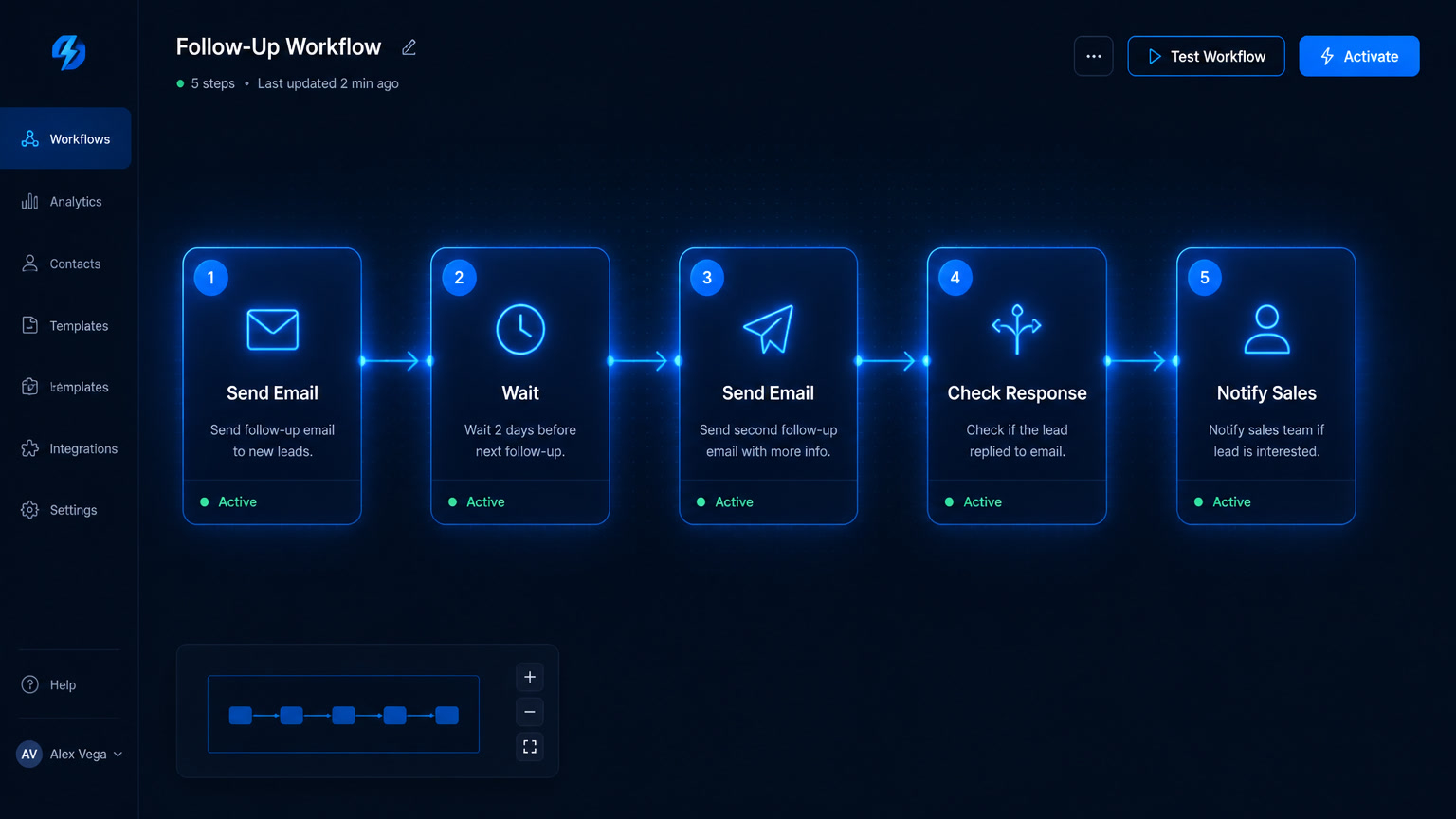
Capture → Enrich → Decide → Sequence → Detect → Escalate
Node 1 — Input webhook: Captures the lead from web form, Meta Ads, or WhatsApp API. Normalizes basic data.
Node 2 — Enrichment: Adds company data, size, industry. With AI, infers intent from the original message.
Node 3 — Silence scoring: Classifies the prospect:
- Hot (responded in <24h, asked for pricing) → immediate human handoff
- Warm (attended demo, didn't respond to follow-up) → 5-touch sequence
- Cold (filled a form and disappeared) → 3-touch sequence + 30-day re-engagement
Node 4 — Multi-channel sequence: Email + WhatsApp with timing based on the 5-touch table. Each touch uses different content based on profile and previous responses.
Node 5 — Reply detection: Polling every 30 minutes that detects email and WhatsApp responses. Updates CRM. Stops sequence. Notifies rep with full context.
Node 6 — Human escalation: When the prospect responds or crosses a score threshold, the rep receives a notification with: conversation summary, all touches sent, content opened/clicked, and AI-suggested response.
Stack and real costs
| Component | Monthly cost | Notes |
|---|---|---|
| n8n self-hosted (VPS) | $10-20 | DigitalOcean or similar |
| OpenAI API (personalization + scoring) | $20-40 | ~5,000 calls/month |
| WhatsApp Business API | $0-50 | Depends on volume |
| CRM (Clientify) | $0-99 | Basic plan up to 5,000 contacts |
| Total | $30-209/mo | vs $1,200+/mo HubSpot Enterprise |
For a team of 3-5 reps processing 100-200 leads monthly, the typical range is $60-120/mo. ROI closes with a single recovered lead that would have gone unnoticed.
The 3 silence patterns (and how to automate each one)
Not all silent prospects are the same. There are three patterns, each requiring a different response:
Pattern 1: "Interested but busy"
Signal: Opened the email, clicked the link, but didn't respond. Or asked for information but never followed up.
Cause: Timing — your proposal arrived during a workload peak. It's not rejection, it's postponement.
Automation: Repeat with different content in 3-5 days. Email 2 with a case study from a similar company. Email 3 with a personalized ROI calculator. WhatsApp with a direct question: "Are you still evaluating options for [specific problem]?"
Success metric: Email opens + clicks = 50% chance the sequence is working. Wait 7-14 days for close.
Pattern 2: "Disappeared after the demo"
Signal: Attended the demo or meeting, showed interest, then ghosted completely.
Cause: Internal competition — another vendor, another higher-priority project, or needs manager approval.
Automation: Two follow-ups with different angles. Email 1: "What internal obstacle did you encounter to moving forward?" (direct question that addresses the real objection). Email 2: "Many of our clients needed to align their team — here's a 1-page summary to share internally." WhatsApp with a 30-second audio from the rep.
Success metric: Response rate to the direct question > 15%. If they respond "I need to get approval from my boss" → activate enablement sequence (material for the decision-maker).
Pattern 3: "The lead that never existed"
Signal: Filled out a form, never responded to first contact.
Cause: Form captured low-intent lead (downloaded a PDF, didn't request a demo).
Automation: Low-frequency nurturing sequence (1 email/week x 4 weeks) with educational content. No WhatsApp — it's too invasive for this intent level. If no opens in 30 days → move to quarterly re-engagement list.
Success metric: At least 2 opens out of 4 emails. If 0 opens → verify email deliverability.
The error nobody tells you about: follow-up without value is automated spam
In Mintec we've seen implementations where teams automate exactly what they were doing manually — "Did you see my message?", "Could you review the proposal?", "Do you have any questions?" — and scale it to 5 automated touches. The result: the prospect marks it as spam and the email domain burns.
Every follow-up must answer one of three questions:
- Does this touch add information the prospect didn't have? (case study, relevant data)
- Does this touch reduce the prospect's effort? (1-page summary, calculator, direct link)
- Does this touch show we understand their situation? (specific question about their industry/problem)
If the answer to all three is "no," don't send that touch. Better 3 value touches than 7 of noise.
The metric that matters isn't "how many follow-ups did you send" but "how many of those sent generated a measurable response or engagement." If your per-touch engagement rate drops below 5%, you need to change the content, not increase frequency.
Metrics that actually matter
To operate this system, you need to measure 4 key metrics:
| Metric | Target | Alert if |
|---|---|---|
| Time to first contact | < 5 minutes | > 30 minutes |
| Follow-up response rate | > 15% per touch | < 5% per touch |
| Recovered leads/month | > 10% of silent leads | < 5% of silent leads |
| Avg silence-to-response time | < 7 days | > 14 days |
The most important metric: recovered leads. Not generated leads, not contacted leads — leads that were dead in the pipeline and returned to activity thanks to the automated sequence.
The next level: AI reply classification
When volume exceeds 100 leads/month, the next step is automatic response classification. An OpenAI or Claude node in n8n analyzes each response and decides:
- Confirmed interest → notify rep with high priority
- Price objection → send ROI case study and schedule follow-up
- "Not the time" → move to long-term nurture (1 email/month)
- "Not interested" → close sequence, mark as disqualified
- Auto-responder / out of office → pause sequence, resume on indicated date
This automatic classification prevents the most expensive mistake: treating a "no" as a "not now," or treating a "not now" as a "no forever."
Where to start tomorrow
If you have no automated follow-up system, start with the minimum — operational diagnostics will tell you where the biggest leakage is:
- Week 1: Set up an n8n webhook that captures leads and stores them in CRM with timestamp
- Week 2: Add an automatic email node that sends 1 hour after first contact
- Week 3: Add follow-up #2 at 24 hours with value content
- Week 4: Add reply detection and automatic detection
You don't need to build all 5 touches at once. Follow-up #2 alone — the one 44% of salespeople never send — recovers 13.85% of silent prospects (Reachium, 2026). With one more node in your workflow, you're ahead of 90% of your competitors.
A prospect's silence isn't a "no." It's a system that doesn't know how to listen.
At Mintec, we implement automated follow-up sequences for companies processing 100 to 500 monthly leads across Latin America. The system combines n8n, WhatsApp Business API, and CRM to recover leads that manual follow-up never reaches. More on automation and chatbots →
Frequently Asked Questions
How many follow-ups does it take to close a B2B sale?
80% of sales require at least 5 follow-up attempts after the first contact. Yet 44% of salespeople give up after one follow-up, and 48% never make a second contact at all.
How long should you wait between follow-ups?
The most effective pattern across 828K conversations: first follow-up at 4 hours, second at 23 hours after the prospect goes silent. Beyond that, space 3-7 days between value-add touches.
Which channels work best for automated follow-up?
Email + WhatsApp + CRM as the base. In LatAm, WhatsApp outperforms email for warm follow-up. Multi-channel automation converts at 2.3x vs single-channel (Forrester Q1 2026).