

The first 72 hours after closing a deal: 5 automations that prevent early churn
43% of B2B churn happens in the first 90 days. Here are 5 automations for the critical first 72 hours that protect deal value and reduce post-close attrition.
43% of B2B client churn happens within the first 90 days — and the most dangerous window is the first 72 hours after the deal closes. A Reddit post with 75 upvotes put it better than any analyst report: "I used to think more customers was the answer. Sometimes the real problem starts after they say yes." Businesses that automate that critical window reduce early-stage churn and protect the value the sale just generated.
Most SMBs pour all their ingenuity into getting the yes. Perfect demo, airtight proposal, tenacious negotiation. But the moment the deal closes, the enthusiasm dissolves into a sea of manual emails, delayed invoices, and kickoffs scheduled "sometime next week." According to Moxo's 2026 B2B Retention Report, nearly half of all clients leave within the first three months — and 50% of B2B buyers switched vendors in the past year because of a poor post-sale experience. It's not that the service is bad. It's that the operation between close and delivery has holes that human attention alone can't plug.
The problem nobody sees: the gap between closing and delivering
Think about what actually happens after a client signs:
- The salesperson sends an email with the signed contract and says "let me introduce you to our operations lead." Without structure, without a checklist, without a formal transition. What could be resolved with an automated handoff becomes a loose message.
- The operations team receives the contact without context — what were the client's goals? What was promised? What's the timeline?
- The invoice gets generated when someone remembers — sometimes two days later, sometimes a week.
- The kickoff gets scheduled for "when both sides have time" — typically 5-7 days after close.
- If something goes wrong, nobody notices until the client calls asking what's happening.
A Default.com (2026) report documents that teams who don't structure this handoff lose critical context at every transition — client goals, project risks, sales commitments. The result: reactive onboarding, clients doubting their decision, and delivery teams starting from scratch. McKinsey (2026) confirmed it: companies deploying AI across end-to-end processes outperform those running fragmented pilots. The same applies to post-sale automation: if each step is manual and isolated, each step is a point of failure.
The 5 automations for the first 72 hours
Five well-designed automations trigger the exact moment the CRM flips from "negotiation" to "won." Each one protects a different aspect of the relationship: money, communication, context, operations, and anticipation.
1. Immediate automated invoicing: collect before the client has to ask
The most expensive post-close mistake is waiting until "someone remembers" to invoice. According to US Tech Automations (2026), companies with automated invoicing collect payments an average of 8 days faster than those invoicing manually. For an SMB closing 10 deals per month at $3,000 average, 8 days of delay means $24,000 in receivables sitting still.
What to automate:
- When the deal changes to "won" in the CRM → invoice auto-generated.
- Invoice sent via email within 15 minutes.
- If no payment in 48 hours → automatic reminder with payment link.
- If no payment in 5 days → escalation to the team with alert.
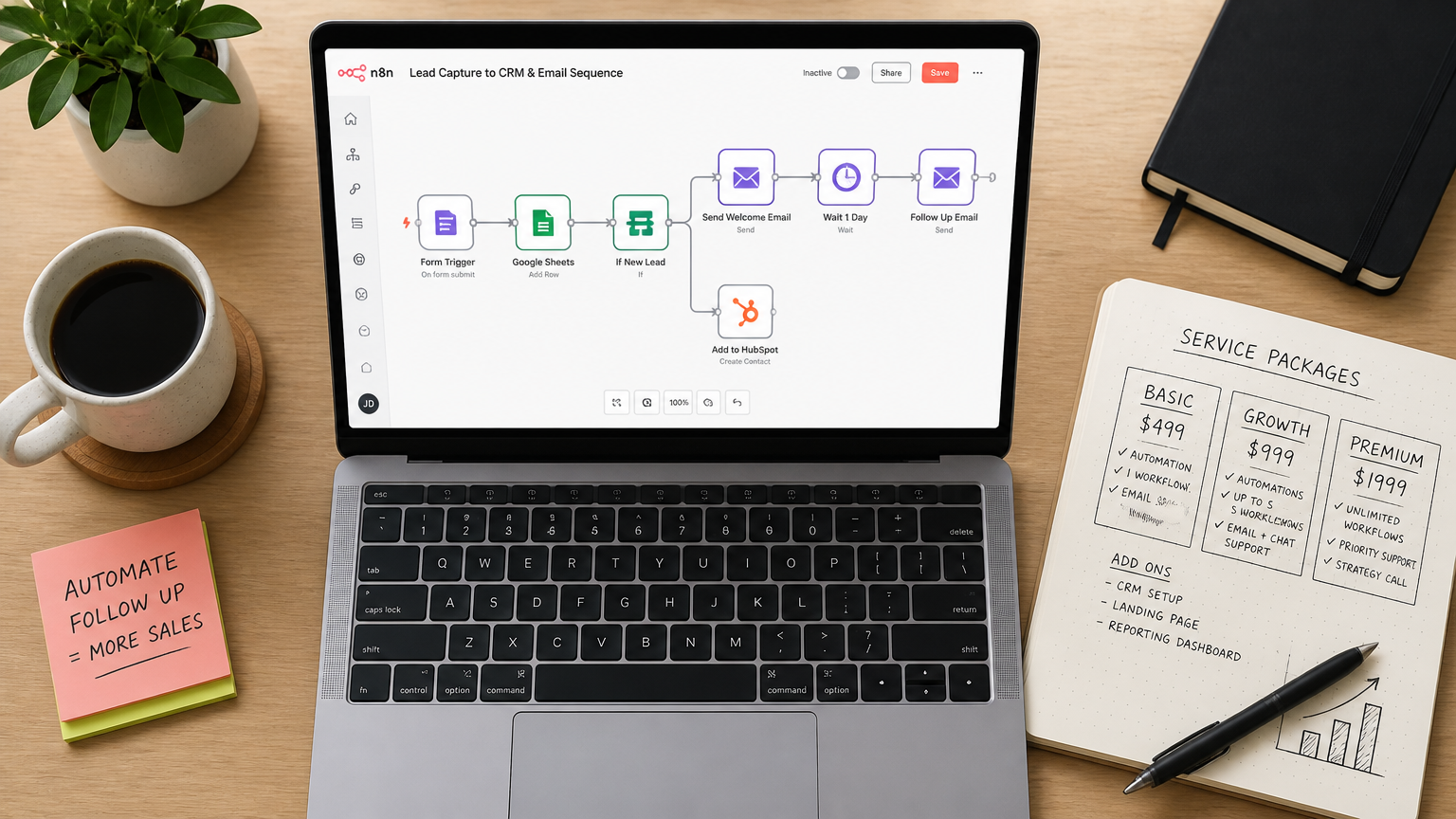
Stack: n8n + CRM + invoicing tool. Cost: $30-80/mo.
2. Immediate welcome sequence: first contact within 24 hours
Rivo (2026) reports that 89% of B2B customers cite customer service as the primary factor in staying with a vendor. WorldMetrics (2026) adds that 50% of customers expect the brand to acknowledge their purchase within 24 hours. If your client signs on Monday and doesn't hear from anyone until Wednesday, you're already losing points.
What to automate:
- Minute 0-15: Confirmation email summarizing what was agreed and next steps.
- Hour 1-2: Notification to the delivery team with client profile and objectives.
- Hour 24: Personalized check-in — "Any questions about what we agreed?" — via WhatsApp or email.
Stack: Make + CRM + WhatsApp API. Cost: $20-50/mo.
3. CRM-to-project handoff: context that never gets lost
67% of knowledge workers spend more than 3 hours per day on manual coordination tasks (Default.com, 2026). When a deal closes, the information lives in the salesperson's head and three scattered emails.
What to automate:
- Automatic creation of the delivery project with CRM data.
- Auto-generated handoff document with fields from the sale.
- Automatic assignment of the delivery lead with project access.
- Complete communication history transferred to the new record.
Stack: n8n + Clientify + ClickUp/Asana/Monday. Cost: $20-50/mo.
4. Kickoff preparation: so the first meeting is the right meeting
43% of B2B churn happens in the first 90 days (Moxo, 2026), and the first meeting with the delivery team defines the client's perception.
What to automate:
- 3 days before kickoff: Automatic sending of preparation materials.
- 1 day before kickoff: Reminder with detailed agenda and objectives.
- 2 hours after kickoff: Automatic summary of actions and delivery dates.
Stack: n8n + ClickUp/Asana + Calendly + email/WhatsApp. Cost: $15-40/mo.
5. Proactive exception alerts: detect before the client notices
WorldMetrics (2026) reports that 35% of customers leave after a single bad experience. Gartner (2026) found that proactive service reduces churn by 32%.
What to automate:
- If any task is more than 24 hours overdue → alert to the team.
- If the client hasn't opened the kickoff email in 48 hours → notification to reach out on another channel.
- If the first milestone isn't completed in 7 days → automatic escalation with proposed action.
- Weekly automatic project health report to the delivery team.
Stack: n8n + ClickUp/Asana + email/Slack. Cost: $15-40/mo.
The real cost of not automating
| Step | Manual (time + cost) | Automated (time + cost) | Difference |
|---|---|---|---|
| Generate invoice | 30-60 min / $15-25 | 0 min / $0.50-2 | 95% less time |
| Welcome email | 15-30 min / $8-15 | 0 min / $0.10-0.50 | 97% less time |
| Context transfer | 1-2 hours / $30-60 | 2-5 min / $0-1 | 95% less time |
| Kickoff preparation | 45-90 min / $20-40 | 0 min / $0.50-1 | 98% less time |
| Exception monitoring | 1-2 hours/day / $30-60 | Automatic / $0.50-2 | Continuous, 24/7 |
| Total per deal | 3-5 hours / $100-200 | <10 min / $2-7 | 97% less time |
The decision framework: what to automate first
What's the average deal value? Under $1,000 → invoicing and welcome only. $1,000-$5,000 → add handoff. Over $5,000 → all five.
How many deals do you close per month? 1-3 → invoicing and welcome. 4-10 → add handoff. 11+ → all five. Over 20 → need a project health dashboard.
How complex is your onboarding? Simple (1-2 meetings) → invoicing, welcome, and kickoff. Medium → add handoff. Complex → all five plus automated documentation.
The metric that matters: time to first value
Forrester (2026) establishes that every $1 invested in onboarding generates $5 in return. At Mintec, we measure Time to First Value (TTFV) — the time between close and the moment the client sees something tangible.
| TTFV | Impact on 90-day retention |
|---|---|
| < 48 hours | 90%+ |
| 2-7 days | 76% |
| 7-14 days | 60-65% |
| > 14 days | <50% |
The five automations have one clear objective: reduce TTFV to under 48 hours. To build the complete automated handoff architecture, combine these first 72 hours with the broader handoff framework.
30-day implementation roadmap
| Week | What to implement | Tool |
|---|---|---|
| 1 | #1 Automated invoicing + #2 Welcome sequence | n8n/Make + CRM |
| 2 | #3 CRM-to-project handoff | n8n + project tool |
| 3 | #4 Kickoff preparation | n8n + Calendly + email |
| 4 | #5 Exception alerts + dashboard | n8n + Slack/email |
The 3 mistakes we see in post-sale automation
Automating without personalizing. A generic welcome email is worse than sending nothing. The first automations must include client-specific data.
Forgetting the human team. Automations don't replace the team — they give them time to focus on what matters.
Not measuring TTFV. If you don't measure the time between close and first value, you don't know if the automations are working.
The link between the first 72 hours and the 90 days
According to Totango (2026), clients with structured onboarding have 92% retention at 90 days versus 76% without structure. Focus Digital (2026) reports that 44% of cancellations happen in the first 90 days, and BrightBots (2026) found that 86% of clients stay when the company invests in onboarding.
The link is direct: if you automate the first 72 hours well, you reduce the probability of your client becoming part of the 43% early-churn statistic. For a broader ecosystem view, the CRM process workflows show how these automations connect with your core CRM operations. And for the complete lead-to-customer lifecycle, our AI lead generation with n8n covers the acquisition side of the equation.
Post-sale automation isn't a luxury. It's the difference between an operation that loses clients to neglect and one that retains them by design.
Frequently Asked Questions
What automations are essential after closing a deal?
Five: immediate automated invoicing, a welcome sequence within 24 hours, frictionless CRM-to-project handoff, kickoff preparation with full context, and proactive exception alerts during the first 72 hours.
How long does a business have to impact retention after a sale?
The first month is the critical window. According to Moxo's 2026 B2B Retention Report, 43% of B2B churn occurs within the first 90 days. The first 72 hours determine whether the client feels they made the right purchase or starts to doubt.
How much does it cost to automate the first 72 hours?
A stack with n8n or Make plus your CRM costs between $30 and $150 USD per month. The return is measured in retained clients: if you prevent losing a single $2,000/month client, the automation pays for itself on the first invoice.