
Reverse Logistics for E-commerce: What to Automate in a Return and What to Leave to Humans
One in five online orders comes back. A returns pipeline with WhatsApp, CRM and n8n: RMA triage matrix, refund-without-return rules, and LatAm retraction deadlines.
Returns are not the problem; processing them by hand is. One in five online orders comes back (20.8% average rate in 2026, versus 8.7% in physical stores), and each unit costs between $10 and $65 to process once someone is reading the inbox, chasing photos, negotiating the refund and tracking the package. The right reverse-logistics automation does four things on its own — take the request, validate eligibility, follow status, move the refund — and leaves four decisions where they belong: damage, high value, fraud suspicion, and disputes. That line is what separates a cheap return from a reverse flow that eats your margin.
We've seen it in the order pipelines we've built for retail clients in the region: teams don't suffer because a customer returned something, they suffer because of the 12 manual touches around one RMA. Here is the architecture we use to delete them.
The size of the gap: one in five orders comes back
Reference numbers, all 2025–2026: US consumers returned $849.9 billion in merchandise in 2025 (15.8% of sales), per the NRF. Online purchases return at 19.3% (NRF / Happy Returns), and 2026 estimates put the figure around 20.8%. McKinsey estimated in February 2026 that retailers spend roughly $200 billion a year recovering value from returns, and that the reverse-logistics services market is worth up to $14 billion.
LatAm pushes in the same direction: Mercado Libre normalized 30-day express returns across seven countries, and 82% of consumers still say free returns are a deciding factor when choosing a store (NRF). Your customer will not tolerate an email thread with three-day response times.
| Category | Online return rate |
|---|---|
| Apparel | 20–30% (up to 50% in some segments) |
| Footwear | 18% |
| Home and furniture | 15–20% |
| Electronics | 8–11% |
| Beauty and skincare | 4–10% |
What a return actually costs
Per-unit cost ($10–$65) breaks down into return shipping, inspection, refurbishing and restocking. Labor concentrates around 40% of that spend — and it is exactly the part that scales badly: every RMA requires someone to read, decide, reply and update the system by hand.
The causes are not random either: 45% of returns are fit, size or color issues; 16% arrive damaged; 14% stem from inaccurate descriptions (Mailmodo, 2026). Translated into decisions: two out of three returns are preventable with better product-page content, and one in three will show up anyway — that is the one to automate.
The triage matrix: what approves itself and what escalates
This is the core piece. An RMA that enters classified by explicit rules dies in minutes; an RMA that lands in a shared inbox dies in days. It is the first thing we build in every implementation:
| Request signal | Automated action | Human review |
|---|---|---|
| Valid window + value under $50 + fewer than 2 returns in 90 days | Self-approves, generates label and status chain | None |
| "Fit/size" reason, apparel product | Approves with a guided swap flow (size suggested from history) | None |
| Damaged or not-as-described | Approves refund or swap immediately when a photo is attached | Only if the photo is ambiguous or the amount crosses the threshold |
| Value over $150 or electronics | Freezes the refund, requests serial/photos, assembles the case file | Yes: one person validates before release |
| Fraud signals (3+ returns in 60 days, history of empty claims, mismatched address) | Holds the refund and opens a case with the evidence assembled | Yes: risk queue, always |
| Dispute, regulator complaint or legal claim | Escalates with priority and full context | Yes, human-only |
The golden rule: the system decides with rules, the person decides with judgment. If your flow needs someone to "review everything" to work, you automated nothing; if it needs no one to review anything, you are one complaint away from PROFECO or the SIC.
The 6-stage returns pipeline
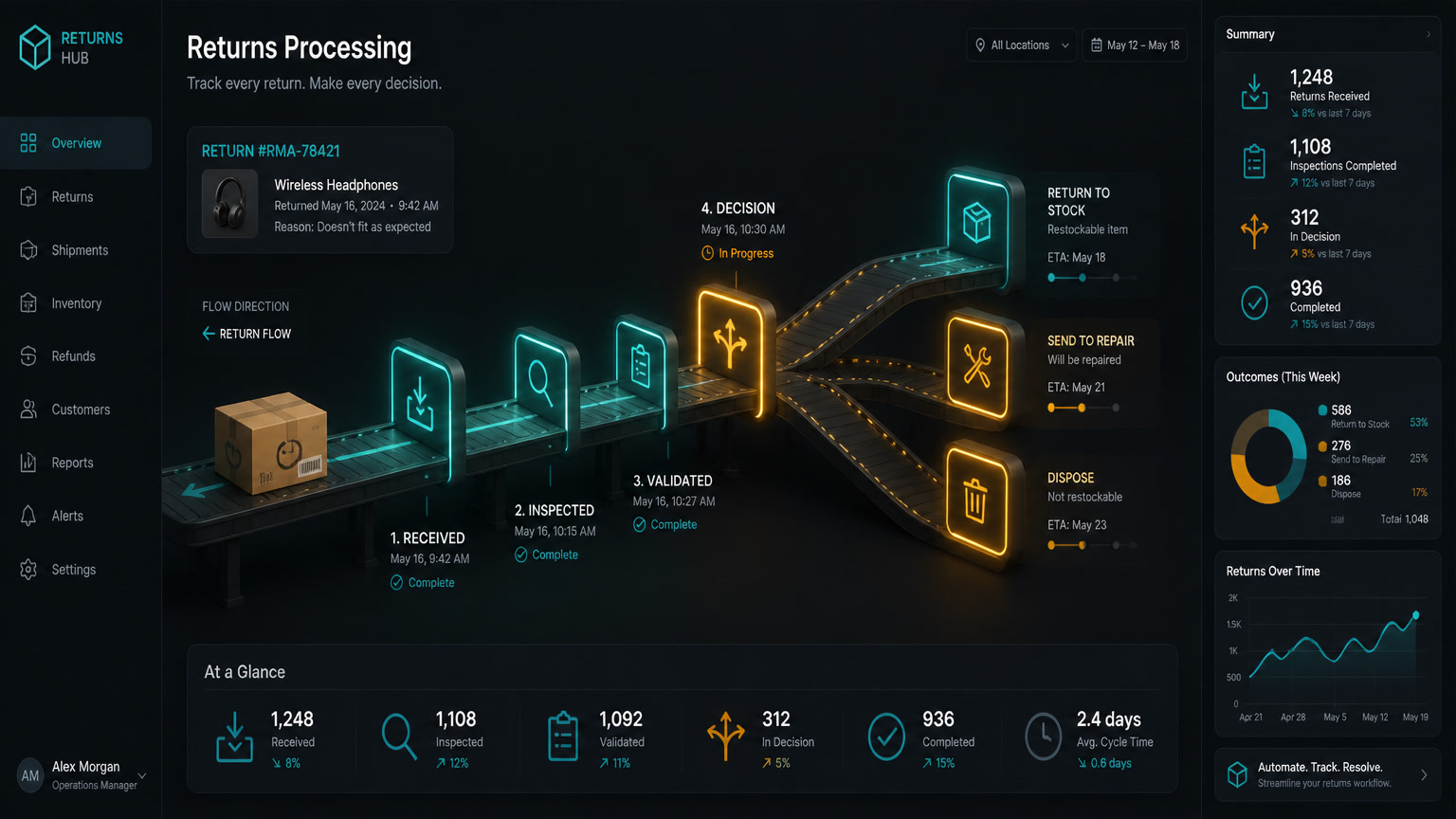
| Stage | What happens | Tooling | Metric |
|---|---|---|---|
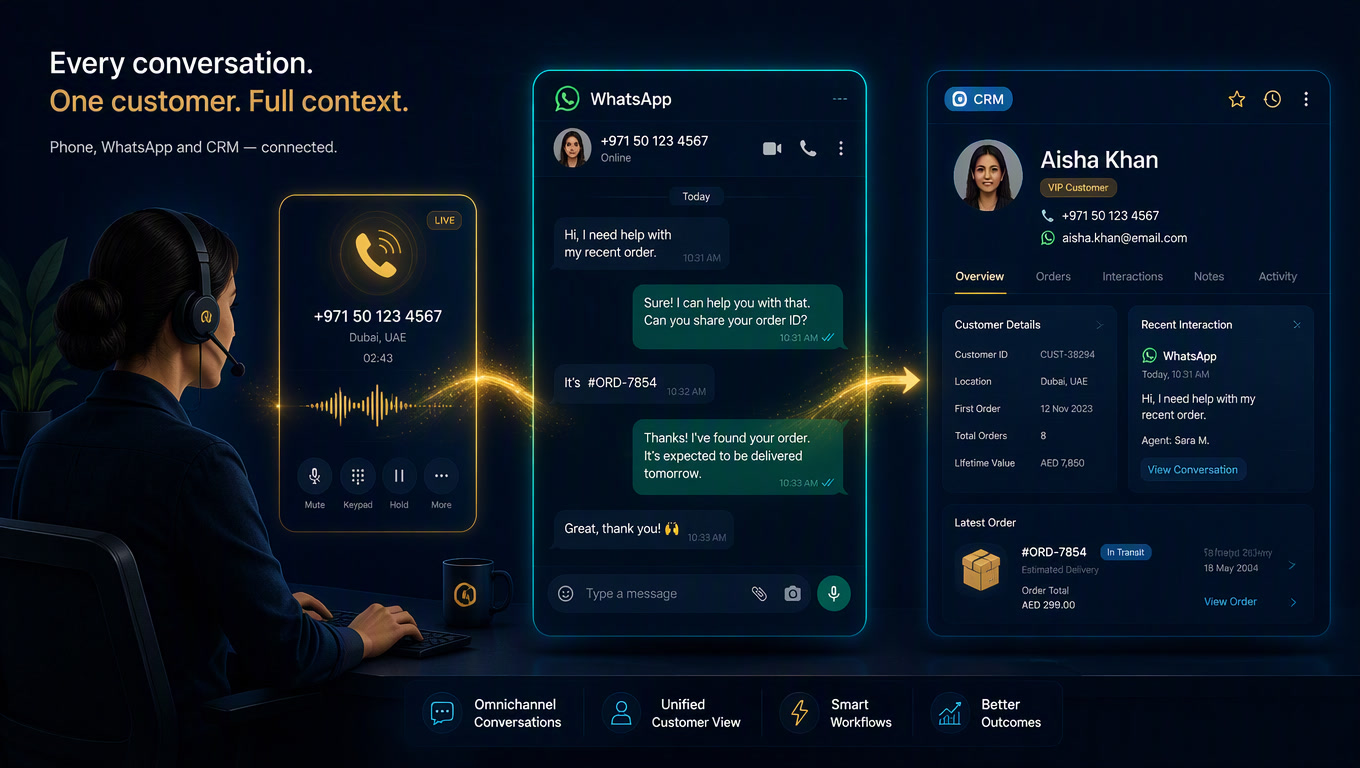
| 1. Request | WhatsApp Flows: reason, photos, order identified by phone → RMA record in CRM | WhatsApp API + Clientify | % of requests that never touched email |
| 2. Eligibility | Rules engine: legal/policy window, category, condition → approve, verify or reject with an explicit reason | n8n | Resolution time (minutes) |
| 3. Return logistics | Automatic label or express drop-off point, carrier tracking via webhook | n8n + carrier API | Packages without tracking: 0 |
| 4. Refund | State machine: received → inspected → refunded, with a 30-day legal clock and day-3 alerts | n8n + payment gateway | Refunds past deadline: 0 |
| 5. Disposition | Decision table: back to stock / spare parts / liquidation / write-off | CRM + inventory | Value recovery rate |
| 6. Prevention | Weekly report: top reasons, preventable share, product-page and packaging fixes | n8n + Looker Studio | Reason #1 fixed in < 7 days |
The full stack lands at $50–150/month (Clientify + self-hosted n8n + WhatsApp Business API) versus dedicated returns platforms that charge per processed order. Stage 5 is where the money comes back: McKinsey puts "decisioning" there — routing each item to restock, refurbish or liquidation based on margin, defect and lifecycle, instead of eyeballing it on the warehouse floor.
When it pays to refund without anyone returning anything
The most counterintuitive decision in the flow: sometimes you should tell the customer to keep it. Narvar reports that 75% of consumers have experienced this, and that 59% of those no-return refunds were for items under $20. The math is simple: return shipping (from $5–7) plus processing ($10–$65) exceeds the recoverable value of a cheap item — before the risk of it coming back damaged and unsellable.
Our rule: if (item cost + resale risk) < (shipping + processing + disposition), refund and tell them to keep or donate it. With two locks: never automatic above $50, and never for customers with 3+ returns in 60 days — fraud already accounts for 15% of return volume (average $120 per fraudulent return), and refund-without-return is its favorite door in.
Retraction deadlines in LatAm: the clock your automation has to know
A return is not just operations; it is a legal deadline. In Colombia, Art. 47 of Law 1480 grants 5 business days of retraction for distance sales and requires 100% of the money back within a maximum of 30 calendar days, no deductions (SIC). In Mexico, Art. 56 of the LFPC gives 5 business days to revoke consent with the product unused, and return shipping is on the consumer unless the item arrived defective or different from what was advertised. Chile and Argentina run 10 days.
Operational translation: every RMA should be born with a 30-day clock running inside the workflow, an automatic alert on day 3 and escalation on day 10. A regulator complaint is not some vague "reputational risk": it is a deadline with a due date your own system can enforce.
Reverse logistics under the October 1 billing model
One billing detail that changes the design: since October 1, 2026, service messages inside the 24-hour window are charged (with 1,000 free per number per month) and proactive status notifications go out as utility templates, on their own volume tiers. In practice: batch RMA status updates into a few daily templates and keep the window open for customer questions, answered inside the window as service messages. We published what a WhatsApp reply costs after October 1 with per-country rates, and the in-chat form pattern lives in the WhatsApp Flows article.
What not to automate (and the number-one mistake)
Do not automate judgment calls: high-value damaged goods, legal claims, fraud disputes. That is where a human steps in with the full case file the system assembled, same as in the bot-to-human handoff.
And the number-one mistake we see: measuring "returns reduced" as the project metric. Preventing returns (content, photos, sizing) and processing them cheaply are two different machines with two different owners. Your reverse-logistics pipeline is measured in cost per RMA and days to refund; prevention is measured in rate per category. Merging them into one KPI is the fastest way to make a working project look like a failure. Related: almost everything that lowers your return rate starts before the purchase — and almost everything that lowers cost per return starts after, the way we saw when attacking first-attempt delivery failures.
Start this week
- Audit 20 real returns: reason, value, manual touches, days to refund. Without that baseline, every saving is an opinion.
- Build the request in WhatsApp (Flow with reason + photo + order lookup) and keep email as backup, not as the main channel.
- Ship only the green row of the matrix: valid window + low amount → automatic approval. That is 60–70% of volume in most stores.
- Wire the refund to a state machine with a 30-day clock and alerts.
- Open stage 5 (disposition) once you have three months of data: that is the value recovery that justifies the project.
Three mistakes that spare you the rework: refunding before inspecting high-value items (opens the door to the 15% fraudulent returns); building the RMA on web forms when your customer lives in WhatsApp; and copying a big-store return policy without running it through your legal deadlines and your real per-unit cost.
Sources: NRF / Happy Returns 2025 Retail Returns Landscape; McKinsey, "From cost center to competitive advantage: Modernizing reverse logistics with AI" (Feb 2026); Narvar, "Refund without return"; Capital One Shopping 2026 return rates; Colombia's SIC and Mexico's PROFECO for retraction deadlines. Figures verified October 2026.
Frequently Asked Questions
How much does it cost to process a return?
Between $10 and $65 per unit depending on product value, return shipping and inspection labor, which typically accounts for around 40% of that cost. The bottleneck in reverse logistics is not shipping — it is the manual touch per RMA.
What is automated reverse logistics?
A flow where the return request, eligibility check, package tracking and refund status are handled by the system (WhatsApp Flows + CRM + n8n), and only judgment calls — damage, high value, fraud suspicion — escalate to a person.
How long does a customer have to return in LatAm?
Colombia: 5 business days from delivery (Art. 47, Law 1480). Mexico: 5 business days with the product unused (Art. 56, LFPC). Chile and Argentina: 10 days. In all cases the refund is due within a maximum of 30 calendar days, with no deductions.