
AI Recruitment Automation: The Hiring Pipeline That Runs Itself
Resume screening, WhatsApp pre-screening, auto-scheduling — with the final decision made by a human. The 3-stage AI hiring pipeline Mintec uses.
Yes, you can automate recruiting with AI without losing hiring quality — the key is a three-stage pipeline where AI preselects, a conversational channel handles the friction, and a human always makes the final call. At Mintec we build hiring automation for clients and run our own recruiting on the same rules: AI parses and scores resumes, WhatsApp handles pre-screening and scheduling, and no model ever decides who gets hired. This article is the blueprint: real costs, a clear table of who decides what, and the legal traps most guides skip.
The problem: hiring is the slowest funnel you own
Recruiting leaks at almost every stage, and the data is blunt about it:
- 72% of employers report difficulty filling open roles (ManpowerGroup 2026). The problem isn't candidate supply — it's process.
- A recruiter burns 80+ hours per hiring cycle screening resumes, coordinating interviews and chasing candidates (MindStudio 2026).
- Human eyes spend 7 seconds per resume (TheHireHub 2026). Seven seconds to decide whether someone enters your funnel.
- A third of recruiter time goes to interview scheduling, and locking one slot can take 10+ emails (Workclaw 2026).
- 61% of job seekers report being ghosted during a hiring process (MindStudio 2026). That's your employer brand, whether you call it that or not.
The read on these numbers isn't "we need more candidates" — it's "we need a pipeline." It's the same conclusion we reached in AI lead generation agents with n8n and CRM: when the funnel filters badly, more volume doesn't fix anything. Recruiting is a lead funnel where the lead is a candidate and the close is a hire. Treating it like one changes everything.
Stage 1: AI-powered resume screening
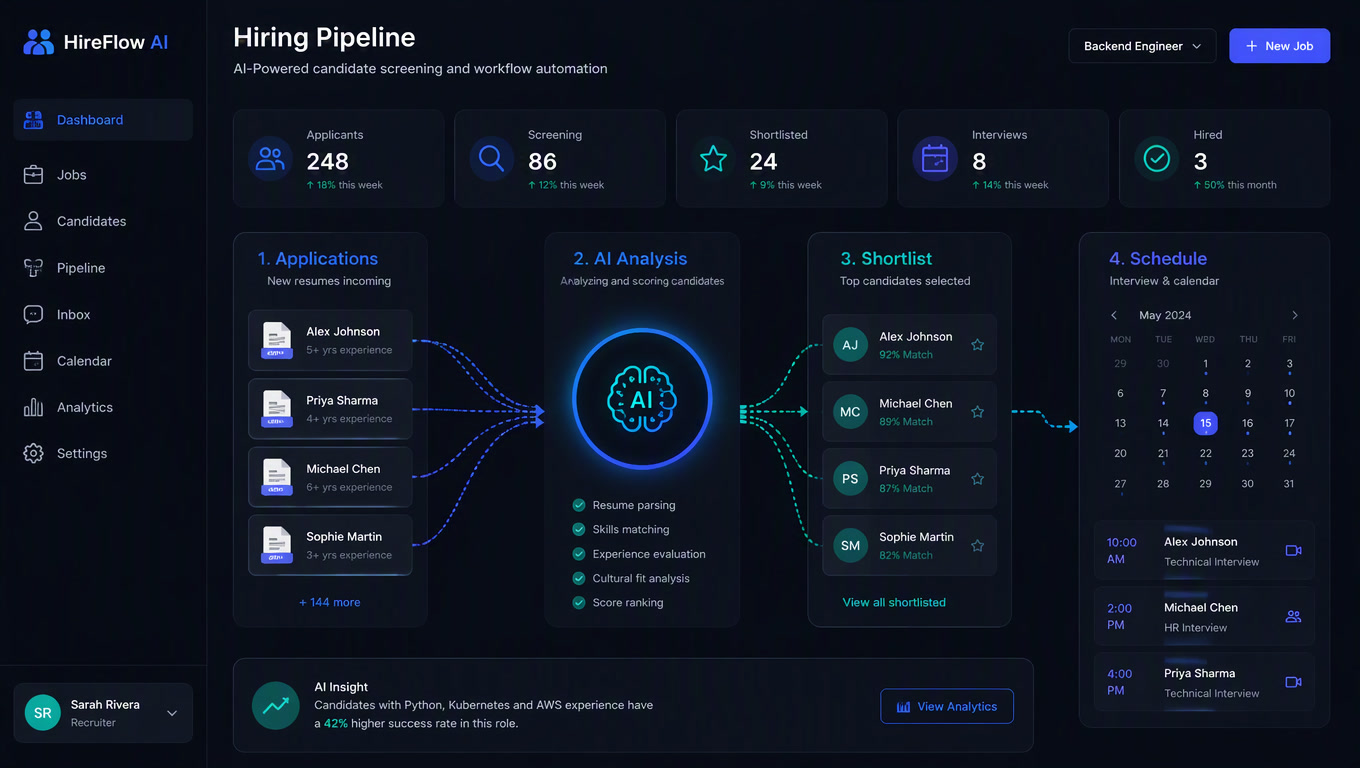
Resume filtering is the first bottleneck. AI models extract experience, skills, languages and career history at 89-94% accuracy in parsing (incruiter 2026), and AI screening cuts time-to-hire by up to 50% (Deloitte) — up to 70% when applied across sourcing, screening and coordination (Pin Data, April 2026).
Here's how we run it:
- Hard rules first. Language, location, minimum seniority, mandatory keywords. This is deterministic logic, not AI: an n8n switch drops anything that fails the base filter. Zero model cost, zero ambiguity.
- AI interprets, it doesn't eliminate. The model scores each resume against an explicit rubric (relevant experience, measurable wins, tooling, languages) and returns a 0-100 score with reasoning. The rubric is ours, not the model's: written before launch, reviewed quarterly, auditable.
- Mandatory human review threshold. Nobody is eliminated on a low score alone. Resumes above the threshold enter the review queue; the rest go to a "revisit if talent is scarce" list, not the trash.
Rule three isn't bureaucracy — it's the lesson of the 19% of organizations that saw qualified applicants screened out by their AI tools (SHRM 2026). Screening AI is great at ordering and terrible at judging alone. In our architecture, the n8n scoring node writes to the CRM but can never change a record's status to "rejected": that status change requires a human.
If this pattern sounds familiar, it's the same one we apply to AI lead qualification: rules for the deterministic, AI for the interpretive, human for the irreversible.
Stage 2: WhatsApp as your recruiting channel
Here's the angle generic guides miss: in Latin America, the most effective recruiting channel is already in every candidate's pocket.
WhatsApp is the #1 messaging app in 100+ countries, and recruiters who use it report far faster candidate responses than email — especially in Europe and Latin America (Workable 2026). Platforms like Talkpush run mass recruiting over WhatsApp in Asia and LatAm with chatbots that pre-screen, schedule and collect documents, cutting hiring time by 30% (ChatArchitect 2026).
The flow we implement for clients:
- Entry: the candidate sees the job post, writes to a WhatsApp number, and a template message starts the conversation inside the 24-hour window.
- Conversational pre-screening: the bot asks 5-7 structured questions (availability, salary expectations, tools, English level, location). Every answer lands as a field in the CRM. A casual chat becomes actionable data — no 20-field form required.
- Scheduling: when the candidate passes pre-screening, the bot offers 3 real slots from the interviewer's calendar and confirms the interview. Reminders fire automatically 24h and 1h before, with the video link.
- Status updates: the candidate never goes silent — every stage change triggers an automatic message. The 61% ghosting stat becomes a process failure, not a default.
The scheduling piece alone kills the 10-email interview dance: the candidate picks a slot, the calendar blocks itself, the CRM updates itself, and nobody touches anything.
Before you build this, read the WhatsApp compliance rules for LatAm: consent, the 24-hour window, approved templates and Meta's policies apply to recruiting exactly as they do to sales. A candidate who never opted in can't be flooded with job-opening messages, even "to help them."
Stage 3: The final decision is human
This is the line between a responsible implementation and a legal problem: AI decides who gets interviewed; humans decide who gets hired.
The EU AI Act classifies AI used in recruitment and selection — CV filtering, ranking, automated interviewing — as high-risk under Annex III, with transparency, technical documentation and human oversight obligations (the Commission published classification guidelines in 2026). Latin America has no direct equivalent, but data protection laws (LGPD in Brazil, LFPDPPP in Mexico, Ley 1581 in Colombia) still require informing candidates about data processing and avoiding discrimination.
The decision table we use on every implementation:
| Decision in the process | AI or human? | Why |
|---|---|---|
| Extract data from resumes | AI | 89-94% parsing accuracy, consistent |
| Match against objective criteria | AI with rubric | Fast and auditable, reviewable thresholds |
| Reject a candidate outright | Human | 19% of tools screened out valid applicants (SHRM) |
| First pre-screening round | AI (chatbot) | Transcript saved as evidence |
| Schedule and remind interviews | AI | Pure automation, zero judgment |
| Cultural fit and soft skills | Human | Context a model doesn't have |
| Draft rejection communications | AI drafts, human approves | Speed + respect and brand |
"AI drafts, human approves" matters more than it looks. Most rejections never get sent because nobody has time to write them — the result is the ghosting that kills your employer brand. An automatic draft a human reviews in 30 seconds removes that excuse entirely.
The pipeline closes with the handoff: the hired candidate moves from the recruiting pipeline into automated client and employee onboarding with full context — interviews, evaluations, agreed terms — without anyone re-asking. Same principle as our sales-to-delivery handoff automation: information isn't transferred, it's automated.
Modular stack vs traditional ATS: the real cost
| Component | Monthly cost | Role |
|---|---|---|
| n8n self-hosted (VPS) | $6-20 | Pipeline orchestration |
| OpenAI/Claude API | $20-50 | Parsing, scoring, pre-screening chat |
| WhatsApp Business API (BSP) | $10-60 | Candidate conversation channel |
| Clientify (CRM as ATS-lite) | $0-99 | Candidate pipeline, stages, history |
| Modular total | $40-230 | |
| Traditional ATS (BambooHR, Workable, etc.) | $99-500+ | Base plan, scales per user |
For a company hiring 20-50 people a year, the modular stack costs less than an ATS and does more: an ATS stores candidates; this pipeline filters them, talks to them, schedules them and loses nobody. And if you already run Clientify as your CRM, candidates are just another pipeline — not a new system.
One honest caveat: this isn't for everyone. If you hire 3 people a year, a basic ATS — or even a spreadsheet — is enough. Recruitment automation pays when volume or speed is costing you hires. At that point the question isn't whether, it's in what order.
What not to automate
We said it in when NOT to use AI in business automation, and it applies double to hiring:
- The final interview. Hiring someone who will sit on your team for five years needs context, judgment and human accountability.
- Screening edge cases. The candidate who fails the hard filter but has an exceptional portfolio: AI flags it, humans decide.
- Offer negotiation. Salary, benefits, start dates — every negotiation has variables no prompt captures.
- Candidate disputes. If someone claims discrimination, the case gets human review with the full process transcript.
The implementation order
Our standard rollout takes 3-4 weeks:
- Week 1: hard rules + AI resume parsing in n8n, writing scores to the CRM. Measure: screening time per vacancy.
- Week 2: WhatsApp Business API + pre-screening bot + scheduling. Measure: candidate response time and no-show rate.
- Week 3: automatic stage-change updates and rejection drafts with human approval. Measure: % of candidates answered at every stage.
- Week 4: rubric review with the team, audit of rejections (did the AI screen out anyone good?) and threshold tuning.
The result we see in practice: the recruiter stops being a resume transcriber and calendar chaser, and goes back to the only thing AI doesn't replace — talking to people and deciding. And if your team needs to learn how to build pipelines like this, the 4-phase plan we use to train automation talent is exactly the order we follow at Mintec.
Recruiting automation isn't dehumanizing hiring — it's stripping out the mechanical part so the human part gets better. The pipeline runs itself. The decision doesn't.
Frequently Asked Questions
Is it legal to use AI to screen resumes?
Yes, with human oversight. The EU AI Act classifies AI used in recruitment and selection as high-risk (Annex III) and requires transparency and human review; in Latin America, data protection laws (LGPD, LFPDPPP, Ley 1581) require informing candidates and avoiding discrimination. The practical rule: AI preselects, humans decide.
How much does it cost to automate recruiting?
A modular stack (n8n + OpenAI API + Clientify + WhatsApp Business API) runs about $40-230/month; a traditional ATS starts at $99-150/month and scales per user. For 20-50 hires a year, the modular stack wins on cost and flexibility.
Does AI remove bias from hiring?
Not automatically. SHRM found that 19% of organizations using AI in recruiting saw qualified applicants screened out by the tool. Bias is mitigated with objective criteria, auditable thresholds and regular testing — not by assuming AI is neutral.