
Travel agency automation: the quote doesn't lose the customer, it gets forgotten
68% of travel inquiries arrive after hours and every quote loses force each day. The five-stage pipeline that keeps the sale alive without spamming the traveler.
The typical loss for a travel agency is not the unanswered inquiry: it's the quote nobody followed up on. The traveler asks for three options on a Tuesday, the agency answers on Thursday, and by then the prospect compared, decided, or got distracted by another catalog. The data is blunt: 68% of travel inquiries arrive outside office hours, and an immediate response converts 5.2 times better than a late one; inquiries handled within the hour convert 7 times better than those waiting 24 hours. In Latin America the volume is also concentrated in high season: the person who handles 3 inquiries a day in January handles 15 in December, and the follow-up cadence — what actually decides the sale — is the first thing to collapse. The automation that moves the needle here is not the FAQ chatbot: it's the system that keeps every quote alive until the traveler decides, without a human having to remember.
AI beat the agency at information, not at operations
Worth looking the industry's fear straight on before selling automation to anyone. Amadeus reports that chatbot use to inspire trips tripled in five years — from 6% to 18% of travelers — and that 42% find AI most useful precisely at the planning stage. A 2026 outlook survey compiled by SleekFlow found that 33% of travelers are likely to use ChatGPT or Gemini this year to plan.
Translated without anesthesia: AI commoditized information. The flight price, the train schedule, and the list of things to do in Lisbon are no longer a product the agency can sell. But the same dataset says 41% of travelers still use an advisor for at least part of their planning — a number that didn't move down, it moved up from 2024. Why? Because what the traveler really buys is not information: it's having someone take charge. The supplier that fails at 11 p.m., the visa that expires in March, the installment due on the 15th, the rebooked flight with impossible connections. That work isn't knowledge work, it's operations.
An opinion, and one that cost us dearly to learn: the agency that competes on information dies in the next two years. The one that competes on operations survives — but only if its operating cost drops, because commission margins are not going to rise to compensate. Automation is not a modern agency's luxury; it's the only arithmetic that works in high season.
The benchmarks disagree: measuring your own leak comes first
The sources don't agree, and the discrepancy is information, not noise. Perspective AI puts travel booking abandonment at 85%; Salmangul reports 60–70% checkout abandonment; Perk attributes 52% of abandonment to poor user experience. None of them are lying — they measure different things — and the agency needs to know which of those funnels is theirs before spending a dollar.
What is consistent across sources is quote-to-booking conversion: 20% to 40% for qualified leads, 45%–55% at the top percentile, and below 15% means a serious sales problem, not a traffic problem. That range is your honest baseline; any "magic conversion" benchmark a software vendor promises should be measured against it.
The diagnostic we recommend is the same one we use with logistics and retail: take 100 real quotes from the last 90 days and classify them. How many were answered within an hour? How many had more than one follow-up touchpoint? How many closed? You'll find one of three patterns: inquiries lost after hours (fix capture), quotes sent exactly once (fix cadence), or bookings dying in documents and payments (fix post-sale). Almost no agency suffers all three at once; almost all of them believe they suffer the first one.
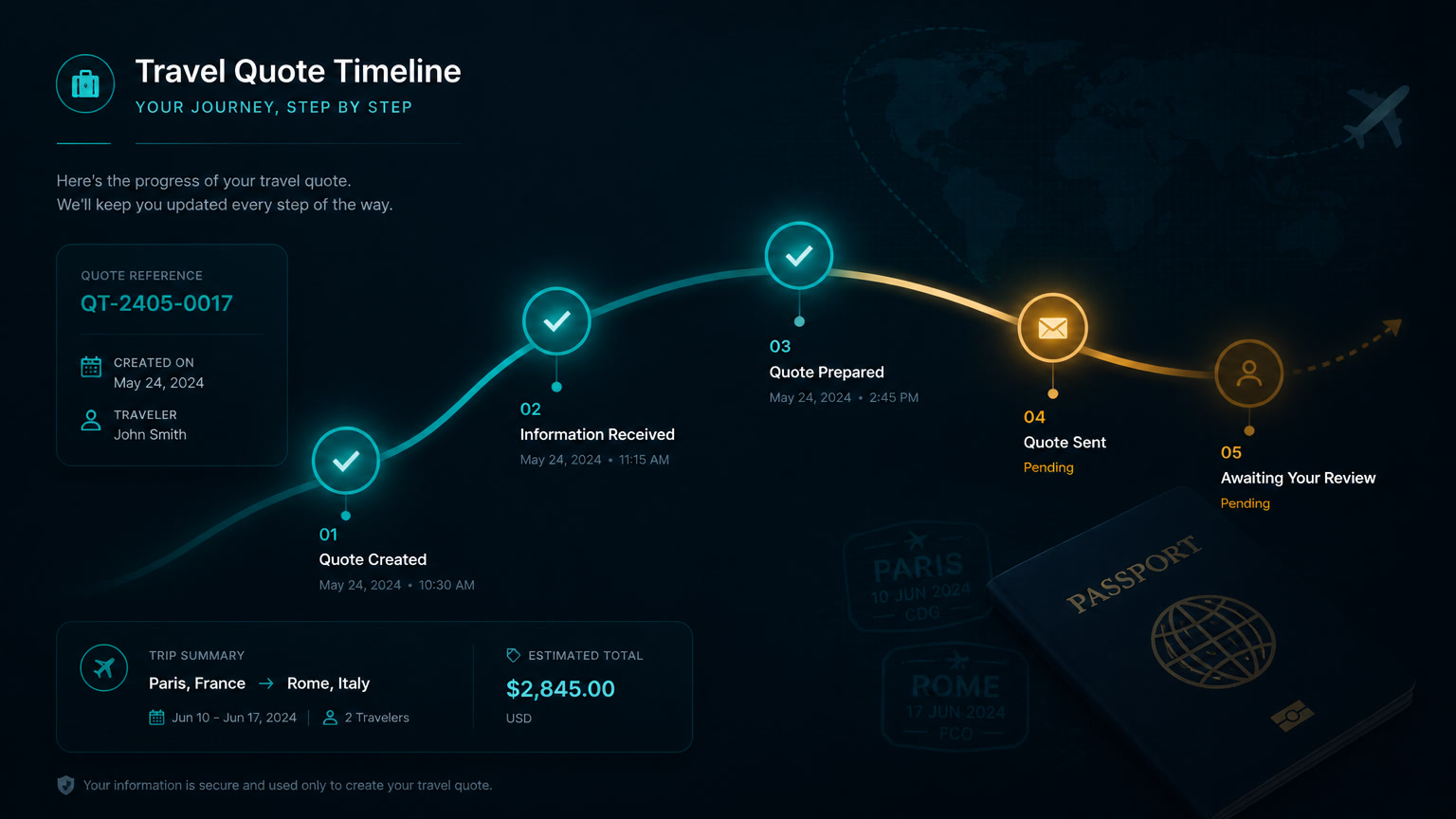
A travel quote has an expiration date
This is the framework we work with, and it changes the conversation because it puts a clock on something agencies treat as eternal. A quote doesn't die from price: it dies from silence. And how fast it dies depends on trip type, not destination:
| Trip type | Typical decision window | Minimum follow-up cadence | What closes it |
|---|---|---|---|
| Weekend getaway | 1–7 days | Day 2 check-in, day 5 urgency (availability) | Fixed dates, fast decision |
| Week-long vacation | 7–21 days | Day 2, day 7 content, day 14 urgency | Comparing 2–3 options |
| Luxury / multi-week | 14–45 days | Day 3, day 10, day 21 modified | Budget approval, schedule |
| Group / corporate | 30–90 days | Weekly, with a status summary | Multiple decision-makers |
Two rules follow from the table that almost nobody implements: first, cadence is set by decision window, not by tool frequency — three emails in five days to a corporate group is spam, to a weekend getaway it's delay. Second, the day-2 contact doesn't sell: it confirms. "Any questions left on option B?" converts better than a discount, and it leaves a clean CRM trail that the quote is alive.
The five-stage pipeline: from inquiry to the traveler who comes back
The cadence above only works with architecture behind it. This is the full pipeline we build for agencies, stage by stage:
| Stage | Trigger | Channel and action | Metric that matters |
|---|---|---|---|
| 1. Capture | Inquiry via WhatsApp, Instagram, web, or missed call | Instant template acknowledgment + AI classification (destination, dates, budget) | % inquiries acknowledged <5 min |
| 2. Quote | Complete brief | Quote draft from template + current rates, advisor-reviewed before sending | Inquiry → quote time (<1h) |
| 3. Cadence | Quote sent, no close | Sequence by decision window (table above), with AI classifying the reply to pause or advance | Quote → booking (20–40%) |
| 4. Post-sale | Booking confirmed | Documents (passport/visa expiry), payment installments and due dates, supplier changes | % bookings with documents verified 30 days out |
| 5. Return | Traveler is back | Survey, review, and a repurchase trigger keyed to the next window (anniversary, season) | 12-month repurchase rate |
The mistake we see again and again: agencies buy a chatbot for stage 1 and leave stages 3 to 5 untouched, which is where the money is. Answering "we're a travel agency, how can I help?" at 2 a.m. is easy to sell and cheap to build; it's also the layer 85% of travelers already cover with ChatGPT without calling anyone. Stage 4 — document deadlines and payments — is where the agency is irreplaceable: no AI engine warns you that the client's passport expires in 60 days and the destination country requires 6 months of validity.
What it costs, including October 1 billing
The full stack for an agency of 1 to 10 advisors runs on:
| Component | Monthly cost | Function |
|---|---|---|
| Self-hosted n8n | $6–20 | Orchestrating the five stages |
| CRM (Clientify or similar) | $0–99 | Pipeline, cadences, segmentation |
| WhatsApp Business API | $3–30+ | Utility templates and in-window replies |
| AI API (classification and drafts) | $20–50 | Stages 1, 2 and 3 |
| Total | $40–150 | No per-seat cost that scales with the team |
One billing detail that changes how you design sequences: since October 1, 2026, WhatsApp charges service messages per message — 1,000 free per number per month — and proactive utility templates (installment reminders, deadline alerts) have no free tier. Translated into cadence: replies inside the 24-hour window are nearly free, but the proactive day-15 installment reminder is a billed template. Design the sequence so the traveler replies inside the window — confirm, ask, object — and the monthly template cost for a mid-size agency stays in pocket change (we break down the billing pattern in our article on what a WhatsApp reply costs after October 1, and installment and payment-recovery logic lives in WhatsApp collections automation).
The Latin American case: high season without hiring ahead
The regional context makes the arithmetic different from a US agency's. In Colombia, tourism generated US$11.42 billion in 2025 — more than coffee and coal exports combined — accounting for 2.1% of GDP and over 1.8 million jobs, per DANE's Satellite Account of Tourism. And per ANATO-ETA data, the Mexican Caribbean concentrates 15.8% of Colombian agencies' sales: a handful of destinations concentrate most of the quote volume precisely when the team is at its minimum.
That's where automation stops being best practice and becomes survival arithmetic. In our clinic and gym implementations we saw the pattern that repeats in any appointment-and-deadline business: automated 24-hour and 2-hour reminders cut no-shows from 18% to 6% in one quarter. An agency's confirmation and deadline layer has exactly the same shape — deadlines someone is supposed to hit and nobody hits when there are three open quotes per person — with the difference that here the "no-show" is a quote that expired in an advisor's inbox.
A public-figures model: 150 quotes a month at 22% conversion closes 33 bookings; moving that rate to 28% purely with the stage-3 cadence — still far from the 45%–55% top percentile — is 9 extra bookings a month. At an average 10% commission on US$2,000 packages, that's roughly US$1,800 more per month against a $40–150 stack. You don't have to believe anyone: audit your 100 quotes and see which stage they die in.
Three mistakes we see in every new implementation
- Automating the question before the quote. The FAQ-responder is the most visible and least profitable layer. Start with after-hours capture and post-quote cadence; the chatbot can wait until month three.
- One cadence for every trip. The same sequence for a weekend getaway and a corporate group guarantees spam on one end and expiration on the other. The decision window rules.
- Confusing sent with read. A quote attached as a PDF to an email with no acknowledgment, no follow-up, and no open tracking is not a sale in progress: it's a file. If your CRM doesn't know the quote went out, it can't know it never came back.
The travel agency is not going to die from AI, but it can die from a badly managed high season: the same demand that fills the year is what breaks a team quoting by hand and following up with mental reminders. Automate what is deadlines — capture, cadence, documents, payments, return — and keep the judgment where your product lives: in the advisor who knows why this hotel and not that one. For the broader WhatsApp-first pattern applied to appointment-driven businesses, our article on hotel reservation automation over WhatsApp follows the same skeleton, and the full WhatsApp-to-cash pipeline shows how the payment stage connects without intermediate spreadsheets.
Frequently Asked Questions
What should a travel agency automate first?
Three things, in this order: instant acknowledgment of after-hours inquiries (68% of travel inquiries arrive when the office is closed), the post-quote follow-up cadence matched to trip type, and post-sale deadlines (passport, visa, installments, supplier changes). The FAQ chatbot comes last, not first.
How much does travel agency automation cost?
Between $40 and $150 USD per month depending on volume: self-hosted n8n ($6–20), a CRM like Clientify ($0–99), the WhatsApp Business API, and an AI API for classifying inquiries and drafting quotes. On top sits per-message WhatsApp template pricing — since October 1, 2026, service messages are billed per message with 1,000 free per number per month, and proactive utility templates have no free tier.
Does a chatbot replace the travel advisor?
No, and 2026 data confirms it: 41% of travelers still use an advisor for at least part of their planning, even though 33% are likely to use ChatGPT or Gemini this year. AI beat the agency at information; the advantage that remains is operations — suppliers, deadlines, flight changes, payment logic — and that is exactly the cheapest layer to automate.