

Google moved the AI Overview source row. Your baseline expired.
Google expands AI Overview definitions by default and is testing sources at the bottom. Both break your AI-visibility baseline. How to re-cut it.
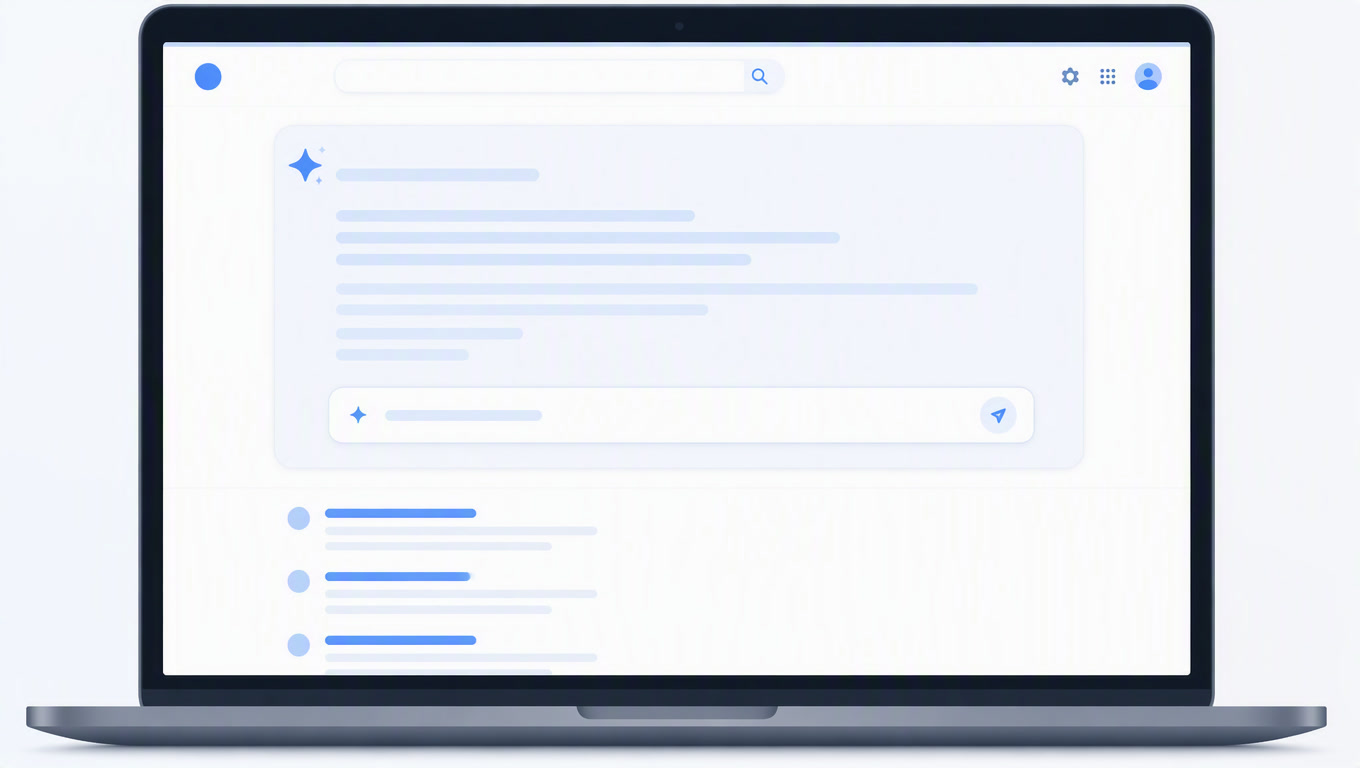
Two things changed inside AI Overviews on November 11 and 12, 2026. Definition answers now open fully expanded, so the answer fills the viewport and the web results sit below the fold. And in a test, the source icons that used to sit at the top of the answer moved to the very bottom of the response, where hovering reveals the full citation list.
Neither change touches your rankings. Neither touches your indexing, your markup, or your crawl budget. Both change the distance between the claim and the citation that supports it, and that is the quantity your AI-visibility reporting has been quietly assuming was fixed.
The short version: re-cut your baseline at November 11, split definition queries into their own cohort, and start recording which layout variant you actually saw. The citation share you report today is an average of three different interfaces, and averaging them is how a real trend gets buried under interface drift.
What Google actually changed
The definition change is confirmed behaviour, not a screenshot. Search Engine Roundtable reported on November 11 that AI Overviews for definition searches now expand by default. The example in that report is blunt: search define expandable and the entire visible portion of the results page is the AI Overview. You have to scroll to reach the web results at all.
That is broader than the expansion Google confirmed in August. Back then, Robby Stein from Google explained that Overviews only expand dynamically "for topics where our systems determine it to be most useful," and added a detail worth keeping: "If you've already started scrolling, the expansion stops to keep your place." Definition queries are no longer a judgement call. They are the default.
The source-row change is a test, spotted by Brodie Clark and reported on November 12. The previous variant of that experiment placed the site count at the top of the Overview, directly above the citations. This variant moves the count to the bottom of the response, and hovering over it displays the full list of citations.
That second detail is the one most coverage skips. Hover requires a pointer. On a phone there is no hover, so the same query can present the same sources behind a different gesture depending on the device in someone's hand. If your measurement pools desktop and mobile, you just pooled two different interfaces.
The citation didn't disappear. The distance changed.
It is easy to read "sources moved to the bottom" as a threat to traffic, and it may well be one. But the more useful reading is structural.
Before, the affordance sat on top of the answer. A reader who wanted to know who said this could glance at the top of the card and click a favicon without moving their eyes far from the first sentence. After, they scroll past a longer answer — longer, because definitions now expand — reach the bottom, and then interact to see who was cited at all.
So the click is no longer a glance. It is a deliberate trip to the end of the answer plus an interaction. The sources are the same sources. The path to them got longer and more deliberate.
In client reporting, the failure mode we see is not a traffic cliff. It is a silent mix. Someone exports a 28-day window that straddles a layout change, sees a delta, and attributes it to content or to a competitor. The delta is the interface. Nothing on the site changed, and the number moved anyway.
Three cohorts, not one
Here is where most audits go wrong. "Queries with AI Overviews" is no longer a single population, because Google now treats the cohorts differently.
Definition queries. Always expanded as of November 11. The answer owns the viewport. Your source row is the furthest it has ever been from the question.
Question and comparison queries. Expanded dynamically, still by Google's own criteria. Some will expand, some will not, and the criteria are not published. This is the cohort where a before-and-after comparison is most likely to be measuring nothing but Google's tuning.
Everything else. Still click-to-expand in most cases. This is the cohort that behaves most like your old baseline, which makes it the closest thing you have to a control.
There is a fourth axis that cuts across all three: device. A hover-revealed citation list and a tap-revealed citation list are not the same measurement, and no vendor dashboard we have seen separates them.
What stops being comparable, and what to record instead
| Change | What the searcher sees | What it invalidates | Record instead |
|---|---|---|---|
| Definitions expand by default (Nov 11) | Long answer above the fold, web results below it | Any CTR baseline on "define" and "what is" queries spanning that date | Cohort split plus a series cut at 2026-11-11 |
| Source count moves to the bottom (Nov 12, test) | Sources require a scroll to the end of the answer | "Cited at the top of the card" as a field; screenshots cropped to the answer | Layout variant: top icons, bottom icons, or none visible |
| Citation list opens on hover | Full list hidden until interaction | Screenshot audits that captured who else was cited | Interaction state plus a capture of the expanded list |
| Same query, different device | Different gesture for the same sources | Site-level averages | Per-device cohorts, same query set |
| Google: no extra requirements, no special schema | Nothing technical to add | Claims that a GEO fix increases AI Overview presence | Eligibility note: indexed and snippet-eligible |
That last row matters more than it looks. Google's documentation on AI features is explicit that there are no additional requirements to appear in AI Overviews or AI Mode, and no structured data or machine-readable file to create. When someone sells you an AI-presence fix that is actually a formatting change, the layout now decides most of what they promised to control.
The 30-minute re-baseline
This is the whole protocol. It does not need a tool licence, and you can run it before the next report goes out.
1. Draw the line at the right dates. November 11 for definitions, November 12 for the source row. Two events, two cuts. Do not pick a single date and call it the change.
2. Never compute a trend across the cut. Two series, side by side: 28 days before, and the new window after. If a chart connects across the change, it is wrong by construction.
3. Split the query set before you compute anything. Definitions, question and comparison queries, and the rest. Pooled numbers hide the treatment.
4. Record the layout variant you actually saw. One value per query per capture: source count at top, source count at bottom, no visible source affordance, or no AI Overview at all. This is the field every dashboard is missing, and it is the one that makes the rest of the data interpretable.
5. Keep a control set you were never cited in. If the control moves the same way as your tracked set, you measured the interface, not your performance. This single check would have saved a lot of the "AI ate my traffic" reporting of the past year.
6. Compare CTR at stable position, per cohort, per device. Position is the only part of the picture you can hold still. If position moved, you have a ranking story, not a layout story, and you should not blame the interface for it.
7. Put the variant and the capture date in the report header. The next person to open that report is the person most likely to compare across a change. Warn them in the artifact itself.
If you want a starting point for step six, query-level CTR decay at a stable position is covered in detail in how to measure AI Overview CTR decay, and the counting quirks inside Search Console's AI position are worth reading before you trust any average in Search Console AI position counting.
Nine fields beat one screenshot
If you build one artifact from this article, build a record with these fields per query and capture: query, locale, device, timestamp, whether an AI Overview appeared, where the source count sat, how many sources were listed, whether you were cited, and your order in the expanded list.
Nine fields. That is the difference between an unfalsifiable screenshot and a comparable observation. When the next layout change lands — and it will — those nine fields are what lets you tell a real shift from a new coat of paint on the same answer.
Order still matters inside that list, by the way. The first source in an AI Overview takes a wildly disproportionate share of whatever clicks leave the panel, which is why citation order inside AI Overviews is worth tracking separately from presence. Moving the row to the bottom does not flatten that distribution. It just makes fewer people see it.
What this does to the work itself
The temptation this week is to go optimize citation proximity: restructure passages so the source chip sits right next to your claim. That lever is mostly gone. Google's layout decides the distance, not your heading structure. If sources render in a strip at the bottom of the response, no amount of tight paragraph design puts your name next to the sentence.
So the durable lever is the one a weak affordance actually rewards. When the sources are one scroll and one hover away, readers do not browse the strip looking for options. They look for a name they already half-trust, and they read the answer for a specific fact they can check. Being the only source that contains that specific fact is now worth more than being the tidiest citation in a list nobody opens.
That is the same conclusion the expansion test pushed toward in August, when AI Overviews started auto-expanding and pushed citations down. Each change makes the citation cheaper to produce and more expensive to reach. The response is not better formatting. It is a narrower claim to a fact only you have.
And it is why the follow-up questions matter more than they used to. When the answer stops being a summary and starts being a conversation, the surface you are competing on is the second question, not the first — the pattern behind why People Also Ask became the real AI Overview battleground.
One more thing, said plainly: any vendor reporting a single citation-share number across this week without telling you when their baseline starts is reporting interface drift as performance. Ask for the start date. If the answer is "we've been tracking since last year," the number is an average of layouts, and it will keep being one.
Google didn't take your citation away. It moved it, and moving it changed the measurement. The only genuinely wrong move is to keep comparing across the move.
If you want a second pair of eyes on the re-baseline — cohort split, control set, the variant field — our SEO and GEO team does this as a scoped audit, and you can start a project here with the query set you already track.
Frequently Asked Questions
Did Google remove the sources from AI Overviews?
No. On November 12, 2026, Search Engine Roundtable documented a test that moves the source count and icons from the top of the AI Overview to the bottom of the response, where hovering reveals the full list of citations. The sources still exist and still link to your page. What changed is where they sit and what gesture reveals them.
Does moving the sources change what I should do for GEO?
Not technically. Google's own documentation on AI features says there are no additional requirements to appear in AI Overviews or AI Mode, and no special schema or machine-readable file to add: eligibility is still an indexed page that is eligible for a snippet. What the layout change breaks is measurement, not optimization.
Is my AI visibility data from before November 2026 useless?
Not useless, but not comparable. A series that crosses the November 11 definition change and the November 12 source-row test mixes layouts, so the difference between the before and after numbers is partly the interface, not your performance. Keep the old data, cut the line, and start a new series with the layout variant recorded.