
Search Console gives every AI Overview link the same position. That is not a rank.
Every AI Overview link reports the block's position, AI Mode counting is undocumented, and your impressions have logging bugs in it. How to report GEO anyway.
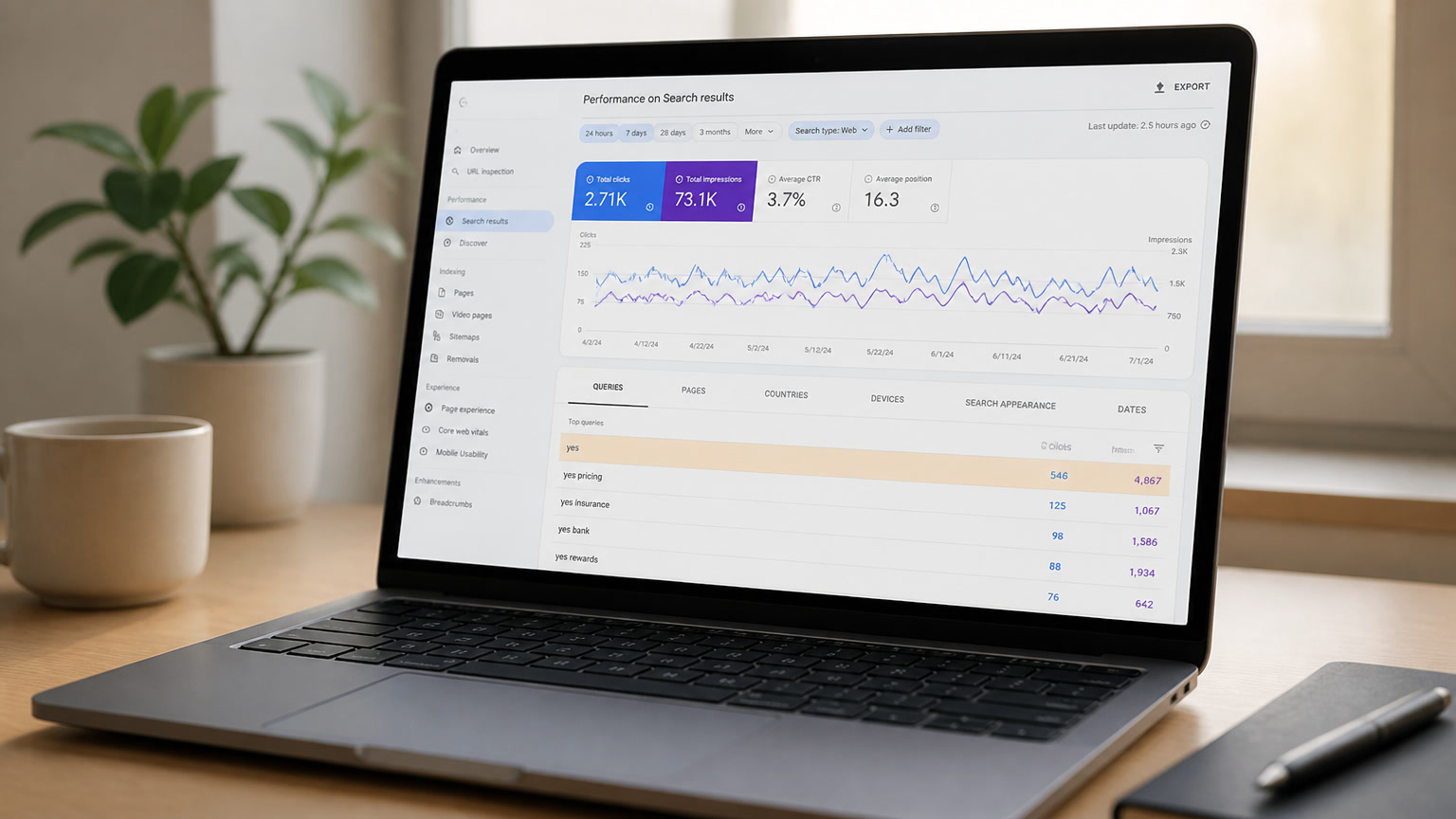
Google gives every link inside an AI Overview the position of the AI Overview itself, not a position within it. For AI Mode, nobody knows: the question was put to John Mueller directly in September 2026 and the documentation has not moved. Meanwhile your impression history contains at least one eleven-month logging error that was never corrected backwards. So the honest way to use average position on AI surfaces is as a dated reading with a caveat attached, not as a rank you put in a client report.
What Search Console actually counts
Three rules govern how AI surfaces show up in your numbers. All three are confirmed, and none of them behave like the rank tracking you did in 2019.
- One impression per URL per query. If your page appears inside the AI Overview and again in the classic listings, Search Console records a single impression for that query, not two. Mark Williams-Cook documented Mueller's confirmation in January 2026, and Search Engine Land covered it the same week. The same aggregation rule applies across every feature on the page: one URL, one impression, no matter how many times it shows.
- AI Overview links inherit the block's position. Google treats the whole overview as one result. If the overview sits at position 1 and carries five citations, all five report position 1. Mueller restated this on September 14, 2026 after another round of questions. A page sitting fourth inside a generated answer reports the same number as the page in the first organic slot below it.
- AI Mode counting is undocumented. Kenichi Suzuki asked the precise version of the question: are citations inside an AI Mode response counted sequentially, so the first link is position 1 and the fourth is position 4, or is the entire response a single block at position 1 the way AI Overviews are handled? Mueller did not answer, and he confirmed the help documentation has not changed in some time. Search Engine Roundtable reported the exchange on September 16, 2026, along with his broader point that position and impression tracking will "evolve over time" as Search, AI Mode and AI Overviews change, and that there are edge cases today.
That gap matters more than it looks. If AI Mode counts sequentially, average position tells you how prominently you were cited. If it counts as one block, average position tells you nothing except that the block exists. You cannot tell which from the report, because Google's own documentation puts AI Overviews and AI Mode inside the Web search type of the Performance report, mixed with classic results, with no filter to separate them.
We wrote about where AI Mode follow-up queries end up when Mueller first confirmed the pattern in August. The short version: the main report is the only place with query data, and it is blended with everything else.
Your comparison window has holes in it
Google maintains a public list of data anomalies, and it is not short. The two that matter for anyone building a GEO baseline:
| Window | What Google documented | What you cannot do with data from it |
|---|---|---|
| May 13, 2025 to April 27, 2026 | A logging error prevented Search Console from accurately reporting impressions. The fix was applied going forward; history was not recalculated. | Any year-over-year impression or CTR comparison that reaches into that window |
| August 13, 2026 | The generative AI report under-counted impressions for several days. Google called it a logging issue, "not representative of visibility changes," and annotated it later. | Reading that dip as a visibility loss, or comparing August against a clean month |
| September 2025 | Google removed the &num=100 parameter, which deleted a layer of scraper impressions industry-wide. | Treating the drop that followed as a performance decline |
Remove one layer of fake impressions and the line falls off a cliff. Half the industry rebaselined onto a floor that was still inflated, because the logging error kept running underneath it.
What our own numbers look like
We pulled our property (sc-domain:mintec.co) through the Search Analytics API on September 27, 2026, because writing this without checking our own data would be exactly the kind of confident nonsense this article is about.
Monthly impressions went from 6,589 in January to 177,740 in September, with clicks moving from 30 to 1,149. That looks like a great story until you notice that January through April sits inside Google's impression logging error. The first four months of our own baseline belong to a window Google has documented as unreliable. We did not catch that by looking at the chart. We caught it because we went looking for the anomalies page.
The ambiguity that cannot be resolved at all: one of our pages, the piece on turning off AI Overviews, recorded 2,675 impressions, 11 clicks and an average position of 9.85 over the last 28 days, a click-through rate of 0.41%. We cannot tell you how many of those impressions came from an AI Overview quoting the page versus a classic result nobody scrolled to. Google does not split them, and there is no API that will. The row could describe a page people see and skip, or a page a model reads out loud and never sends anyone to. In a client deck, presenting either story as fact would be a guess wearing a spreadsheet.
That is the state of the measurement, not a temporary gap that next quarter's dashboard will fix. Mueller's framing is the right one: the goal is a useful approximation of how your site shows up, not a written-in-stone absolute for position counting.
How we report GEO now
We stopped reporting average position on AI surfaces as a rank in June, after the first AI performance reports landed and we spent two weeks trying to reconcile numbers that did not agree with each other. The protocol we run instead:
- Date every reading. Every figure we log carries the day it was pulled and a note of what Google changed that month. When the rules move, we re-baseline instead of pretending the series is continuous.
- Never compare across a documented anomaly. If a client asks for year-over-year impressions and the window touches the logging error, we say so before we open the spreadsheet.
- Report position as a band, with the caveat in the same sentence. "Between 4 and 11, blended across organic and AI surfaces" is more honest than 7.4, and nobody has ever made a different decision off the decimal.
- Track the counters Google cannot redefine. Pages cited in the generative AI report, branded search volume, direct traffic. Those survive a change of definitions; average position does not.
- Watch the documentation, not the interface. Google said the help page is where significant changes will be announced. There is no changelog inside the report itself, so a number you did not write down is a number you cannot defend later.
This also changes which content work is worth doing. Our read on the Princeton GEO paper is the same lesson from the other side: the tactics that hold up are the ones measured against something stable, and citation share measured on a moving ruler is not that.
What to do this week
Take a dated snapshot today: impressions, clicks, and the unique pages showing in the generative AI report. Then open your last four monthly reports and check whether any year-over-year comparison you made reaches into May 2025 through April 2026. If it does, footnote it now, before a client finds it.
Last, pull average position out of the AI section of your reporting. Replace it with pages cited, impressions, and the branded search delta. It is a smaller number and a more defensible one.
The point of measuring AI visibility was never precision. It is knowing how often a model puts you in front of someone, and being honest about how much of that you actually know.
Frequently Asked Questions
Does Google give every link in an AI Overview the same position?
Yes. Search Console treats the AI Overview as a single result, so every link inside it reports the position of the AI Overview block itself rather than its position within the answer. Google confirmed the behavior in September 2026.
Can you separate AI Mode and AI Overviews from organic traffic in Search Console?
Not in the Performance report. Google places AI Overviews and AI Mode inside the Web search type alongside classic results, with no filter to pull them back out. The separate generative AI report shows impressions by page only, with no clicks and no queries.
Why did my Search Console impressions drop when my rankings did not?
Because impressions come from logging, not from a live count of eyes. Google has documented logging errors in the Performance report, including May 13, 2025 to April 27, 2026, when impressions were reported inaccurately. Check Google's data anomalies page before calling any drop a ranking change.