
The first citation in an AI Overview takes 47% of the clicks: how to get that slot
Citation order inside an AI Overview splits clicks 47/23/14 across first, second and third source. What Google's May 2026 inline-citation change did to that order, and what to restructure to take the first slot.
The first citation in an AI Overview takes 47% of the clicks: how to get that slot
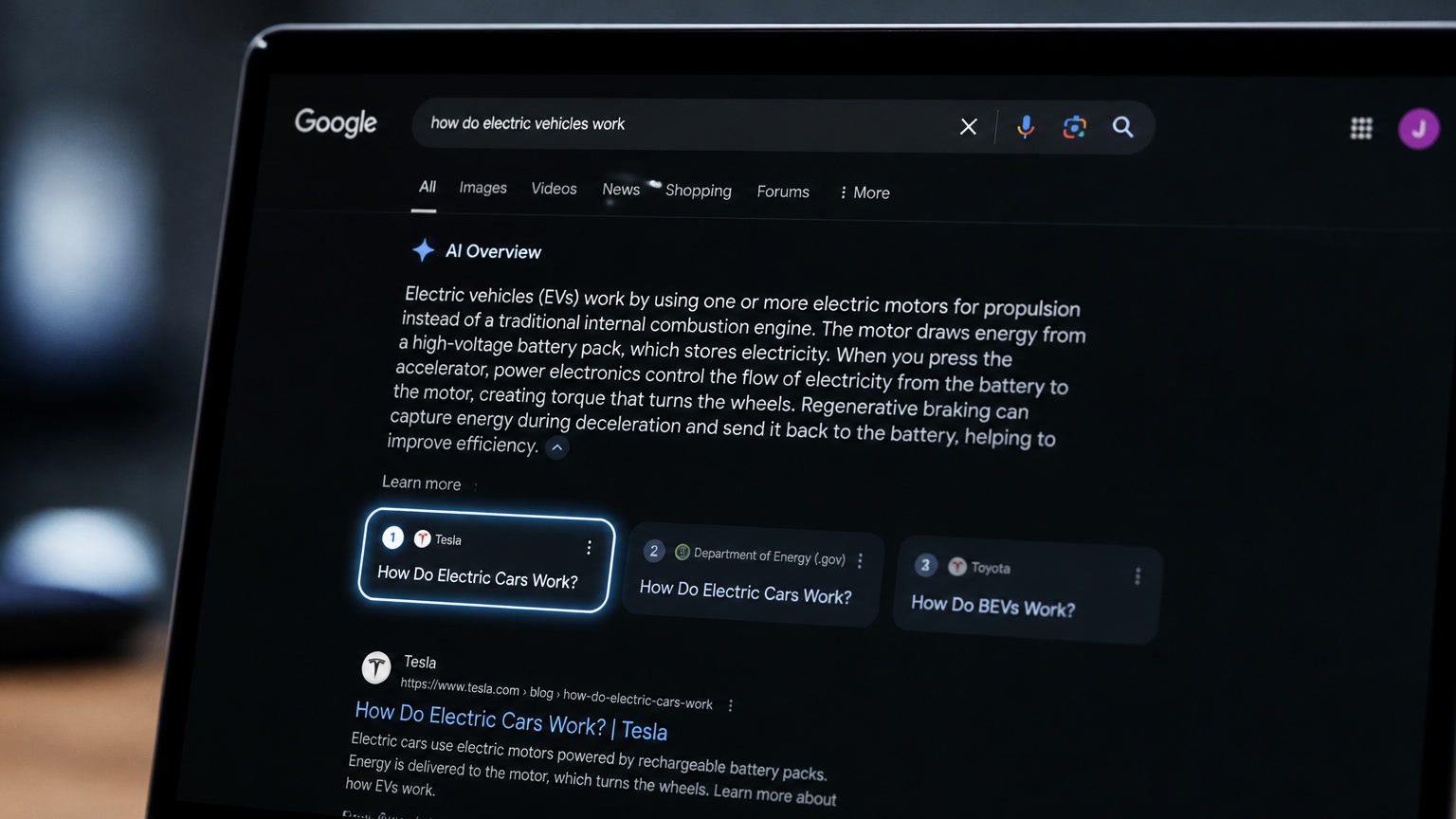
Inside an AI Overview, the first cited source takes 47% of the clicks that leave the panel, the second 23%, the third 14%. This is not a variant of the old ranking ladder: the ladder reproduced itself inside the summary, shorter and steeper than the one it replaced.
Some honest context before any strategy. Those clicks are few. The Ipsos panel of 900 adults behind Pew's study recorded clicks to cited sources on just 1% of visits to pages with an AI Overview. That 47% divides a small handful. And still, of every surface where a brand can show up in a Google search today, being the first source glued to the answer is the one that best divides what little is left.
What each position actually divides
The breakdown comes from Datos' (Semrush) clickstream and is compiled in Searchlab's AI Overviews statistics page: first cited source, 47% of the panel's clicks; second, 23%; third, 14%.
Compare that to what the same proportion does in organic results. Advanced Web Ranking measures position 1 at around 20% CTR on searches with no AI Overview. Inside the panel, the first citation captures close to half of whatever the panel produces. The inequality gets sharper as the panel replaces the blue list.
Seer Interactive, in its 2026 study covering 53 brands and 5.47 million queries, measures the same phenomenon from the other side. On informational queries with an AI Overview, cited brands averaged 2.07% organic CTR against 0.94% for uncited ones: a little more than double. Queries without an AI Overview sat at 3.35%. Being cited does not return you to the world before, but inside the current one it nearly doubles what you get. We already took that cited-vs-uncited jump apart in the citation paradox; what is left is the question above: what happens when there are two cited sources and only one gets the sentence.
The clicks are few. That is why order matters more.
This is the part most headlines skip. If 1% of visits click a citation, the size of the prize is not the argument. The distribution inside that 1% is, because it is the only part where you are still competing for something uneven.
And the interface made position weigh more, not less. On May 6, 2026 Google changed how sources are attributed in AI Overviews and AI Mode:
| Element | Before May 6, 2026 | After |
|---|---|---|
| Citation placement | Grouped list at the end of the summary | Inline, next to the sentence it supports |
| Source preview | None | Hover card with site name and page title |
| Social and forum citations | Generic platform attribution | Creator's name and handle |
| Subscriptions | Undistinguished | Labeled and surfaced |
| End of summary | The text just ended | Suggested angles linking to deeper reads |
Before, every source lived together at the end and order was a list the reader had to walk. Now each citation hangs off a specific claim. The first claim in the answer carries the first source, which is the first thing the reader sees next to the text. Position is a slot in the narrative.
Where the first slot gets decided
Selection does not happen at page level, it happens at passage level. Google says it plainly: to appear as a supporting link in an AI Overview, a page must be indexed and eligible to be shown with a snippet. That is the floor, and everything cited has already cleared it.
Past that, three findings order the decision:
- Ahrefs: only 38% of URLs cited in AI Overviews sit in the organic top 10 for the same query, against roughly 76% in July 2025. Ranking helps less each month.
- Indig (via Search Engine Land): 44.2% of citations come from the first 30% of the page's content. Cited passages run near 20% proper-noun density against 5-8% for generic prose.
- CXL, in its sample of 100 cited pages: 55% of cited passages appeared within the first 30% of the source page.
Same pattern in all three: the model reads upward, keeps what it finds first, and takes what can stand on its own. A page at position 40 beats position 1 when its first paragraph already is the answer.
What to restructure this week
If one of your queries triggers an AI Overview and you are not the first citation, five moves, in order of impact:
- Open with the answer, not the context. A 40 to 70 word paragraph that answers the query directly, before any introduction. That is the passage the model extracts and the one that ends up glued to the first claim.
- Write definitions that stand alone. Sentences in the "X is Y" form, entity named. If the sentence needs the previous one to make sense, it does not survive extraction.
- Cover sub-queries with headings that are real questions. Google decomposes the query into several questions and cites each separately. A heading with no answer under it is a sub-query your competitor covers.
- Every claim travels with its number, its source and its date, in the same paragraph. Citations stranded three hundred words away drop out when the passage is extracted. Fresh data weighs: Princeton's research found a new statistic lifts citation rates 32%, and an inline citation to a recent source, 30%.
- Measure the order alongside presence. Being cited and being the first citation are two different metrics. Log which of your pages comes first and in what slot.
The volatility nobody warns you about
One warning before you optimize order like it were a stable ranking position. In that same SISTRIX crawl, about 11 domains appear per AI answer: 8 hold steady and 3 rotate without stopping. The order you write down today may not be tomorrow's.
This does not invalidate the work. It means the first citation is defended with structure, not with a one-off push. Run the query three or four times before concluding you lost first place; if the order changes between runs, your problem is stability rather than content, and what gets rewarded there is consistency of sources over time.
How to see it on your site
Search Console launched the Generative AI features report in June 2026 and extended it to all sites on August 31. It gives impressions by page, country, device and date. It gives no queries, no clicks, and no order for your citations.
So verification is manual and fits in twenty minutes:
- Pull your ten pages with the most impressions in that report.
- Run their target query in AI Mode, expand the summary, and note where your citation sits relative to the others.
- Run the query three times. Write down whether the order holds.
- Sort the pages by "lost first citation", not by "not cited". They are different problems with different fixes.
For the full measurement framework, see how to measure GEO performance. And if what worries you is that the sentence next to your link does not say what your page says, that is a different problem with a different name: claim fidelity, and it gets audited in cited does not mean quoted.
What does not change with all this
That few clicks do not make citation irrelevant. What citation produces is the first interaction, and that interaction is sometimes not a click: the reader keeps your brand while reading the answer. We develop that accounting in why AI Overview clicks and traffic don't add up.
And that winning the first citation does not come from chasing the first citation. It comes from writing the page the model can lift clean: answer up top, entities named, dated data, sub-queries covered. Order is a consequence of that structure, not a separate tweak. For the full map of acronyms and mechanics, see the GEO, AEO and SEO framework.
Where the 47% comes from
We went looking for the primary table behind the 47/23/14 breakdown and could not find it: we have it via Searchlab, which attributes it to Datos and SparkToro's clickstream. Better to say that now than have you ask. There is also no public study comparing first-citation CTR against second-citation CTR with controls for query, device and intent, so the parallel with the 20% organic CTR is directional.
What is measured and published is this: clicks to citations are rare (Pew/Ipsos, 68,879 searches), being cited nearly doubles CTR against not being cited (Seer, 53 brands), and the organic top 10 weighs less every month among cited sources (Ahrefs, 38% against 76%). Even if the exact 47% moves, those three hold the argument up.
Frequently Asked Questions
Which citation position in an AI Overview gets the most clicks?
The first one. Datos' clickstream breakdown, as compiled by Searchlab, puts the first cited source at 47% of the clicks that leave an AI Overview, the second at 23% and the third at 14%. The denominator is the catch: the Ipsos panel behind Pew's study recorded clicks to cited sources on just 1% of visits to pages with an AI Overview, so that 47% divides a small handful of clicks.
Does the citation order change between runs of the same query?
Yes, often. SISTRIX tracked 82,619 prompts across six countries over 17 weeks and found 53% of cited sources stayed the same between runs while 47% rotated. Treating the first slot as a stable asset is a mistake: measure the order across several runs before concluding you lost first place.
Does ranking first on Google still determine whether you get cited?
Less every month. Ahrefs found only 38% of URLs cited in AI Overviews come from the organic top 10 for the same query, against roughly 76% in July 2025. Eligibility is still the floor: the page has to be indexed and eligible for a snippet. But selection happens at passage level, and an extractable passage from position 40 beats an introductory paragraph from position 1.