AI Mode, AI Overviews, and ChatGPT Cite Completely Different Sources — The 40,000-Point Data Breakdown
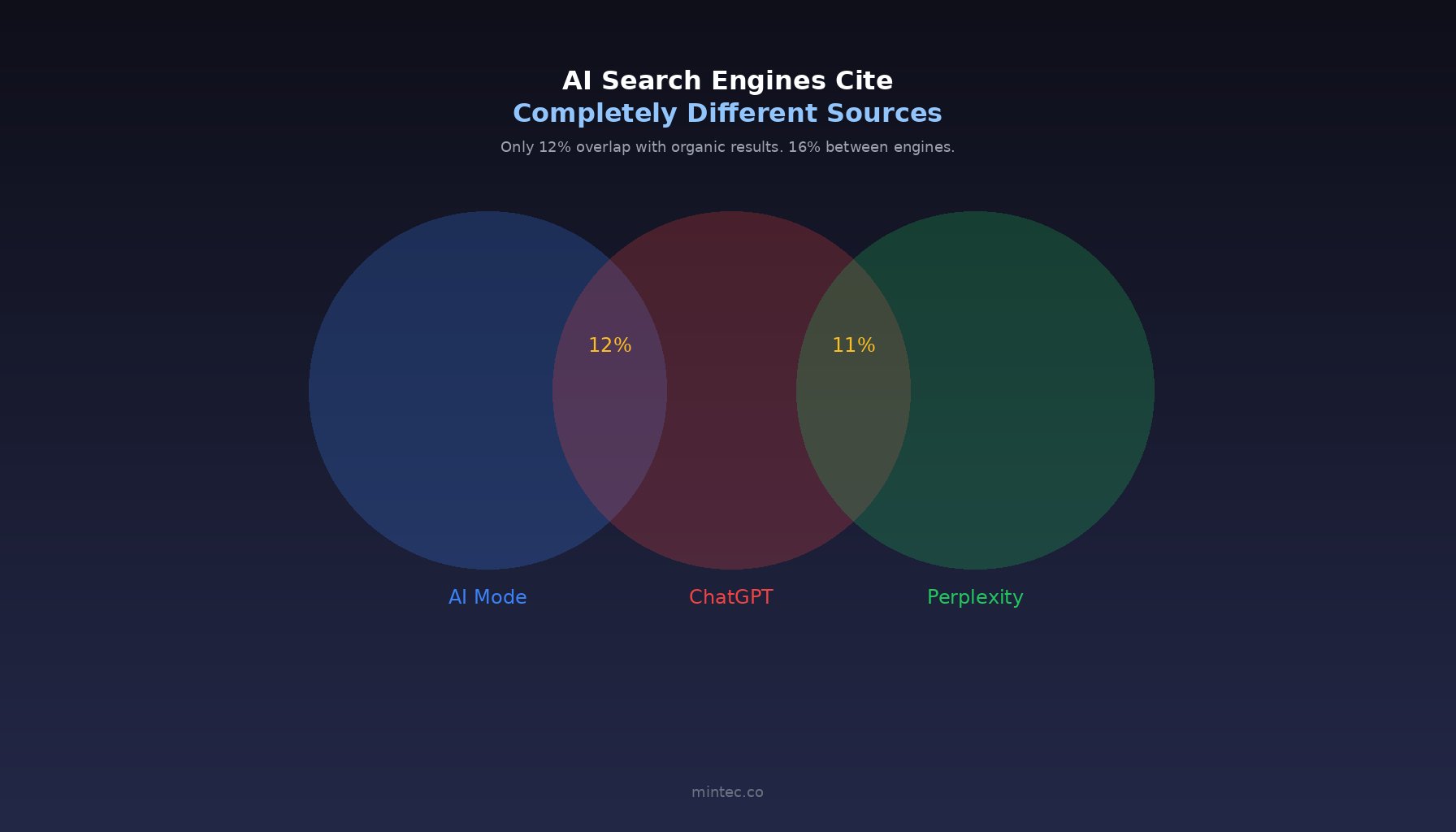
BrightEdge found 16% overlap between citation sources across AI engines. Moz found only 12% of AI Mode citations match organic rankings. Perplexity favors YouTube, ChatGPT leans on Wikipedia, Google AI Overviews cites Reddit. Here's the full breakdown and what to do about it.
AI Mode, AI Overviews, and ChatGPT Cite Completely Different Sources — The 40,000-Point Data Breakdown
Here's a fact that should change how you think about AI search optimization.
Three different AI search engines answer the same query. One cites Wikipedia at the top. Another pulls from a YouTube video. A third cites Google's own shopping page. None of them cite the same URL.
This is not a hypothetical. This is what the data shows, and the numbers are stark enough that pretending "optimizing for AI search" is one thing will waste your budget.
Let me walk through what each engine actually does.
The overlap problem
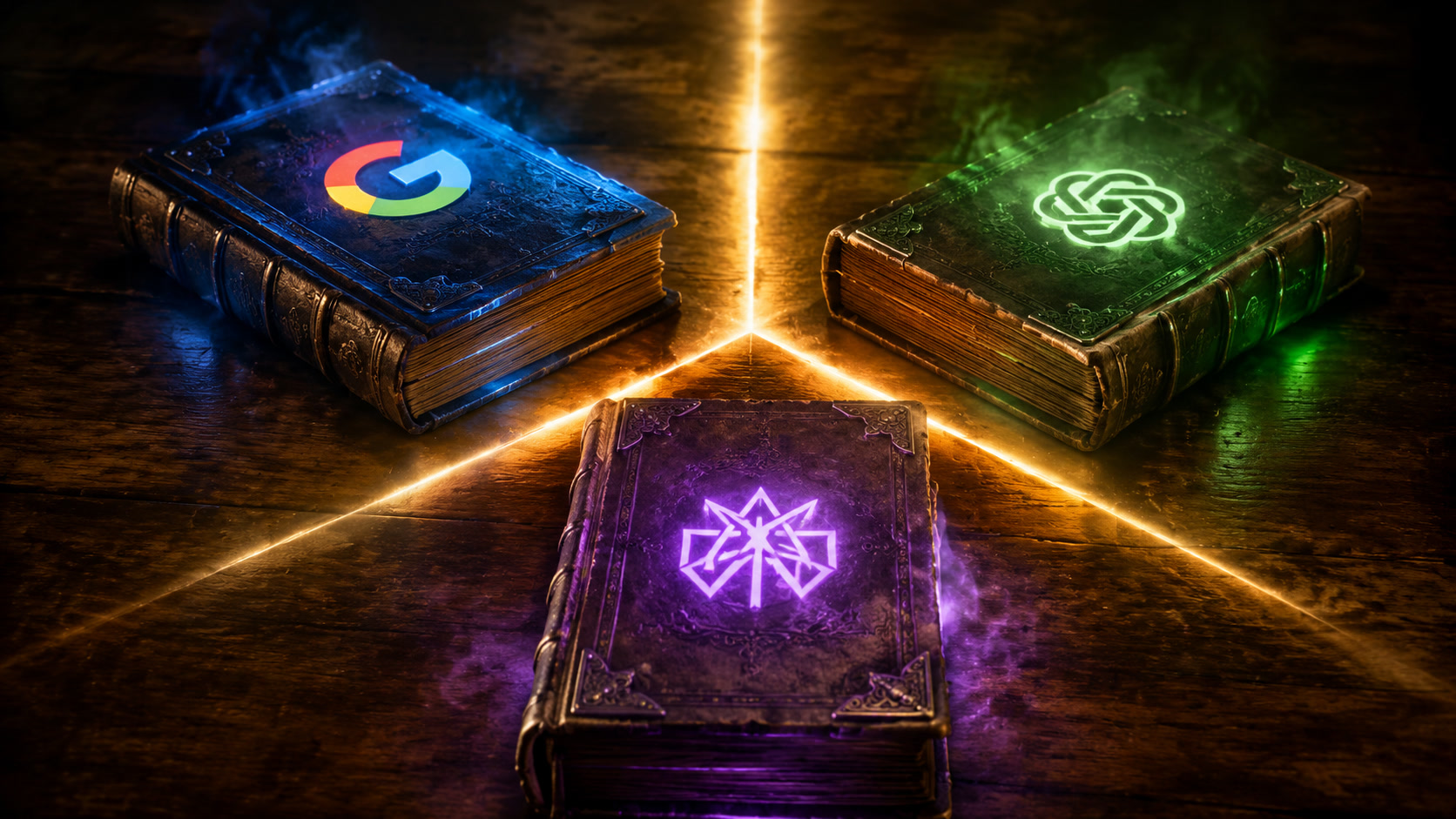
Multiple studies from 2026 converge on the same finding: AI search engines do not share a common citation pool.
BrightEdge published data showing the overlap between any two engines' cited sources ran as low as 16%. Averi, analyzing 680 million AI citations across ChatGPT and Perplexity, found only 11% of domains were cited by both. A third of Perplexity's citations go to sources no other engine touches.
These aren't small differences. They're structural. Each engine has its own editorial logic, its own training data biases, and its own preferred source hierarchy. You cannot optimize for "AI search." You have to optimize for each engine's citation behavior — or at least know which one matters most for your audience.
Google AI Mode: the self-referencing machine
AI Mode is Google's most aggressive AI search format. It gathers information from 10 or more unique URLs per response, builds a custom answer on the fly, and cites its sources in a panel alongside the response.
Moz analyzed 40,000 keywords in AI Mode and found something that should make traditional SEOs uncomfortable: only 12% of AI Mode citations match URLs in the top 10 organic search results. The AI is not picking from the same list the ranking algorithm produces.
SE Ranking's analysis of 1.3 million AI Mode citations tells us where it does pull from. Google.com — Google's own properties — account for 17.42% of all AI Mode citations. That's more than YouTube, Facebook, Reddit, Amazon, Indeed, and Zillow combined.
YouTube shows up as the second most cited external source. This matters because AI Mode responses are text-heavy and verbose — they read like briefing documents. If you're not producing video content that Google can transcribe and cite, you're leaving citations on the table.
AI Mode favors structured, entity-dense content with clear factual claims. It's Google's own ecosystem, optimized for Google's own retrieval pipeline, running on Gemini 3.5 Flash since May 2026.
Google AI Overviews: Reddit and YouTube country
AI Overviews, the version that appears above traditional search results, behaves differently from AI Mode.
Reddit accounts for 21% of AI Overview citations according to multiple studies. YouTube is close behind at 18.8%. Together, two platforms that don't produce traditional "SEO content" drive nearly 40% of the citations.
The implication is uncomfortable if you've built your career on publishing 2,000-word blog posts. AI Overviews favors content with real-world authority signals — community upvotes, comment threads, view counts, publication dates — over content that simply follows SEO best practices.
A January 2026 Guardian investigation found that Google AI Overviews cites YouTube more than any medical website for health queries. The format doesn't discriminate by editorial quality as much as traditional search did.
ChatGPT Search: Wikipedia first, news nowhere
ChatGPT Search is a different animal entirely.
The 5W Citation Source Audit, released in May 2026 and synthesizing data from nine independent research sources, found that Wikipedia accounts for the largest share of ChatGPT citations. Wikipedia plus Reddit together drive over 25% of all ChatGPT citations. The Wall Street Journal, New York Times, and Bloomberg — three of the most authoritative news sources in traditional PR — do not appear in ChatGPT's top 20 cited sources.
This is a structural break from how PR and earned media have worked for decades. Getting covered in a major newspaper used to be the pinnacle of credibility signaling. To ChatGPT's citation algorithm, a well-structured Wikipedia page with clean citations matters more.
ChatGPT also shows a strong preference for content with clear definitions, structured comparisons, and FAQ schemas. If your content reads like an encyclopedia entry — specific, well-sourced, neutral-toned — ChatGPT will cite it. If it reads like thought leadership, it won't.
Perplexity: YouTube's biggest fan
Perplexity relies heavily on YouTube content, especially for educational and how-to queries. The Conductor study tracking 7 months of citation data found YouTube anchored Perplexity's top citation slot consistently.
Perplexity also has the highest percentage of unique sources — sources no other engine cites. About a third of its citations are exclusive. This means Perplexity is more willing to pull from niche or long-tail content than Google or ChatGPT are.
Why the differences exist
It's tempting to think these engines will converge over time. I'm not convinced.
Each engine uses different retrieval architectures. Google AI Mode and AI Overviews run on Google's own index, which is the largest and most curated on the web. ChatGPT Search uses Bing's index plus its own web crawling. Perplexity maintains its own retrieval pipeline optimized for real-time answers.
The training data also differs. ChatGPT was trained on a massive corpus that includes Wikipedia as a significant component — the model "trusts" Wikipedia-style writing because it matches its training distribution. Google's models are trained on their own index and user behavior data. Perplexity optimizes for freshness and comprehensiveness.
These are not bugs that will be fixed. They're features of how each system was designed.
What this means for your strategy
I've seen too many content strategies this year that say "optimize for AI search" as a single bullet point. That's roughly as useful as saying "optimize for the internet."
Here's what the data actually supports.
Prioritize by audience. If your customers use ChatGPT (B2B professionals, researchers, students), optimize for Wikipedia-style writing: clear definitions, neutral tone, FAQ schema. If your customers search Google (everyone), prioritize AI Mode optimization: entity density, structured data, multiple formats including video.
Build in multiple formats. AI Overviews cites YouTube heavily. AI Mode cites Google properties. ChatGPT cites text-heavy sources. Perplexity cites video. If you're producing only blog posts, you're invisible to the citation preference of at least two engines.
Stop treating press coverage as an AI signal. Getting cited by the NYT won't help you get cited by ChatGPT. Invest in structured, well-sourced content that AI models can parse confidently — Wikipedia-style citations, entity-rich copy, clean schema markup.
Track citations separately by engine. If you're only measuring organic rankings, you have no idea whether your AI citation strategy is working. Use tools that track citations across AI Mode, AI Overviews, ChatGPT, and Perplexity separately. The page that ranks #1 in Google might be invisible to ChatGPT, and vice versa.
The honest take
The thing that bugs me about most AI search advice right now is how confidently wrong it is. People treat "GEO" like it's one thing — add schema, write clearly, get cited. The data says the opposite. These engines disagree with each other about what counts as a credible source. They disagree by a wide margin.
Most agencies will keep treating AI optimization as a single checkbox. That's fine for thought leadership posts. It's not going to work when clients start asking why their ChatGPT citations are flat despite ranking #1 in Google.
The teams that separate their strategy by engine — and measure results by engine — will be the ones who can actually show ROI from AI search. The gap between those teams and everyone else is going to widen fast.
You don't need to be on every engine. You need to know which engine your customers use, and optimize for that one properly.
Frequently Asked Questions
What percentage of AI citations overlap between different AI search engines?
According to BrightEdge, the overlap between citation sources across any two AI engines can be as low as 16%. Averi found that only 11% of domains cited by ChatGPT are also cited by Perplexity across 680 million citations analyzed.
Which sources does Google AI Mode cite most?
SE Ranking found that Google.com accounts for 17.42% of all AI Mode citations. YouTube is the second most cited external source. Only 12% of AI Mode citations match URLs in the top-10 organic search results, per Moz's study of 40,000 keywords.
How do ChatGPT citations differ from Google AI Overviews?
ChatGPT Search cites Wikipedia as its #1 source, while Google AI Overviews cites Reddit (21%) and YouTube (18.8%) most frequently. Traditional news outlets like WSJ, NYT, and Bloomberg don't appear in ChatGPT's top 20 cited sources.