
How to Measure GEO ROI in 2026: The 4 Metrics That Actually Matter
Google's AI Mode just crossed 1 billion users. ChatGPT referral traffic converts at 7% — higher than organic search. Yet almost nobody measures GEO ROI correctly. Here's a practical framework with the 4 metrics that separate signal from noise.
How to Measure GEO ROI in 2026: The 4 Metrics That Actually Matter
Google's AI Mode just crossed 1 billion monthly users. Queries are doubling every quarter. ChatGPT referral traffic converts at 7% — higher than organic search.
But when I ask clients and peers how they measure GEO ROI, the most common answer is some variation of "uh... we check our mention counts in the tools."
That's not measuring ROI. That's counting coins without knowing their value.
This article is the framework we use internally at Mintec to determine whether our Generative Engine Optimization work is actually paying off. Four metrics, not forty — because GEO's problem right now isn't lack of data. It's lack of signal.
Why traditional metrics don't carry over
Let's start with the obvious: classic SEO metrics don't translate to GEO.
Ranking #1 on Google doesn't mean ChatGPT will cite you. Having a high Domain Rating doesn't mean Perplexity considers you an authoritative source. Search Engine Land's 8 GEO metrics guide showed that the correlation between traditional rankings and AI citations has been eroding through 2026 — what was once a strong relationship is now moderate at best.
The GEO tools that have emerged over the past 18 months (there are over 40 now, per Presenc AI's landscape map) measure things like Share of Model Voice and mention frequency. Interesting data points, but they don't tell you whether your GEO investment is generating traffic, leads, or revenue.
The fundamental problem: tools measure visibility. ROI is conversion. They're not the same thing.
The 4 metrics that actually matter
1. Accuracy-Weighted Citation Rate
Not all citations are equal. An incorrect mention — one that attributes false data or misrepresents your offering — is worse than no mention.
We calculate something we call AWSOV (Accuracy-Weighted Share of Voice):
AWSOV = (Total mentions × Accuracy factor) / Total industry mentions
The accuracy factor ranges from -1 to 1. If ChatGPT describes you exactly right, it adds 1. If it compares you unfavorably against a competitor without basis, it adds 0.3. If it attributes incorrect information, it subtracts.
This isn't theoretical. The Regional Court of Munich issued an injunction against Google in June 2026 ruling that AI Overviews are Google's own content. If the AI cites you incorrectly, there's legal exposure. Accuracy measurement isn't optional.
How to measure it: Use tools like GenOptima or Similarweb for mention tracking, but supplement with a weekly manual review of 20-30 relevant queries across ChatGPT, Gemini, Perplexity, and AI Overviews. Document whether the citation is accurate, the context, and whether it positions you favorably or not.
2. AI-Assisted Traffic
This is the metric most people think they're measuring but almost nobody measures correctly.
The problem: traffic from Google's AI Overviews is lumped in with traditional organic traffic in Google Analytics. If you don't separate it, you have no idea how much of your "organic" traffic actually comes from generated responses.
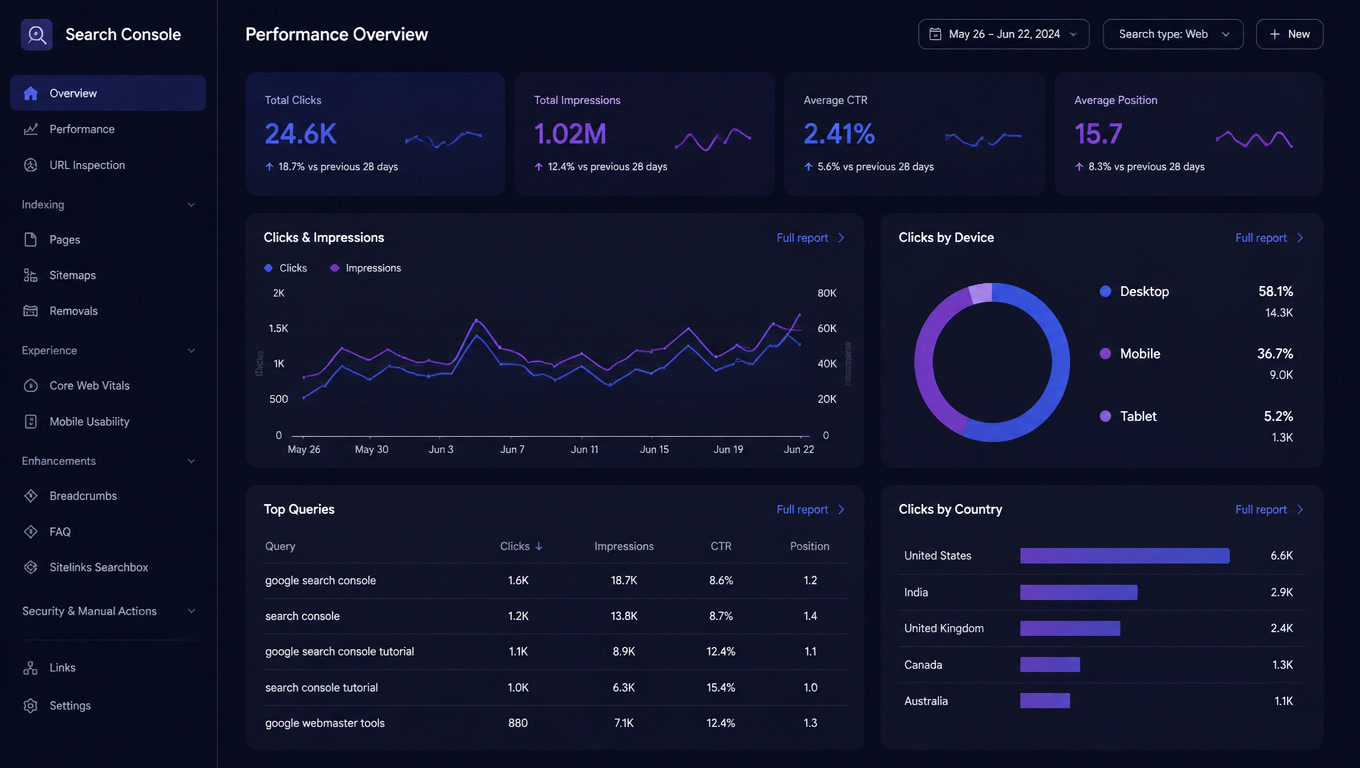
Google Search Console recently launched a dedicated AI performance report showing impressions and clicks from AI Overviews and AI Mode. It's the first official data we have, but it only covers Google.
For other sources (ChatGPT, Perplexity, Gemini, Claude):
- Use UTMs with parameters like
?utm_source=chatgptor?utm_source=perplexityon your shared links. - Implement server-side tracking to catch referrers from platforms that strip UTMs.
- Create a custom "AI Search" channel in GA4, segmented by source/medium.
The benchmark: SparkToro's 2026 data shows ChatGPT referral traffic converts at 7%, vs. 5% for Google organic. In B2B SaaS, Perplexity conversion rates are even higher because the platform attracts technical decision-makers. If your AI traffic is converting below 3%, something in your GEO strategy needs adjustment — you're probably optimizing for citation volume instead of accuracy.
3. Semantic Coverage by Query Intent
Most GEO tools give you a single number: "your brand appears in X% of queries." That's worthless without knowing what kind of queries.
Segment by intent:
- Informational: "what is generative engine optimization" — low commercial value, high volume
- Commercial: "best GEO agency Latin America" — high value, lower volume
- Transactional: "hire GEO services" — the holy grail, low volume but high conversion
- Navigational: "Mintec GEO" — they already know you, just confirming
How to measure it: Group your target keywords by intent. For each group, calculate your citation rate in ChatGPT, Gemini, and Perplexity. A healthy GEO strategy should show 60-70% citation in informational queries (where you build authority) and at least 30-40% in commercial queries (where you capture demand).
If you're at 90% in informational and 5% in commercial, you're building general authority but not capturing converting traffic. The fix: create content specifically for comparison and purchase queries. A post like GEO vs SEO: what's actually changed in 2026 pulls double duty on both intent types.
4. Share of Model Voice by Platform
SOMV is the most well-known GEO metric, but it needs context.
High SOMV on ChatGPT isn't the same as high SOMV on Perplexity. ChatGPT has 800 million weekly users but its fast mode doesn't do live web search — it relies on training data. Perplexity and Google's AI Mode search live, meaning citations are more dynamic but also more volatile.
Google announced at I/O 2026 that AI Mode surpassed 1 billion users with queries doubling every quarter. They also launched Information Agents — 24/7 background monitors for AI Ultra subscribers. Each platform has different citation rules, and optimizing for one doesn't guarantee results on another.
How to measure it: Use tools that track multiple platforms (Similarweb, GenOptima). Don't marry one platform. If your SOMV is high on ChatGPT but low on Perplexity, you have a freshness problem — your content isn't current enough for live-search engines to cite it. The fix: add dates, recent data points, and regular updates to your content.
The reporting framework we use
Monthly, for each client:
- Week 1: Extract AWSOV and SOMV from tools + manual review of 30 queries
- Week 2: Analyze AI-assisted traffic in GA4 (custom segment)
- Week 3: Review semantic coverage vs. competitors (which queries you cover and which you don't)
- Week 4: One-page executive report with 2-3 concrete actions for the next month
The monthly report never exceeds one page. If you can't summarize your GEO ROI in under 5 bullet points, you haven't understood it well enough.
What nobody tells you
GEO is overhyped right now. There are agencies selling "ChatGPT ranking" like it's SEO circa 2010. And yes, the opportunity is real — AI Mode has 1 billion users and ChatGPT referral converts better than organic. But most of the metrics being reported today are vanity metrics dressed up as KPIs.
My advice: before you buy a GEO tool or hire a GEO agency, ask how they measure citation accuracy. If they don't have an answer, they're counting mentions — not creating value.
The brands that win with GEO won't be the ones that appear most often. They'll be the ones that appear with accuracy in the queries that actually drive their business.
Frequently Asked Questions
How do you measure Generative Engine Optimization ROI?
GEO ROI is measured by combining four metrics: citation rate in AI search engines (how often ChatGPT, Gemini, and Perplexity cite you), accuracy-weighted citation precision, assisted traffic from generated responses, and post-citation conversion rate. Without segmentation by query intent (informational vs. commercial), any single number is misleading.
What's the difference between SEO and GEO metrics?
Traditional SEO metrics track keyword rankings, organic clicks, and SERP visibility. GEO metrics track citation in AI-generated responses, citation accuracy, share of model voice (SOMV), and traffic arriving from AI assistants like ChatGPT, Gemini, AI Overviews, and Perplexity. They're not interchangeable — high rankings don't guarantee AI citations.
How much traffic can GEO optimization generate?
In competitive sectors (SaaS, marketing, fintech), well-positioned brands report 5-15% of total traffic from AI sources. ChatGPT referral converts at 7% vs. 5% for Google organic (SparkToro 2026 data). Google AI Overview traffic is harder to isolate but the new Search Console AI performance report helps. Benchmarks vary significantly by industry and content maturity.