Google Finally Showed Us AI Search Data. Most People Will Read It Wrong.
On June 3, 2026, Google launched dedicated AI performance reports in Search Console. For the first time, we can see how our content appears in AI Overviews and AI Mode. The catch: nobody knows how to read this data yet. Here is a framework to avoid drawing the wrong conclusions.
Google Finally Showed Us AI Search Data. Most People Will Read It Wrong.
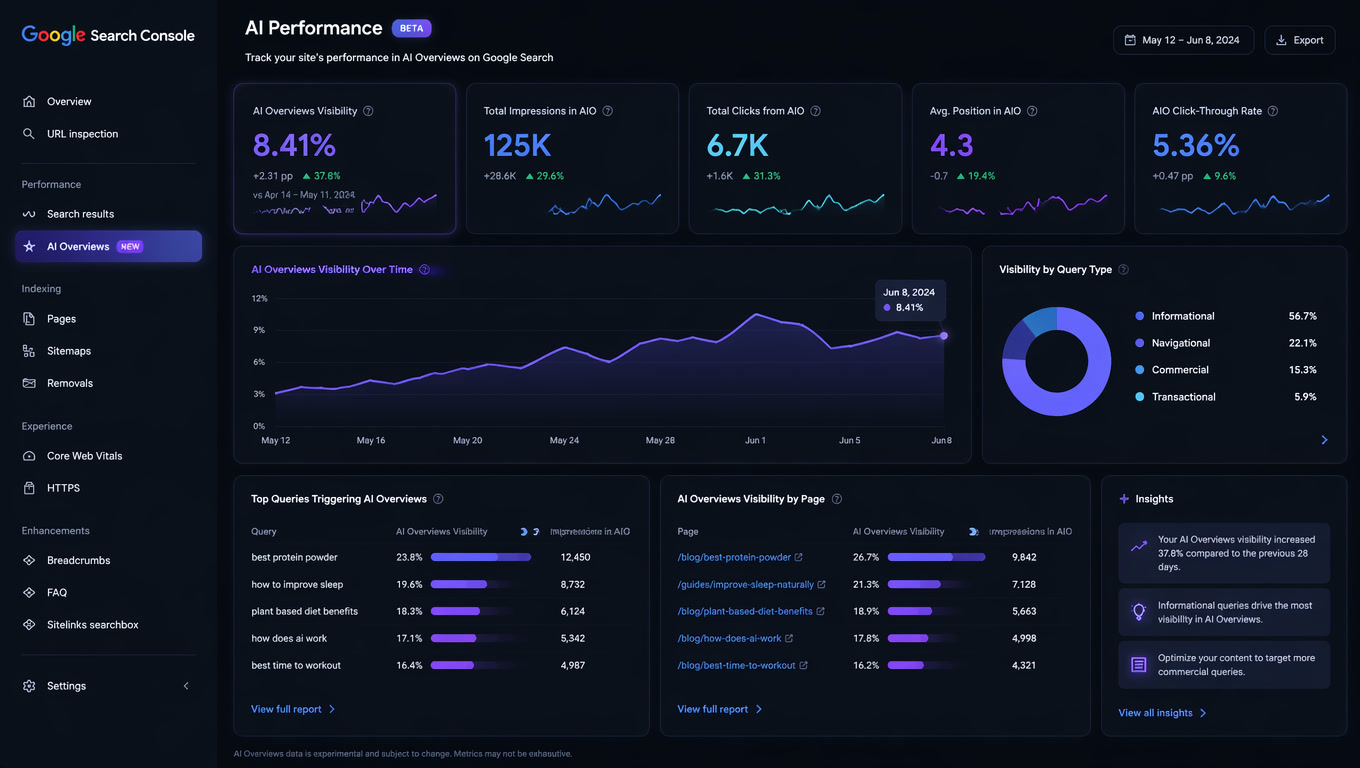
On June 3, 2026, Google enabled the new Generative AI performance reports in Search Console. For the first time, any site with beta access can see dedicated metrics for AI Overviews and AI Mode. No more guesswork. No more third-party tool estimates. Real Google data on how your content shows up in generative search results.
Sounds great. And it is. But there is a catch most marketers will miss: these numbers do not measure what you think they measure.
What Google Actually Released
Two new reports appeared in Search Console for a subset of sites (initially UK-based, rolling out globally):
- Generative AI performance report (Search): Shows organic impressions in AI Overviews and AI Mode, broken down by page, country, device, and date. Includes clicks when users click links within the generative response.
- Generative AI performance report (Discover): Same thing for generative AI features inside Google Discover.
Google announced it in their developer blog on June 3, and the full documentation is in the Search Console help center.
We finally have visibility. But having data is not the same as understanding it.
The Problem: AI Impressions ≠ Value
The latest study from SEO.com shows 48% of Google searches now display an AI answer at the top of the page. That is up from 34.5% in December 2025 — the fastest growth rate since AI Overviews launched.
But here is what the same study shows: most of those AI answers get zero clicks. The user gets their answer directly in the generative snippet and moves on.
This creates a paradox for the new Search Console reports. A site can have high AI visibility — cited in AI Overviews for important queries — and zero AI clicks because the answer was self-contained.
If you only look at click numbers, you will conclude your content is not working for AI. But it might be doing exactly what Google designed it to do: answer the query without requiring a click.
Mintec's Framework for Reading the AI Reports
We have spent 15 years reading Search Console data. These new reports need a different approach. Here are the three metrics that actually matter:
1. AI Impression Share
Do not look at absolute impressions. Look at what percentage of your total impressions come from AI features versus traditional search. A growing AI share indicates your content is being extracted by Google's generative models.
What to do: If your AI Impression Share is high (>20%), your content is well-structured for extraction. If it is low, check whether you are using structured data, descriptive headings, and formats Google can cite (tables, lists, definitions).
2. AI Click Rate vs. Traditional Click Rate
Compare the CTR of your pages in AI results versus traditional results. A large gap (e.g., 5% traditional vs. 0.5% AI) suggests your content is being consumed for self-contained answers.
What to do: Not necessarily bad. But if you want to convert AI visibility into traffic, include phrases like "according to our analysis" or "based on [date] data" — signals that generative models interpret as a reason to link to the original source.
3. Citation Frequency per Query
This is not a direct Search Console report (yet), but you can infer it: if a page generates many AI impressions but few clicks, it is appearing as a reference source but not driving action.
What to do: Add a methodology section or "full data available at..." to data-heavy articles. This gives Google a reason to cite your page as a primary source rather than synthesizing everything in the snippet.
What Nobody Is Saying
The SEO gurus are going to spend the next few weeks posting superficial takes on these reports. "Look how many AI impressions you have." "Optimize for AI Overviews." All very generic.
The uncomfortable truth: there are no benchmarks yet. Nobody knows what a "good" AI impression number is because these reports are less than a week old. Anyone selling you a target metric is making it up.
What we do know: 48% of searches already have AI answers. The opt-out toggle for AI data collection in Search Console takes effect June 17, 2026. And Google's official AI optimization guide — which we broke down here — makes clear that well-structured, authoritative content is what generative models prioritize.
What to Do This Week
- Check if you have access. Go to Search Console → Performance → "Search Generative AI." If you do not see it, your account is not in the beta yet. It is coming.
- Take a baseline screenshot. With no historical data, your first measurement is your benchmark. Do not panic if AI impressions are low.
- Compare your best-performing pages in AI vs. traditional search. The ones that work well in both are your most valuable content.
- Do not optimize for AI at the expense of traditional search. For now, traditional traffic is still orders of magnitude larger. The strategy is to prepare for a hybrid future, not abandon what works.
If you want to understand how to prepare your content for AI Overviews and AI Mode, we have a full breakdown of Google's official optimization guide and a practical GEO framework for local businesses — both based on real client data, not theory.
The AI data is here. The question is whether you read it right.