The Vanity Metric Problem in GEO: Why Most AI Visibility Scores Are Misleading
Over 40 GEO tools now measure 'AI visibility.' Most track things that don't correlate with traffic or conversions. Here's what actually matters for generative engine optimization measurement.
A year ago, "are we visible in AI search?" was a question nobody could answer. Today there are over 40 platforms selling you the answer. Problem is, almost all of them measure different things in different ways, and almost none of them measure what actually makes a difference.
I'm not saying GEO tools are useless. They're not. But there's a gap between what they report and what you actually need to know — and that gap is getting dangerous.
The rise (and noise) of GEO measurement tools
In 2025, dedicated platforms for measuring AI search visibility barely existed. By July 2026 there are over forty. According to Presenc AI's 2026 GEO tools landscape map, the category now includes monitoring tools, content optimization platforms, authority signal generators, and "AI brand publishing" systems — all in under 18 months.
The problem isn't that they exist. The problem is what they measure.
Nearly every GEO tool focuses on three metrics:
- Brand mentions — how often your brand appears in generated responses
- Share of Model Voice (SOMV) — your mention share vs. competitors
- Citation frequency — how regularly AI cites you
These sound relevant. But scratch the surface and the cracks appear. Search Engine Land's 8 GEO metrics guide from May notes that SOMV is useful for competitive categories because AI responses compress the consideration set — but that frequency isn't the same as influence.
Why citation frequency isn't enough
Imagine your brand appears in 60% of ChatGPT responses for your industry's queries. Sounds amazing, right?
Now imagine that in 40% of those mentions, ChatGPT describes you as "a tool for beginners" or compares you unfavorably with a competitor. Or worse: attributes features you don't have.
That's not visibility. That's noise.
Surface metrics (mentions, SOMV, frequency) operate on a false assumption: that every mention is positive or neutral. In practice, AI responses are contextual and comparative. Your brand can be highly cited but always in the context of "this isn't as good as alternative X."
But there's a more serious problem. In June 2026, the Regional Court of Munich issued a temporary injunction against Google, ruling that AI Overviews generated by Google are the company's own content rather than protected search results. This means if an AI cites you incorrectly — attributing false data, positions you don't hold, or outdated information — there's legal exposure.
Suddenly citation accuracy isn't just a brand problem. It's a legal liability.
What you should actually measure in GEO
After working with multiple clients trying to correlate GEO metrics with real business outcomes, here's what we've found actually matters:
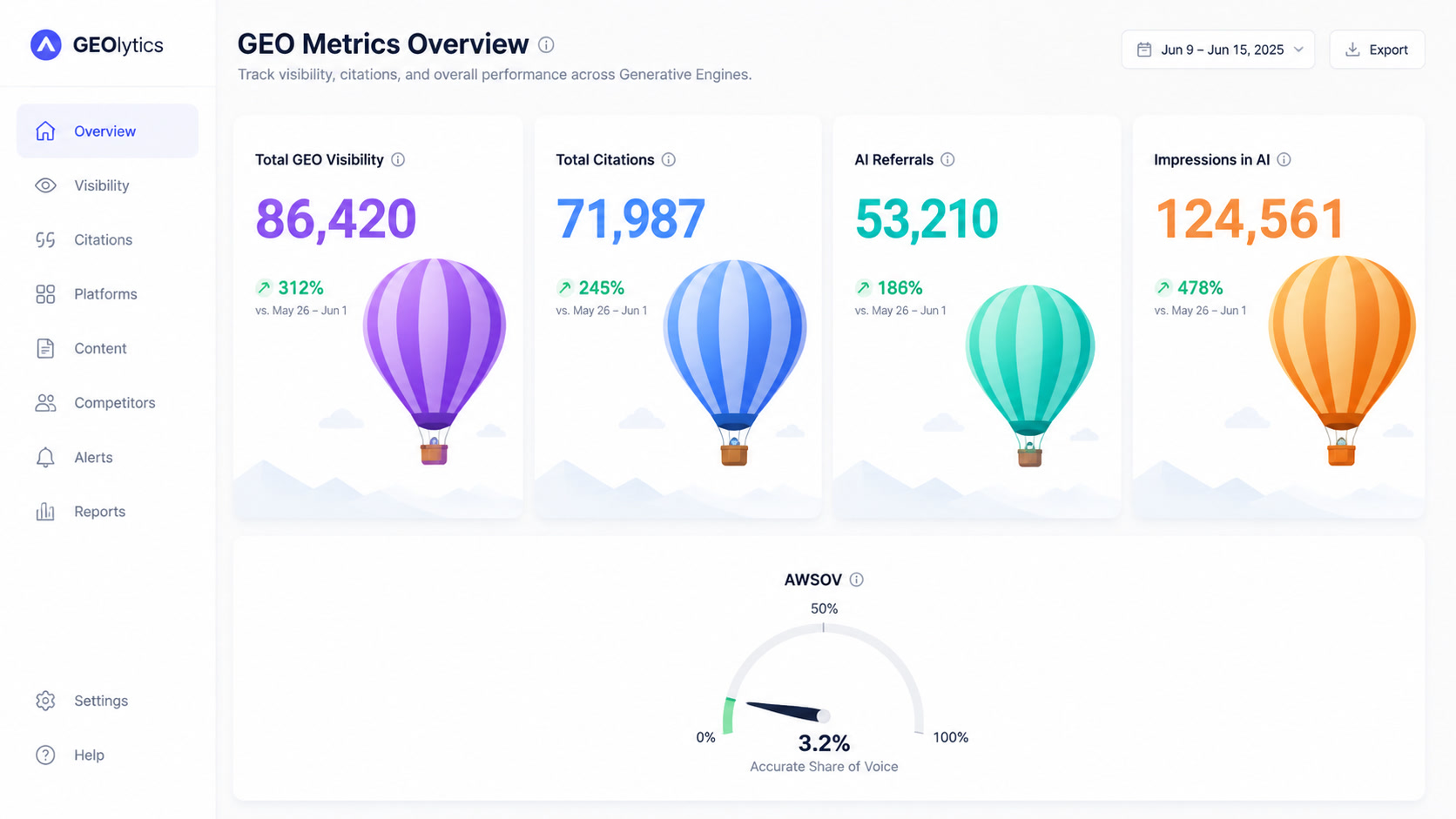
Accuracy-Weighted Share of Voice (AWSOV). We weight each mention by how accurate and contextually favorable it is. An incorrect mention subtracts, not adds.
Prompt quality that cites you. Not all AI queries are equal. A mention in response to a high-intent commercial query ("best digital agency for ecommerce") is worth orders of magnitude more than a generic informational query ("what is digital marketing"). The more mature GEO tools are starting to segment by this, but most still average everything.
Post-citation conversion rate. This is the one almost nobody tracks. Someone lands on your site from ChatGPT, Perplexity, or AI Overviews — then what? Do they convert? According to 2026 SparkToro data, ChatGPT referral traffic converts at 7% vs. 5% for Google organic. But that only counts if you're actually separating that traffic from regular organic. Most sites don't, and they're flying blind on the full funnel.
Topic-level semantic coverage. Instead of counting mentions, measure how well you cover the entities and relationships an AI needs to label you an authority. Harder to measure, way more predictive. Cover the sub-topics with depth and evidence, and the citations show up.
How to fix it
You don't need to abandon your current GEO tools. But you do need to supplement them with:
A citation verification system. Manually or semi-automatically review a sample of your mentions in ChatGPT, Gemini, Perplexity, and AI Overviews. Are they accurate? Is the context correct? Are they attributing things that aren't true?
Query intent segmentation. Separate your metrics by search intent. Mentions in commercial and comparison queries are the ones that actually move the needle.
Conversion tracking from AI sources. Use specific UTMs or server-side tracking to identify traffic coming from generated responses. Without this, you're flying blind.
An accuracy score. Just as Google has E-E-A-T, you should have an internal score for how accurate your AI presence is. If a tool reports 80% SOMV but your accuracy score is low, the number is worthless.
Right now GEO is where SEO was in 2005: everybody counts their mentions, nobody checks if those mentions actually do anything. The people who figure out the difference between signal and noise first — who ask "is this citation accurate?" instead of "how many citations do I have?" — are going to clean up when the rest of the industry catches on.
My two cents: ask your tool for citation accuracy, not citation volume. If it can't give you that, you're probably measuring the wrong thing. And with the Munich ruling, measuring the wrong thing can cost you more than a bad meeting with your CMO.
Frequently Asked Questions
What are vanity metrics in GEO?
Vanity metrics are indicators like Share of Model Voice, brand mention counts, or citation frequency that sound impressive but don't correlate with real traffic, conversions, or brand authority. Tools report them because they're easy to measure, not because they're valuable.
What is the most important metric in Generative Engine Optimization?
There isn't a single metric. What matters is the combination of: citation accuracy (how correctly AI cites you), citation quality (what context you appear in), and post-citation conversion rate (whether people who arrive from AI actually take action). Frequency without accuracy is noise.
How does the German court ruling affect GEO measurement?
The Munich court ruled that Google's AI Overviews are Google's own content, not protected search results. This means inaccurate citations aren't just a brand problem — they're a legal liability. GEO measurement must now include accuracy scoring, not just visibility tracking.
How do you track conversions from AI search traffic?
Use specific UTMs or server-side tracking to identify traffic arriving from AI-generated responses (ChatGPT, Perplexity, Gemini, AI Overviews). Most sites don't separate AI Overviews traffic from regular organic, completely losing funnel visibility. Without this separation, you can't measure whether your GEO efforts actually drive business results.