
Auto Repair Shop Automation: From Estimate to Approved Repair Order
The bottleneck in a repair shop is not the phone — it is the approval. A five-stage pipeline to automate estimates, authorizations and return visits over WhatsApp.
The automation that moves the needle in an auto repair shop is not the one that books appointments — it is the one that turns an estimate into a signed repair order and brings the customer back for the next service. The phone matters, but the money leaks in two holes after that. The first: the customer who hears a price out loud, with no evidence, and says "let me think about it." The second: the customer who never comes back because nobody told them service was due. In Latin America, where independent shops dominate and the vehicle fleet is aging — 13 years average age in Mexico — the second hole is silent and bigger than the first.
The phone is not the bottleneck — the approval is
Yes, shops miss calls. The Automotive Service Association estimates that nearly one in four calls during business hours goes unanswered, and between two and six in ten missed calls are never returned: 62% of customers never call back, and 78% abandon the business after an unanswered call. At dealerships the gap is worse — Numa puts the average at 30–40% of inbound calls missed, with 15–20% of volume arriving after hours, where the failure rate is 100%.
But fixing that only leaves you with more conversations, not more repairs. The real drop-off happens afterwards:
- The estimate without evidence. Cox Automotive's 2026 Fixed Ops and Ownership Study found that customers who received photos or videos of the recommended repair reported 53% more trust in the shop and were 49% more likely to approve the additional service. The average ticket on those repair orders rose by USD 230.
- The approval that stalls. The 45% of consumers dissatisfied with dealership service cite exactly the same thing: unexpected costs and poor communication. It is not the price — nobody explained, with evidence, what would be done and why.
- The return visit that never gets booked. Cox reports that only 54% of owners of cars two years old or newer returned to the selling dealership in 2025, down from 72% in 2023. Every lost customer is worth more than USD 12,000 in lifetime value, and customers who do get serviced there are 74% more likely to buy their next car from the same dealer.
Opinion: most shops buy a chatbot to book appointments and leave untouched the step that actually decides revenue. Scheduling a repair is convenience; approving it is the business. Automate it in reverse.
What the rules already require you to put in writing
This is the detail almost no "chatbots for repair shops" article mentions, and it is what turns automation into something more than a convenience: authorizing a repair is a legal requirement, not a UX preference.
Mexico's NOM-068-SCFI-2000 requires every repair or maintenance operation to be recorded on a service order or adhesion contract, written in Spanish and meeting the standard's information requirements, and it requires the provider to obtain written authorization from the consumer before proceeding with faults not originally described. The pattern repeats across the Atlantic: Spain's Royal Decree 1457/1986 requires that work may only proceed once the customer has given consent by signing the estimate, and that hidden defects be reported within a maximum of 48 hours with the price and the customer's express consent before touching them.
Translated into daily operations: every extra job needs a traceable yes. A phone call is not one. A "yeah, go ahead" at the counter gets argued later. A WhatsApp thread with the itemized estimate, the inspection photos and an explicit timestamped confirmation is, today, the cheapest evidence a shop can produce.
And since October 1, 2026 that evidence has a defined price: Meta now bills service messages with 1,000 free service messages per business phone number per month, and out-of-window template messages have no free tier. Reference rates run about USD 0.0068 per message in Brazil, USD 0.0085 in Mexico and USD 0.0008 in Colombia. A repair approval costs cents. The average repair order does not.
The five-stage pipeline
This is what we build when a shop — independent or dealership — asks us to close the full loop. Each stage has an owner, a trigger and a metric:
| Stage | Trigger | What gets automated | Metric |
|---|---|---|---|
| 1. Capture | Missed call, after-hours message | Immediate WhatsApp reply with three real open slots | % of missed calls that turn into conversation |
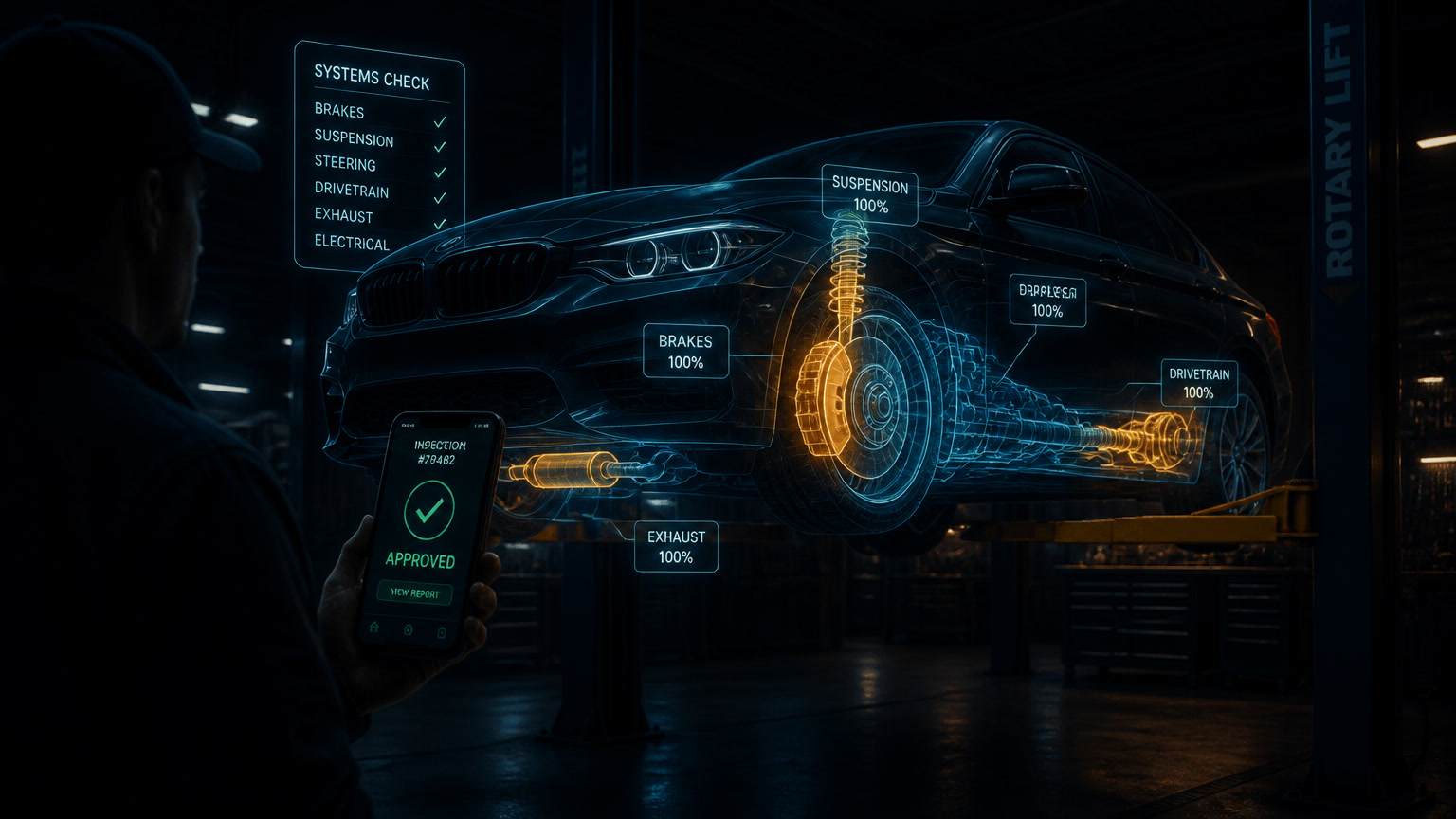
| 2. Evidence | Vehicle on the lift / diagnosis ready | Short photo or video of the worn part + itemized estimate sent to the customer | % of estimates with evidence attached |
| 3. Authorization | Estimate sent | One-tap consent that writes the service order and kicks off the work | Estimate-to-approval time |
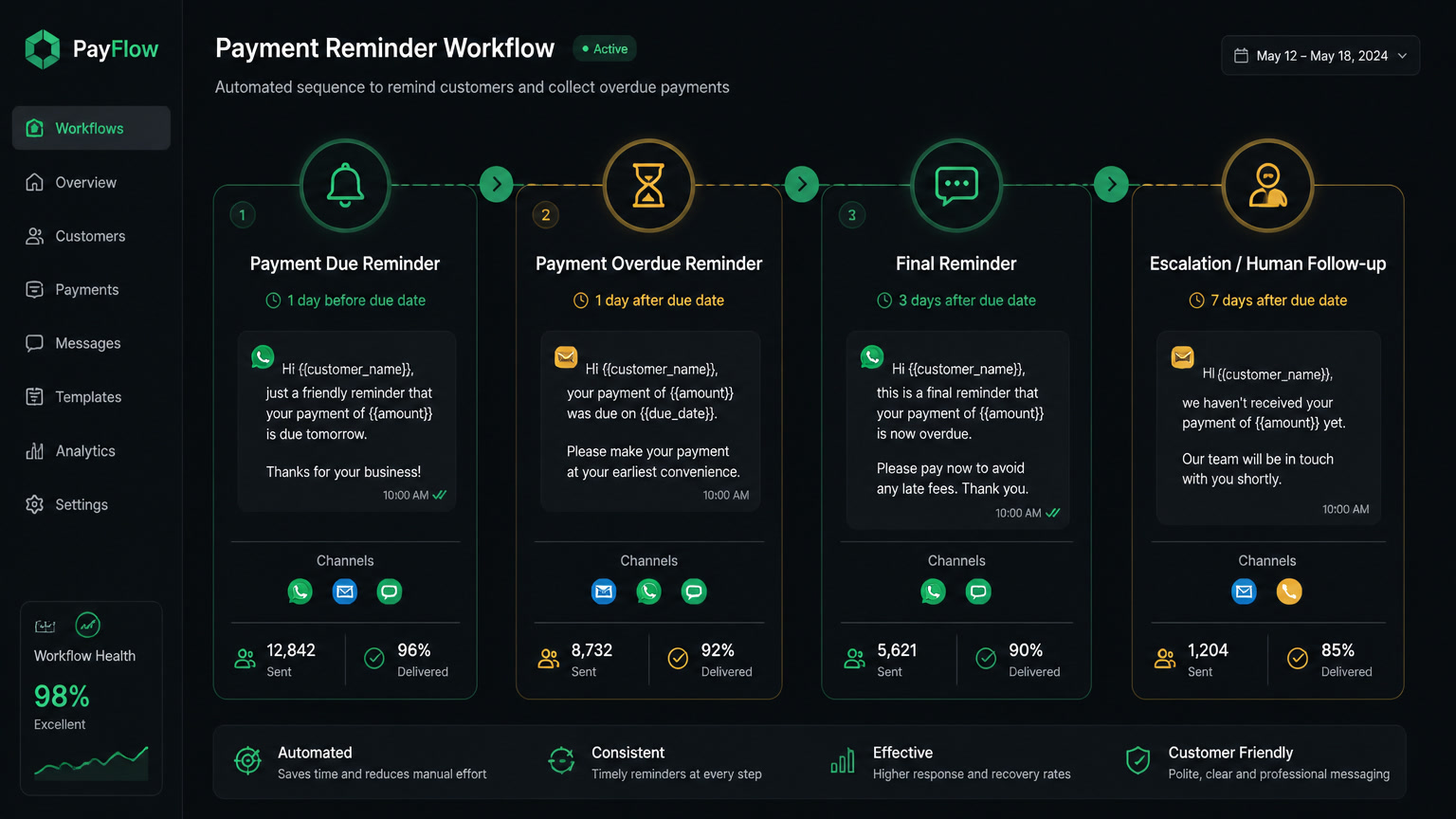
| 4. Confirmation | Appointment booked | Active confirmation + a reminder close to the hour, with one-tap rescheduling | No-show rate |
| 5. Return | Vehicle delivered | Next maintenance interval calculated and booked before the customer leaves | % leaving with a next appointment |
Stages 1, 3 and 5 are the ones no shop does well today. Stage 2 is the one that decides the ticket. Stage 4 is the one everybody already buys.
The three-stage rule: automate capture and confirmation in week one; evidence and authorization in week two; the return loop only once the other four are being measured. Scheduling the next-service reminder before you have written approval is automating the end of a funnel that still leaks in the middle.
What to automate and what to leave to the mechanic
The question we always get is whether AI should be talking to customers on the shop's behalf. Our answer is a two-axis matrix — input variability and cost of error — that we apply identically in clinics, insurance and now automotive:
| Decision | Predictable input | Natural-language input | Expensive error |
|---|---|---|---|
| Answer after hours | Rules + slots | AI agent with a closed catalog | Human reviews before sending |
| Classify the reason for the call | Rules | AI (free text and audio are its territory) | Low: it can miss |
| Draft the estimate | Template with variables | AI only fills fields, never the price | High: a person sets the price |
| Approve extra work | Amount + job-type threshold | Always human above USD 300, and always on brakes, engine, chassis | Very high |
| Book and rebook | Calendar rules | AI understands "Tuesday morning" | Low |
Opinion: a shop does not need an agent that sells. It needs a system that forgets nothing. The diagnosis, the price and the decision to open the engine are the product; everything else is logistics, and logistics does get automated.
The numbers that carry the investment
- No-shows. Published benchmarks for automated reminders in repair shops move no-shows from 20–25% to 8–12% with confirmation at 48 hours and on the day; at dealerships the reported jump goes from 18% to 4.2%, roughly USD 127,000 recovered per store per year.
- Approval with evidence. Beyond Cox's +49% approval likelihood and +USD 230 per order, digital-inspection implementations report a 27% lift in average repair order value.
- Return visits. Customers serviced at the same shop are 74% more likely to buy their next car there, and the lifetime value of a lost customer exceeds USD 12,000.
- In our own appointment-agent implementations the same pattern holds across verticals: 9.7 minutes of manual coordination per appointment, 41% conversion from inquiry to booked visit, and a no-show rate that drops from 18% to 6% when the reminder goes out on its own, over WhatsApp, with one-tap confirmation.
Against that range, a USD 40–130/month stack (self-hosted n8n, WhatsApp API, AI API) is paid for by a fraction of one approved repair order.
Three mistakes we see in every implementation
- Buying the chatbot before the evidence. A bot that books without sending photos produces more conversations that end in "let me think about it." Evidence is what converts.
- Letting the AI set the price. The AI drafts, itemizes and explains. The price is set by the service advisor, always. A badly generated estimate is not a UX problem — it is an argument with the customer in front of the car.
- Forgetting the return loop. 45% of dissatisfaction comes from unexpected costs and poor communication, and service retention collapses from 72% to 54% in two years. A customer who leaves without a next appointment booked is already in the 54% that do not come back.
Where to start this week
Start with the stage that costs the least and measures fastest: an automatic reply to after-hours missed calls offering three real slots. Then build evidence and authorization, where the revenue is. Close with the return loop.
If you are comparing platforms before deciding, our breakdown of CRM and WhatsApp for Latin America covers which channel fits which volume; the guide to AI agents for appointment scheduling holds the architecture for stages 1 and 4; and what a WhatsApp reply costs after October 1 has the real rates for sizing stage 3. The WhatsApp lead-to-cash pipeline completes the circuit for shops that also sell over chat.
Frequently Asked Questions
What can be automated in an auto repair shop?
Five things, in this order: capturing missed calls over WhatsApp, sending photo or video evidence from the inspection, an estimate with one-tap authorization, appointment confirmation and reminders, and the next-service reminder. What does not get automated is the technical diagnosis and the decision to repair — the mechanic's judgment is the product.
Is approving a repair over WhatsApp legally valid?
In Mexico, NOM-068-SCFI-2000 requires every repair operation to be recorded on a written service order in Spanish, and requires prior written authorization from the consumer for work not originally described. The pattern repeats elsewhere: work may only proceed once the customer has given written consent. a WhatsApp thread with a timestamp, an itemized estimate and an explicit confirmation satisfies that better than a phone call nobody records.
How much does it cost to automate a repair shop's front desk?
Self-hosted n8n ($6–20/month), the WhatsApp Business API and an AI API for message classification and drafting add up to $40–130 per month depending on volume, plus per-message WhatsApp template charges. A dealership running 85 appointments a day recovers that with a single reduction in no-shows: published reminder-automation reports move no-shows from 18% to 4.2%.