
Real Estate Automation: From Portal Lead to Booked Showing on WhatsApp
How to automate real estate lead follow-up in LatAm: a portal-to-showing pipeline on WhatsApp, synced inventory and advisor handoff. Stack and costs.
Real Estate Automation: From Portal Lead to Booked Showing on WhatsApp
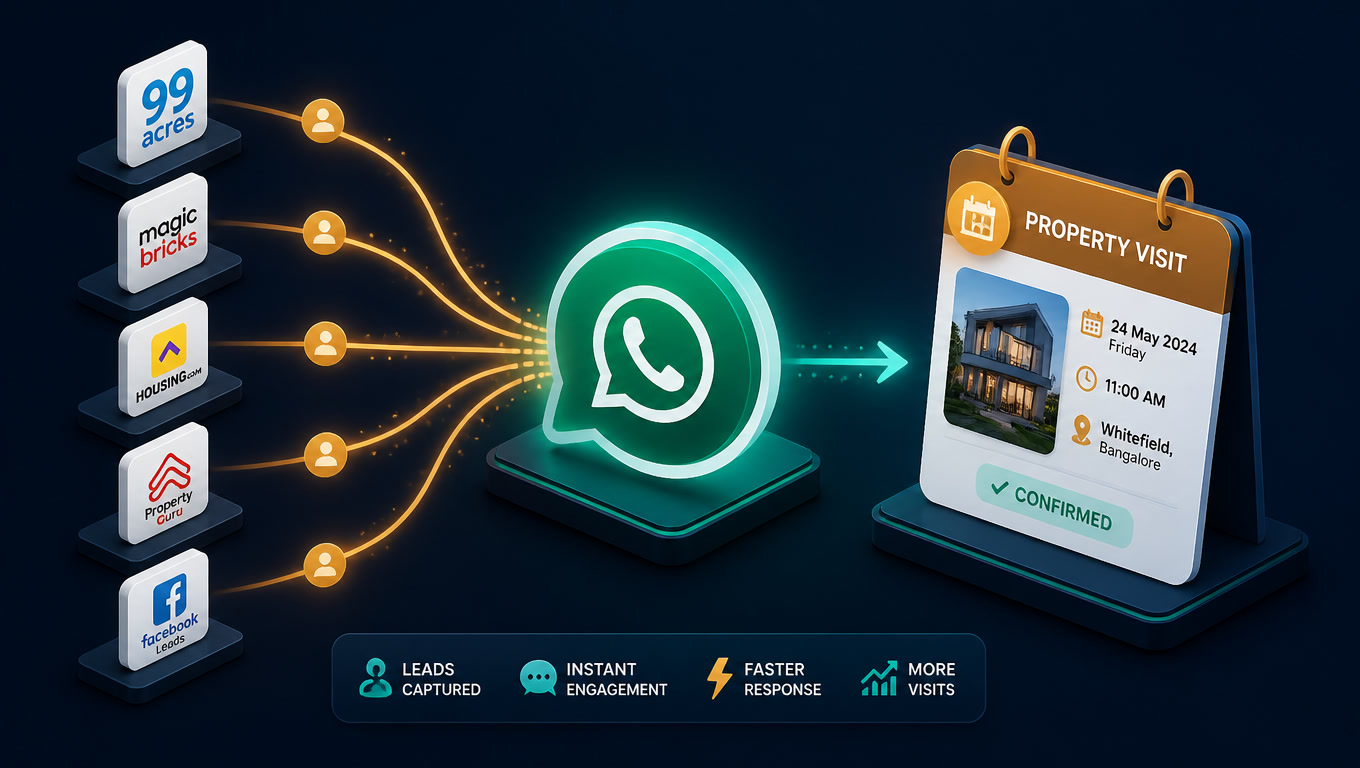
The automation that actually helps a real estate agency is not a chatbot answering questions: it is a pipeline that picks up the lead landing on a portal, answers it on WhatsApp in under a minute, qualifies it with four data points, matches it against the live property inventory and leaves the showing booked on the advisor's calendar — with full context and nobody copy-pasting a single message. That is the system we have been implementing for real estate agencies in Mexico and Colombia, and it is what separates an agency that answers from one that loses the lead in 15 hours.
Portals deliver the contacts; the problem starts there. Inman's real estate technology survey puts the average agent at 917 minutes — over 15 hours — to respond to a new lead, and Harvard Business Review's response research is brutal: whoever answers within 5 minutes is 100 times more likely to reach the prospect and 21 times more likely to qualify them than whoever answers at 30 minutes. Our own speed-to-lead diagnostic confirms it on the ground: in LatAm markets the conversation is decided on the first channel the buyer writes to, and that channel is WhatsApp.
The single-inventory rule: why most real estate bots fail
Here is the opinion that has won us more than one client argument: 90% of real estate chatbots fail on data, not on AI. The bot answers beautifully, qualifies fluently — and then shows a property that already sold, at a price that changed last week. A buyer who discovers that once never comes back.
The root cause is structural. LatAm has no centralized MLS like the U.S.: a mid-size agency publishes on three to five different portals — Inmuebles24 and Mercado Libre Inmuebles in Mexico, FincaRaíz and Metrocuadrado in Colombia, Properati in Argentina — and every portal has its own fields, its own formats and its own copy of the data. Publishing one property across five portals by hand takes up to 150 minutes, and an agency with 25 active listings updating prices four times a month easily clears 50 hours a month of pure data entry (reference data for the Colombian market, ver.me, 2026). Inmuebles24, Mexico's leading portal with 6.2 million monthly visits, offers no open public API: just API connectors for selected CRMs.
That is why the first component of any serious real estate automation is not the bot: it is a single source of truth for inventory that feeds both the portals and the conversational assistant. When the bot and the portals read from the same database, the bot can never promise something that does not exist. When every tool keeps its own copy, you are building on sand — and automated multiposting (publish once, distribute to every connected portal) is the same lever: agents who automate data entry and basic follow-up recover an average of 20 hours per week (GrowthFactor, 2026).
The 6-stage pipeline: from portal inquiry to confirmed showing
This is the architecture we build, stage by stage. Every row is a design decision, not a generic description:
| Stage | What gets automated | Typical tooling | Key metric |
|---|---|---|---|
| 1. Capture | Portal, form or Instagram lead arrives by webhook/email and is born as an enriched CRM record | Portal webhook + n8n + Clientify | % of leads captured without retyping |
| 2. Response | First WhatsApp message in <60 s with the property they asked about, inside the 24-hour window | WhatsApp Business API + n8n | Time to first contact |
| 3. Qualification | Four data points in conversation: budget, area+type, timeline, showing availability | AI agent or question tree | % leads with all 4 fields complete |
| 4. Matching | Answers crossed against live inventory; dead listings are discarded before they are ever sent | n8n + inventory database | % replies with confirmed availability |
| 5. Scheduling | Real advisor slots proposed, confirmed with automatic reminders | Calendar + n8n + utility template | Showings booked / qualified leads |
| 6. Handoff | Advisor receives the full card: conversation, listings viewed, budget and next step | CRM + Slack/internal WhatsApp | % of booked showings that happen (no-show) |
Two details that make the difference. First: stage 4 is the one everyone skips. Matching against live inventory — not against a list pasted into a Google Sheet — is what stops the bot from recommending a sold property. Second: stage 5 goes uphill if you propose "fictional" slots; connecting the advisor's real calendar is what turns a proposed appointment into one that happens. For scheduling as a discipline, our article on AI agents for appointment scheduling develops the four-layer architecture.
Qualification in 4 fields: everything the advisor needs before picking up the phone
Badly designed real estate bots ask 14 questions and the buyer leaves at the third. We qualify with four, in this order:
- Budget — the hardest filter and the one that saves the most money. An out-of-range lead should never reach an advisor with a full pipeline.
- Area + type — neighborhood, buy or rent, house/apartment/land. This is what enables inventory matching.
- Timeline — "when would you move?" separates the curious from the one who signs in 60 days.
- Showing availability — closing on a time slot instead of "I'll get back to you" is what turns a chat into a showing.
If four data points let you filter and show real listings, you do not need the fifth question. That is the difference between a qualification agent that actually books meetings and a bot collecting pretty answers: the goal is not to know more about the lead, it is to reach the advisor with the minimum needed for the call to end in a showing.
What to automate and what to leave to humans
| Signal | Decision | Why |
|---|---|---|
| Listing questions: location, price, amenities | Automate | Deterministic answers pulled from inventory |
| Matching needs to available properties | Automate | Filter logic, not judgment |
| Booking, confirming and reminding about showings | Automate | Pure coordination, zero reputational risk |
| Price objections and negotiation | Human | This is where the commission is won or lost |
| Post-showing feedback and drop-out reasons | Human + supporting AI | Data to improve, not to automate blindly |
| Complaints, incidents or legal issues on a property | Human | Escalate with context, never answer with a template |
The rule we apply: automate the transaction, not the relationship — the same one we use in our bot-to-human handoff. And one calendar warning: since October 1, 2026 every turn sent inside WhatsApp's 24-hour window is billed as a service message; compressing the conversation is no longer just UX, it is cost control (we broke it down in our service message pricing analysis).
The stack and the real cost
| Component | Function | Monthly cost |
|---|---|---|
| WhatsApp Business API (via BSP or direct) | Conversation channel | $0-50 + per-message fees |
| Clientify or another CRM | Records, pipeline and listings | $0-99 |
| Self-hosted n8n | Orchestration: portal → CRM → bot → calendar | $6-20 (VPS) |
| Inventory sync | Single source → portals + bot | $0-40 |
| AI (classification and matching) | Qualification and matching | $20-50 |
| Total | $50-220/mo |
Against that: dedicated real estate CRMs with a built-in bot run $150-500 USD per month and almost always arrive with the inventory disconnected from the portals. Our full WhatsApp CRM comparison for LatAm explains when the all-in-one platform is worth it and when the modular stack wins.
The 4 metrics we watch in production
- Time to first contact — if it is not under 60 seconds, the rest of the pipeline barely matters.
- Leads with all 4 fields qualified — measures conversation quality, not volume.
- Showings booked over qualified leads — the real yield of automated scheduling.
- Showings that happen (no-show rate) — the silent indicator that confirmations and reminders are not doing their job.
The three mistakes we see when implementing
- Bot before inventory. They buy the assistant, train it on 200 questions and nobody connected the property database. Result: hallucinated sold listings in week one.
- Qualifying without giving value. The first reply must carry the listing the buyer asked about, never a survey. Asking is the second message, never the first.
- Scheduling against invented availability. Proposing slots without reading the real calendar multiplies no-shows and burns the advisor. You read the calendar, you do not deduce it.
None of these mistakes are technology problems; all three are sequencing problems. That is why we insist real estate automation gets built in order: inventory first, response second, qualification third, scheduling fourth.
Frequently asked questions
Do I need the WhatsApp Business API or is the WhatsApp Business App enough? The free app serves a single user and allows no real automation: without a webhook there is no 60-second reply and no inventory matching. A pipeline like this needs the API (direct or through a BSP), and since October 1, 2026 every service message inside the 24-hour window is billed per message — with 1,000 free service messages per month per number.
Can I start without replacing my current CRM? Yes. The pipeline sits on top: n8n receives the lead, qualifies over WhatsApp and only writes to the CRM at the end of stage 3. Many of our launches coexist with spreadsheets for the first few weeks; the inventory is the one thing that cannot stay in the spreadsheet.
What happens when the buyer asks for a person? The agent escalates with a full summary — conversation, listings viewed, budget, availability — to the assigned advisor. A handoff without context is the most expensive mistake in stage 6.
Automation does not beat a good advisor in a race: it removes the 15-hour delay, the manual copying and the stale listings so they only show up for what is actually theirs. The agency that wins in LatAm in 2026 will not be the one with the fanciest bot, but the one whose inventory, response and calendar say the same thing in the same minute. If you want us to audit your own portal-to-showing flow, drop us a line and we will walk through it with you.
Frequently Asked Questions
What is real estate lead automation?
It is connecting the leads that arrive from portals, your website and social channels to a flow that replies on WhatsApp in under a minute, qualifies with four data points (budget, area, type and timeline), matches those answers against the live property inventory and books the showing without manual work, handing the full context to the advisor.
How does a WhatsApp bot answer a portal lead that fast?
The portal sends the lead by webhook or email to an automation engine like n8n, which creates the CRM record, fires the first reply through the WhatsApp Business API inside the 24-hour window, and continues the conversation with qualification logic and inventory matching.
How much does it cost to automate follow-up for a real estate agency?
A modular stack (WhatsApp Business API, a CRM like Clientify, self-hosted n8n and inventory sync) runs about $50-220 USD per month depending on volume, versus $150-500 per month for dedicated real estate CRMs with a built-in bot — which usually arrive with the inventory disconnected.