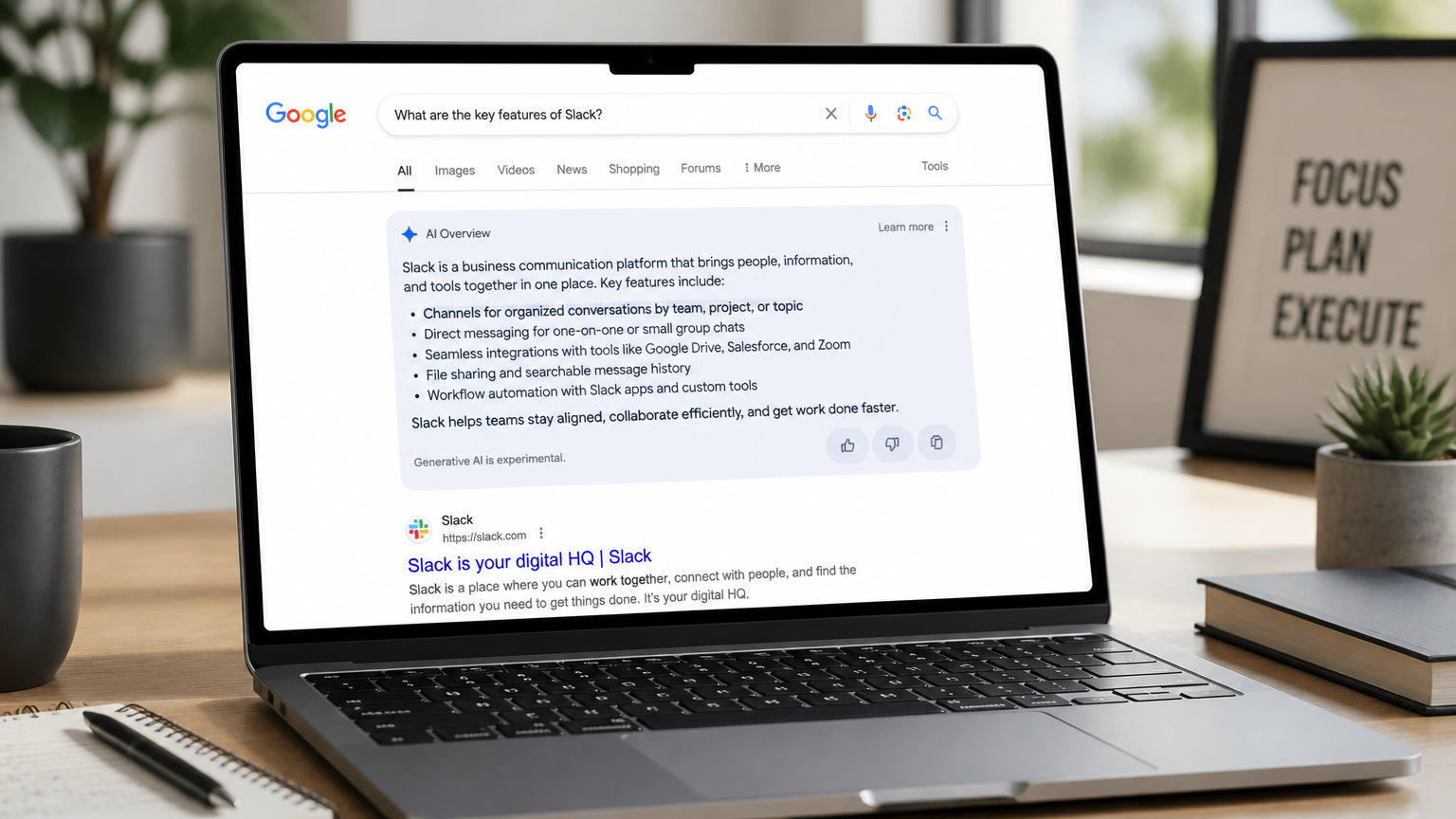
AI Overviews now answer 83% of brand searches. Your homepage is no longer the first thing people see.
Ahrefs crawled 232.8 million search results and found AI Overviews on 82.91% of branded queries by September 29, 2026, up from 61.3% in July. Three datasets, who actually gets cited, and the brand SERP audit we run instead.
AI Overviews now answer 83% of brand searches. Your homepage is no longer the first thing people see.
Google put an AI Overview on 82.91% of US desktop results for branded keywords on September 29, 2026, up from 61.3% in July, according to an Ahrefs crawl of 232.8 million search results. In the 100-brand sample, 76.2% of those blocks sat in position one, above the company's own website. The text Google writes about you leans on Wikipedia, YouTube and LinkedIn rather than your site. For most of the last decade, the first result for your own name was the one thing you could count on. It isn't anymore.
That is the whole story. The rest is evidence, the disagreements between datasets, and what we changed in our own audit routine because of it.
Three datasets, one direction
Three teams measured this independently in the last week of September, and none of them agree on the level. All of them agree on the slope.
| Source | Method | Branded queries with an AI Overview |
|---|---|---|
| Ahrefs, October 2 | 232.8M US desktop crawls, July to September | 61.3% (July) → 65.1% (August) → 73.3% (September); 82.91% on Sept 29 |
| Ahrefs, 100-brand sample | 100 known brand names, July 1 to September 30 | 5 of 98 usable results (July 1) → 63 of 100 (Sept 30) |
| DemandSphere | Branded keywords, daily, all markets and devices | ~27–35% most of September → 69.21% (Sept 26) → 90.48% (Sept 27) → 82.06% (Sept 29) |
| Chris Long (Nectiv) | SerpApi scrape of 100 enterprise brands | 93 of 100 |
The Ahrefs headline number covers non-branded queries too: 78.3% of unbranded searches triggered a block in September. In July the gap between branded and unbranded was 12.2 percentage points. In September it was 5. That gap is what used to protect you. A year ago AI Overviews were an informational-query phenomenon, and your brand query was a safe harbor. The harbor is gone.
Honest note on methodology: DemandSphere's 27–35% for early September and Ahrefs' 73.3% monthly average for the same month cannot both describe the same thing. Different keyword sets, different definitions of a branded query, different counting rules. Direction is consistent across all four, level is not. If a tool vendor quotes you one of these numbers as fact, ask which definition they used before you build a slide around it.
What Google writes about you, and who it reads first
In the Ahrefs sample, Wikipedia accounted for almost 72% of external citations inside brand-search AI Overviews, with YouTube and LinkedIn next. You do not own any of those three. You can edit a Wikipedia page if the community lets you, you can maintain a YouTube channel and a company LinkedIn page, but none of it lives on your domain and none of it answers to your CMS.
There is one piece of small good news in the study: only 2 of 58 answers where the full text was visible discussed a competitor at all (Pepsi's answer brought up Coca-Cola; Intel's named TSMC and NVIDIA). Google is describing you, mostly neutrally, using other people's pages. It is not yet a comparison shopping surface for your category.
Two more details worth keeping: in the 100-brand sample, 48 of the 63 AI Overviews appeared in position one with an average position of 1.49, so the block usually replaces your homepage rather than sitting beside it. And Ahrefs' earlier work puts the cost of any AI Overview at 58% lower click-through for the top-ranking page. That 58% figure comes from unbranded queries. Nobody has measured branded CTR yet, which we'll come back to.
What we changed in the audit
We already ran a 30-minute GEO audit on client sites, and brand queries were a single line inside it. They are now a separate pass, run monthly, with four checks:
- Presence. Twenty of your money brand queries, desktop and mobile, logged with a date. Does a block appear, and where does it sit relative to your homepage. This is the number that tells you whether you are in the 63 or the 37.
- Citations. Every domain the block links to. If Wikipedia, YouTube and LinkedIn are the whole list, your owned pages are not in the conversation about your own name. That is a signal about your entity coverage, not about your rankings.
- Substance. What does the text actually claim: founded when, sells what, priced how. Compare it against your homepage and your Organization schema. Wrong facts here are worth fixing at the source rather than arguing with Google about.
- Competitors. Watch this one before it becomes a problem. At 2 of 58 it is noise. At 30 of 58, someone else's positioning is introducing your brand to your own buyers.
The fixes that come out of this pass are unglamorous: consistent naming and sameAs across your profiles, a maintained LinkedIn and YouTube presence, accurate structured data, third-party profiles on the platforms your category actually reads, and a Wikipedia page only if you genuinely warrant one. This is the entity layer, and it is what the GEO, AEO and SEO distinction looks like when the query is your own name: SEO gets you ranked, the entity layer gets you described correctly.
What we don't know
State the unknowns plainly, because most commentary on this study skips them:
- Branded CTR impact is unmeasured. Chris Long warned about it; neither his test nor DemandSphere recorded a single click. The 58% number does not transfer automatically.
- The data is US desktop. Mobile and non-US markets behave differently, and AI Overview triggering changes week to week with no announcement, as DemandSphere's 90.48% spike on September 27 shows.
- Presence is not citation. DemandSphere counted any AI Overview on the query, whether or not it mentioned the brand. Some of those blocks answer a different question than the one your customer typed.
- No Google statement. Google did not announce this expansion, and it can quietly reverse it, as it has with other triggers.
What to do this week
- Run the twenty-query check on your own brand today. Screenshot it. That is your baseline and nobody else has it for you.
- Open every AI Overview you find and list who it cites. If your own domain is missing from the description of your own company, note which pages of yours are absent and why they might not be quotable.
- Fix the facts at the source: homepage copy, Organization schema, LinkedIn, Crunchbase, wherever the wrong number lives. Do not start with a new blog post.
- Pull branded impressions and clicks from Search Console for the last eight weeks and keep the chart. When branded CTR studies start landing, you will want your own line next to them.
And an opinion, since this is the part a dataset can't give you: the brands panicking about this are aiming at the wrong layer. You will not win your own name back by publishing more content on your own domain, because Google is not reading your domain first for these queries. You win it by being unambiguous as an entity everywhere the models look, and by giving the sources they do read a version of you that is accurate and hard to improve on. That work was already on the list. It just moved up.
Frequently Asked Questions
How many branded searches show an AI Overview?
82.91% of US desktop results for branded keywords carried an AI Overview on September 29, 2026, according to an Ahrefs crawl of 232.8 million search results. Monthly averages rose from 61.3% in July to 65.1% in August and 73.3% in September. Two smaller datasets agree on the direction: Chris Long found AI Overviews on 93 of 100 enterprise brand names, and DemandSphere recorded a jump from roughly 30% to 90% in the last week of September.
Does an AI Overview on my brand query steal clicks from my site?
Nobody has measured it yet. Ahrefs found AI Overviews cut click-through on ordinary queries by 58%, but neither Chris Long's test nor DemandSphere's tracking recorded clicks on branded queries. The risk is real and unquantified: the block usually sits in position one, above your own homepage, so treat it as an open question and watch your branded impressions and clicks in Search Console while the gap is still small.
Which sources does Google cite in brand-search AI Overviews?
Wikipedia leads with almost 72% of external citations, followed by YouTube and LinkedIn. Those three are much harder for a brand to control than its own domain, which is why entity consistency across profiles matters more than publishing another page on your own site.