

Your Page-2 Ranking Drop Might Not Be Real
96.5% of the corrupted result sets two trackers found started at position 9 or lower. How to tell a collection artifact from a real ranking loss.
Between September 16 and October 21, 2026, a measurable share of the search result pages that rank trackers collected did not answer the query they were collected for. The pages looked normal, the title still showed the full search phrase, and there was no "Showing results for" notice. But below the top results, the listings were often about a single word of the query. If your report shows a page falling from position 11 to position 40 in that window, the first hypothesis is not that Google demoted it. It is that the tool recorded a page nobody was searching for.
That distinction decides whether you spend the next two weeks fixing content or fixing a report. This is how to tell the two apart in about twenty minutes.
What the two studies actually measured
Two rank-tracking companies found the same pattern independently, using different methods, and published within weeks of each other.
SE Ranking ran 10,000 US desktop keywords it tracks for research. Of the cases where it flagged unrelated listings, 84% had results that followed only one word of the query; the rest followed two or more words. Single-word keywords never came back with unrelated results, which is consistent with there being no other word for the results to follow. None of the unrelated groups began in the top five: 3.5% started at positions 6 to 8, and 96.5% started at position 9 or lower. The share of tracked keywords whose saved result list contained any unrelated listing went from 0.09% on September 16 to 57.3% on September 17, and reached 67.2% by September 24, the end of its test period.
Nozzle approached it from the other direction, flagging a page when a term that historically appeared in the results for a keyword showed up in 20% or fewer of them. Page 2 began dropping words on September 16; page 1 followed four days later. From September 16 through October 21, page 2 ignored part of the query on 12.6% of the desktop searches it could judge on both pages, against 2.2% for page 1. On 93.6% of the page-2 results that dropped words, page 1 still answered the query correctly. In a separate study of what it calls poisoned SERPs, Nozzle put the average share of affected first- and second-page results at 22.6%, peaking around 43.5% on September 30.
The two vendors define the fault differently, so their percentages cannot be compared to each other. Read them as two independent confirmations that the collection layer was unreliable for six weeks, not as one rate.
Why nobody noticed for two weeks
Three details from the studies explain why this ran undetected inside thousands of agency reports.
The page still carried the full query in its title 99.8% of the time, with no "Showing results for" notice. To anyone spot-checking the SERP by eye, it looked like a normal result page.
Almost all of the damage sat below the fold of the report. Positions 1 through 5 were largely intact. The part of the page an SEO reads carefully was the part that stayed right; the part a client's dashboard averages into a single "average position" number was the part that broke.
And page 2 was hit several times harder than page 1 — the exact segment that most reporting treats as a rounding error, because it rarely earns clicks anyway.
There is a fourth detail that matters more for this lane than for classic SEO. In Nozzle's September 30 example, the query "easy strawberry jam" still returned a jam recipe in the AI Overview while the organic results below it were about the word "easy," including the television series. The AI layer answered the question correctly on a page where the organic list had lost it. A citation report and a rank report pulled from the same collection run can therefore describe two different pages.
The four signatures
A tracker drop below the top five is one of four things. Each has a different diagnostic and only two of them are your problem.
| Signature | What the tracker shows | What Search Console shows | What to do |
|---|---|---|---|
| Collection artifact | A step change on one refresh, concentrated at positions 9+, with replacement domains that answer one word of the query | Impressions and clicks for that query flat across the same dates | Re-pull the query. No content work. |
| Real page-2 loss | A gradual slide across two or more refreshes, with replacement domains that are on-topic competitors | Impressions fall for that query and average position falls with them | Diagnose the page: intent match, internal links, freshness. |
| Intent narrowing | You "lose" a long query while the head term holds position | Head term impressions stable, long-tail impressions fall | Nothing. The query got smaller. |
| Demand decay | Position holds, the ranking simply stops earning | Impressions fall while position is stable | Replace the page's demand, not its title. |
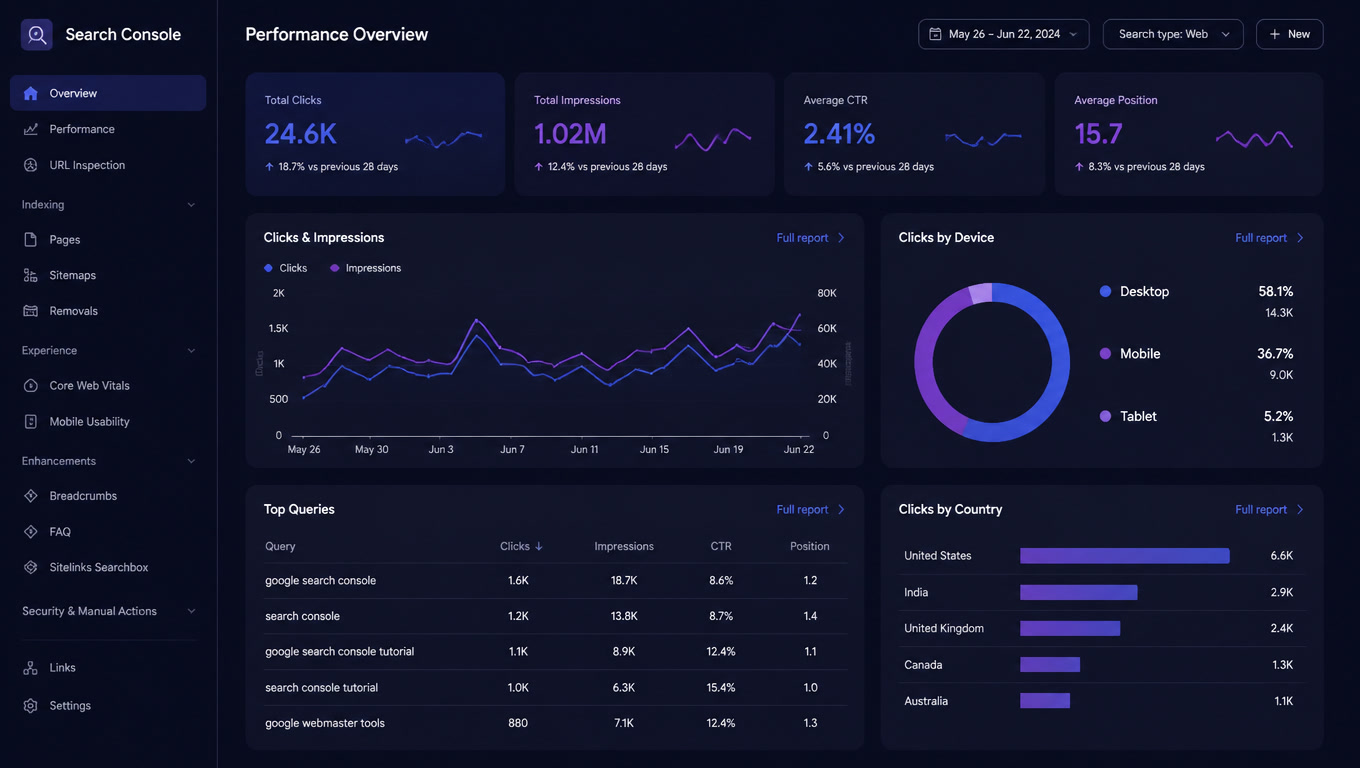
The column that decides the case is the third one. Search Console records what Google showed to real searchers; a tracker records what one script collected from one location, device and moment. When they disagree about a step change, the aggregate view is the more likely description of the world.
The twenty-minute check
- Re-run the exact query manually, in the same country, language and device setting the tracker uses, in a clean session. Do not trust the saved screenshot.
- Read positions 9 to 15. Do those domains answer the whole phrase or one word of it? If a bank query now returns pages about the word "line," you have found the fault.
- Pull Search Console for the same query and the same seven days, using the query filter and the date dimension. Flat impressions beside a collapsed tracker position is the artifact signature.
- Ask your tracker whether it collects page 2 at all. AccuRanker has stated that pages 2 and beyond have the related single-word problem and that it would document it separately. A tool that stops at position 10 cannot see most of this, which is not the same as being right about position 10.
- Write the collection date, device and location into the report. Six weeks from now, the only defence against a bad number is the metadata that says when and where it was collected.
The real cost is the fix, not the number
A false drop is an annoyance. The remediation it triggers is the damage.
When a page "falls out of the top 10," the standard playbook is a title rewrite, a content refresh, a merge into a stronger URL, or a cannibalization fix that de-optimizes a second page. Every one of those is a change to a page that was performing. In agency work the same sequence recurs: a report shows a collapse on a mid-page keyword, the page gets rewritten to chase it, and months later nobody can tell whether the rewrite helped because there was never a loss to recover from. The rewrite outlives the false alarm.
The rule is simple and it is cheap: no remediation below position 5 from a single tracker refresh. One refresh is a data point. Two refreshes plus a Search Console read is a finding.
What this does to your AI-visibility numbers
If your citation share comes from the same collection layer, it inherits the same fault. The strawberry jam case is the clean illustration: the AI Overview answered, the organic list did not, and any "share of voice" number computed from that page would have been computed from a page that had already lost the query.
That is the same problem in a different costume as the one we wrote about in why your AI visibility report is only worth its prompt set: the metric is only as good as the instrument that produced it. And it is the reason Search Console position counting has to be read as a dated observation rather than a rank — Google's own logging has holes in it too.
What changes in practice is small and unglamorous. Keep three sources dated to the same week: the tracker, Search Console, and one manual read. Store the raw collected results, not just the position number, so the next person can see what the page actually contained. And treat any six-week window where a vendor documents a collection fault as a window you cannot use for baseline comparisons — the same discipline we applied when reading the weeks after the September spam update finished rolling out.
What this means if you are the one being measured
For anyone evaluating an SEO or GEO partner right now, the test is not whether the report has a ranking chart. It is whether the report says how the data was collected, when, and from where — and whether it flags the window when the tooling was known to be unreliable. A number without that metadata is a number that cannot be audited, and an unauditable number is a decision waiting to be made for the wrong reason.
If your organic visibility is flat while AI answers are absorbing the clicks, the measurement problem and the visibility problem usually arrive together. Our SEO and GEO service starts with the instrument, not the content calendar, because a report you cannot defend is worse than no report.
Frequently Asked Questions
Was my September 2026 ranking drop real?
It depends on where it happened. Of the unrelated result sets SE Ranking flagged, 96.5% started at position 9 or lower, and Nozzle measured that page 2 ignored part of the query on 12.6% of the desktop searches it could judge against 2.2% for page 1. A drop below position 8 in that window is a collection artifact until Search Console impressions for the same query contradict it.
How do I know if my rank tracker collected a corrupted page?
Read the results that replaced you. If the domains now sitting at positions 9 to 20 answer only one word of your query rather than the whole phrase, the page was collected with part of the query dropped. Then pull the same query in Search Console for the same dates: flat impressions next to a collapsed tracker position means the collection was wrong, not the ranking.
Does this affect AI Overviews and AI Mode?
The AI layer and the organic list can disagree on the same page. In Nozzle's September 30 example the AI Overview still returned a jam recipe while every organic result was about the word easy. So a citation report and a rank report from the same collection run can be describing two different pages, which is why AI visibility numbers built on the same layer inherit the same fault.