Mirage Spent $50K on a 24-Hour AI News Channel — The Real Production Math
On August 11, 2026, Mirage streamed 24 hours of AI-anchored news on X: 50,000 viewers, 824,000 impressions, and roughly $35 per broadcast minute. This article breaks down the real synthetic media pipeline — licensing, voice, avatars, QC, distribution — and what it means for AI video production budgets.
Mirage Spent $50K on a 24-Hour AI News Channel — The Real Production Math
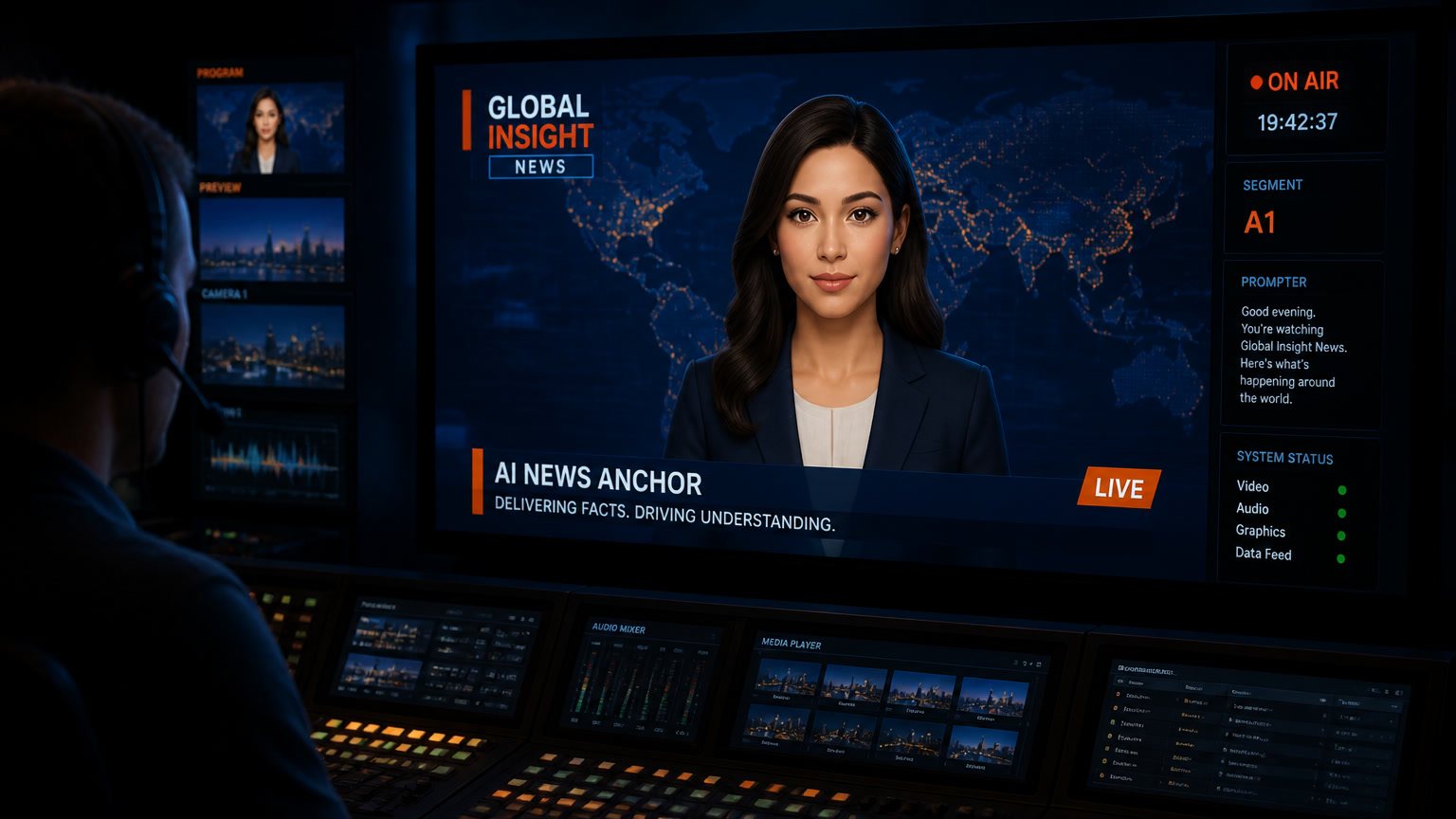
Yes, you can now broadcast 24 hours of fully synthetic news for roughly $35 per aired minute. On August 11, 2026, Mirage — the startup behind Captions, last valued at $500 million — proved it on X: four AI-generated anchors covered real Reuters stories for a full day, reached 50,000 viewers, and pulled 824,000 impressions. What the experiment actually reveals is not that AI media production is cheap — it's that the cost has moved from generation to distribution, quality control, and trust.
Variety documented the experiment on August 13: the company spent roughly $50,000 on the Tuesday broadcast, paid accounts like @historyinmemes to promote it, and built the four anchors from its Avatar X model, ChatGPT's image generator, and Google's Gemini text-to-speech. CEO Gaurav Misra built and ran the project essentially alone, with $30,000 worth of Claude Code credits. The stories were days-old Reuters wire items; the only real footage on screen came from Reuters journalists and stock libraries. For the AI-generated "guests" in its interviews, the company recruited more than a dozen people — mostly venture capitalists — who licensed their likenesses and approved the scripts their avatars would read. One notable name: Billy McFarland, of Fyre Festival fame.
The math nobody published
The important number is not $50,000 — it's what that buys per unit of output:
| Metric | AI broadcast (Mirage) | Traditional TV newsroom | YouTube/TikTok production |
|---|---|---|---|
| Cost per aired minute | ~$35 | $500–$5,000+ | $50–$500 |
| People required | 1 engineer + AI agents | 20–100 staff | 1–5 people |
| Script-to-air time | Minutes (with manual pre-review) | Hours–days | Hours |
| News source | Licensed wire (Reuters) | Own reporters + wires | Wire or own coverage |
| Distribution cost | Paid (X promos) | Cable/ad inventory | Organic + boost |
| Quality control | Pre-review + post-hoc fixes | Editorial chain | Manual review |
The ~$35-per-minute figure comes from dividing $50,000 by 1,440 minutes of airtime — but it's misleading. The experiment didn't produce 1,440 unique minutes: segments were recycled, and the total includes paid promotion, which is distribution, not production. In our analysis of synthetic video ROI we insist on separating those line items, because mixing them is exactly how AI business cases get inflated.
The 5-stage pipeline of a synthetic channel
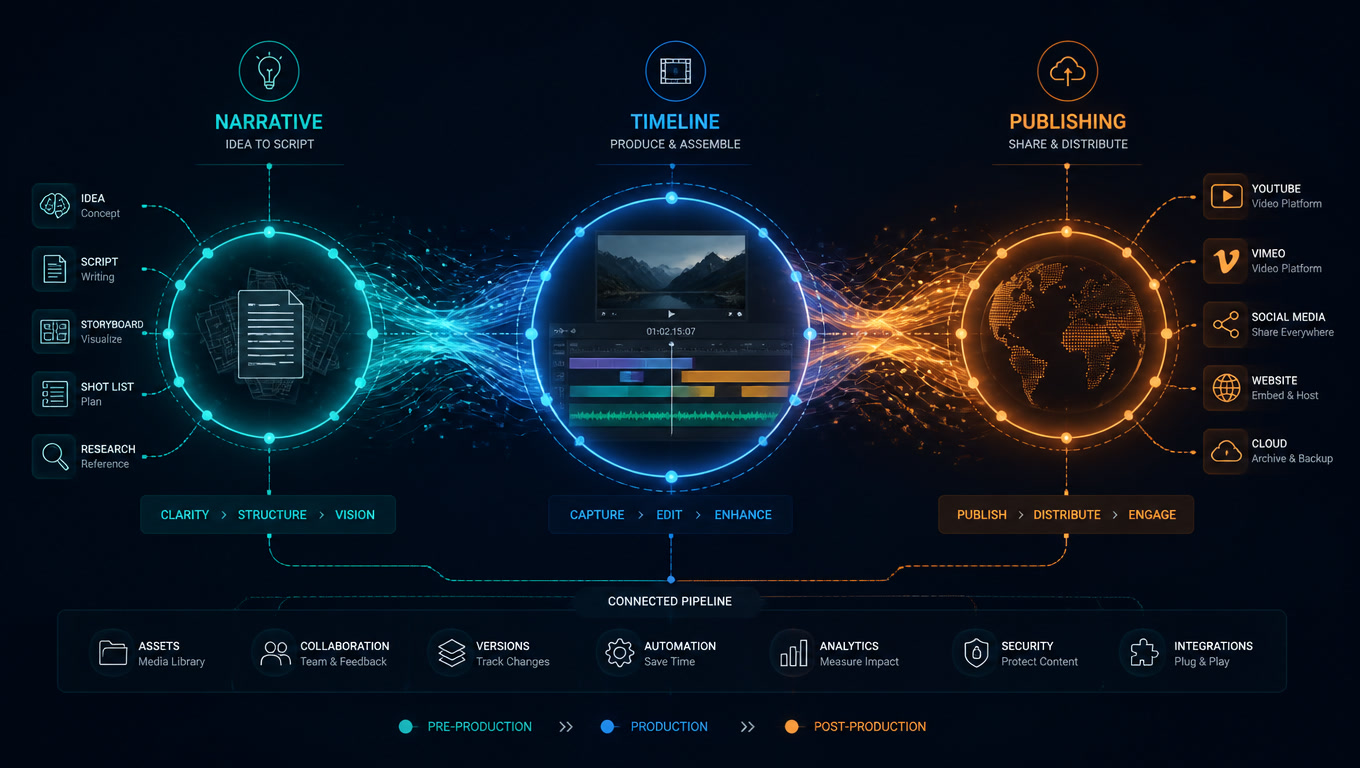
What Mirage built decomposes into five stages — the same skeleton we use in AI video projects at Mintec, scaled to continuous broadcast:
- Licensing and scripting — days-old Reuters stories, rewritten by an agent instructed to follow "general journalistic standards" (no AP Style, no formal ethics code).
- Voice — Gemini text-to-speech narrating each block.
- Avatar and graphics — anchors "Tom Callahan" and "Marcus Sterling," generated with Avatar X plus ChatGPT image generation for each story's visuals.
- Assembly and QC — Misra watched the stream hours ahead of air to catch errors. It still misidentified a woman in a Reuters package as President Donald Trump; the correction came afterward on the company's X account, not during the broadcast.
- Distribution — live X stream plus paid accounts to promote it.
That pipeline is real and it works. But notice what's not on the list: no editors, no fact-checking, no live accountability. Mirage's own engineer, Jason Silberman, summed it up on X: "when the CEO starts tokenmaxxing too hard and spends $50k in a day on a marketing stunt."
Where synthetic production breaks
From our work building multi-model AI video pipelines and post-processing for generated video, the Mirage experiment confirms three patterns we were already seeing:
First, generation stopped being the bottleneck. Generating 24 hours of content is trivial compared to validating it. Manual QC with hours of lead time doesn't scale: every extra hour of airtime multiplies the material a human must review. The fix isn't more humans — it's automating verification (proper nouns, data points, archive context) before the agent even writes the script.
Second, transparency is a design decision, not a patch. Mirage ran a permanent graphic signaling that everything was AI-generated — and the misidentification still damaged credibility. With EU AI Act Article 50 now enforceable, marking is not optional: any synthetic media pipeline distributing in the EU needs machine-readable and human-visible labels from stage one.
Third, distribution costs the same as in traditional media. 50,000 viewers with paid promotion is not an organic result — it's the entry price of any new channel. Impressions are bought; audiences are not.
What we'd do differently
Our opinion, biased by having produced synthetic video for real clients: the 24/7 use case is the most spectacular and the least profitable. Attention on X isn't linear across the day, continuous broadcast costs don't amortize, and live-error risk grows with every hour on air.
The pattern that does work — we see it in actual campaigns — is: short vertical slots at fixed times, niche channels with human-reviewed scripts, and an explicit QC budget. In our framework for accessible synthetic media we separate generation cost from compliance cost: accessibility, provenance marking, and editorial review. That's what turns a marketing stunt into a media product.
Pew Research found in June that 40% of respondents believe AI will ultimately be worse for society. Mirage's experiment won't move that number with avatars reading three-day-old wire copy. What could move it is the unglamorous work: pipelines with automated verification, transparency from the first frame, and humans accountable for what goes on air.
The lesson for any brand producing AI video: cost is no longer the barrier. The barrier is everything surrounding generation — and that doesn't get solved with more tokens.
Frequently Asked Questions
What is Mirage News Network?
A 24-hour experiment by Mirage, the startup behind the Captions video-editing app: a live X broadcast where four AI-generated anchors (Avatar X, ChatGPT image generation, Gemini text-to-speech) covered real news licensed from Reuters. It cost roughly $50,000, reached 50,000 viewers, and drew 824,000 impressions.
How much does it cost to run an AI news channel?
Mirage's experiment cost about $50,000 for 24 hours of broadcast — roughly $35 per aired minute — including content licensing, script and voice generation, avatars, graphics, compute, and paid promotion. That's an order of magnitude cheaper than a traditional newsroom, but distribution and trust still cost the same as in human media.
Can AI anchors replace human journalists?
Technically yes for reading scripts — Mirage proved it. But the replacement fails where the work is invisible: error handling (the stream misidentified a woman in a Reuters package), editorial standards, and accountability. Generation is no longer the bottleneck of synthetic production; quality control and audience trust are.