
EU AI Act Article 50 Is 25 Days Away: How to Mark Synthetic Media in Your Web Pipeline
By August 2, 2026, every AI-generated image, video, and audio asset circulated in the EU must carry machine-readable markings. Here is what web developers and media producers need to implement.
We are 25 days away from August 2, 2026. That is not just another regulatory deadline — it is the enforcement date for Article 50 of Regulation (EU) 2024/1689, the EU AI Act. From that day forward, every piece of synthetic content — image, video, audio, text — generated by AI must carry a machine-readable mark identifying its artificial origin.
If your agency or studio produces video with Kling, Veo, Sora, Runway, or any generative tool, and those assets end up on websites accessible from the EU, this applies to you. It does not matter if your servers are in Honduras, Mexico, or Indonesia. Like GDPR, the AI Act has extraterritorial reach: if your outputs reach European users, you are obligated.
We have spent the last few months testing compliance pipelines for clients who use synthetic media. What we found is that most technical teams are unprepared — not because they do not want to comply, but because nobody has told them exactly what to implement. This article closes that gap.
What Article 50 requires technically
The Regulation's language is clear but intentionally technology-neutral. Marks must be:
- Technically feasible — a real solution exists
- Effective — the mark survives reasonable transformations
- Interoperable — different systems can read it
- Robust — survives re-encoding, format changes, cropping
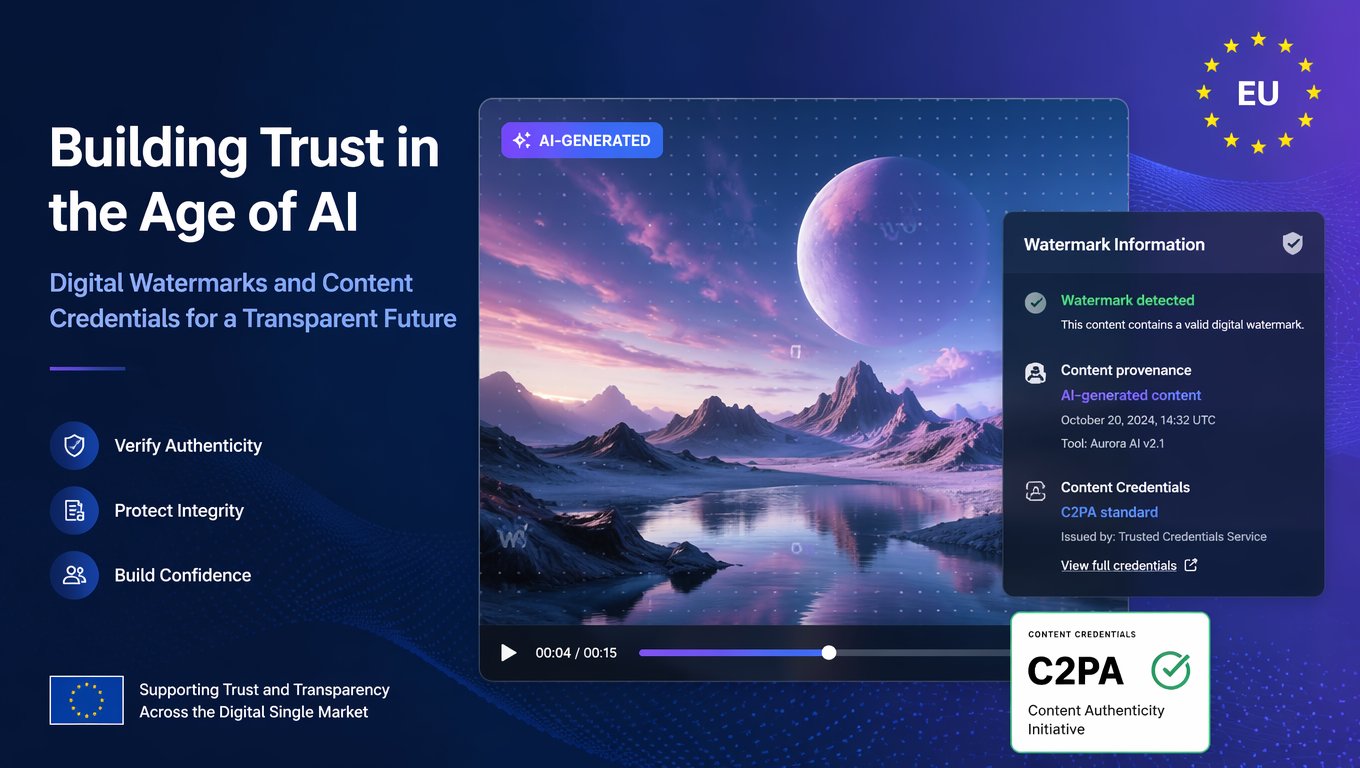
Two methods explicitly satisfy the requirement: invisible watermarks and C2PA Content Credentials.
| Method | What It Does | Strength | Weakness |
|---|---|---|---|
| Invisible watermark | Embeds a payload into image pixels or audio spectrum, imperceptible to humans | Survives screenshots, social media re-compression, format conversion | Limited payload (~48-256 bits). Can only signal AI origin flag + ID, not a full certificate chain |
| C2PA Content Credentials | Attaches a cryptographically signed manifest to the file: AI system used, date, responsible organization | Full verifiable provenance. Tamper-evident. Audit trail | Stripped by screenshots and most social media platforms. Lives in file metadata |
The defensible compliance posture is embed both at generation time. When the file is shared intact, the C2PA manifest provides the full credential. When someone takes a screenshot or the file gets re-encoded on TikTok, the invisible watermark persists as a residual AI-origin signal.
Integrating C2PA into your media pipeline
C2PA (Coalition for Content Provenance and Authenticity) is an open standard backed by Adobe, Microsoft, Intel, Google, Sony, and dozens of media organizations. Here is how it works:
- At generation time (or immediately after), call a C2PA signing API that produces a JSON manifest containing:
softwareAgent,dateTime,assertions(what was AI-generated), andcredentials(your organization's certificate). - The manifest gets packaged into the file's metadata — XMP for images, sidecar for MP4 video, or JUMBF container for universal support.
- Every time the file is modified, a new signed assertion can be appended, creating a complete audit chain.
In our production pipeline for a synthetic content client, we implemented C2PA via the ForensicMark API. The flow looks like this:
# Pseudo-code: watermarking pipeline integration
from forensicmark import Watermarker

marker = Watermarker(api_key=config.FORENSIC_API_KEY)

def publish_ai_video(video_path, metadata):
    # 1. Embed invisible watermark on every frame
    watermarked = marker.embed_watermark(video_path)

    # 2. Attach C2PA manifest with system, model, and date
    c2pa = marker.sign_manifest(
        watermarked,
        assertions={
            "ai_generated": True,
            "model": "Kling 3.0",
            "org": "mintec.co",
            "timestamp": metadata["created_at"]
        }
    )
    return c2pa
The cost is marginal compared to the compliance risk. ForensicMark charges ~$0.001 per image and ~$0.01 per minute of video. At 500 assets per month, that is $5-15 in monthly compliance cost.
Invisible watermarks: the layer that survives the ecosystem
Invisible watermarks operate at the pixel level. They modify the image or video frame imperceptibly to encode a binary payload. Detection systems can read that payload even after:
- JPEG compression at 70% quality
- Resizing to 800px
- Screenshot + crop
- Upload and re-download from Instagram or TikTok (partial degradation)
The real limitation is payload, not robustness: 48-256 bits is not enough for a full certificate chain. But 48 bits is enough to encode a system ID, a timestamp hash, and an "this is AI" flag. A verifier looks up that ID against a database for full details — and the C2PA manifest provides those details when the file travels intact.
This duality — short persistent payload + full fragile C2PA manifest — is exactly why the Regulation mentions both methods. Neither alone covers all distribution scenarios.
What changes for synthetic media producers
If your agency or studio produces AI video for clients — ad spots, product demos, social content — Article 50 requires rethinking your post-production pipeline.
Before August 2: Generate → edit → deliver MP4 → client uploads anywhere.
From August 2: Generate → watermark + C2PA → edit → package with metadata → deliver with provenance certificate.
The additional step is technically trivial (one API call between generation and delivery), but the pipeline must be configured before the deadline. And here is the catch: most video generation APIs (Kling, Veo, Sora) do not include native watermarking. You have to implement it as an external layer.
What non-compliance costs
Article 50 fines scale up to 15 million euros or 3% of global annual turnover. For a small agency billing $2M annually, 3% is $60,000. For a mid-size firm at $20M, it is $600,000.
But the real risk is not the fine — it is compliance clauses appearing in production contracts. We have seen EU clients adding Article 50 certification requirements since April 2026. Agencies that cannot demonstrate compliant synthetic media watermarking will simply lose bids.
Where to start: a 25-day action plan
- Audit your pipeline — Identify which AI-generated assets reach EU-accessible channels. Extraterritorial reach means the server location does not matter.
- Choose your watermarking stack — ForensicMark, Steg.AI, TrueScreen, IMATAG, or raw C2PA. Most offer REST APIs that integrate in minutes.
- Implement the dual layer — Invisible watermark + C2PA at generation time. The law requires marking at generation, not at publication.
- Document the process — The Regulation requires technical documentation of the marking system. Maintain logs per asset: tool, model, timestamp, payload.
- Train the editorial team — Designers and editors using generative tools must understand that every output must pass through the watermarking pipeline before publication. (Synthetic media accessibility requirements add another layer to this workflow.)
On our last project — a multi-channel campaign for an EU client using Kling 3.0 and Seedance 2.0 clips — we integrated ForensicMark in three days. The integration was one additional API call in the post-processing worker. Operating cost: $0.01 per minute of video.
Article 50 is not a technical barrier. It is an awareness and preparation barrier. Teams that have their watermarking pipeline configured before August will operate normally. Teams that start researching on August 1 will have 24 hours of panic.
Twenty-five days. The deadline is real. Compliance is cheap. The fine is not.
Frequently Asked Questions
What does EU AI Act Article 50 require technically?
From August 2, 2026, all AI-generated or manipulated audio, video, images, and text must carry machine-readable markings disclosing their AI origin. Marks must be technically feasible, effective, interoperable, and robust — surviving reasonable post-processing like re-compression, format conversion, and screenshots.
What are the two compliant methods the regulation explicitly recognizes?
The Regulation names two technical approaches: invisible watermarks (embedding a payload directly into pixels that survives social media re-encoding) and C2PA Content Credentials (cryptographically signed manifests attached to file metadata). The recommended posture is both — C2PA for full verifiable provenance when files are shared intact, invisible watermarks as a residual signal when metadata is stripped.
What are the penalties for non-compliance?
Fines up to 15 million euros or 3% of global annual turnover, whichever is higher. Beyond financial penalties, non-compliance creates reputational risk as AI disclosure becomes a consumer trust signal in an increasingly regulated environment.