When AI Orchestrates the Entire Video Pipeline: What Fotor Agent, Boreal, and Catalyst Change About Your Workflow
Three September 2026 launches — Fotor Agent, Creatify Boreal, and Socialive Catalyst — converge on one point: AI no longer generates individual clips, it orchestrates the full pipeline. Here's what that means for agencies, brands, and the future of creative control.
When AI Orchestrates the Entire Video Pipeline: What Changes in September 2026
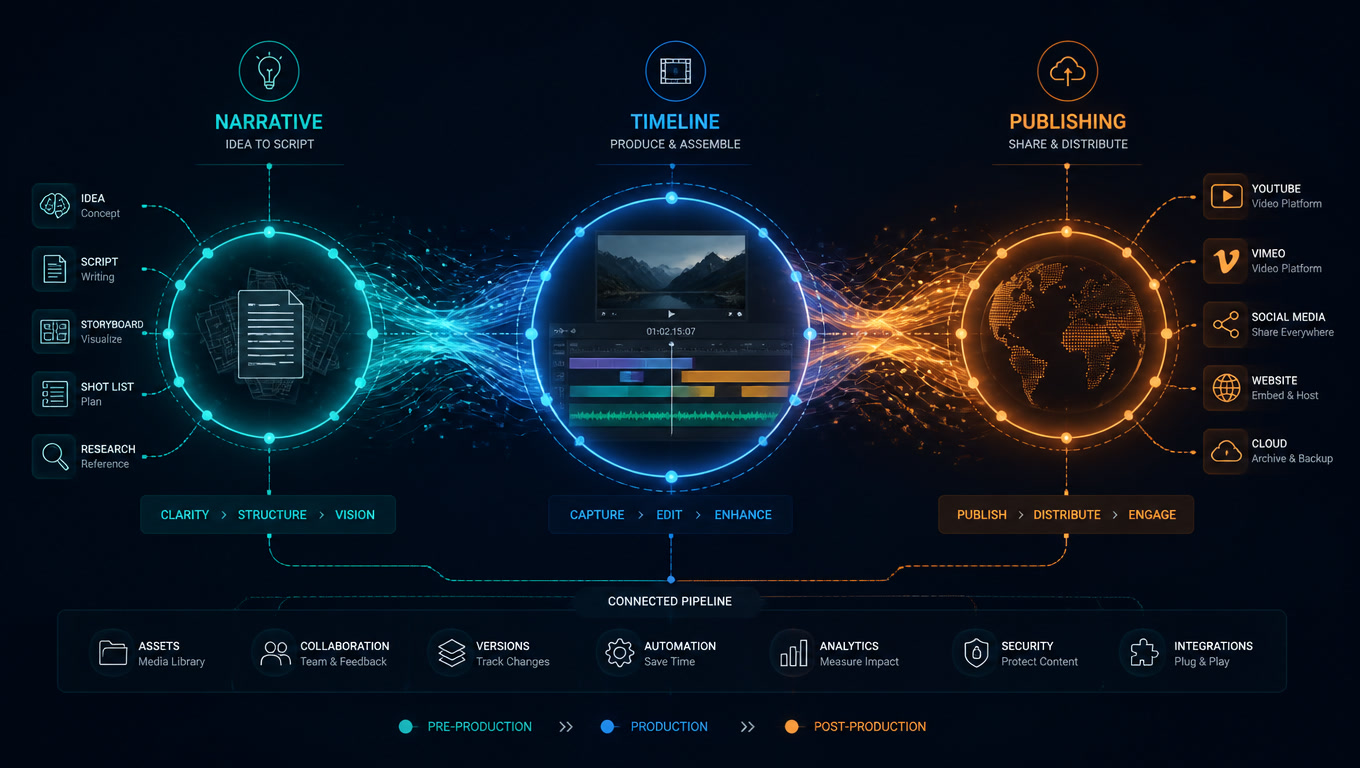
AI video stopped generating isolated clips. In September 2026, three different tools arrived at the same conclusion from different directions: the bottleneck is no longer generating video — it's orchestrating the full pipeline without losing creative control, brand compliance, and editorial traceability.
Fotor Agent (launched September 15, #1 on Product Hunt), Creatify Boreal (September 21, open-source at $0.01/second), and Socialive Catalyst (September 14, enterprise early access) represent three angles of the same convergence: video production as agent, not tool.
If your current workflow is "generate clip → export → import into editor → adjust → render → upload to CMS → review → publish," these launches just compressed that chain. The question that remains: who reviews before publishing?
The Convergence: Three Tools, One Point
Fotor Agent — Complete Orchestration
Fotor (800M+ users) shipped an agent that takes a brief or raw material and produces a complete video: narrative, 4K editable motion graphics, multi-track timeline, subtitles, music, and voiceover. Everything parametric — you can change text, colors, timing, and element positions without regenerating.
What matters here isn't individual clip quality (which is solid), but that graphic elements stay alive. Text, layout, animation, and layers live on an interactive canvas, not baked into a flat video file. According to Fotor, this cuts motion graphics costs to 1/200th of After Effects and accelerates editing 50x.
For agencies, the shift is operational: a junior designer can produce what previously required a motion graphics team. For brands, the risk is that speed outpaces review capacity.
Creatify Boreal — Volume at Predictable Cost
Creatify Labs launched Boreal, an open-source text-to-video and image-to-video model that generates in real time (1 second of video per 1 second of GPU) at $0.01/second. A 5-second clip costs ~$0.05. Twenty storyboard clips: ~$0.25, under 2 minutes.
In blind benchmarks against a leading closed model, Boreal matches perceptual quality and leads on motion, at 40x the speed and 12x lower cost. The trade-off: lower resolution and reduced fidelity on complex multi-subject scenes.
What matters for your workflow: iteration cost is effectively zero. You can test 20 variations of the same ad in the time it used to take for one. But "can" doesn't mean "should" — without an approval workflow, 20 variations become 20 brand inconsistencies.
Socialive Catalyst — Compliance as a Feature, Not an Afterthought
Socialive attacked the problem from the opposite end: enterprise video with compliance guardrails built into the first prompt. Catalyst (early access September, GA October 2026) converts instructions into on-brand video, but the differentiator is that orchestration includes compliance review, approval routing, and governance-aware publishing.
For regulated industries (healthcare, finance, legal), this is a real change: AI generates within the rules, not after someone manually verifies.
The Problem These Three Launches Expose
The convergence has a dark side nobody is openly discussing: when AI orchestrates the full pipeline, the human review layer becomes the system's bottleneck.
Think about it:
- Before: AI generates clip → human edits → human reviews compliance → human publishes
- Now: AI orchestrates everything → human reviews everything → human publishes
Output volume grew exponentially. Human review capacity didn't. This creates three concrete risks:
1. Brand inconsistency at scale. When 20 ad variants generate in 2 minutes, who verifies each one meets color, typography, tone, and messaging guidelines? Fotor Agent keeps elements parametric (editable), but Boreal produces flat files. Post-editing capability varies dramatically between tools.
2. Compliance lag. Socialive addressed this with approval workflows, but Fotor and Boreal assume you manage your own flows. In small teams, "manage" means "someone reviews when they have time" — which is the same as not reviewing.
3. Editorial traceability. When an AI agent generates, assembles, and publishes, who's responsible for the content? The platform? The marketing team? The user who wrote the prompt? Traditional CMS platforms have audit trails for human publications. AI-orchestrated flows need the same — or better.
The Framework: Four Layers for AI Video Orchestration Without Losing Control
If you're evaluating these tools for your team, you need a governance framework, not just a feature list. Here's the one we use at Mintec:
| Layer | What It Controls | Key Question |
|---|---|---|
| Generation | Model, quality, cost per clip | Does the output meet resolution and style standards for the destination channel? |
| Orchestration | Timeline, multi-track, assets, sequencing | Can you edit individual elements after generation? |
| Governance | Brand guidelines, compliance, approval | Is there an approval flow before anything reaches the CMS? |
| Publishing | CMS integration, audit trail, distribution | Is there a record of who approved what and when? |
All three tools cover Generation and Orchestration. Only Socialive natively covers Governance and Publishing. For Fotor and Boreal, you need to build those layers yourself — whether through your CMS, a manual approval workflow, or an orchestration tool like n8n that connects generation with a review gate before publishing.
What This Means for Agencies and Brands
If you're an agency: Video production is no longer a differentiator by capacity. It's a differentiator by quality control and iteration speed. Your value isn't in producing 10 videos — it's in producing 10 videos that meet guidelines, pass compliance, and reach the right channel with proper tracking.
If you're a brand: Ask your team or agency what approval workflow exists for AI-generated video. If the answer is "someone reviews before publishing," you need something more structured. The volume these tools enable multiplies inconsistency risk.
If you're an individual creator: Boreal is your best entry point. $0.05 per clip, no subscription, open-source. But don't confuse low cost with low risk — every clip you publish carries your name and your brand.
The Question That Remains
AI video went from "generate a clip" to "orchestrate the entire production." That's a genuine qualitative leap. But governance — who reviews, how it's approved, what gets logged — still depends on human decisions most teams haven't made.
Those who build that layer now will have an advantage when volume scales. Those who won't will have 200 clips without an audit trail and an overwhelmed compliance team.
The right tool isn't the one that generates the most. It's the one that generates more and maintains control.
At Mintec, we design AI video production workflows with governance built in from day one. If your team needs to scale video without losing brand control, let's talk.
Related articles:
Frequently Asked Questions
What is AI video orchestration?
It's when an AI system doesn't just generate a clip — it coordinates narrative, creates assets, assembles the timeline, applies brand guidelines, and publishes, all in a single conversational workflow without fragmented tools.
What's the difference between Fotor Agent and Creatify Boreal?
Fotor Agent focuses on complete orchestration: generates editable motion graphics, assembles multi-track timelines, and keeps elements parametric. Boreal is an open-source generation model that produces video at $0.01/second in real time — ideal for high-volume individual clips.
Why do CMS platforms need guardrails for AI-generated video?
Because when AI orchestrates publishing directly from the creative flow, the human verification layer for brand compliance, legal review, and editorial quality disappears. CMS platforms need scoped tokens, rate limits, and approval workflows so AI operates within rules, not outside them.