
Enterprise Synthetic Video: How to Measure Real ROI Beyond the Hype
Synthetic video has moved past the novelty phase. It's now a serious production tool that needs serious metrics. Here's the framework we use at Mintec to measure the real return on AI-generated content — with field data, real cases, and production lessons learned.
Enterprise Synthetic Video: How to Measure Real ROI Beyond the Hype
From "pilot phase" to "platform phase": how to measure whether your AI video investment is actually working.
A year ago, synthetic video was a tech demo. Marketing teams would generate a talking avatar, post it on LinkedIn, and celebrate the impressions. In 2026, that's no longer enough. The AI video market has crossed $700 million and companies are moving from isolated pilots to integrated production platforms. The question has shifted from "can AI generate video?" to "what's the real return on investing in this?"
And that question is harder to answer than it sounds.
The Synthetic Video Attribution Problem
Traditional video has clear metrics: cost per minute produced, editing time, reach, play rate. Synthetic video introduces variables that traditional attribution models don't capture well:
A personalized AI-generated video sent via email has multiple touchpoints. The recipient watches the video, clicks a link, visits the site, gets retargeted, fills a form, receives a sales call, and finally converts. What share of that conversion belongs to the synthetic video?
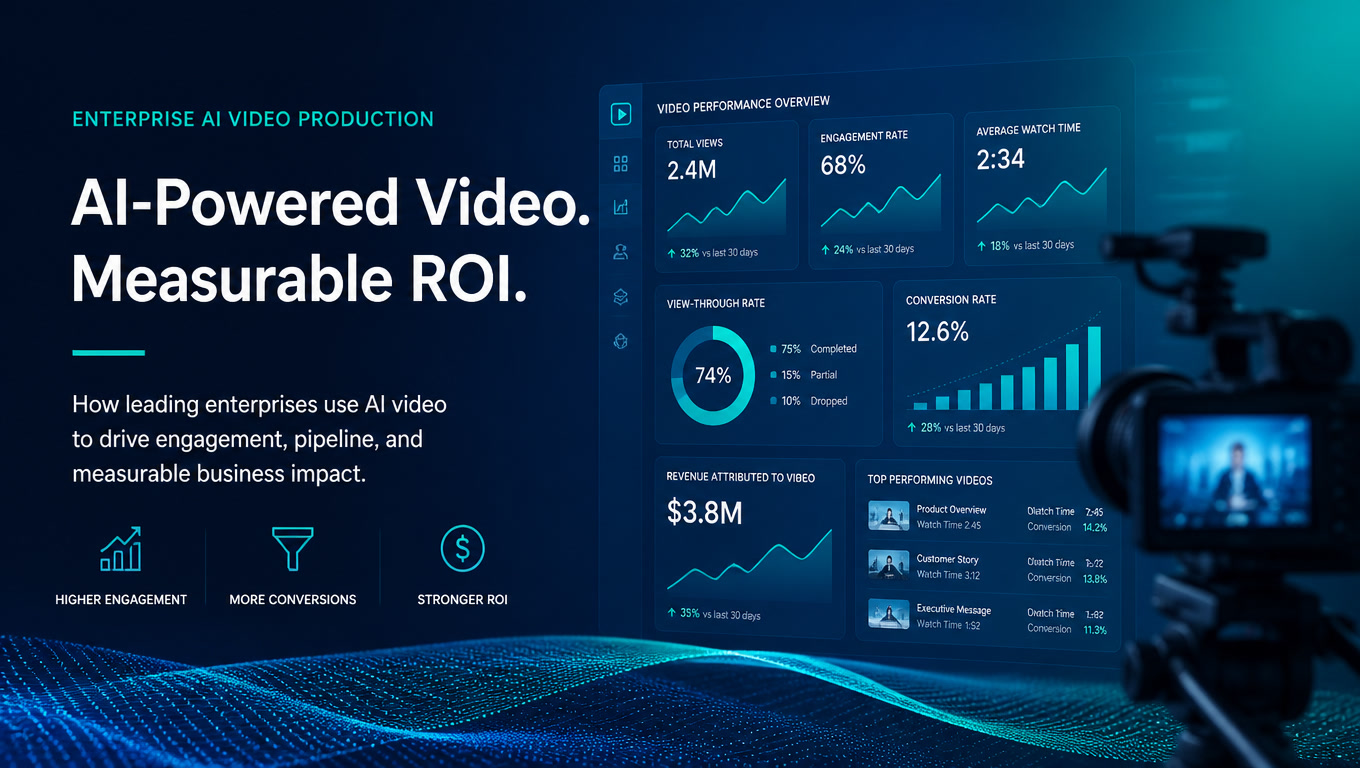
The data we've gathered from real implementations shows clear patterns. According to ngram.com's AI video statistics report (April 2026), video in email drives a 9.1% conversion rate versus 5.4% without — a 68% lift. Personalized follow-up videos sent by sales reps increase response rates from 19% to 36%. But these aggregate numbers hide an uncomfortable truth: attribution is still the Achilles' heel.
Mintec's ROI Framework for Synthetic Video
After implementing synthetic video pipelines for multiple clients, we've developed a three-tier measurement model. It's not perfect, but it beats "tell me how many views it got."
Tier 1: Production Efficiency (The Easiest ROI)
This is the most straightforward and what most companies measure first.
- Cost per minute: A traditional video with talent, camera, lighting, and editing costs between $1,000 and $5,000 per final minute. A synthetic AI avatar video costs between $5 and $50 per minute, depending on platform and quality.
- Production time: What once took two weeks now takes hours. One client reduced training video production from 14 days to 6 hours.
- Volume: With similar budgets, a company can produce 50x more content. This has direct implications for A/B testing, personalization, and multi-channel reach.
The trap: production efficiency is not an end. Making bad videos faster and cheaper is not a strategic win.
Tier 2: Funnel Impact (The ROI That Actually Matters)
This is where measurement gets serious. It's not about how many videos you produced. It's about what those videos did.
- Video completion rate (VCR): How many recipients watch the full video? Our data shows personalized synthetic videos achieve 65-80% VCR, significantly higher than the 30-40% of generic videos.
- Click-through rate (CTR): Personalized video in email generates 8-12% CTR versus 2-4% for text-only emails. In B2B prospecting campaigns, we've seen response rates double.
- Conversion rate: AI-generated product videos on landing pages lift conversion by 15-30% in our implementations, consistent with industry data showing video in email converts at 9.1%.
- Return rate: In e-commerce, accurate product video reduces returns by up to 40% because it sets correct expectations about the product.
The key here is multi-touch attribution. Don't assign all credit to the synthetic video if the customer also passed through email, social, and organic search. Use data-driven attribution models to distribute credit proportionally.
Tier 3: Business Impact (The ROI That Justifies the Investment)
This is the tier that separates companies scaling synthetic video from those running experiments.
- Cost per lead generated: Compare CPL of synthetic video campaigns versus traditional campaigns. At scale, CPL should drop 30-60%.
- Close velocity: Sales teams using personalized follow-up videos report 20-40% shorter sales cycles.
- Customer lifetime value (LTV): Onboarding and training content with synthetic video improves retention. One SaaS implementation showed 25% churn reduction after introducing personalized onboarding videos.
- Content creation time: For marketing teams producing content in multiple languages, synthetic video with voice cloning and lip-sync reduces localization from weeks to hours.
Where Synthetic Video Fails (Lessons Learned)
Not everything is positive. We've seen enough failed implementations to know what to avoid.
The uncanny valley is still a problem. AI avatars have improved, but in long continuous shots, the human eye detects imperfections. Eye movement, breathing, micro-gestures — current avatars don't replicate these perfectly. Our rule: under 2 minutes for pure avatar footage; longer videos must interleave B-roll or on-screen graphics.
Personalization without strategy is noise. We've seen clients personalize every frame of a video but lack a clear message. Result: technically impressive videos that no one remembers. Personalization must serve the narrative, not replace it.
C2PA provenance is becoming a requirement. For regulated industries (fintech, healthcare, legal), synthetic content labeling isn't optional. The C2PA (Coalition for Content Provenance and Authenticity) standard lets companies demonstrate their content is transparent about AI origin. Companies that don't implement C2PA now will face compliance problems in 2027.
Infrastructure costs scale non-linearly. Synthetic video generation at scale isn't cheap on infrastructure. Each minute of AI-generated video requires significant GPU power. Most companies underestimate this cost when doing the initial "cost per minute" calculation.
The Role of the Human Creative Director
Here's a direct opinion: synthetic video without human creative direction produces functional but forgettable content. AI tools can generate an avatar reading a script. What they can't do is decide what tone to use, what visual metaphor works best for a specific audience, or when silence is more powerful than words.
At Mintec, our workflow combines AI generation with human creative direction. The creative team defines the narrative strategy, tone, and structure. AI executes the production at scale. The result is content that's fast to produce but feels human.
The Bottom Line
Enterprise synthetic video is emerging from the hype phase and entering the maturity phase. Companies that treat it as a production tool — with clear metrics, responsible attribution, and creative direction — will gain a real competitive advantage. Companies that treat it as a tech gimmick will end up with impressive videos that nobody watches.
The ROI of synthetic video isn't in producing more content. It's in producing the right content, for the right person, at the right moment — and measuring it properly.
Related articles:
- Synthetic Media: Revolutionizing Video Production
- Synthetic Media: Storytelling at the Speed of Culture
- The Content Flywheel: Short-Form Video Automation
- The Death of Stock Photography: Generative AI for Unique Brand Assets
Explore our AI video & audio services →
Sources
- ngram.com, "50+ AI Video Statistics for 2026" — April 2026
- Artlist, "AI Video Trends 2026: The Future of Creative Production" — survey of 6,500+ creators
- iStudios Media, "Synthetic Video Personalization: Scaling Enterprise Video" — February 2026
- Blings.io, "Personalized Video Statistics 2026: Benchmarks Every Marketer Needs"
- AppScale Blog, "Synthetic Media Architecture: AI-Generated Video, Voice, and 3D Enterprise Guide" — March 2026