

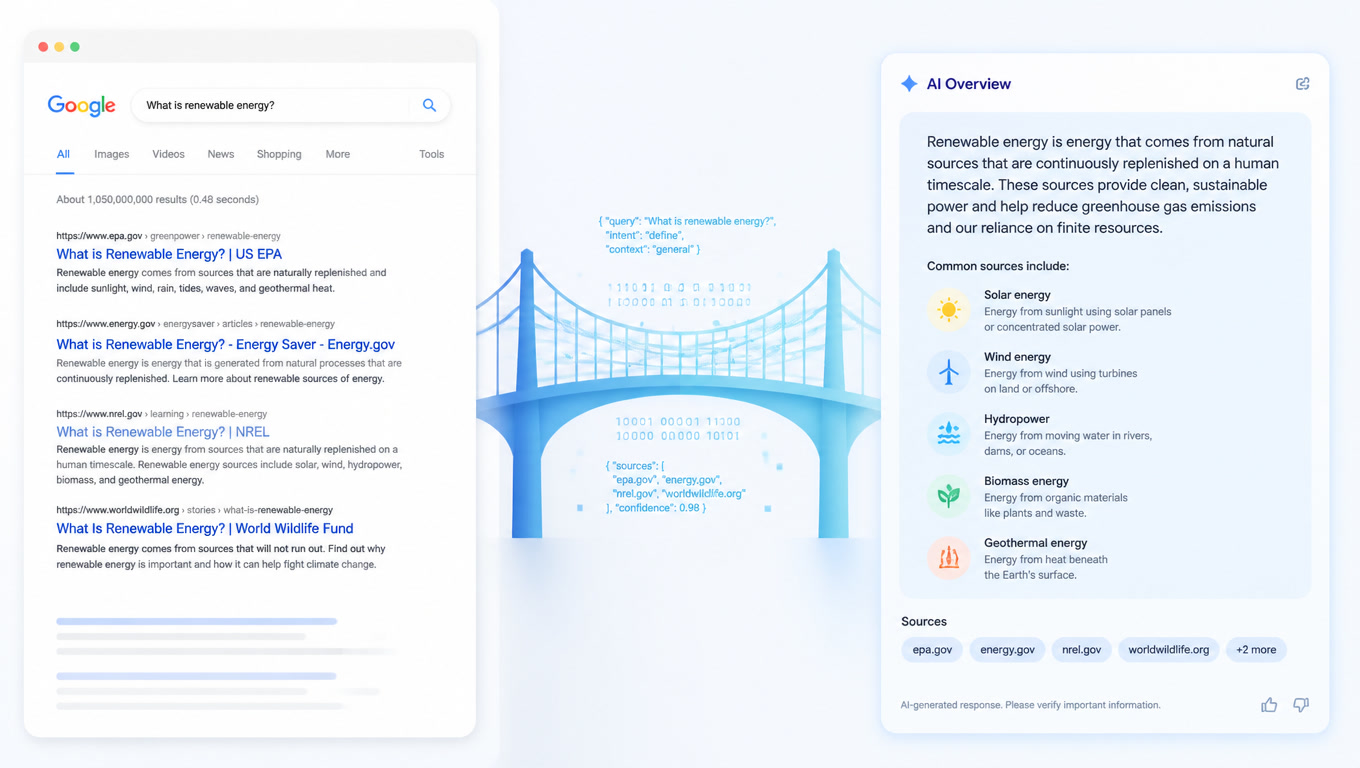
GEO, AEO, and SEO: Google says they are the same thing. Here is what that actually means.
Google published official guidance saying GEO and AEO are still SEO. Here is what the documentation actually says, what it ignores, and what you should do differently.
Google calls GEO and AEO "still SEO." That is both true and incomplete.
In May 2026, Google published a guide called "Optimizing your website for generative AI features on Google Search." The document is direct about something the SEO industry has been arguing about for two years:
"From Google Search's perspective, optimizing for generative AI search is optimizing for the search experience, and thus still SEO."
The guide defines "AEO" as answer engine optimization and "GEO" as generative engine optimization, then folds both into standard SEO. Google employees have said this at conferences before, but now it is on record in their documentation.
Here is what that means, what it does not mean, and what you should actually do about it.
What the documentation actually says
The guide makes four claims worth paying attention to:
Google's AI features use the same ranking systems as traditional search. The AI stuff sits on top of the existing index and quality signals, not beside them.
You do not need special markup for AI. Google says llms.txt, content chunking, and AI-specific rewriting are unnecessary. Their systems "are able to understand the nuance of multiple topics on a page."
Structured data helps, but not because it is an "AI thing." Schema markup makes you eligible for rich results, which is the same game it has always been. There is no special AI schema.
Content that ranks well organically tends to get cited in AI Overviews. The correlation is strong because the systems overlap.
What the documentation ignores
Google's guide is useful as a reference, but it leaves out some things that matter.
The document talks about AI Overviews as if they are the only AI surface that matters. They are not. ChatGPT, Perplexity, Claude, and Gemini all pull from the web, and none of them follow Google's ranking signals. A page that gets cited in Google AI Overviews might never appear in a Perplexity answer, and vice versa.
Google also does not address the 8% click-through problem. Pew Research found that only 8% of visits with an AI summary led to a click, compared to 15% without one. The guide frames AI features as additive (more visibility!) without acknowledging that visibility without clicks is not traffic.
And the guide does not mention the referral data problem. AI-referred visitors arrive through direct or (none) in GA4 because there is no standard UTM or referrer string. You cannot easily measure the impact of AI visibility on your actual business goals without workarounds.
The real distinction nobody talks about
Google says GEO is SEO. Technically correct. But the skillset that gets you cited in AI search is not the same skillset that gets you ranked on page one.
Traditional SEO rewards keyword targeting, backlink authority, technical health, and content freshness. GEO rewards extractability, entity clarity, citation-worthiness, and structured information density.
Here is a practical comparison:
| What gets you ranked | What gets you cited |
|---|---|
| Backlinks and domain authority | Clear, quotable definitions |
| Keyword-optimized headings | Structured answers to specific questions |
| Fresh content signals | Comprehensive topic coverage on a single page |
| Technical SEO (speed, mobile, schema) | Entity relationships and source attribution |
| Long-form content | Concise, extractable passages (40-80 words) |
You can rank #1 in organic results and never get cited in an AI Overview. You can get cited in AI Overviews without ranking on page one. The overlap is real, but the skills are not identical.
What this means for your content strategy
If Google is right that GEO is SEO, then the existing SEO playbook works for AI visibility. Do the basics well, and AI features will follow. That is the optimistic read.
If you look at the actual data, the story is more nuanced. Reddit captures 59.41% of generative AI referral traffic, according to July 2026 data from Search Engine Roundtable. Wikipedia gets 40.59%. Those two sources dominate AI citations across every platform. That is not because they have great SEO. It is because they have structured, factual, extractable content that models can pull from cleanly.
The practical takeaway: the fundamentals Google describes are necessary but not sufficient. To actually show up in AI search, you also need:
- Content that answers questions directly, not just content that ranks for keywords.
- Structured passages that models can extract without context. If your answer requires reading three paragraphs before it makes sense, it will not get cited.
- Entity signals that link your brand to your topic area. Google's Knowledge Graph, but also mentions on authoritative sites that AI models train on.
- FAQ and Q&A content that matches how people actually ask questions in AI search (conversational, full-sentence, specific).
The metric problem
Google's guide includes a new Search Console report for AI performance. It shows impressions from AI Overviews and AI Mode. It does not show clicks. It does not differentiate between a generated interface and a standard AI Overview.
This is the measurement gap. You can see that your content appears in AI features. You cannot see whether that appearance drives any business outcome.
For now, track three things:
- Brand search volume. If AI citations are working, more people should be searching for your brand directly.
- AI Overview impression share in Search Console. Which pages appear, how often, and in which queries.
- Referred session quality in GA4. Filter for (none) and direct traffic that lands on pages you know are cited in AI. Compare conversion rates to organic search traffic.
These are imperfect signals. But they are the best available until Google connects AI impressions to actual user actions.
What you should stop doing
Google's guide is explicit about a few things you can drop:
- Do not create llms.txt files specifically for AI search visibility. Google says they are not needed.
- Do not rewrite content to sound like it is written for AI. Google says AI systems understand natural language fine.
- Do not break content into tiny chunks hoping AI will pick up individual pieces. Google says their systems handle multi-topic pages.
- Do not chase "GEO certifications" or buy special AI optimization tools that promise to get you cited. The tactics are the same good SEO tactics with some AI-specific additions.
What you should start doing
The real work is not about labels. Whether you call it SEO, GEO, or AEO, the practice that gets results in AI search looks like this:
- Answer questions directly in your content. Put the answer in the first 40-80 words of any section that addresses a specific query.
- Use structured data for rich results eligibility. Same as before, but now with higher stakes.
- Build entity relationships. Get mentioned by authoritative sources. Make sure your brand name is associated with your topic area across the web.
- Create content that works as a citation source. If someone reads your page, they should be able to quote a specific fact, statistic, or definition from it.
- Track AI impressions separately. Use Search Console's AI performance report, but pair it with brand search data and GA4 filtering.
Google says GEO is SEO. They are right that the fundamentals overlap. They are wrong to imply that good SEO automatically produces good AI visibility. The two disciplines share a foundation, but AI search rewards different outcomes, and the measurement tools are not there yet.
The best time to start optimizing for AI search was when the first AI Overviews appeared. The second best time is now, using the SEO skills you already have and adding the extractability layer that AI systems need.
Related reading:
- AI Overviews clicks and traffic tradeoff - the paradox of AI search traffic
- AI Mode queries in Search Console - how to read the new AI performance reports
- Google's Search Console AI control settings - how to manage AI visibility for your site
Frequently Asked Questions
Is GEO a separate discipline from SEO?
Google says no. Their published AI search guide defines GEO as optimizing for the search experience, which they consider part of standard SEO. In practice, some tactics that help in AI search (like structured data for extractability) go beyond traditional SEO, so the reality is messier than the label.
Do I need llms.txt for AI search visibility?
Google explicitly says no. Their guide calls llms.txt and other AI-specific markup unnecessary for appearing in generative AI features. AI crawlers can discover and index content without it.
How do AI Overviews decide which sources to cite?
AI Overviews use retrieval-augmented generation (RAG) and query fan-out to pull from the Search index. Content that answers questions directly, has clear entity signals, and ranks well organically tends to get cited. There is no separate GEO ranking system.