
Gym member retention automation: the attendance-signal system that catches churn before the cancellation
Gyms keep 66.4% of members a year — one in three leaves. Attendance predicts churn better than surveys, and a signal ladder responds on WhatsApp before anyone cancels.
Gym member retention automation: the attendance-signal system that catches churn before the cancellation
To reduce member churn, the signal that matters is not the satisfaction survey and not the cancellation date — it's attendance. A retention system compares every member against their own visit baseline, fires a WhatsApp message when frequency drops below the threshold, escalates to a person when the member doesn't respond, and works the lapsed list in monthly cohorts. The industry retains 66.4% of members a year — one in three leaves — and behavioural research shows irregular-attendance segments churn at 21-24% against 4.6% for consistent attenders. Churn is decided weeks before it's signed.
The number comes from the Health & Fitness Association's 2025 Fitness Industry Benchmarking Report: average annual retention of 66.4%, calculated across 175 companies and more than 17,000 facilities in 27 countries. For a gym operator it translates to one thing: every year you lose a third of the base that cost you real money to build.
The uncomfortable part is what the research says about when you can see it coming. Attendance predicts better than satisfaction. A peer-reviewed study of fitness centres found that segments with low visit frequency and consistency churn at 21.3% and 23.7%, while the "dedicated reliables" churn at 4.6% — and attendance consistency carried the largest effect of every variable measured (F = 374, p < 0.001). The member who leaves almost never tells you first. They stop showing up, and that absence was already the notice.
The other half of the evidence is just as direct. Industry retention research (Paul Bedford) reports that members with a structured onboarding are still active at six months at 87%, versus 60% with manual follow-up. And a single conversation with staff makes a member 20% more likely to return the following month; four or more interactions push that to 80%. The Harvard Business Review puts the economics plainly: acquiring a customer costs five to 25 times more than retaining one, and Bain's research attributes a 25% to 95% profit increase to a 5% lift in retention.
None of those levers requires an AI agent. They require someone watching attendance at the right moment.
The wrong buying order: chatbot first, signal second
When a gym owner decides to "automatize," they almost always buy the opposite of what they need: a chatbot or AI receptionist that answers "what are your hours?", "how much is membership?" and "is there parking?". It fixes the inbox, not the leak. We already cover that layer here — the AI appointment scheduling architecture and the AI customer support playbooks handle inbound demand well.
The retention problem is different. A retention flow is event-driven, not inquiry-driven: nobody types "I want to cancel" three weeks early. The evidence we published on clinic no-shows carries over almost word for word: one well-placed reminder beats three messages in a row, and more cadence never fixes a wrong signal. Blasting "we miss you!" at everyone every Monday is noise; messaging when this member stopped matching their rhythm is the play.
Our stance is deliberately blunt: an 800-member gym doesn't need a conversational agent, it needs eight well-connected workflows on top of its gym management app. And before connecting anything, read the list of processes you shouldn't automate: automating retention badly makes retention worse.
The signal ladder: what triggers which message
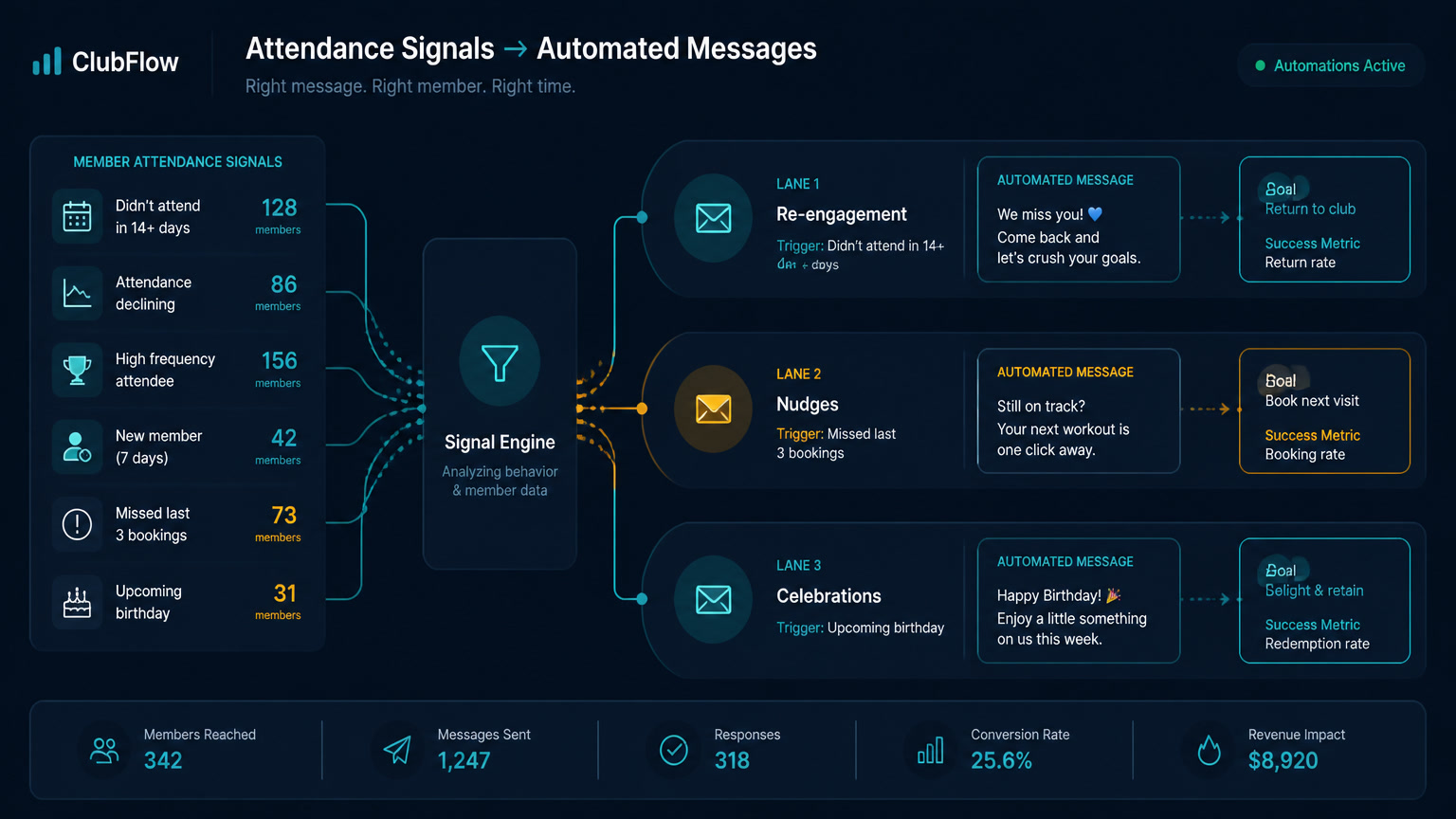
This is the framework we use when we design retention for membership businesses. Every row is a trigger, not a calendar entry: the message goes out because something happened in the data, not because it's Tuesday.
| Signal (event in the data) | Threshold | Automated action | Who closes |
|---|---|---|---|
| New member, no first booking | 7 days after signup | Message with available slots and one-tap booking | Automated |
| Onboarding in progress | Fewer than 4 visits in the first 30 days | Day 2 / 7 / 14 sequence with class recommendations | Coach task on day 14 |
| Frequency declining | Visits drop 50% below the member's own baseline for 7 days | Short check-in, no offer | Automated |
| At risk | 10-14 days without a visit | Class recommendation tied to their history, booking link | Automated |
| Save lane | 21-28 days without a visit | Pause or plan-change option plus a direct message | Front desk closes it |
| Membership expiry | T-30 / T-7 / T-1 | Renewal sequence; if attendance is climbing, upgrade path | Automated |
| Recently lapsed | Up to 90 days after expiry | Monthly win-back cohorts tied to the last class they took | Automated; human replies |
| Sensitive reply (injury, pregnancy, illness) | Keyword in the response | Stops the sequence and offers a pause, never a discount | Human |
Two rules hold the whole table up. First: automation surfaces, a person closes — when a member hits the save lane, a task is created with name, location, last visit and a suggested action; the system picks the moment, a person the member knows finishes the conversation. Second: the threshold is relative, not absolute — a four-visits-a-week member who drops to one is not the same case as a monthly member who hasn't shown up in three weeks. Comparing against each member's own baseline avoids the most common mistake in retention tooling: shouting at the occasional attendee.
What to build, by gym size
| Gym profile | Recommended stack | Approximate monthly cost | When not to use it |
|---|---|---|---|
| 1 location, under 500 members | Gym app with native workflows + WhatsApp Business App + manual reminders with templates | $0 - $60 | Don't buy the API or an AI agent: your volume doesn't justify it |
| 500 - 2,000 members, 1-3 locations | n8n self-hosted + WhatsApp Business API + gym app API + CRM (Clientify or similar) | $40 - $150 | Needs half a technical person; with nobody to maintain it, stay in the row above |
| 2,000+ members or 3+ locations | Vertical fitness platform with AI agent (Mindbody, Glofox, Wodify) or a dedicated integration | $300 - $1,000+ | Don't buy it for the demo: it demands a well-modelled class catalogue, coaches and billing |
The expensive mistake is buying the third row when you're in the first. Vertical platforms solve scale problems a neighborhood gym doesn't have, and they charge for that scale. The middle row is where most smaller operators get 80% of the result for a fraction of the cost — provided someone understands workflows, the same CRM automation design you'd use for sales.
The Latin America math: why the ROI isn't the US one
Almost every published WhatsApp retention case study is calibrated on US gyms charging $60 to $149 a month. In Latin America the membership ticket is a different animal, and that changes what an expensive stack is worth. The South American health and fitness club market is worth USD 5.66 billion in 2026 and growing 10.18% a year (Mordor Intelligence), with tens of thousands of small operators competing for a member who pays little.
Let's do the arithmetic with explicit assumptions: 1,000 members, $25 monthly fee, 66.4% annual retention. Every percentage point of retention recovered is 10 members a year, or $3,000 in avoided annual churn. Moving from 66.4% to 72% — an improvement inside the range of published case studies — is 56 members and roughly $16,800 a year. A middle-row stack costs under $1,500 a year. There's no debate: the lever is attendance, not conversation.
The channel, meanwhile, has a known price. Since October 1, 2026 WhatsApp charges for service responses beyond the first 1,000 free messages per business number per month, at utility rates of $0.0008 in Colombia, $0.0085 in Mexico and $0.026 in Argentina per delivered message — the breakdown is in what responding on WhatsApp costs since October 1. For a gym sending 200 to 500 retention messages a month, the Meta bill stays at $0; utility templates (reminders and renewals) are billed from the first send and marketing templates (win-back with an offer) always have been — in both cases, cents per recovered member.
One channel point that isn't up for discussion in Latin America: WhatsApp penetration is above 90% in Brazil, Colombia and Mexico (DataReportal, 2026). A local gym's email lands in spam; its WhatsApp doesn't. On consent, the rule is the same one we detailed for clinics: recorded consent for promotional messages, a clear legal basis for sensitive data under LGPD or local equivalents, and immediate respect for opt-out.
The four metrics that actually measure retention
- At-risk recovery rate: how many flagged members visit again before cancelling. Published cases show 18% to 38%.
- 90-day retention of new members: the onboarding indicator, not the pricing one.
- Renewal rate: it climbs when the conversation starts 14 days before expiry, not one day before.
- Dormant reactivation: share of the inactive base that answers cohort-based win-back.
Everything else — sends per month, open rates, "messages handled by AI" — is activity, not retention. If your dashboard only shows activity, you're measuring effort, not outcome.
What not to automate
The cancellation. Make it easy and frictionless: automate the exit survey and the pause offer, never the block-out or forced retention. A member who has to fight to leave leaves badly and talks about it. Discounts as the only save turn retention into a price war against gyms with less overhead, and you don't win that one. Health data: injuries, pregnancies and medical conditions don't belong in a campaign flow, they belong in a conversation with a person — and in the region they're sensitive data. And sequences that already got a reply: the moment a member writes back, the automation stops.
If you're starting from zero, the sensible path is the one we already mapped for automating internal CRM processes applied to your member base: signal first, message second, human escalation last. The gym that wins isn't the one that messages the most. It's the one that messages when the data says so.
At Mintec we build automation systems for membership businesses and SMBs across Latin America: attendance signals, n8n flows, WhatsApp Business API and CRM wired into your gym management app. Let's talk about your operation.
Frequently Asked Questions
How much does gym member retention automation cost?
It depends on size. A single-location gym under 500 members can start with the native workflows in its gym management app plus WhatsApp Business App: $0 to $60 a month. Between 500 and 2,000 members, n8n self-hosted plus the WhatsApp Business API and your gym app's API runs $40 to $150 a month. Vertical platforms with an AI agent start at $300 a month and only pay off above 2,000 members or multiple locations.
How much can automation reduce member churn?
Published case studies report relative reductions of 18% to 38%: a three-location chain took annual churn from 28% to 17%, and one studio moved its renewal rate from 61% to 78% by starting the conversation 14 days before expiry instead of one day before. The real range depends on whether attendance data is connected before the first message goes out.
What data does a gym need to get started?
Three things: check-in history with timestamps per member, expiry date for every membership, and class reservations with attendance status (showed, no-show, cancelled). If your gym management app exposes those through an API or an export, you already have the raw material — if they live in a spreadsheet, that is your first automation job.