
Your Chatbot Doesn't Need a Better Model — It Needs a Better Knowledge Base
Most AI chatbot failures are knowledge base problems, not model problems. A 5-layer framework for structuring, maintaining and measuring your chatbot knowledge base.
Your Chatbot Doesn't Need a Better Model — It Needs a Better Knowledge Base
When a chatbot gives wrong answers, it's almost never the model's fault. In our implementations with clinics, logistics firms, and retail across Mexico, Colombia, and Chile, roughly 80% of traceable errors came from the knowledge base: stale documents, duplicate entries, badly cut chunks, or content that was never updated. Fixing the base lifts resolution rates from the low 30s to 60%+ without changing a single line of model code.
It's the most repeated pattern we see at Mintec. A client launches their chatbot, it answers well for the first days, and two months later the team is convinced "the model got worse." They switch providers, test another LLM, burn weeks. The model was never the problem: prices changed, a new product shipped, and nobody updated the base.
The industry average for autonomous resolution is 44.8% (Lorikeet CX, cited by Digital Applied), while teams with well-maintained bases reach 89%. That 44-point gap isn't explained by the model — it's explained by how the knowledge base is built and maintained. And ignoring it has a concrete price tag: each AI-resolved ticket costs $0.62 versus $7.40 for a human-handled one (McKinsey 2026 data), so losing 10 resolution points can cost $5,000–$15,000 extra per month in support.
Why RAG makes your documentation your product
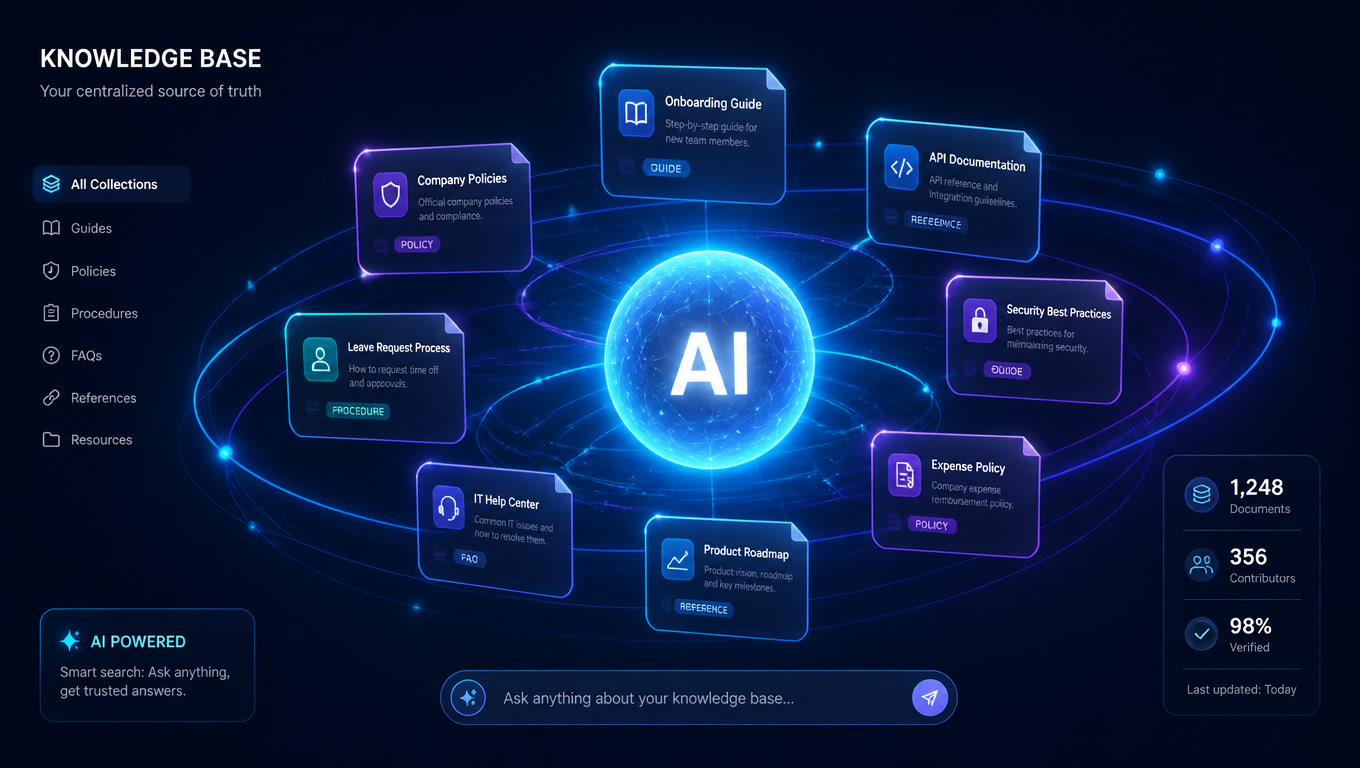
Before fixing anything, understand how a modern chatbot works. It isn't "trained" on your data in the weight-updating sense. It uses RAG (Retrieval-Augmented Generation): your documents are split, embedded as vectors, and stored in a vector database. When a customer asks, the system retrieves the most relevant fragments and hands them to the model as context. The model never changes — what changes is what it retrieves.
The uncomfortable implication: answer quality depends more on your documents than on the LLM's intelligence. As Alee's June 2026 guide puts it, "source quality and chunking strategy determine answer quality more than any model choice." A frontier model with a dirty base answers as badly as a small one.
The 5-layer framework for building your knowledge base
After implementing and maintaining chatbots for a dental clinic in Mexico City, a Bogotá logistics firm with 12 sales reps, and an eyewear retailer in Guadalajara, we settled on a 5-layer framework. Attack layers in order — each one fixes the most common mistake of the previous.
Layer 1: Source selection
What you upload is the single most important decision, and the most botched. More content isn't better — it's more noise.
| Upload these | Never upload these |
|---|---|
| FAQ and help-center articles (the backbone) | Outdated doc versions (the bot contradicts itself) |
| Full pricing pages, not just headline numbers | Internal Slack exports (half-correct informal info) |
| Policies: shipping, returns, privacy | Vague marketing copy ("industry-leading solutions") |
| Product documentation and onboarding content | Monolithic 200-page PDFs with no structure (chunk terribly) |
| Sales battlecards and common objection handlers | Duplicate content — it dilutes retrieval |
Mental test: if a customer asked this exact question, would this document give a clear, accurate answer? If not, fix it before uploading — don't upload it as is.
Layer 2: Atomic entries
Each entry must answer one topic. "Return policy" and "How to cancel a subscription" are different entries even though both involve money. Long entries mixing three topics confuse retrieval: the system finds the right fragment for the wrong question.
The metric we track: base coverage — the share of your customers' real questions that have a dedicated entry — should sit above 70%. If you're below that, it's not a prompt problem: the base simply doesn't have the information.
Layer 3: Chunking for non-technical teams
Chunking is where most DIY attempts fail. Chunks too large retrieve irrelevant context; too small lose the meaning a question needs. The ranges we use (from Alee's guide and our own practice):
| Size | Best for | Risk |
|---|---|---|
| 100–200 tokens | Dense tables, FAQs | Retrieval too narrow |
| 300–500 tokens | Help articles, policies — the sweet spot | None significant |
| 600–900 tokens | Long technical docs | Off-topic content in the same chunk |
Two simple rules: overlap chunks by 50–100 tokens so answers don't get cut at boundaries, and always cut at semantic boundaries (paragraph end, heading change) — never by blind token count. If your platform won't let you control this, that's a red flag when choosing a vendor.
Layer 4: Freshness and update triggers
Stale content is the #1 reason bots degrade over time — Alee confirms it: "stale content is the most common reason bots degrade." The bot doesn't know your price changed; it answers with what it has.
The system we recommend: automatic weekly re-crawling of your sources (sitemap, docs) plus immediate manual updates for anything significant — price changes, new products, new policies, new hours. And watch out: old content doesn't disappear on its own. Rename a product and the previous version stays in the vector store, ready to be cited. You must remove it explicitly.
Layer 5: Ownership and feedback
A base without an owner is a dead base. Someone accountable must review failed conversations weekly (the "I don't knows" and negatively rated answers), fix the entries that failed, and document patterns. In our experience, real conversation data is worth 3× synthetic data: your first 100 chats tell you exactly which entries are missing or wrong.
What we saw in real implementations
Two cases that sum up the argument:
- Dental clinic in Mexico City: autonomous resolution went from 28% to 44% in one week. We never touched the model. We only restructured the base: removed duplicates, split mixed entries, updated hours and prices.
- Logistics firm in Bogotá: from 38% to 67% in three weeks after moving the base to RAG with versioned sources and weekly updates. Same model, same platform, different base.
In both cases the client asked us to "change the model" before we showed them the problem was in the documents. Blaming the technology is easier than admitting the documentation is a mess — but technology doesn't fix documentation.
The metrics that actually matter
| Metric | Healthy value | What it tells you |
|---|---|---|
| Base coverage | > 70% | Is there an entry for real questions? |
| Recall@3 | > 80% | Does the right fragment appear in the top 3? If not: chunking or embedding problem |
| No-answer rate | 10–20% | Too low: the bot confabulates. Too high: missing entries |
| Weekly resolution trend | Stable or rising | Is the base staying fresh? Two down weeks = stale base |
If you're not measuring at least three of these, you don't know if your chatbot works — you only know it answers. For the full measurement system, our chatbot quality scorecard covers all five dimensions.
The 7-question audit for your base today
- Does every entry answer a single topic?
- Are there duplicate or contradictory versions of the same document?
- Are chunks cut at semantic boundaries, not by blind token count?
- Does a named person update the base when a price changes?
- Do you review failed conversations at least weekly?
- Does the bot show the source of each answer? (Non-negotiable in regulated industries)
- Do you know this week's no-answer rate? And last week's?
Fail more than two, and you know where to start — and it isn't buying a better model.
When it's NOT a knowledge base problem
The framework has limits. Three cases where fixing the base isn't the answer: if your queries are 100% predictable (hours, locations, fixed prices), a conditional rules-based chatbot wins — we explain why in when NOT to use AI for automation. If the issue is tone or response format, that's the prompt, not the base. And if your bot resolves well but doesn't generate leads, that's a conversion problem, not a knowledge problem.
To decide which chatbot tier fits your volume and complexity, our 4-tier cost framework orders the investment. And once your base is healthy but you want to push resolution from 60% to 80%, the next step is the continuous training system we detailed in how to train and improve your chatbot.
The conclusion is uncomfortable and liberating at once: your chatbot is a mirror of your documentation. Fix the documents, and the bot fixes itself. We see it every day at Mintec — the projects that win aren't the ones with the newest model, but the ones that treated the knowledge base as what it really is: the chatbot's actual product.
Frequently Asked Questions
What is a knowledge base for an AI chatbot?
It's the set of documents, FAQs, policies, and product data the chatbot retrieves to answer questions. In a RAG system, the AI model never changes — what changes is the context retrieved from that base. If the base is bad, the model gives bad answers no matter how advanced it is.
How often should I update my chatbot's knowledge base?
Every time your business changes: prices, products, policies, hours. The practical rule we use: automatic weekly re-crawling plus immediate manual updates for significant changes. An unmaintained base loses accuracy within weeks.
Do I need fine-tuning or a knowledge base (RAG)?
For answering questions about your business, RAG is almost always the right choice. Fine-tuning changes model behavior (tone, format) but doesn't inject reliable, traceable facts. RAG hands the model the exact passage from your documentation at query time, and updates the moment you edit a document.