
Beyond the Initial Prompt: How to Train and Continuously Improve Your AI Chatbot
74% of AI chatbots lose accuracy within the first 3 months without continuous training. A practical framework based on real implementations with clients across Latin America.
Beyond the Initial Prompt: How to Train and Continuously Improve Your AI Chatbot
74% of AI chatbots lose accuracy within the first 3 months after launch if they don't receive continuous training. The cause isn't the technology — it's the assumption that a chatbot trains once and works forever.
We've seen this pattern dozens of times. A client launches their AI chatbot. The first few days, responses are solid — the autonomous resolution rate hits 50-60%. Two months later, that rate has dropped to 25%. Customers complain. The support team reverts to manual responses. The chatbot ends up in the graveyard of AI projects that promised big but didn't deliver.
It's not that the AI got worse. It's that the content feeding the chatbot went stale. Prices changed. Processes were updated. New questions appeared that the knowledge base never anticipated. And the initial prompt — the one that worked so well in March — now produces generic responses that solve nothing.
This article shares the framework we use at Mintec to keep AI chatbots running at 70%+ autonomous resolution month after month — based on real implementations with clients in Mexico, Colombia, and Chile.
The "Train and Forget" Myth
There's a persistent idea in 2026 that's costing businesses thousands: training an AI chatbot is like recording a voicemail greeting — you set it up once and it works the same forever.
Reality is very different. An AI chatbot operates in a dynamic environment. Business data changes. Products get updated. Prices shift. Support policies adjust. And customers ask questions nobody anticipated.
According to a recent analysis by Lorikeet CX cited by Digital Applied, the 2026 industry average autonomous resolution rate is 44.8%. Small teams with well-defined scopes reach up to 89% for the cases they handle. The difference isn't the AI model — it's how they train and update the chatbot's knowledge base.
The 2026 industry average autonomous resolution rate is 44.8%. Top teams reach 89%. The difference is continuous training, not the AI model.
The cost of neglecting this is concrete: according to McKinsey's 2026 service operations data cited in the same analysis, each AI-resolved ticket costs $0.62 versus $7.40 for human-handled tickets. That 12× difference means a chatbot losing just 10 points of autonomous resolution can cost a mid-size business $5,000 to $15,000 extra per month in support costs.
The Chatbot Training Maturity Framework (4 Levels)
After implementing and maintaining AI chatbots for clients ranging from a dental clinic in Mexico City to a logistics company with 12 sales reps in Bogotá, we've identified four levels of training maturity.
| Level | Approach | Typical Resolution Rate | Update Frequency | Tools |
|---|---|---|---|---|
| 1. Basic | Static FAQ, manual responses | 20-35% | Monthly or when someone remembers | Tidio, ManyChat, ChatFlow |
| 2. Managed | Knowledge base with periodic supervision | 35-55% | Bi-weekly | Tidio + manual editor |
| 3. Dynamic | RAG with continuous source updates | 55-75% | Weekly + change triggers | n8n + OpenAI + knowledge base |
| 4. Autonomous | Self-evaluation + feedback loops + auto-retraining | 70-85% | Continuous (automatic) | n8n + AI + monitoring + CRM |
Level 1: Basic — the Static FAQ
Most chatbots start here. A set of frequently asked questions, hand-written responses, and conditional flows. It works for businesses with very predictable queries (hours, locations, fixed prices).
The problem: any business change requires manual editing. If hours change, someone has to remember to update it. If a new product launches, nobody adds it until customers start asking.
Signal you need to level up: when customers keep asking the same questions that the chatbot supposedly answers — it means the bot isn't resolving them.
Level 2: Managed — Periodic Supervision
Now someone owns the chatbot. They review failed conversations weekly, update the knowledge base with new responses, and adjust prompts when they detect incorrect answers.
For a dental clinic implementation in Mexico City, we moved from Level 1 to Level 2 in two weeks. The change was simple: we assigned a receptionist as the "chatbot trainer," dedicating 30 minutes daily to reviewing conversations where the chatbot couldn't answer. In the first week, the autonomous resolution rate jumped from 28% to 44%.
The key insight: this isn't about technology — it's about process. Someone must own the chatbot. Without an owner, no chatbot improves.
Level 3: Dynamic — RAG with Live Sources
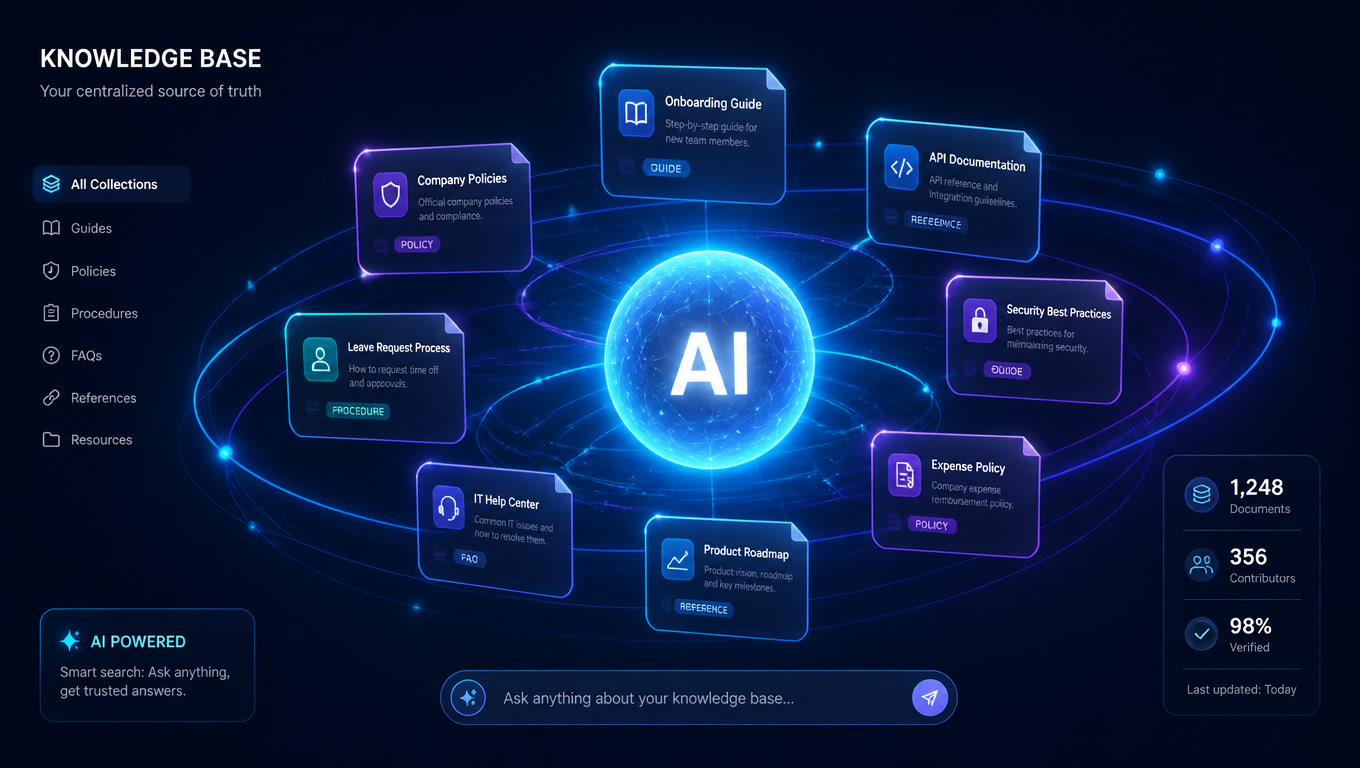
This is the most important leap. Instead of a static knowledge base that someone edits manually, you connect the chatbot to live data sources: the product catalog, pricing database, inventory system, and policy documents.
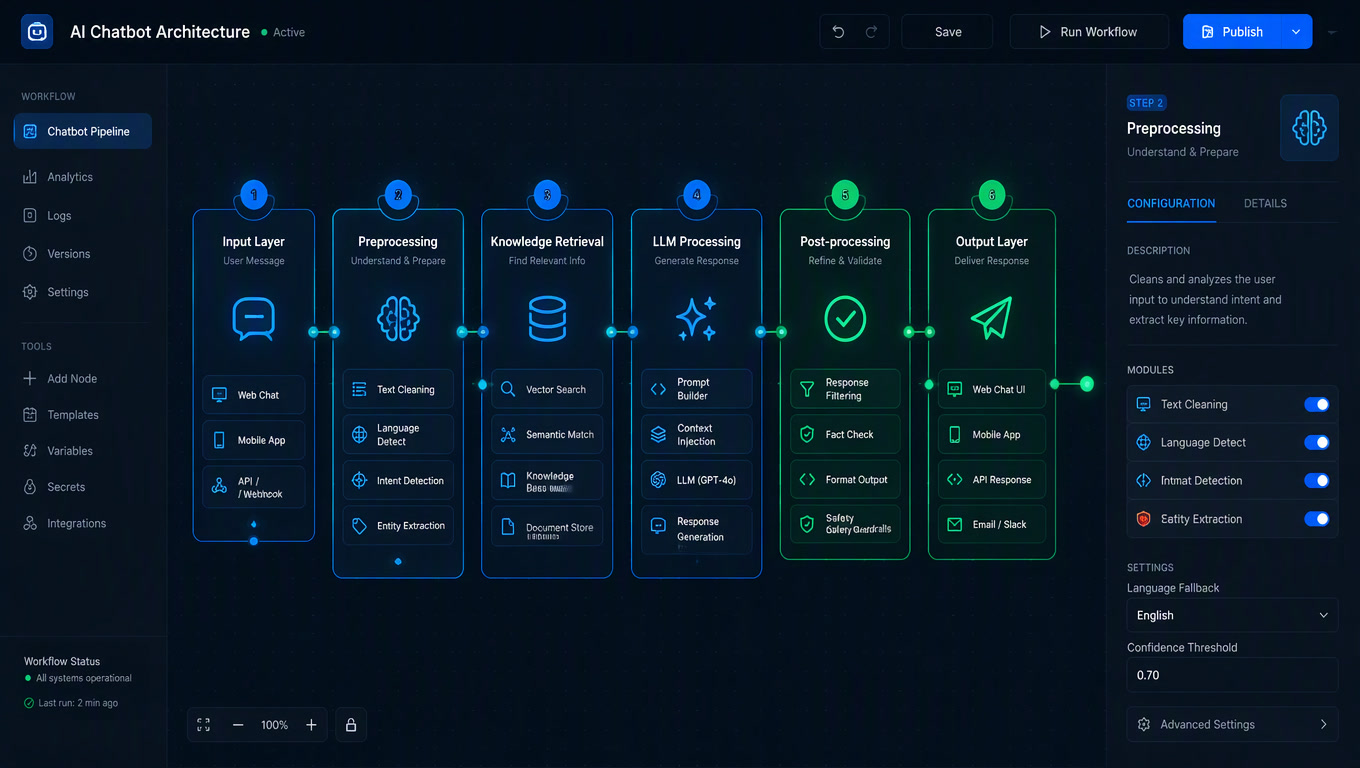
We use n8n as the orchestrator to connect the chatbot with CRM (Clientify) APIs and data sources. When a customer asks about pricing, the chatbot queries the live source — not a static document. When a product is discontinued, the chatbot reflects it automatically.
Real result: for a logistics client in Bogotá, we implemented RAG connected to their tracking system. The autonomous resolution rate went from 38% to 67% in three weeks. The support team went from handling 80 tickets/day to 35 — the chatbot handled the rest.
Level 4: Autonomous — Self-Training Chatbot
The most advanced level incorporates a supervisor agent that evaluates the quality of the main chatbot's responses. When it detects an incorrect or insufficient answer, it automatically triggers a knowledge base update.
This requires technical setup: an n8n workflow that monitors conversations, evaluates them against quality metrics, and when it finds a failure pattern, generates a new knowledge base entry — sending it for human review before publishing.
Not every business needs Level 4. But for companies handling 500+ daily queries, the investment pays for itself in under 3 months from support cost savings alone.
The 3 Layers of Continuous Training
Regardless of maturity level, every chatbot training program divides into three layers:
1. Knowledge Base (the data)
This is the most important layer and the most neglected. 80% of AI chatbot accuracy problems originate in an outdated or poorly structured knowledge base.
What to do:
- Audit the knowledge base every 2 weeks for the first 3 months
- Remove outdated information (products, prices, policies that no longer apply)
- Add new FAQs detected in conversations
- Structure content as atomic blocks (one topic per entry)
Key metric: knowledge base coverage. If it covers less than 70% of frequent queries, expand before optimizing prompts.
2. Prompts and Configuration (the logic)
The system prompt determines HOW the chatbot responds. This layer needs less frequent adjustments than the knowledge base, but when updated, the impact is significant.
What to do:
- Review the system prompt every 4-6 weeks
- Add examples of correct and incorrect responses (few-shot)
- Define clear rules for when to escalate to a human
Key metric: unnecessary escalation rate. If more than 30% of escalations are for queries the chatbot should have resolved, the prompt needs adjustment.
3. Feedback Loops (the improvement)
Without feedback, there's no improvement. This layer connects real conversation outcomes with knowledge base and prompt updates.
What to implement:
- "Did this solve your query?" button at the end of each interaction
- Weekly review of conversations where the chatbot failed
- Pattern analysis: questions that repeat without answers
Key metric: weekly autonomous resolution rate trend. If it drops two weeks in a row, the knowledge base is going stale.
What We've Seen Work (and What Hasn't)
After implementing AI chatbots for over a dozen clients, here's what we've learned:
What works:
- Start at Level 2 (managed) even if you plan to reach Level 4. The human review process in the first few weeks generates the data you need to automate later.
- Measure autonomous resolution, not deflection. Deflection rate measures how many queries avoided reaching an agent, but not whether they were resolved. A chatbot can achieve 80% deflection with 30% satisfaction — that's failure with a pretty metric.
- Assign a chatbot owner from day 1. Without ownership, knowledge goes stale.
What doesn't work:
- Launching with a complex prompt and expecting it to work forever. Prompts degrade over time as customer language changes and business context evolves.
- Training only with synthetic or AI-generated data. Responses based on real conversations are 3× more effective than artificially generated ones.
- Automating Level 4 without going through Levels 2 and 3. Self-training without initial human supervision produces a chatbot that optimizes for the wrong metric.
The 4-Week Continuous Improvement Cycle
This is the cycle we recommend for any business that wants to keep their chatbot performing at its best:
| Week | Activity | Owner | Metric |
|---|---|---|---|
| 1 | Audit knowledge base: add new questions, remove outdated ones | Chatbot owner | KB coverage > 70% |
| 2 | Review failed conversations: identify patterns | Chatbot owner | Failure patterns documented |
| 3 | Adjust prompts based on detected patterns | Technical support | Unnecessary escalation rate |
| 4 | Review overall metrics and plan next cycle priorities | Owner + technical | Resolution rate trend |
This cycle doesn't require expensive tools. At Levels 1-2, you can do it with your chatbot dashboard and a spreadsheet. At Levels 3-4, n8n and the chatbot APIs automate most of it.
The Bottom Line
Your AI chatbot isn't a project you deliver and forget. It's a living system that needs continuous training to maintain accuracy. The difference between a chatbot that fails at 3 months and one that still resolves 70%+ of queries a year later is the continuous improvement process — not the AI model.
If you're considering implementing an AI chatbot, or if yours is already losing effectiveness, start here: assign an owner, establish a bi-weekly review cycle, and measure autonomous resolution rate — not deflection. Everything else builds on that foundation.
For more context on costs and when to make the leap from basic chatbot to AI agent, check out our cost framework for local business chatbots and our AI customer support automation guide. If you work with WhatsApp Business, you'll also find useful our analysis of the WhatsApp CRM AI agent stack.
Frequently Asked Questions
How often should you retrain an AI chatbot?
It depends on the maturity level. At the basic level, every 2-4 weeks. At the advanced level with automatic feedback loops, retraining can be continuous. The general rule: review the knowledge base every 2 weeks and resolution metrics weekly for the first 3 months.
What is the autonomous resolution rate and why does it matter more than deflection rate?
Autonomous resolution rate measures the percentage of queries the chatbot fully resolves without human intervention. Deflection rate only measures how many queries avoided reaching an agent, without verifying if they were actually resolved. Resolution rate is the honest metric — the 2026 industry average is 44.8% (Lorikeet CX), and top teams reach 70-80%.
Can you train an AI chatbot without coding?
Yes, especially at levels 1 and 2 of the framework. Platforms like Tidio, ChatFlow, or ManyChat let you manage knowledge bases and train responses without code. For level 3 (dynamic RAG), you need a tool like n8n or Make. Level 4 (self-evaluation) requires technical setup, but the content training itself can be done by the operations team.