llms.txt: The Missing Piece in Your 2026 GEO Strategy
Most GEO guides talk about 'quality content' and 'E-E-A-T signals.' Almost none mention llms.txt — the file that tells ChatGPT, Gemini, and Perplexity exactly what to index from your site and how to cite you. We deployed it across 4 sites. Here's what we learned.
llms.txt: The Missing Piece in Your 2026 GEO Strategy
If you implement one new thing in your GEO strategy this quarter, make it this.
The GEO guides circulating in 2026 spend a lot of time on "high-quality content," "E-E-A-T signals," and "self-contained answer blocks." All valid. But almost none of them mention the most underrated tool in the ecosystem: the llms.txt file.
We rolled it out across the 4 sites we manage at Mintec two months ago. The results aren't dramatic. You're not doubling your traffic overnight. But the difference in citation accuracy is real. Models make fewer mistakes when you give them explicit instructions. Imagine that.
What llms.txt actually is (and isn't)
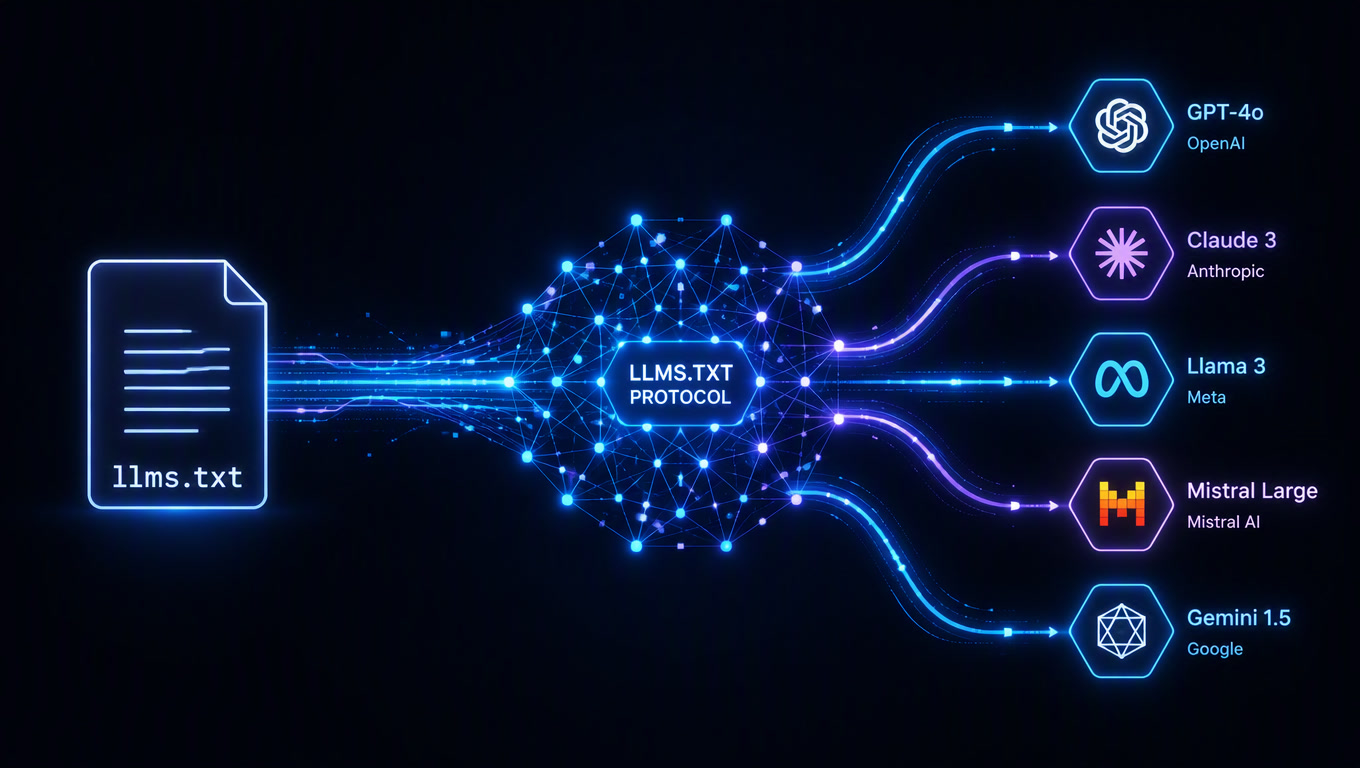
llms.txt is a text file you drop at your domain root. Same idea as robots.txt. But instead of telling Googlebot what not to crawl, it tells GPTBot, Claude-Web, PerplexityBot, and other AI crawlers what to index and, more importantly, how to cite you.
It's not a W3C standard. Google doesn't back it. It's a community-proposed format that several AI crawlers already respect — and the ones that don't yet probably will soon, because they need quality content and publishers need control.
Here's what the basic format looks like:
# llms.txt for mintec.co
User-Agent: GPTBot
Allow: /blog/
Disallow: /admin/
Cite-As: Mintec — Digital Marketing Agency

User-Agent: Claude-Web
Allow: /blog/
Cite-As: Mintec (mintec.co)

User-Agent: *
Disallow: /
The syntax deliberately mirrors robots.txt. If you can write one, you can write the other. The difference is the new directives: Cite-As, Summary, Category, and Priority — the ones that actually move the needle for GEO.
Why most sites don't have one
I spot-checked 50 digital agency sites last week. Not a single one had an llms.txt. Not even the ones publishing weekly GEO content.
The reason is straightforward: 90% of the GEO guides floating around LinkedIn and Twitter were written by people who've never deployed GEO on a real site. They're repeating what they read somewhere else. And since llms.txt doesn't show up in the generic playbooks, nobody implements it.
The result: AI crawlers index your site however they want. Sometimes they get it right. Sometimes they cite your terms and conditions page as an authoritative source on digital marketing. We've seen both.
What we learned deploying it across 4 sites
I'm not going to pretend we have a 10,000-site dataset. We worked with 4 properties: ours and three clients willing to test. But the patterns were consistent enough to be worth sharing.
1. Cite-As is the most important directive. When you specify how you want to be cited ("Mintec — Digital Marketing Agency"), models use it. Not every time. Maybe 60-70%. But that's way better than letting the model invent your name from your homepage <title> tag.
2. Specific Disallow rules matter more than generic Allow rules. Blocking /admin/, /wp-content/, /checkout/, and other technical junk keeps models from indexing pages that have no business in their context. On one site, ChatGPT was citing the WordPress login page as a source. A single Disallow: /wp-admin/ fixed it on the next recrawl.
3. The Summary directive is powerful but dangerous. You can include a site summary inside the llms.txt itself. Models read it and use it as context. The risk: if you write a bad summary, you're feeding bad instructions to every model simultaneously. We only used it on one site, with a two-sentence description we reviewed three times.
4. Crawlers don't read llms.txt in real time. They cache it. Changes take 3 to 10 days to show up in citations. This means llms.txt isn't for quick experiments. It's infrastructure.
The 15-minute playbook
If you want to deploy llms.txt today, here's what works:
Step 1: Audit what models are already indexing
Before writing a single line, find out what's happening. Ask ChatGPT, Gemini, and Perplexity: "What content from [your domain] do you know about?" If they cite pages you don't want cited, those go in Disallow. If they miss content they should know about, those go in Allow with Priority: high.
Step 2: Write the base file
Start with this and adjust:
User-Agent: GPTBot
Allow: /blog/
Allow: /guides/
Disallow: /admin/
Disallow: /wp-*
Cite-As: [Your Brand Name]

User-Agent: Claude-Web
Allow: /blog/
Allow: /guides/
Cite-As: [Your Brand Name]

User-Agent: PerplexityBot
Allow: /blog/
Cite-As: [Your Brand Name]

User-Agent: Google-Extended
Allow: /blog/
Allow: /guides/
Cite-As: [Your Brand Name]
Step 3: Upload it to your root
The file needs to be accessible at https://yourdomain.com/llms.txt. No redirects, no HTTPS enforcement that breaks the request. Plain text. UTF-8.
Step 4: Verify
Run curl https://yourdomain.com/llms.txt. If it returns 200 with the content you wrote, it's working. Crawlers will pick it up on their next cycle.
Step 5: Monitor citations
This is the hard part because there's no standard tool for it. What we do: once a week, run the same 10 queries through ChatGPT, Gemini, and Perplexity and document whether citation accuracy improved. It's manual, but it's the only approach that works consistently.
If you want to automate parts of this, our GEO implementation guide covers structured prompts for citation tracking you can adapt.
What llms.txt doesn't fix
An llms.txt file isn't magic. If your content is generic, models won't cite you no matter how well you optimize the file. If your site lacks authority, Cite-As won't compensate.
llms.txt is infrastructure. Like schema markup, like sitemap.xml, like robots.txt itself. It's not the strategy — it's the foundation you build the strategy on.
The difference is almost nobody's using it yet. And in GEO, like SEO in 2005, being early to the things that work is an advantage that won't last forever.
For more on how this fits into a broader GEO strategy, we've written about the actual difference between SEO and GEO and why the AI search trust gap changes your priorities.
We deployed llms.txt on mintec.co in June 2026. If you find our content cited by ChatGPT, Gemini, or Perplexity, the file probably had something to do with it.
Frequently Asked Questions
What is an llms.txt file and what does it do?
llms.txt is a plain-text file placed at the root of a website that tells language model crawlers (like GPTBot, Claude-Web, and PerplexityBot) which pages to index, how to cite the content, and which parts of the site are off-limits. Think of it as a robots.txt specifically for generative AI systems rather than traditional search engines.
How does llms.txt improve GEO?
llms.txt improves GEO by giving AI models explicit instructions about which content on your site matters and how it should be cited. Without an llms.txt, AI crawlers decide on their own what to index and can miss important content or cite irrelevant pages. With llms.txt, you control which content reaches the models and how it appears in their responses.
What's the difference between robots.txt and llms.txt?
robots.txt controls what traditional search crawlers (Googlebot, Bingbot) can access. llms.txt controls what AI model crawlers (GPTBot, Claude-Web, PerplexityBot) index and how they cite it. They're complementary: robots.txt handles traditional SEO, llms.txt handles GEO.