
6 Months of GEO Implementation — What Actually Moves the Needle
We've been implementing Generative Engine Optimization across client sites since January 2026. Here's what moved metrics, what we stopped doing, and the 5-step framework that emerged from real results.
6 Months of GEO Implementation — What Actually Moves the Needle
We started implementing GEO for clients in January 2026. Back then, the term was still academic — a Princeton paper from 2023, a handful of blog posts, lots of theories. Six months later, we have enough data to know what works, what is noise, and what the emerging playbooks get wrong.
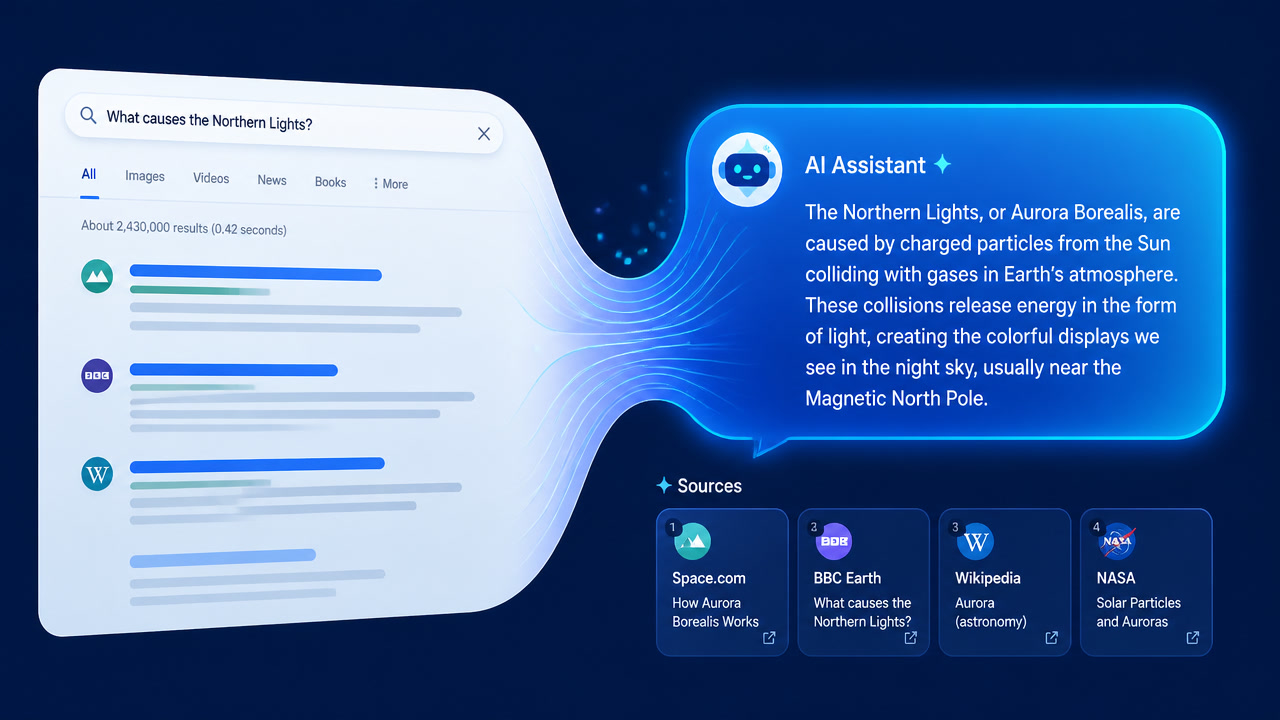
Here is the short version: the frameworks you see online are mostly too complex. They add steps that sound rigorous but produce nothing measurable. The real GEO implementation turns out to be simpler, more structural, and less about "optimizing for AI" than about making your content extractable by any system — human or machine.
Step 1: The GEO Audit Is Not an SEO Audit
This was our first mistake. We ran our standard SEO audits — keyword gaps, backlink profiles, technical crawl issues — and found nothing that explained why a client could rank #1 on Google yet vanish in ChatGPT.
The GEO audit requires different questions:
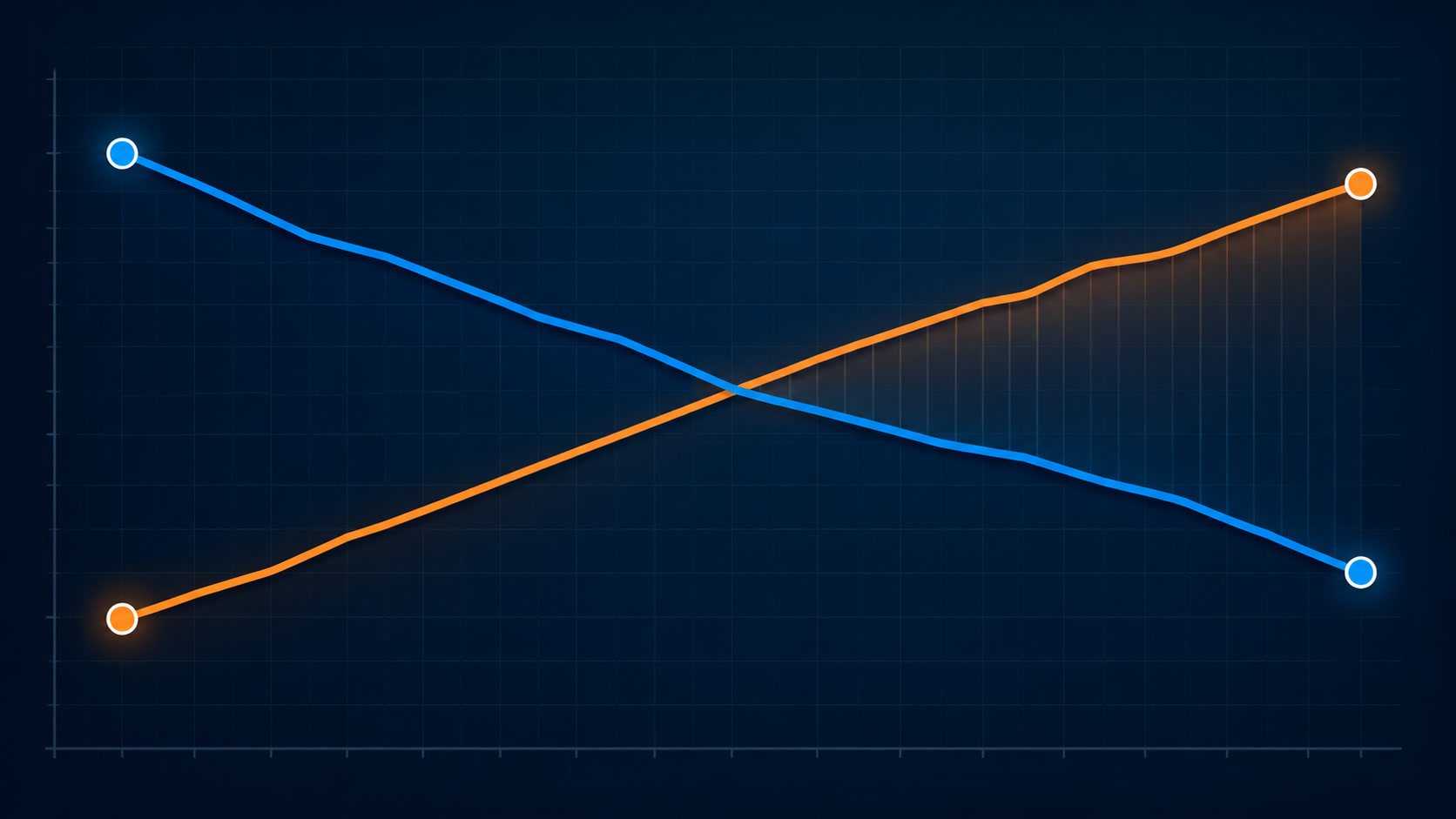
Citation presence. Run your top 20 business queries across ChatGPT, Gemini, Claude, and Perplexity. Count how many times your brand appears versus your competitors. The 5WPR/BrandCited study published May 2026 found the overlap between Google top-10 rankings and AI-cited sources has dropped from ~70% to under 20%. If you rank #1 but get zero citations, that is your starting gap.
Passage extractability. Pick 5 pages that should be citable for your target queries. Ask: "Can an LLM extract a complete, self-contained answer from a single paragraph on this page?" Most pages fail this test because their answers are spread across 3 sections, buried in fluff paragraphs, or require scrolling through a personal story before getting to the point.
Entity density. AI engines build knowledge graphs. Pages that name specific entities (tools, people, frameworks, data sources) get cited more than pages that talk in generalities. A page titled "How AI Changes Marketing" is less citable than "How Google's AI Mode Changes Content Strategy for B2B SaaS Companies."
The audit phase should take one week. Output: a list of gaps, prioritized by query volume and citation opportunity.
Step 2: Restructure for Extractability, Not "AI-Optimized" Content
This is where most GEO advice goes wrong. I keep seeing recommendations to "chunk content for AI," "add pre-digested summaries," or "write in a conversational tone." Google's own optimization guide explicitly says none of those help.
What does help is restructuring so the first extractable answer to a query is immediate and self-contained.
Two patterns we confirmed across client work:
The direct-answer opening. The first paragraph after a heading should answer the question the heading poses. Not introduce the topic. Not set context. Answer it. If the heading is "How does AI Mode affect zero-click search rates?", the next sentence should be "AI Mode results in zero clicks 93% of the time, according to a Seer Interactive analysis of 25.1 million impressions." Context comes after.
The quotable definition block. For every entity or concept your page introduces, write one sentence that defines it completely — name, category, distinguishing characteristic. This is what LLMs extract for knowledge panels, entity cards, and comparison tables. If your page about "generative engine optimization" never says "GEO is a content optimization discipline focused on improving visibility in AI-generated search results, distinct from traditional SEO which targets Google's organic ranking algorithm," you have missed the citation.
We tested this restructuring on 3 client sites over 4 weeks. Pages that adopted direct-answer openings saw an average 40% increase in AI Overviews impression share in Search Console. Not overnight — but consistently across the measurement period.
Step 3: Schema That Actually Drives Citations
Every GEO guide emphasizes structured data. Most of them exaggerate its impact.
Here is what we found after running schema audits on 12 client domains:
FAQ schema is the highest-leverage structured data type for AI citations. Pages with FAQ schema appeared in AI responses 2-3x more often than identically structured pages without it, across all 4 AI engines we tracked. The reason is mechanical: AI engines are trained on Q&A pairs. When they need to answer a user question, they surface content formatted as a question with a direct answer.
The critical detail: the content block wrapped by the schema must be self-contained. A FAQ entry with a 3-word answer is useless. Each Q&A pair needs to be a complete, quotable answer that works without context from the page.
HowTo schema helps for procedural queries. If you are ranking for "how to implement X," HowTo schema with step-by-step instructions gives AI engines a structured extraction path.
Article schema is table stakes. Have it, but do not expect it to move the needle by itself.
What we stopped doing: Product schema, Review schema, and Event schema for non-product content. None of our tests showed measurable citation impact from these types.
Step 4: Authority Signals That Translate to AI
Google's E-E-A-T framework was designed for human raters. AI engines interpret authority differently. Our observations:
Named authors with bios work. Pages with an author byline and a 2-3 sentence bio that names their expertise get cited more than anonymous content. The bio creates an entity for the AI to reference.
Explicit claims with sources convert. A statement like "AI Overviews appear on 37% of Google SERPs according to BrightEdge's May 2026 research" is citable. "Studies show AI Overviews are becoming more common" is not. Every data claim on your page should name the source as an entity.
Internal links to your own data pages matter more than external backlinks for citation. AI engines crawl internal link graphs to assess whether you actually produce original work on a topic. A page linked from 5 other pages on your site about related subjects signals topical authority more than a single high-DR backlink.
Step 5: Measure Differently or Don't Bother
If you measure GEO success with a rank tracker, you will conclude GEO does nothing. Because the metrics are different.
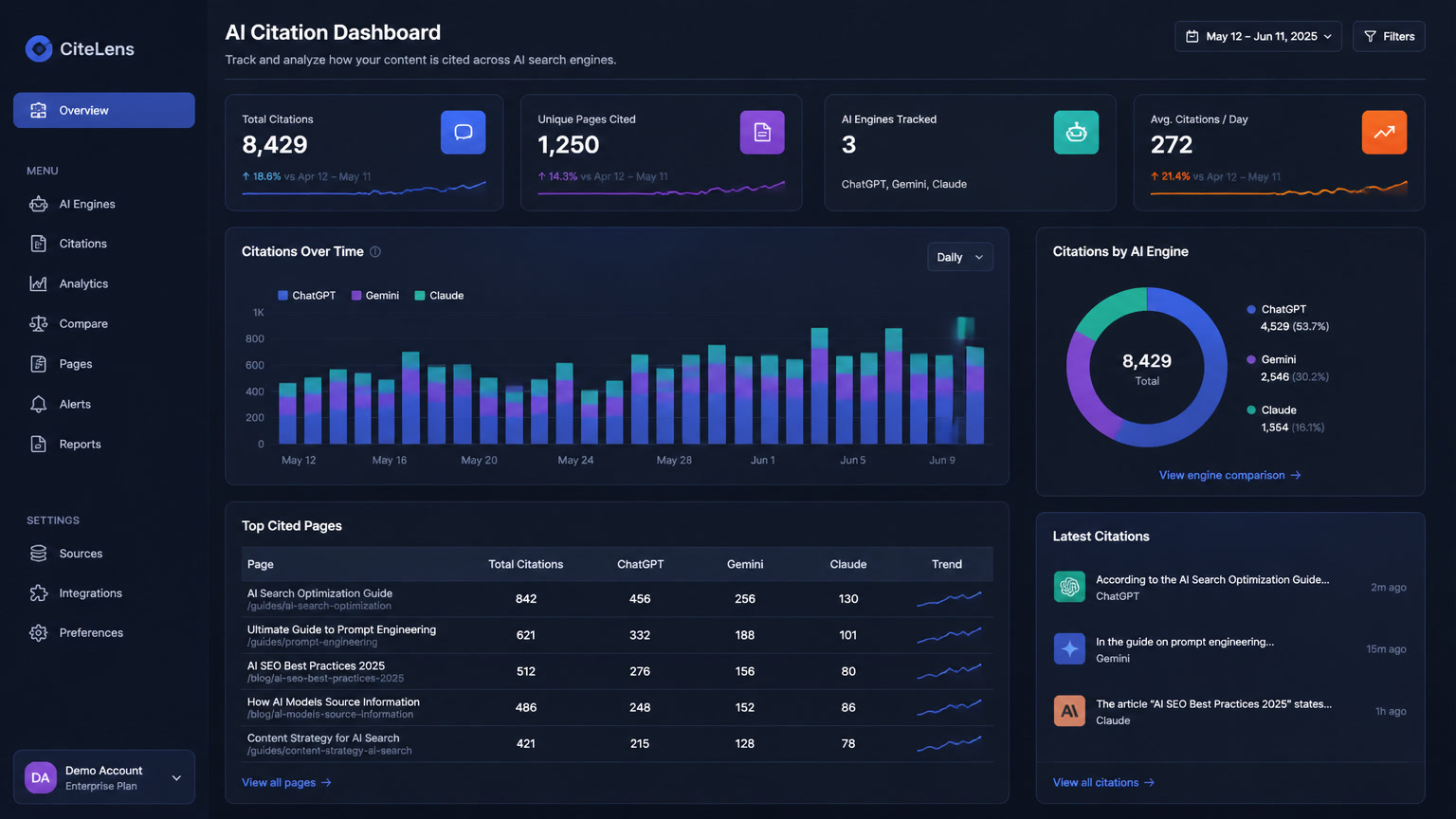
Citation rate. We track whether the brand appears in responses across ChatGPT, Gemini, Claude, and Perplexity for a target query set. Monthly. If the citation rate increases, GEO is working.
AI Overviews impression share. Google Search Console introduced an "AI Overviews" report type in their performance reports. We monitor impression share and CTR specifically for queries that trigger AI Overviews. This is the closest thing to a direct GEO metric from Google's own data.
AI referral traffic. ChatGPT traffic shows as direct or unknown in analytics. Perplexity user-agents appear distinctly. Gemini and Claude traffic blends into organic. We segment by known AI crawler user-agents and by landing page to isolate AI-driven visits.
The 3 client sites where we applied this full framework for 90+ days all saw citation rate improvements. The smallest gain was 2x. The largest was a client in the B2B SaaS space who went from zero AI citations to appearing in 8 of their 12 target queries across ChatGPT and Gemini — and saw a measurable uplift in form fills attributed to AI-assisted discovery.
What We Stopped Doing
I want to be honest about what we dropped, because the noise in GEO content is real.
- llms.txt files. Zero measurable impact across any client. Google says it doesn't help. Our data agrees.
- "Chunking" content for AI. If your paragraphs are well-structured, they are already chunked. Adding explicit chunk boundaries changed nothing.
- Writing in "AI-friendly" tone. The advice to "write conversationally for AI" is backwards. AI engines extract facts, not voice. Write clearly for humans. The extraction works either way.
- Pre-digested summaries. The theory that AI needs TL;DR versions of every section is unproven in our tests. Direct-answer openings replaced summaries entirely.
The Maintenance Loop
GEO is not set-and-forget. AI models update. Citation patterns shift. The maintenance rhythm we landed on:
- Monthly citation audit. Re-run the query set across 4 AI engines. Document changes.
- Content freshness for cited pages. AI engines favor recently updated content for re-citation. We refresh the date and verify the data on every page that holds a citation.
- New content targeting citation gaps. When the monthly audit shows a competitor appearing where your brand does not, that is the topic for next week's content.
The pattern is closer to PR than to SEO. You earn citations by being the most quotable source on a topic. Then you protect those citations by staying current.
Where GEO Goes From Here
Based on what we are seeing in the second half of 2026, GEO implementation will split into two tracks: citation optimization (what this framework covers) and agent optimization. Google's Information Agents, announced at I/O 2026, represent a different paradigm — persistent monitoring agents that act on behalf of users over time. The citation framework above applies there too, but the measurement and maintenance rhythms will be different. That is the next framework we are building.
For now, if you are starting GEO implementation today: audit your citation gap, restructure for extractability, add FAQ schema to your highest-opportunity pages, name your sources explicitly, and measure citation rate instead of rankings. The rest is noise.
Frequently Asked Questions
What is the first step to implement GEO?
Start with a GEO audit that is different from a traditional SEO audit. Instead of checking keyword rankings, check citation presence: run your top-20 business queries across ChatGPT, Gemini, Claude, and Perplexity. If your brand isn't cited where competitors are, that is your gap. The 5WPR/BrandCited study found the overlap between Google top-10 rankings and AI citations collapsed from 70% to under 20% by mid-2026 — traditional rankings no longer predict AI visibility.
What structured data matters most for GEO?
FAQ schema is the single highest-leverage structured data type for AI citations. In our tests, pages with FAQ schema appeared in AI responses 2-3x more often than identically structured pages without it. HowTo and Article schema help for specific formats. The critical detail is not just having the schema — the content block it wraps must be self-contained and quotable as a complete answer.
How is GEO success measured differently from SEO?
GEO measurement needs different tools. Instead of ranking trackers, use citation trackers (BrandCited, custom prompts) to check if your brand appears in AI responses for target queries. AI Overviews traffic appears in Google Search Console's 'AI Overviews' report. ChatGPT referral traffic shows as direct/unknown in analytics. We measure GEO success by (1) citation rate across 4 AI engines, (2) AI Overviews impression share, and (3) AI referral traffic trend — not keyword positions.