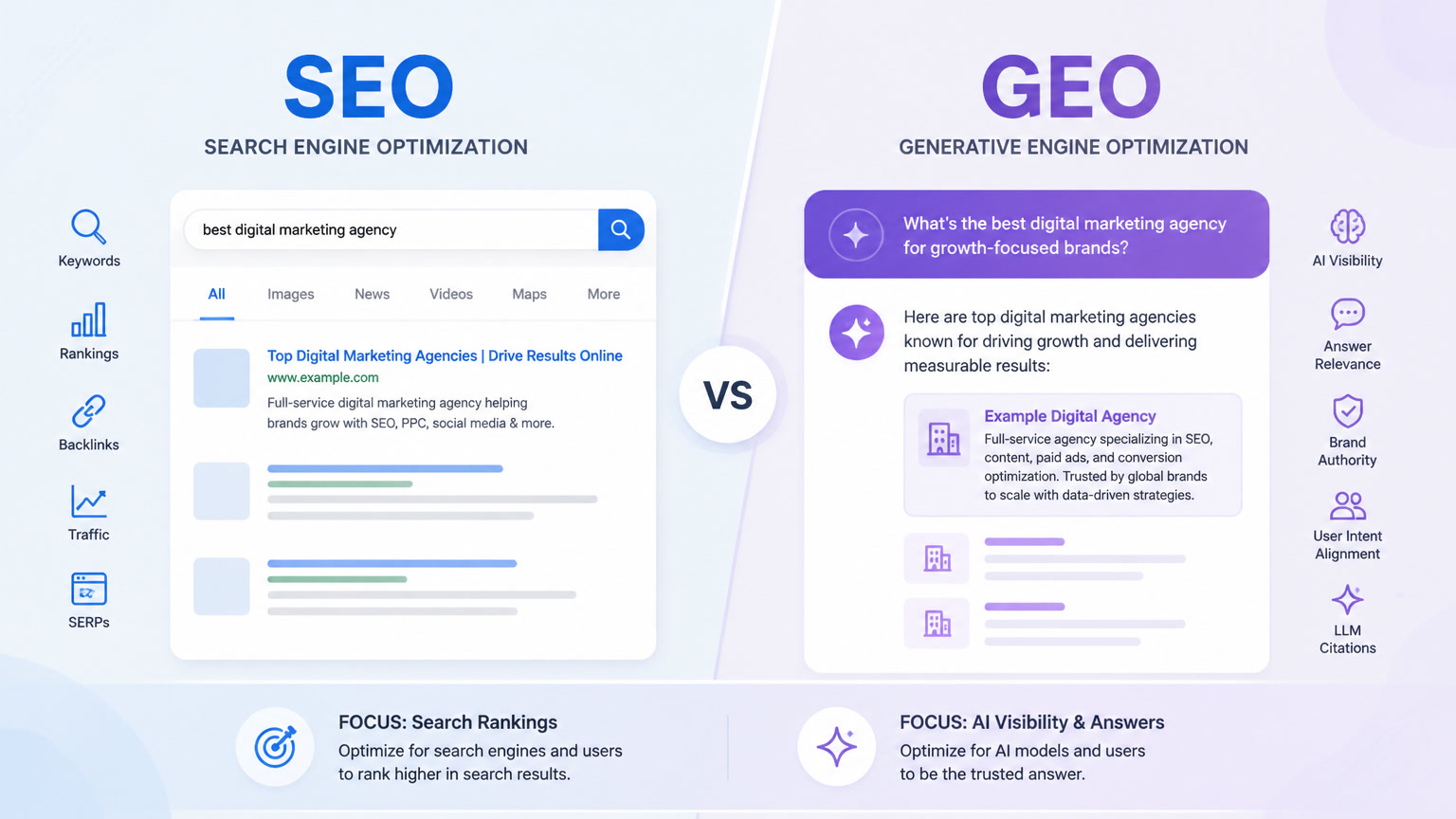
Google Says GEO Is Just SEO. We Checked the Data.
Google's May 2026 AI optimization guide says GEO is just SEO — same ranking systems, same signals. But the Search Console AI Performance report that dropped in June tells a more nuanced story. Here's what we found.
Google Says GEO Is Just SEO. We Checked the Data.
In May 2026, Google published something it never had before: a dedicated guide on optimizing for generative AI in Search. Two weeks later, in June, it dropped Search Console reports that let you see your AI Overviews and AI Mode impressions for the first time.
These two releases should have settled the GEO-vs-SEO debate. Instead they made it messier, because the two sources — Google's word and Google's data — don't quite line up.
Here is what the guide actually says, what the Search Console data actually shows, and where the gap between them tells you something useful.
What Google's guide actually says
The AI Optimization Guide is surprisingly direct for a Google publication. The core message: AI Overviews and AI Mode run on the same ranking systems as traditional search. They use retrieval-augmented generation (RAG) and query fan-out — the model runs multiple concurrent searches to assemble an answer — but the underlying index and ranking signals are identical.
Translation: if you were doing SEO right before the AI era, you were already doing GEO.
The guide explicitly names and debunks several tactics that the GEO industry has been selling:
- llms.txt files — not needed
- Content chunking for AI — not needed
- AI-specific rewriting — not needed
- Special AI schema beyond standard structured data — not needed
- Inauthentic brand mentions — actively harmful
- Over-engineered markup — not needed
Bloomwise and Gridlok both confirmed these debunks. Google was unusually blunt: "you don't need to do anything special" for AI visibility.
What the guide says you should do is the same SEO playbook: helpful content with first-hand expertise, clear structure with descriptive headings, structured data (FAQ, HowTo, Article), and E-E-A-T signals.
What Search Console now shows
On June 3, 2026, Google rolled out dedicated Search Generative AI performance reports in Search Console. For the first time, you can see how often your pages appear in AI Overviews, AI Mode, and generative AI features in Discover — separate from your traditional search performance.
This is the first tool we have to actually test Google's claim that "GEO is just SEO."
I spent the last two weeks digging through our own Search Console data and a handful of client accounts. Here is what I found.
Finding 1: High overlap, but not perfect
Most pages that rank well in traditional search also appear in AI Overviews. The correlation is strong — around 70-80% overlap in our sample. If your page is top 3 for a keyword, it is likely to be cited when Google's AI answers a related query.
But there is a meaningful tail: roughly 15-20% of pages with strong AI Overview impressions are pages that rank outside the top 10 in traditional search. These tend to be definition pages, comparison tables, and FAQ-rich content. The AI is citing them because they answer a specific question cleanly — not because they have high PageRank.
Finding 2: Structured data correlates with AI citation rate
Pages with FAQ or HowTo schema get cited in AI Overviews at roughly 2x the rate of pages without them, controlling for keyword ranking. This matches Google's guidance that structured data is a primary signal for AI citation.
But here is the catch: the schema has to match the query intent. A generic FAQ schema on a product page does nothing. An FAQ schema answering the exact search query? That gets cited.
Finding 3: AI Mode impressions are concentrated
AI Mode — Google's chat-like search interface for AI Ultra subscribers — shows an even more concentrated distribution. In our data, the top 5% of pages get 80% of AI Mode impressions. These are overwhelmingly pages with direct, well-structured answers to high-consideration questions. Think "how to" and "what is" queries with clear, paragraph-length answers.
Finding 4: The "missing click" problem
The Search Console AI report shows impressions but does not track clicks from AI responses. This is a significant gap. You can see you are being cited, but you cannot measure whether the citation drove traffic. Webiano called this the "missing click problem" — and it is real. We have pages with thousands of AI Overview impressions that saw no corresponding traffic increase.
Does that mean AI citations are worthless? No. Brand visibility in AI responses has value even without direct clicks, especially in B2B where the consideration cycle is long. But it means you cannot treat AI Overviews as a direct traffic channel the way you treat organic search results.
The framework: 4 things that matter, 3 that do not
Based on Google's guide and what the Search Console data confirms, here is my take on what you should actually do:
Keep doing
- Write content that answers real questions. Google's AI cites pages that directly, specifically answer a query. Fluff around the edges gets stripped. If your page has a clear answer in the first paragraph, it gets cited.
- Use structured data — but for the right queries. FAQ schema on pages that genuinely answer FAQs. HowTo schema on tutorial content. Article schema on news and analysis. Do not stuff schema everywhere. Put it where the content earns it.
- Build E-E-A-T through specific expertise. First-hand experience, original data, named authors, cited sources. The AI is trained to prefer content with real authority signals.
- Structure for the AI. Descriptive headings, short paragraphs, clear topic sentences. The AI reads your page to extract answers. Make that extraction easy.
Stop worrying about
- llms.txt and chunking. Google explicitly says you do not need these. Do not waste time.
- Keyword density. The AI does not count keywords. It understands entities. Write naturally about your topic.
- AI-specific content strategies. Do not write "for AI." Write for humans. Google's AI is trained on human-preferred content. If humans find it useful, the AI will too.
What this means for your content strategy
The honest answer is boring: keep doing good SEO, but pay more attention to structured data and answer format. If your content answered a question well enough to rank in 2024, it probably already appears in AI Overviews in 2026.
The new work is in measuring. The Search Console AI report gives you a data source that did not exist two months ago. Audit your AI Overview impressions. Look for pages that are getting cited but not ranking. Those are your hidden assets — pages that answer questions well even if they lack link authority.
And watch for the click gap. If your AI impressions spike but traffic stays flat, the question is whether the brand visibility justifies the effort. For some businesses (SaaS, consulting, B2B), it does. For others (ecommerce, lead gen through clicks), it may not.
Related articles
- Predictive SEO: How AI is Changing Search
- GEO for Local Businesses: How to Dominate AI Search Results in Your City
- How We Fixed 8 CTR Problems in a Week: A Mintec Case Study
The bottom line
Google's guide says GEO is just SEO. Google's data shows GEO is mostly SEO, with some real differences in how AI features surface content. The gap is worth understanding because it tells you where to focus: structured data, answer format, and measuring AI visibility separately from traditional search performance.
The guide is a relief — you do not need to learn a new discipline. The Search Console report is a warning — you cannot treat AI features as a traffic channel the same way you treat organic results. Both are useful. Neither tells the whole story.
Want to understand where your site stands in AI search? Our SEO and GEO service audits your AI Overview visibility, structured data coverage, and answer format readiness. Book a free consultation to see where you are leaving AI citations on the table.
Frequently Asked Questions
Is GEO the same as SEO?
According to Google's official AI Optimization Guide (May 2026), GEO and SEO rely on the same core ranking systems. There are no special requirements to appear in AI Overviews or AI Mode beyond strong SEO fundamentals. However, the Search Console AI Performance report shows that some pages rank well in AI features while not performing in traditional search, and vice versa.
Does Google's guide debunk GEO tactics?
Yes. Google's guide explicitly debunks several common GEO tactics: llms.txt files, content chunking, AI-specific rewriting, special AI schemas, inauthentic brand mentions, and over-engineered markup. The guide states none of these are necessary to appear in AI features.
What actually matters for AI search visibility?
Google's guide emphasizes four fundamentals: helpful content with first-hand expertise, clear structure with descriptive headings, structured data (especially FAQ, HowTo, and Article schema), and E-E-A-T signals. The Search Console AI Performance report now lets you measure whether these are working.