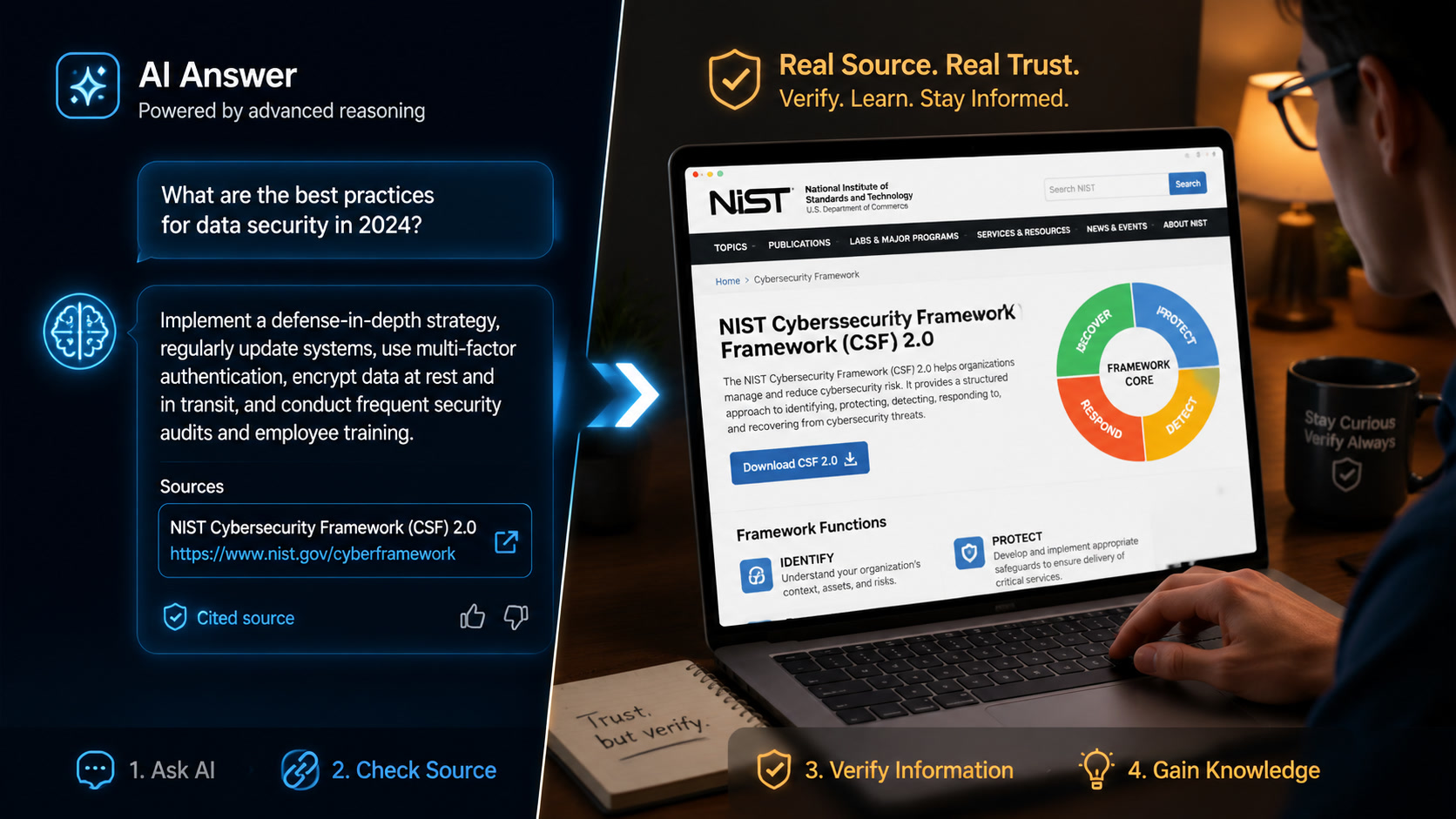
The AI Search Trust Gap: Why Your GEO Strategy Needs to Survive the Verification Click
Google AI Mode just hit 1B users while YouGov reports only 28% of Americans trust AI search. The gap between adoption and trust is your biggest GEO opportunity — but only if you build content that survives the click AFTER the citation.
The AI Search Trust Gap: Why Your GEO Strategy Needs to Survive the Verification Click
Two data points from July 2026 should reshape your content strategy for the rest of the year.
Google AI Mode just crossed 1 billion monthly users. Queries are doubling every quarter. The whole thing runs on Gemini 3.5 Flash across nearly 200 countries. It is the largest deployment of agentic search on the planet.
At the same time, a YouGov survey published July 13 found that only 28% of Americans trust information from an AI assistant. 70% still trust traditional search engines more. The U.S. has the lowest AI-assisted search rate of any country in the 19-market study — 48%, compared to 89% in India, Indonesia, and the UAE.
There's a massive gap between AI search adoption and AI search trust. And that gap — not the citation arms race — is where the real GEO opportunity lives.
What the citation panic misses
Most GEO advice in 2026 boils down to the same idea: "optimize your content so AI models cite you." That's necessary but it's not sufficient.
The YouGov study asked what happens after someone gets an AI answer:
- 22% click through to the links the AI provides
- Another 16% cross-reference the answer against other sources
- Only 17% stop searching once they have the AI's answer
Among daily AI searchers, the click-through rate climbs to 33%. The people who use AI assistants the most are the ones most likely to go verify the answer.
Mark Fantino, YouGov America's SVP, put it in one word: people want "receipts" — source links, official sites, something to verify against.
AI isn't killing clicks. It's creating a new kind of click — the verification click — that happens after the answer, not before.
Why the "zero-click" framing is misleading
The dominant SEO narrative since 2024 has been the zero-click apocalypse. A Pew Research study from July 2025 found users clicked a traditional result link on only about 8% of visits with an AI Overview present, versus roughly 15% without.
That stat gets cited everywhere. But it misses something critical: clicks inside AI responses. The same YouGov data shows that links within AI answers get clicked — and at a rate that contradicts the "nobody clicks anymore" story.
The real risk isn't that your page gets no traffic. It's that:
- You don't get cited in the AI answer (you lose visibility)
- You get cited, but your page isn't good enough to keep the user who arrives via that verification click
That second problem is where most brands are blind. And it's where GEO needs to go next.
The four-pillar framework for surviving the verification click
We've been implementing GEO for clients since early 2026. The approach that works isn't producing generic "AI-optimized" content. It's building pages that win the moment after the citation.
1. Be deeper than the AI answer
When a user clicks through from an AI response, they already have a summary. Your page needs to deliver something the model couldn't — or wouldn't — include.
That means: original data, proprietary analysis, first-hand perspective, or a take that contradicts the generic consensus. If your page just restates what the AI already summarized, the user bounces.
Concrete example: Our 6-month GEO implementation post shared real metrics from client work — what moved the needle and what didn't. An AI model can't fabricate that. That specificity is what turns a citation into a session.
2. Show your receipts
The YouGov data is blunt: 16% of AI users say clear source links increase trust the most. Another 15% say the answer coming from an official source matters most.
Put this into practice:
- Visible publish and update dates
- Explained methodology (how you got those numbers)
- Real author bylines (not "Mintec Staff")
- Links to original studies, not just internal pages
- Schema markup AI crawlers can parse cleanly
Google published its official guide to optimizing for generative AI search a few weeks ago. If your page lacks clear semantic markup, models are going to pass over it for someone else's.
3. Structure for extraction, not just reading
AI models extract content differently than humans read. They pull whole paragraphs, look for definitions, favor comparison tables, and latch onto structured lists.
A GEO-effective post needs:
- A direct answer in the first paragraph — answer the question immediately
- Descriptive headings — not "Introduction" but "Why 72% of Americans Don't Trust AI Search"
- Comparison tables — models privilege them because they're easy to extract
- Data with context — "28% trust" isn't a number, it's a story about who and why
4. Turn citation into recurring traffic
The verification click doesn't have to be the last interaction. If your page delivers, that visitor can:
- Subscribe to your newsletter
- Read related articles (linked contextually)
- Remember your brand as a reference for future searches
This requires strategic internal linking — not a generic "related posts" block at the bottom, but links within the text that expand on specific points. If you're discussing how Google unified AI Overviews and AI Mode, link to the deeper analysis. Not because it exists, but because it adds context the verification-click reader will value.
What to do this week
The AI search market isn't expanding outward. It's compounding inward — among a group of people who were always going to be early adopters. 53% of frequent AI searchers expect to use it even more in the coming year — but only 4% of non-users plan to start.
This changes where you allocate budget:
Priority 1: Classic SEO fundamentals. 86% of online searchers used a traditional search engine in the past 30 days. Traditional search isn't the legacy channel — it's still the primary channel. If your 2026 roadmap quietly deprioritized on-page SEO, technical crawlability, or schema in favor of "AI visibility," reverse that.
Priority 2: Content that survives the verification click. Don't optimize just to get cited. Optimize so that when you're cited, your page is good enough that the user stays, explores, and returns.
Priority 3: Build official-source credibility. Visible dates, real authorship, transparent methodology. Trust isn't won with better prompts — it's won with visible receipts.
The YouGov forum drew a parallel I keep coming back to: AI search is where ecommerce was in roughly 2002. People didn't refuse to buy online because the copy was bad — they refused because nobody had yet proven the transaction was safe. What closed that gap wasn't cleverer prose. It was third-party verification, padlock icons, return policies spelled out. The digital equivalent of a receipt.
AI search needs the same thing. And the brands that provide that proof — that build pages that survive the verification click — will be the ones capturing the traffic everyone else is panicking about losing.
Frequently Asked Questions
What percentage of Americans trust AI search results in 2026?
Only 28% of Americans trust information from an AI assistant, according to a July 2026 YouGov study. By contrast, 70% trust traditional search engines. The U.S. ranks last among 19 surveyed markets for AI search trust.
Does Google AI Mode reduce click-through rates to websites?
YouGov found that only 17% of AI searchers stop searching after receiving an AI answer — and 22% click through to the cited links. Among daily AI users, click-through rises to 33%. People want receipts: sources to verify against.
How should GEO strategy change in response to low AI search trust?
GEO strategy must prioritize not just being cited in AI answers, but building pages that survive the 'verification click' — content that is deeper, better sourced, and more current than what the AI summarized. This means visible dates, real authorship, original data, and structured markup for extraction.