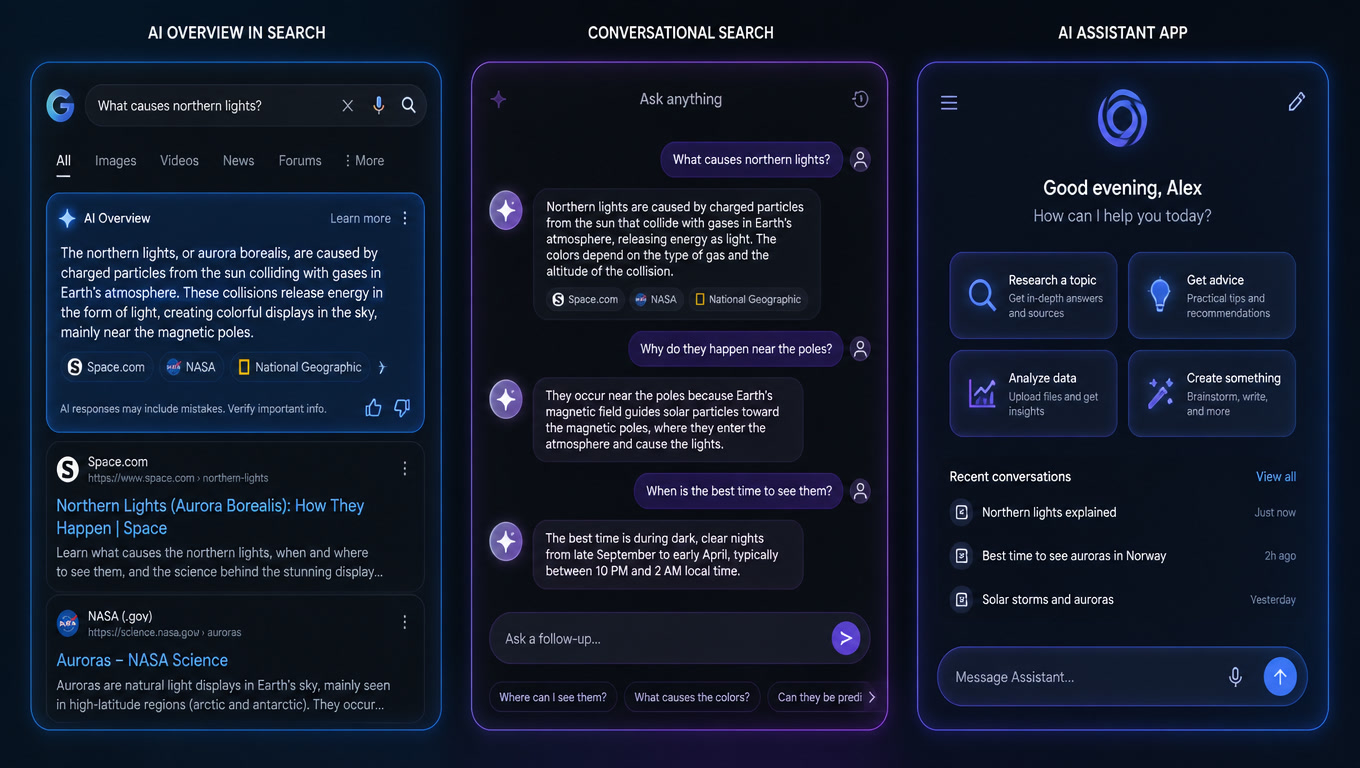


Gemini 3.8 Flash is answering in AI Mode. When Google swaps the model, your citations reorder
Google put Gemini 3.8 Flash in AI Mode on Sep 2, under three weeks after 3.7 Flash. Why a model swap reorders your brand's citations, and how to re-baseline before touching your content.
Gemini 3.8 Flash is answering in AI Mode. When Google swaps the model, your citations reorder
On September 2, 2026, Google put Gemini 3.8 Flash behind AI Mode for AI Pro and Ultra subscribers worldwide, less than three weeks after 3.7 Flash landed there, and it's the third Flash release in six weeks. A model swap is a citation reordering event: the sources Google picks to answer can move while your site doesn't change a single line. Here's what that means for your visibility, and the re-baseline protocol we run at Mintec every time Google rotates the model.
Two Google Search executives confirmed it on X the same day. Robby Stein, VP of Product for Search, wrote "Gemini 3.8 Flash has landed in Search." Nick Fox, head of Google Search, put it more bluntly: "Less than three weeks after 3.7, we're introducing Gemini 3.8 Flash." Google's official announcement calls 3.8 Flash its "most intelligent workhorse model," with major improvements over 3.7 across software engineering, agentic tasks, and critical multi-step reasoning in specialized domains, at the same price: $0.75 per million input tokens and $3.75 per million output.
Translation for anyone doing SEO: the model that decides which citations appear in AI Mode just changed, again, and this is going to keep happening every few weeks from now on.
Why a model swap is a visibility event, not a release note
AI Mode doesn't have rankings. It has synthesis. Google retrieves a candidate set of pages, and the model decides which sources to use, how to summarize them, which sentence to quote, and which brand to name. Swap the model and you swap the selection criteria: a newer model can favor fresher passages, different structures, or sources the previous one ignored. Your content didn't move. The selection rule did.
The scale of the effect isn't theoretical. SE Ranking studied 10,000 queries in AI Mode and found only 9.2% average URL overlap across three repeated searches of the same query, with 21.2% of queries showing zero overlapping results. That's with a fixed model. Now add a model change on top of it. If the overlap rate was already 9%, crediting a citation change this week to "what you did on your blog" is almost always a misattribution. The model or the noise caused it, not your content.
There's also an asymmetry nobody talks about. The 3.8 swap is subscriber-only: AI Pro and Ultra, the highest-intent commercial audience paying for the best search. AI Overviews, the mass surface, is still on 3.7 Flash. Google road-tests new models first with the people most likely to make purchase decisions, and the rest of the web finds out later. Ads inside AI Mode already showed Google treats this surface as a storefront. Now it's also the test track.
If you can't see it, does it matter?
Most readers won't see the swap. The model selector lives behind the (+) icon in AI Mode, and it only appears for paying subscribers. If you don't pay for AI Pro or Ultra, the answer you get still comes from whatever default Google assigns, and Google doesn't tell you which one that is.
That doesn't make the news optional. Three reasons:
First, the subscriber cohort is your most valuable audience. These are the people testing multi-step planning queries, comparing vendors, shortlisting brands. If their answers re-order, your share of that consideration set moves even though none of your analytics will ever show it.
Second, the subscriber rollout previews the default. 3.7 Flash ran on subscribers for weeks before AI Overviews picked it up. The same path is likely for 3.8. What you measure on AI Mode this month is what you'll measure site-wide next quarter.
Third, your Search Console data can't tell the difference. AI Mode queries appear in the main performance report, but that report records impressions and clicks, not which model generated the answer. The only way to know a swap affected you is to have measured before it happened.
Model swap vs algorithm update: they are not the same
| Dimension | Algorithm update | AI Mode model swap |
|---|---|---|
| Announcement | Google names it and posts about it | An executive tweets it, or nothing at all |
| What changes | The ranking system over the index | The model that retrieves, summarizes, and cites |
| How you detect it | Volatility in positions and traffic | Shifts in citation share and mentions |
| Right response | Audit and adjust pages | Re-baseline and wait before touching anything |
| Cadence | Every few months | Three releases in six weeks |
That last row is what changes the operation. Google just set the pace: three Flash releases in six weeks, and any of them can land in Search. If your reaction to every swap is rewriting content, you'll spend the year rewriting. The operational question isn't "what changed?" It's "when do I have enough evidence to know whether I was affected?"
The re-baseline protocol we run at Mintec
We measure LLM traffic weekly and audit citations with prompt panels for clients. Every time Google rotates the model in AI Mode, we run the same protocol. Five steps, and not one of them touches a page:
- Snapshot the current state this week. Pick 10-15 real commercial queries in your category, the ones a buyer would type. Run them in AI Mode and record: cited with URL, mentioned without link, or absent. Save dated captures. If you're doing this for a client, understanding how citations get measured comes first.
- Mark the event on your timeline. "3.8 Flash in AI Mode, September 2" is a bias variable, same as a core update. Every movement in your report from now on compares against that date.
- Wait two or three weeks and repeat. SE Ranking's volatility numbers make a one-day sample pure noise. The valid comparison is between your September 2 snapshot and the one from mid-month.
- Attribute before you act. If your citation share dropped, the model is the likeliest cause, not your content. If yours dropped and a competitor rose, look at their structure: direct answers, data, named sources. That tells you which signal the new model rewards.
- Only then, act on what survives any model. The KDD 2024 GEO study (Princeton, Georgia Tech, and co-authors) already showed which interventions move visibility in generative engines: statistics, named quotations, and attributed sources. Those signals don't care about the Flash version. The same logic applies to how Google treats old outbound links in AI citations: generative surfaces select per page and per context, not by old dogma.
What not to do: don't buy "Gemini 3.8 SEO"
The offers are coming: "certified optimization for Gemini 3.8 Flash." Don't buy it. Nobody can optimize for a model Google rotates every three weeks and that only subscribers can see. Anyone selling that is selling you the same checklist with a version number stamped on it.
What you can do today, free, and it works with any model:
- Answer directly at the top of every page, no throat-clearing. An extractable answer in the first 100 characters beats a narrative-built paragraph.
- Use numbers with sources. "74% of shoppers use AI" outweighs "more and more shoppers use AI."
- Name your citations. A study, a person, a verifiable dataset.
- Corroborate off-site. Mentions across the open web are still the fuel for citations under any model.
- Watch your own Search Console: AI Mode queries now appear in the main report, separate from the generative AI report. It's your only free first-party data.
The uncomfortable pattern is worth naming: Google can move your citations without warning, without explanation, and without any action on your part. The answer isn't chasing every swap. It's having a photograph before each change, waiting for a real signal, and keeping content built to be extracted rather than guessed at. The models will keep rotating. What survives them doesn't change with them.
And when the new model reaches AI Overviews for everyone, whoever already has the September 2 snapshot will know exactly whether they won or lost. Everyone else will be arguing in forums about whether it was a core update.
Looking for the Spanish version? Lee el análisis en español.
Frequently Asked Questions
What model is Google AI Mode using now?
Since September 2, 2026, AI Mode answers with Gemini 3.8 Flash for Google AI Pro and Ultra subscribers worldwide. You pick it via the (+) icon in the model selector inside AI Mode. AI Overviews is still running on Gemini 3.7 Flash.
Why does a model swap affect my AI citations?
The model decides which sources get retrieved and how they get summarized. A newer model can favor fresher passages, more structured data, or different sources, so citations can reorder without anything changing on your site. SE Ranking's study of 10,000 queries found only 9.2% URL overlap across three repeated AI Mode searches, so volatility is normal even without a model change.
What should I do when Google changes the model behind AI Mode?
Don't rewrite for the swap. Re-baseline: capture 10-15 real commercial queries with who gets cited, wait two or three weeks, compare citation share, and only then act on the signals that survive any model: verifiable data, named attributions, and direct answers.